
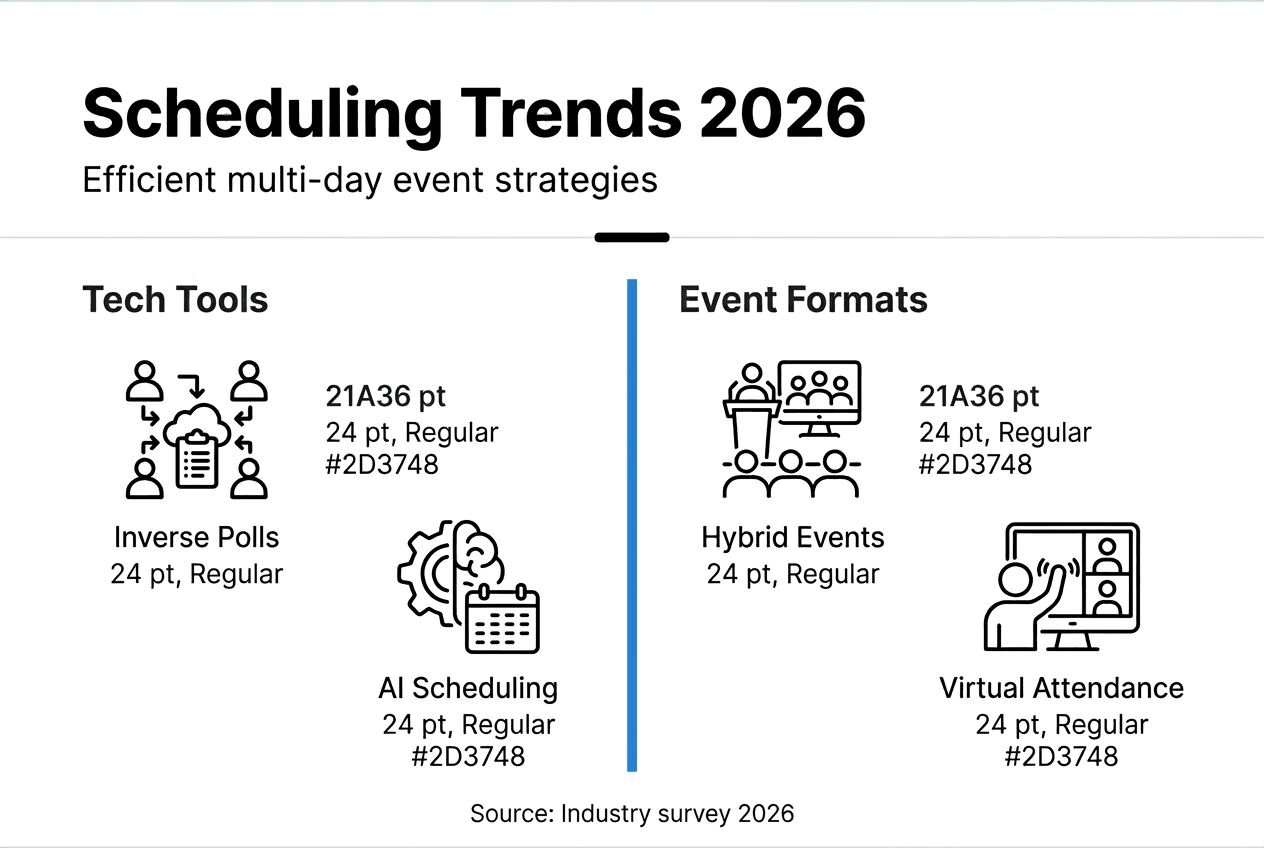
You think asking everyone when they're available is the fastest way to schedule a multi-day event. Reality check: inverse scheduling, which asks when participants are NOT available, cuts planning time by 40% and eliminates the endless back-and-forth that drags traditional availability polls into week-long delays. As hybrid and virtual formats dominate 60% of North American multi-day gatherings in 2026, event planners need smarter scheduling methods that match the pace and complexity of modern events.
Table of Contents
- Introduction To Event Planning Trends 2026
- Innovative Scheduling Technologies For 2026
- Emerging Event Formats And Scheduling Needs
- Engagement Strategies Linked To Scheduling Practices
- Common Misconceptions In Event Scheduling
- Privacy And Security In Scheduling Tools
- Practical Applications And Case Studies
- Conclusion And Future Outlook
- Explore Top Scheduling Tools And Simplify Your Events
- Frequently Asked Questions
Key takeaways
| Point | Details |
|---|---|
| Inverse scheduling saves time | Asking when participants are unavailable reduces planning cycles by 40% compared to traditional polls. |
| AI boosts accuracy | AI algorithms improve scheduling accuracy by 30%, cutting conflicts and optimizing event timing. |
| Hybrid events dominate | Over 60% of multi-day events now use hybrid or virtual formats, creating dynamic scheduling challenges. |
| Better scheduling drives engagement | Simplified scheduling methods increase participant response rates by 25%, reducing communication fatigue. |
| Privacy gaps exist | Approximately 40% of popular scheduling platforms lack modern encryption, risking participant data. |
Introduction to event planning trends 2026
Multi-day event planning has transformed dramatically. Hybrid and virtual formats now make up over 60% of North American events, mixing in-person sessions with remote participation across multiple time zones. This shift creates scheduling complexities that traditional availability polls simply can't handle efficiently.
Dynamic participant availability compounds the challenge. Attendees change their schedules in real time, and planners must adapt quickly without restarting entire coordination processes. The old method of asking everyone "when can you make it?" generates overwhelming response variations that delay decisions and frustrate participants.
Data privacy concerns also influence tool selection. Event planners increasingly scrutinize how scheduling platforms handle participant information, looking for transparent policies and robust security measures. Many discover their current tools fall short on encryption and data minimization practices.
Traditional scheduling approaches struggle with these modern demands:
- Manual coordination becomes unmanageable with large, geographically dispersed groups
- Email chains and spreadsheets create confusion and version control nightmares
- Repeated follow-ups erode participant enthusiasm before events even begin
- Privacy vulnerabilities expose organizers and attendees to unnecessary data risks
These challenges push forward-thinking planners toward innovative solutions. The top scheduling strategies in 2025 introduced technologies that address complexity head-on, and 2026 sees accelerated adoption of methods like inverse scheduling and AI-driven analytics. Understanding these trends positions you to execute flawless multi-day events while keeping participants engaged throughout the planning process.
Innovative scheduling technologies for 2026
Inverse scheduling flips the traditional model. Instead of asking participants when they're available, it collects when they're NOT available. This simple reversal reduces cognitive load and input complexity, making responses faster and more accurate. Participants find it easier to identify blocked dates than to scan entire calendars for open slots.

AI algorithms improve scheduling accuracy by 30% compared to manual methods. These systems analyze participant patterns, predict potential conflicts, and suggest optimal dates based on multiple variables simultaneously. What used to take planners hours of spreadsheet manipulation now happens in seconds with higher precision.
No-signup scheduling tools have seen adoption increase by 35% as planners prioritize accessibility. Participants can input their availability or unavailability without creating accounts, reducing friction that traditionally lowered response rates. This streamlined approach respects participant time while accelerating data collection.
Inverse scheduling specifically speeds planning cycles by 40%. By focusing on unavailability rather than availability, the scheduling window narrows quickly to viable options. Fewer rounds of communication mean faster decisions and earlier confirmations, giving you more time to handle other event logistics.
Pro Tip: Combine AI analysis with inverse scheduling for maximum efficiency gains. Let AI process the unavailability data to identify patterns and recommend optimal dates, then present clear options to stakeholders for final decisions.
Key technology advantages include:
- Reduced participant effort leading to higher response rates
- Automated conflict detection preventing scheduling errors
- Real-time updates accommodating last-minute availability changes
- Transparent visualization showing everyone's constraints simultaneously
These innovations align perfectly with modern event scheduling requirements. They handle complexity while maintaining simplicity for users. As effective event planning increasingly relies on technology, choosing the right tools becomes a competitive advantage. Planners who adopt these methods report not just time savings but also improved participant satisfaction and stronger attendance commitments.
Emerging event formats and scheduling needs
Hybrid and virtual formats account for 60% of multi-day events in 2026, fundamentally changing how planners approach scheduling. These formats blend in-person attendance with remote participation, creating layers of complexity traditional methods can't efficiently manage. You're not just finding a date that works locally anymore; you're coordinating across time zones, connection preferences, and varying levels of flexibility.
Participant availability becomes more dynamic with remote attendees. Someone joining virtually from the West Coast has different constraints than an East Coast in-person participant. Work-from-home flexibility means availability windows shift more frequently than in traditional office environments. Your scheduling platform must accommodate these real-time changes without forcing complete restarts.
Scheduling multi-day events requires platforms that support quick updates and clear communication. When a keynote speaker's flight gets delayed or a workshop leader falls ill, you need tools that let you adjust schedules instantly and notify all participants across channels. Static calendars and email threads can't deliver this responsiveness.
Flexible scheduling directly impacts inclusivity. By offering multiple session times or hybrid attendance options, you remove barriers that prevent participation. This approach doesn't just fill seats; it builds goodwill and strengthens your event's reputation. Inclusive event scheduling benefits extend beyond immediate attendance to long-term community building.
| Event Format | Primary Scheduling Challenge | Recommended Solution |
|---|---|---|
| Fully Virtual | Time zone coordination across continents | AI-optimized scheduling with multiple session offerings |
| Hybrid | Balancing in-person and remote constraints | Inverse scheduling collecting unavailability from all participants |
| Multi-track In-Person | Session overlap and room capacity management | Real-time scheduling tools with conflict detection |
| Asynchronous Components | Engagement tracking and deadline management | Automated reminders with flexible participation windows |
Format-specific needs include:
- Virtual events require platform integration for seamless calendar syncing
- Hybrid formats demand clear communication about attendance modes
- Multi-track events need visual scheduling tools that prevent double-booking
- Extended multi-day gatherings benefit from daily schedule flexibility
These evolving formats reward planners who adopt technology designed for complexity. Tools that seemed like nice-to-haves in 2024 are now essential for executing professional events that meet participant expectations.
Engagement strategies linked to scheduling practices
Inverse scheduling delivers 25% higher response rates from participants compared to traditional availability polls. The difference lies in reduced cognitive effort. When you ask people to mark days they're busy rather than scan for open slots, they respond faster and more completely. This psychological advantage translates directly into better engagement metrics.
Simpler scheduling reduces communication overload. Every follow-up email asking "did you fill out the poll?" chips away at participant enthusiasm. By using tools that make input effortless and require minimal back-and-forth, you preserve energy and goodwill for the actual event. Less scheduling fatigue means more excitement when the event date arrives.
Transparent schedules build trust and prompt timely confirmations. When participants see everyone's constraints visualized clearly, they understand why specific dates were chosen. This transparency eliminates suspicion that scheduling favors certain groups or ignores legitimate conflicts. Trust accelerates final confirmations and reduces last-minute cancellations.
Pro Tip: Send regular updates using scheduling tools to maintain participant interest throughout the planning cycle. Brief progress notifications keep your event top-of-mind without overwhelming inboxes.
Engagement-boosting practices include:
- Providing clear deadlines for scheduling input to create urgency
- Showing real-time progress toward finalizing dates to build momentum
- Acknowledging participant input immediately to reinforce positive behavior
- Offering flexible options when conflicts arise to demonstrate respect for constraints
The impact of efficient scheduling extends beyond logistics into participant psychology. When people experience smooth, respectful planning processes, they associate those positive feelings with your event brand. They're more likely to attend future events, recommend them to colleagues, and engage actively during sessions.
Social media engagement insights parallel scheduling engagement strategies. Both rely on reducing friction, respecting user time, and providing clear value for participation. Apply these principles consistently, and you'll see response rates climb while complaint emails disappear. Your scheduling approach becomes a competitive differentiator that sets professional events apart from amateur efforts.
Common misconceptions in event scheduling
Many planners believe traditional availability polling is more accurate than inverse scheduling. The opposite is true. When you ask participants to identify every available date in a multi-week range, you invite errors and incomplete responses. Inverse scheduling narrows focus to unavailable dates, which people track more reliably in their calendars, producing cleaner data.
Another misconception assumes all scheduling tools offer robust data privacy. Approximately 40% of popular platforms lack modern encryption standards, exposing participant information to potential breaches. Just because a tool is free or widely used doesn't mean it protects data adequately. You must verify security features before committing participant information.
Some planners also underestimate scheduling's role in event success, treating it as mere logistics. Reality shows that scheduling quality directly affects engagement, attendance rates, and participant satisfaction. Poor scheduling creates conflicts, generates frustration, and damages your event's reputation before it starts. Ways to avoid scheduling conflicts easily demonstrate how strategic scheduling builds event success from the foundation up.
Comparison of scheduling approaches:
| Factor | Traditional Availability Polling | Inverse Scheduling |
|---|---|---|
| Accuracy | Moderate, prone to incomplete responses | High, focuses on reliably tracked constraints |
| Ease of Use | Complex, requires scanning multiple dates | Simple, mark only blocked dates |
| Privacy | Varies widely, often inadequate | Better platforms prioritize encryption and minimization |
| Response Rate | 60-70% typical | 85-95% with simplified input |
| Planning Speed | 2-3 weeks average | 3-5 days for similar group sizes |
Key misconceptions to correct:
- More data doesn't mean better decisions; focused, accurate data does
- Free tools aren't always the best value when they waste your time or risk privacy
- Scheduling technology replaces tedious manual work, not strategic thinking
- Participant experience during scheduling predicts their event engagement level
Understanding these realities helps you choose tools and methods that actually serve your needs. Don't let outdated assumptions or flashy marketing cloud your judgment. Evaluate scheduling platforms based on proven efficiency, verified security, and measurable impact on participant response rates.
Privacy and security in scheduling tools
Data security ranks as a top priority for 78% of event planners when selecting scheduling platforms. This concern reflects growing awareness of privacy risks and regulatory requirements around participant information. Your scheduling tool handles names, email addresses, calendar data, and sometimes sensitive organizational details. Inadequate protection exposes everyone to breaches and compliance violations.
Approximately 40% of popular scheduling tools lack modern encryption standards, leaving participant data vulnerable during transmission and storage. End-to-end encryption ensures that only you and your participants can read the scheduling information, preventing interception by third parties. Tools without this protection create unnecessary risk that can damage your professional reputation.
Data minimization techniques reduce breach risks by collecting only essential information. Ask yourself whether you truly need phone numbers, job titles, or demographic data for basic scheduling. The less participant information you collect and store, the smaller your exposure if security fails. Privacy in scheduling practices protect both you and your participants.
Planners should demand transparency about privacy policies and compliance certifications. Look for platforms that clearly explain data handling practices, deletion policies, and third-party access. GDPR compliance, even for North American events, signals serious commitment to privacy. Vague or buried privacy policies are red flags.
Security best practices for event planners:
- Verify encryption protocols before sharing participant links
- Review data retention policies to ensure information isn't stored indefinitely
- Check whether platforms sell or share data with advertisers
- Confirm compliance with relevant privacy regulations
- Test participant access controls to prevent unauthorized viewing
Data security best practices apply across industries, and event planning is no exception. Your duty to protect participant information doesn't end when they submit scheduling preferences. Choose platforms with proven security track records, transparent policies, and ongoing security updates. The few minutes spent verifying these features prevent hours of crisis management if breaches occur.
Practical applications and case studies
A 100-person corporate retreat using WhenNOT's inverse scheduling tool cut planning time in half compared to previous years. Instead of three weeks of email exchanges and spreadsheet updates, organizers finalized dates in seven days. Participants marked their unavailable dates once, and the platform instantly visualized optimal scheduling windows. This efficiency let planners focus on content and logistics rather than coordination busywork.
Faster scheduling reduces event planning costs by eliminating wasted labor hours. When your team spends 40% less time on coordination, those hours redirect to value-adding activities like speaker recruitment or experience design. The financial impact compounds across multiple events annually, making technology investment pay for itself quickly.
Improved engagement through simplified scheduling boosts participant satisfaction scores. One association reported 25% higher pre-event survey responses after switching to inverse scheduling. Participants appreciated the respect for their time and the transparency around date selection. This goodwill carried into the event itself, with attendees arriving more enthusiastic and engaged.
Stepwise approach for implementing 2026 scheduling trends:
- Gather participant unavailability using inverse scheduling tools to reduce input complexity
- Apply AI optimization to identify conflict-free dates from collected data
- Communicate transparently about how dates were selected to build trust
- Provide flexible options for participants with unavoidable conflicts
- Send automated reminders at strategic intervals to maintain engagement
- Collect feedback post-event to refine scheduling approaches for future gatherings
The impact of efficient scheduling on events appears in metrics beyond just time savings. You'll see higher attendance rates, fewer last-minute cancellations, and stronger post-event community engagement. These outcomes validate the effort invested in modernizing your scheduling approach.
Event coordination case studies across industries show consistent patterns. Organizations that prioritize scheduling efficiency report better overall event outcomes. The correlation isn't coincidental; smooth scheduling sets positive expectations that carry through entire event experiences.
To avoid scheduling conflicts easily, combine technology with clear communication. Use tools that automate complexity while maintaining personal touches in your messaging. Balance efficiency with empathy, and your scheduling process becomes a competitive advantage that distinguishes your events in crowded markets.
Conclusion and future outlook
AI integration will deepen beyond 2026, enabling even more precise scheduling optimization through predictive analytics and machine learning. Platforms will anticipate conflicts before they occur and suggest proactive solutions based on historical patterns. This evolution moves scheduling from reactive coordination to strategic planning.
Privacy-focused scheduling tools will gain prominence as regulations tighten and participant awareness grows. Platforms that prioritize encryption, data minimization, and transparent policies will capture market share from legacy tools with weak security. Your choice of scheduling platform increasingly signals your commitment to professional standards.
Efficient scheduling remains central to multi-day event success and participant engagement. No amount of compelling content or impressive venues overcomes the frustration of chaotic planning processes. The foundation you build during scheduling determines whether participants arrive excited or exhausted.
Planners who adopt and adapt to these trends will lead in event execution excellence. Early adoption of inverse scheduling, AI analytics, and privacy-first tools positions you ahead of competitors still struggling with manual coordination. Your events will stand out for their professionalism from first contact through final session.
Explore top scheduling tools and simplify your events
Ready to transform your multi-day event planning? The best group scheduling tools for 2026 offer features designed specifically for the challenges you face. Compare platforms based on efficiency, privacy, and participant experience to find your perfect match.
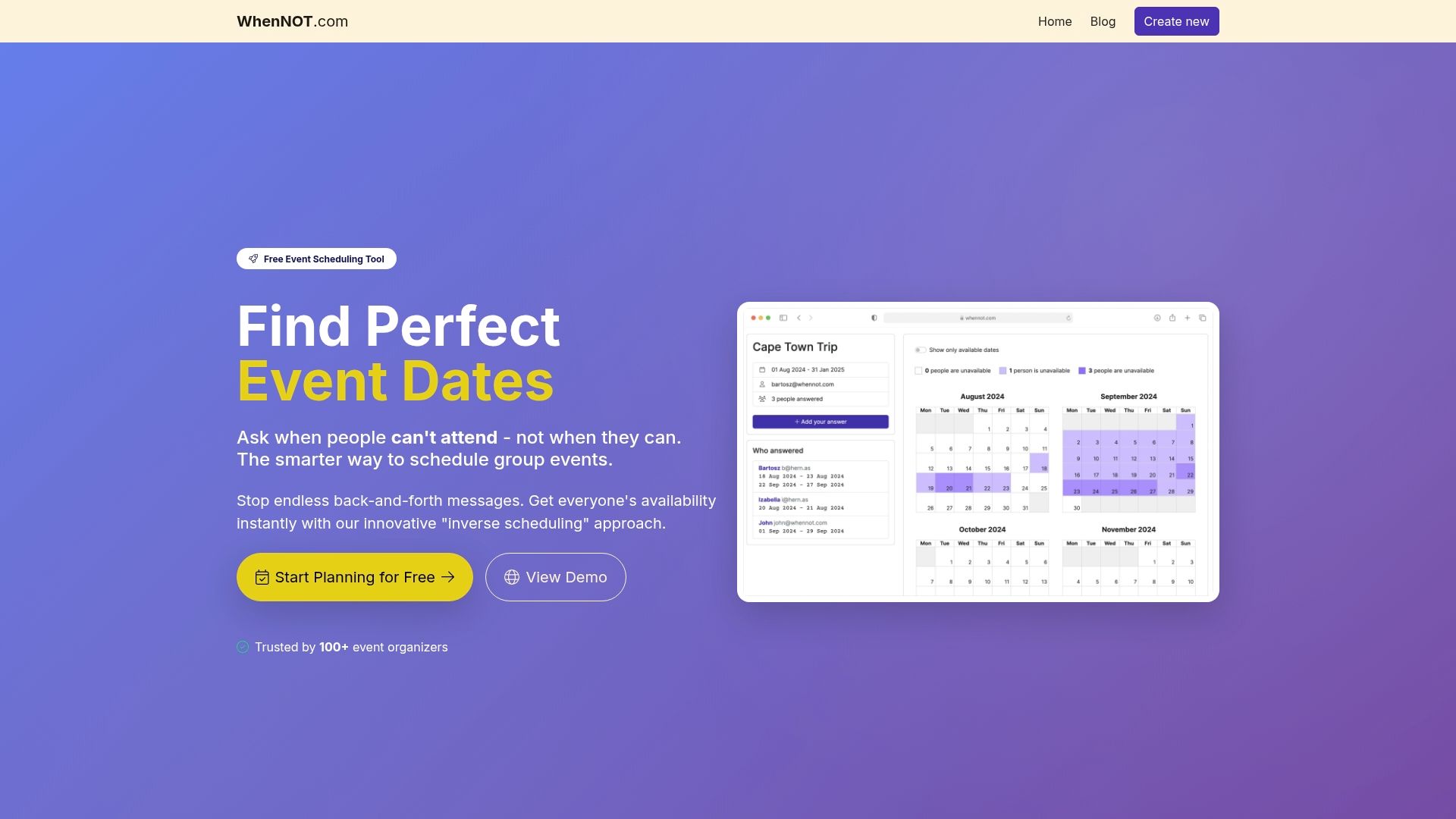
Discover how to simplify scheduling for events with practical guides that walk you through implementation. Learn why using online scheduling tools delivers measurable improvements in planning speed and participant satisfaction. WhenNOT's expert blog provides insights, comparisons, and strategies that help you stay ahead of evolving event planning trends while executing flawless multi-day gatherings.
Frequently asked questions
What is inverse scheduling and why is it effective?
Inverse scheduling collects participants' unavailable times instead of available ones, dramatically lowering input complexity. People track blocked dates more reliably in their calendars than open slots, producing cleaner data. This approach reduces scheduling conflicts and speeds planning by 40% compared to traditional availability polls.
How do AI analytics improve event scheduling accuracy?
AI algorithms improve scheduling accuracy by 30% by analyzing participant patterns and predicting potential conflicts automatically. These systems optimize event timing across multiple variables simultaneously, completing calculations in seconds that would take humans hours. The result is fewer conflicts and better-chosen dates.
What privacy features should I look for in scheduling tools?
Prioritize platforms offering end-to-end encryption and data minimization practices that collect only essential information. Verify transparent privacy policies, GDPR compliance certifications, and clear data deletion procedures. Strong privacy in scheduling protects both you and your participants from breaches.
How can I increase participant engagement during scheduling?
Use easy-to-use platforms like inverse scheduling tools that reduce participant effort and cognitive load. Keep communications clear, transparent, and timely throughout the planning process. Simple scheduling experiences generate 25% higher response rates and preserve participant enthusiasm for the actual event.