
Nearly half of American professionals report missing important events due to poor scheduling practices. With busy work calendars and family demands, traditional event planning often leaves some voices unheard. Understanding inclusive event scheduling opens the door for every participant to feel welcome and engaged. This article explores smarter strategies and real solutions that help American groups create accessible, flexible gatherings for everyone involved.
Table of Contents
- Inclusive Event Scheduling Defined and Debunked
- How Inverse Scheduling Differs From Traditional Tools
- Key Features That Enhance Accessibility
- Real-World Applications For Groups and Teams
- Common Challenges and How to Avoid Them
Key Takeaways
| Point | Details |
|---|---|
| Inclusive Scheduling | This method considers diverse participant needs, removing barriers to engagement by providing multiple options and clear communication. |
| Inverse Scheduling | This innovative approach simplifies group planning by allowing participants to indicate when they are unavailable, reducing complexity and cognitive load. |
| Accessibility Focus | Event planning must prioritize features such as flexible formats and clear communication to ensure equitable participation for all attendees. |
| Preparing for Challenges | Anticipating potential scheduling obstacles enables organizers to adopt flexible strategies, improving collaboration and minimizing disruption. |
Inclusive Event Scheduling Defined and Debunked
Inclusive event scheduling represents a strategic approach to planning gatherings that actively considers and accommodates the diverse needs of all potential participants. At its core, this methodology goes beyond traditional scheduling by recognizing that standard time-blocking approaches often exclude individuals with varied constraints and requirements.
The concept of inclusive scheduling involves creating planning processes that intentionally remove barriers to participation. This means considering factors like work schedules, family responsibilities, accessibility needs, and personal preferences when coordinating group events. Comprehensive event planning guidelines suggest that true inclusivity starts with understanding the unique circumstances of each participant.
Key principles of inclusive event scheduling include:
- Offering multiple date and time options
- Providing flexible participation methods
- Ensuring physical and digital accessibility
- Communicating clearly about event expectations and requirements
- Allowing participants to communicate their specific needs without stigma
Effective inclusive scheduling isn't about perfectly accommodating everyone simultaneously, but creating a framework that demonstrates genuine respect for participant diversity. Modern scheduling tools like event scheduling tools can help organizers implement these principles by providing more nuanced coordination methods that recognize individual differences.
How Inverse Scheduling Differs From Traditional Tools
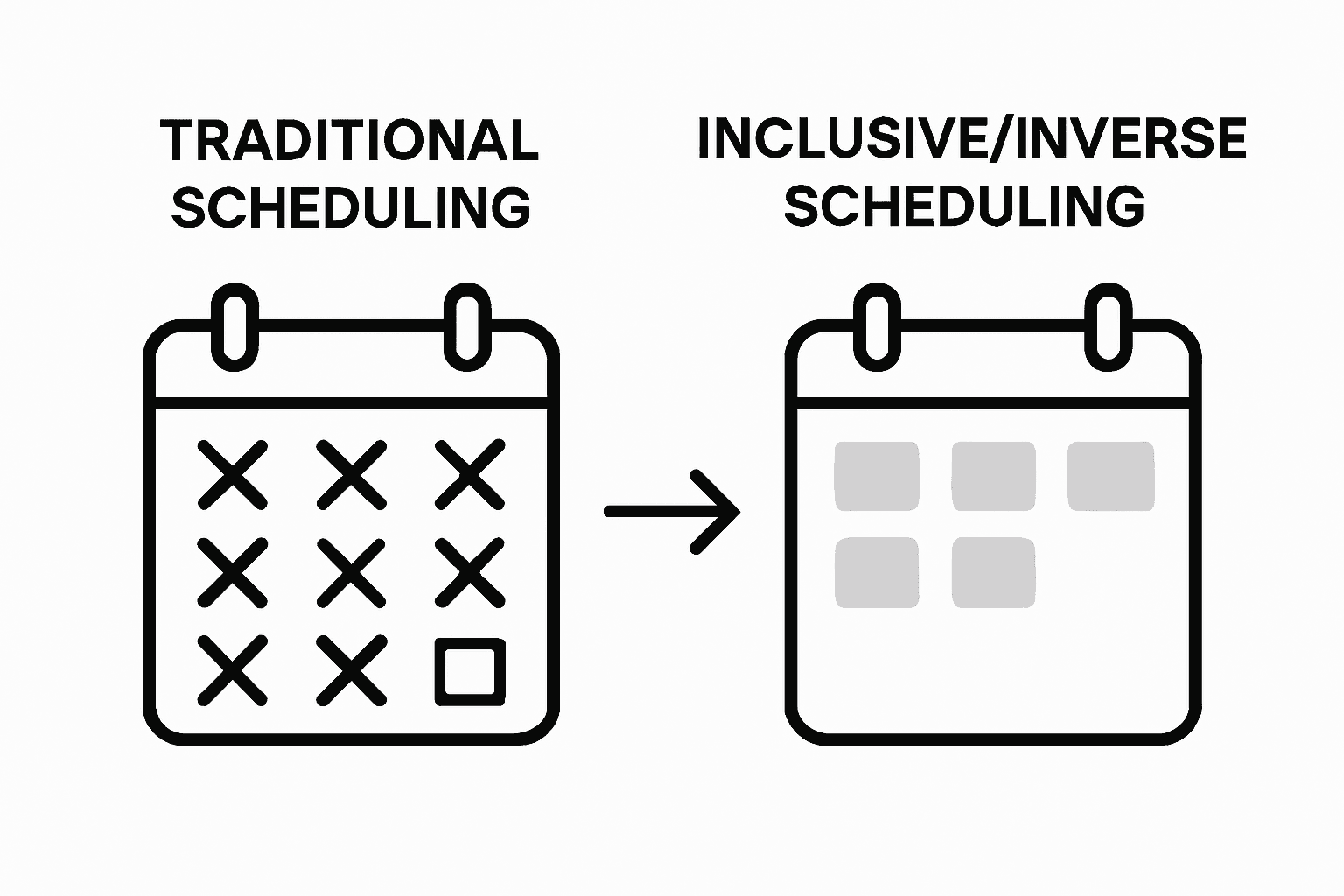
Traditional scheduling methods have long relied on participants indicating their available times, creating complex coordination challenges. Inverse scheduling flips this conventional approach by asking participants to share when they are unavailable instead, dramatically simplifying the group planning process.
Innovative research approaches demonstrate that inverse scheduling can significantly reduce coordination friction by shifting the fundamental paradigm of time management. Where traditional tools require multiple rounds of communication and compromise, inverse scheduling allows participants to quickly communicate their constraints without extensive back-and-forth negotiations.
Key differences between traditional and inverse scheduling include:
- Traditional scheduling: Participants list available times
- Inverse scheduling: Participants mark unavailable periods
- Traditional approach: Requires multiple communication cycles
- Inverse approach: Streamlines decision making
- Traditional method: Often leads to decision fatigue
- Inverse method: Reduces cognitive load on participants
The power of scheduling innovation lies in recognizing that people often find it easier to identify what they cannot do, rather than precisely pinpointing when they are free. By allowing participants to quickly mark their unavailable times, inverse scheduling transforms group coordination from a complex negotiation into a straightforward, user-friendly process.
Key Features That Enhance Accessibility
Accessibility in event scheduling goes far beyond simply choosing a date and time. Inclusive event planning requires a comprehensive approach that considers the diverse needs of all potential participants, ensuring that everyone can engage meaningfully regardless of their individual circumstances.

Comprehensive accessibility guidelines highlight several critical features that transform event scheduling from a simple logistical task to a thoughtful, welcoming process. These features address physical, digital, and communication barriers that might otherwise prevent full participation.
Key accessibility features include:
- Providing multiple participation formats (in-person, virtual, hybrid)
- Offering flexible time slots across different time zones
- Ensuring digital platforms are screen-reader compatible
- Allowing anonymous accommodation requests
- Providing clear, advance communication about event expectations
- Offering real-time captioning or sign language interpretation
- Creating options for both synchronous and asynchronous engagement
The ultimate goal of inclusive event planning is to remove barriers and create environments where everyone feels welcome and able to contribute. By anticipating and addressing potential accessibility challenges proactively, event organizers can create more meaningful, equitable experiences that truly value diverse participant needs.
Real-World Applications for Groups and Teams
Group scheduling is a critical challenge across numerous professional and personal contexts, requiring sophisticated approaches that accommodate diverse participant needs and constraints. Collaborative planning has evolved from traditional manual coordination to sophisticated digital solutions that recognize the complexity of modern team interactions.
Inclusive event planning templates demonstrate the nuanced requirements for effective group scheduling across different organizational settings. Whether coordinating corporate retreats, academic conferences, family reunions, or volunteer team meetings, the core principles of accessibility and flexibility remain consistent.
Specific real-world applications for advanced scheduling techniques include:
- Corporate team retreats and strategic planning sessions
- Academic research group meetings
- Professional development workshops
- Nonprofit board coordination
- Family reunion planning
- Hobby and interest group gatherings
- Interdepartmental project teams
- Community volunteer organizations
The power of group scheduling strategies lies in recognizing that each team has unique communication dynamics and scheduling challenges. By implementing flexible, participant-centered approaches, organizations can dramatically reduce coordination friction, improve engagement, and create more inclusive collaborative experiences that respect individual participant constraints and preferences.
Common Challenges and How to Avoid Them
Event scheduling is fraught with complex challenges that can derail even the most well-intentioned planning efforts. Group coordination demands a nuanced approach that anticipates potential roadblocks and proactively addresses participant constraints before they become insurmountable obstacles.
Comprehensive event planning resources highlight the most prevalent scheduling challenges that teams and organizers encounter. These challenges range from logistical complications to communication breakdowns that can significantly impede successful group planning.
Common scheduling challenges include:
- Time zone differences for distributed teams
- Conflicting personal and professional commitments
- Varying participant availability windows
- Communication gaps between team members
- Limited flexibility in traditional scheduling approaches
- Accessibility and inclusion barriers
- Complex decision-making processes
- Individual scheduling preferences
The key to overcoming these challenges lies in understanding scheduling obstacles and implementing flexible, participant-centered strategies. By recognizing that each group has unique dynamics and constraints, organizers can develop more adaptive and inclusive scheduling approaches that respect individual needs while achieving collective goals.
Simplify Your Inclusive Event Scheduling Today
Are you struggling with coordinating group events that respect everyone's unique availability and needs? The challenge of managing diverse schedules, time zones, and accessibility demands can quickly overwhelm traditional scheduling methods. This article highlights how inclusive event scheduling and inverse scheduling approaches help reduce communication friction and honor participant constraints.
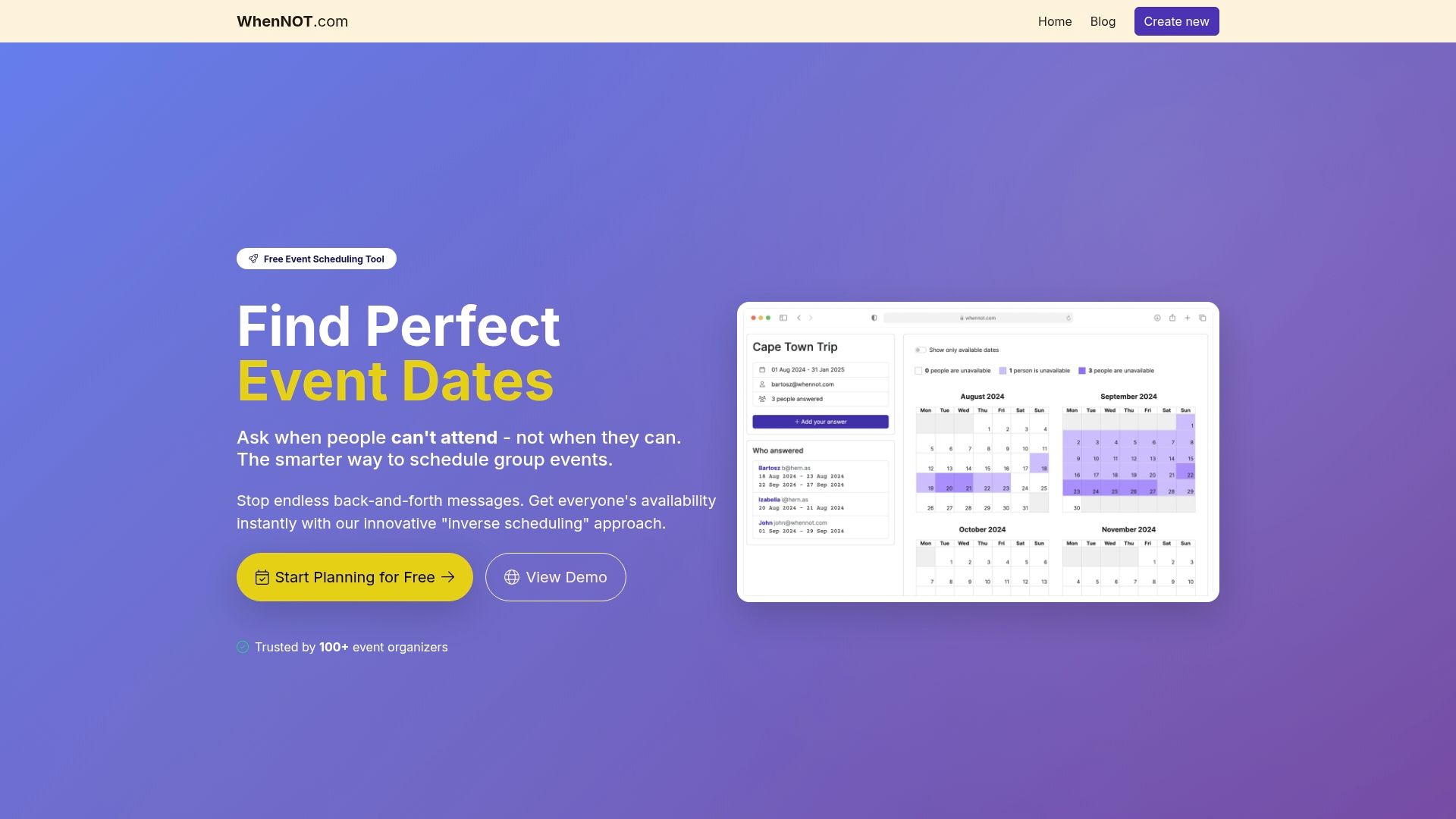
Experience the power of WhenNOT, an innovative online scheduling tool designed to streamline group planning by asking participants when they are unavailable instead of available. This method simplifies multi-day or flexible date events, improves accessibility, and fosters genuine inclusivity. With WhenNOT, you can create and share events effortlessly, visualize everyone's busy times simultaneously, and avoid time-consuming back-and-forth messaging. Discover how our free, user-friendly platform supports your goals for effective, participant-centered event planning by visiting WhenNOT. Start simplifying your group coordination now and experience event scheduling the way it should be.
Frequently Asked Questions
What is inclusive event scheduling?
Inclusive event scheduling is a strategic approach to planning gatherings that considers the diverse needs of participants, aiming to remove barriers to participation through flexible time options, accessible formats, and clear communication.
How does inverse scheduling differ from traditional scheduling methods?
Inverse scheduling asks participants to indicate their unavailable times instead of their available times, simplifying the coordination process and reducing the need for extensive back-and-forth negotiations.
What key features enhance accessibility in event scheduling?
Key features for enhancing accessibility include multiple participation formats (in-person, virtual, hybrid), flexible time slots, anonymous accommodation requests, and real-time communication about event expectations.
What common challenges do organizers face in event scheduling?
Common challenges include time zone differences, conflicting commitments, varying participant availability, communication gaps, and individual scheduling preferences that can complicate the planning process.