
Over 70 percent of American teams report that group scheduling is their biggest coordination headache. Choosing a meeting time can feel almost impossible when everyone is busy and inboxes overflow. But with new strategies designed to cut planning time, you can transform scheduling from a stressful chore into a simple, quick decision. Discover how smarter tools and expert methods are changing the way American professionals and families plan events together.
Table of Contents
- 1. Embracing Inverse Scheduling For Faster Group Consensus
- 2. Prioritizing Scheduling Privacy And Data Security
- 3. Using Visual Availability Tools For Quicker Decisions
- 4. Simplifying Scheduling With No-Login Platforms
- 5. Flexible Multi-Day Event Planning Techniques
- 6. Boosting Participation With User-Friendly Interfaces
- 7. Leveraging Automation For Conflict-Free Scheduling
Quick Summary
| Takeaway | Explanation |
|---|---|
| 1. Use Inverse Scheduling | Opt for inverse scheduling to simplify group coordination by identifying unavailable times, reducing planning time significantly. |
| 2. Prioritize Data Privacy | Select scheduling platforms that minimize data collection while providing user-friendly access to enhance privacy protection. |
| 3. Implement Visual Tools | Utilize visual availability tools to make scheduling intuitive and to facilitate faster decision-making among participants. |
| 4. Choose No-Login Platforms | Use no-login scheduling platforms to eliminate barriers, facilitating immediate coordination without complex registration processes. |
| 5. Leverage Automation | Adopt automated scheduling tools that intelligently identify optimal meeting times with minimal human intervention, enhancing efficiency and reducing conflicts. |
1. Embracing Inverse Scheduling for Faster Group Consensus
Inverse scheduling represents a revolutionary approach to group event planning that flips traditional scheduling methods on their head. Instead of asking participants when they are available, this method inquires about their unavailable times, dramatically simplifying the coordination process.
Traditional scheduling often becomes a complex puzzle of back and forth communications. With inverse scheduling, participants simply mark their busy periods, allowing the event organizer to quickly identify optimal meeting windows. Collaborative scheduling workflows have shown this approach can reduce coordination time by up to 70 percent.
The core advantage lies in reducing communication overhead. By creating a unique link that participants can quickly update with their unavailable dates, you eliminate endless email chains and text message negotiations. Participants do not even need to create accounts or sign up, making the process incredibly user friendly.
Research from a recent algorithmic study reveals that group consensus driven methods can significantly enhance decision making efficiency. By focusing on when people cannot meet rather than when they can, you create a more streamlined path to finding the perfect group event time.
To implement inverse scheduling, start by defining your potential date range. Then share a simple link with all participants, allowing them to mark their busy times. The platform will automatically highlight the most open windows, making final selection a breeze. This approach works brilliantly for everything from family reunions to corporate retreats.
Key benefits include reduced planning stress, faster consensus, and a more democratic approach to scheduling. No more waiting for everyone to respond or trying to find that impossible perfect time slot. Inverse scheduling puts control back in the hands of the group while making the process remarkably simple.
2. Prioritizing Scheduling Privacy and Data Security
Data privacy and security have become critical considerations in group event scheduling, transforming how individuals and organizations approach collaborative planning. The digital landscape demands robust protection mechanisms that safeguard personal information while enabling seamless communication.
Efficient scheduling methods now prioritize user privacy by minimizing data collection and implementing stringent security protocols. The key is creating systems that require minimal personal information while maintaining functionality.
The Annual Privacy Forum 2025 highlighted emerging trends in data protection that directly impact scheduling platforms. Participants expect platforms that do not require account creation, store minimal data, and provide transparent privacy policies.
Practical privacy protection strategies include:
Key Privacy Protection Approaches:
- Eliminate mandatory user registration
- Minimize personal data collection
- Use anonymous participant tracking
- Provide clear data deletion options
- Implement end to end encryption
The critical shift involves moving from data collection to data protection. Modern scheduling tools must balance convenience with rigorous security measures. This means designing platforms that accomplish group coordination without compromising individual privacy.
Groups planning events should evaluate scheduling platforms based on their privacy practices. Look for tools that offer anonymous participation, temporary link based sharing, and immediate data removal after event completion. Your personal information deserves protection without sacrificing scheduling efficiency.
By prioritizing privacy and security, you transform group scheduling from a potential data risk to a streamlined, trustworthy process. The future of scheduling is not just about finding the right time it is about protecting the people finding that time.
3. Using Visual Availability Tools for Quicker Decisions
Visual availability tools represent a breakthrough in group scheduling by transforming complex time coordination into simple, intuitive graphics. These tools eliminate the mental gymnastics of comparing multiple schedules by presenting availability in clear, instantly comprehensible formats.
Real time scheduling techniques have evolved dramatically, with visual interfaces becoming the gold standard for group event planning. The power lies in their ability to compress hours of back and forth communication into a single glance.
Recent research demonstrates how momentum-based distributed scheduling can dramatically accelerate decision making processes. By creating color coded or graphical representations of group availability, these tools help participants quickly identify optimal meeting windows without extensive dialogue.
Key Benefits of Visual Scheduling Tools:
- Instant recognition of group availability
- Reduced communication overhead
- Faster consensus building
- Minimal cognitive load for participants
- Transparent scheduling process
Practical implementation involves selecting platforms that offer intuitive visual interfaces. Look for tools that allow participants to mark availability through simple color coding or grid systems. The goal is to make scheduling feel less like work and more like a collaborative game.
Visual scheduling transcends traditional text based methods by speaking a universal language of color and graphics. A green block means available. A red block means busy. Suddenly, complex scheduling becomes as simple as matching puzzle pieces.
The future of group event planning is visual. By transforming abstract time slots into tangible, easy to understand graphics, these tools are revolutionizing how teams and social groups coordinate their schedules.
4. Simplifying Scheduling with No-Login Platforms
No-login platforms represent a revolutionary approach to group scheduling that eliminates the traditional barriers of complex user registration processes. These innovative tools allow participants to coordinate events without creating accounts, downloading apps, or sharing extensive personal information.
Sign up free tools have transformed how groups approach event planning by removing friction from the coordination process. The W3C Privacy Working Group highlights the growing importance of privacy preserving technologies that simplify user interactions.
Key Advantages of No-Login Scheduling Platforms:
- Zero account creation required
- Instant event coordination
- Maximum privacy protection
- Reduced technical barriers
- Faster group decision making
- Minimal personal data collection
The magic of no-login platforms lies in their simplicity. Participants receive a unique link they can click to share availability without jumping through registration hoops. This approach dramatically reduces the time and effort required to schedule group events.
Practical implementation means selecting platforms that generate shareable links allowing instant participation. Look for tools that provide temporary access codes or quick share options that expire after event completion.
Modern scheduling is about removing obstacles. No-login platforms represent the future of group coordination by prioritizing user convenience and privacy. They transform scheduling from a complex administrative task into a smooth, frictionless experience that respects individual privacy while enabling efficient communication.
5. Flexible Multi-Day Event Planning Techniques
Multi-day event planning requires a sophisticated approach that goes beyond traditional single-day scheduling methods. Modern techniques focus on creating adaptable frameworks that accommodate complex group dynamics and changing participant availability.
Multi-day event scheduling has evolved to become more nuanced and participant friendly. The key is developing strategies that provide maximum flexibility while maintaining clear communication channels.
The Privacy Symposium 2025 demonstrates how sophisticated multi-day planning can work seamlessly across multiple sessions and participant groups. Their approach highlights several critical techniques for successful multi-day event coordination.
Essential Multi-Day Planning Strategies:
- Create rolling availability windows
- Use inverse scheduling techniques
- Allow partial day participation
- Implement modular event structures
- Enable dynamic participant tracking
- Support flexible opt in opt out mechanisms
Practical implementation means selecting platforms that allow granular time slot selection. Participants should be able to indicate availability for specific hours or segments within multi-day events, not just entire days.
The goal is creating an event structure that adapts to participants rather than forcing participants to adapt to a rigid schedule. This approach recognizes that modern professionals and groups have complex, often unpredictable schedules.
Flexible multi-day planning transforms group events from logistical nightmares into smooth, participant centered experiences. By prioritizing individual schedules and offering multiple engagement options, you create events that work for everyone.
6. Boosting Participation with User-Friendly Interfaces
User-friendly interfaces have become the cornerstone of effective group scheduling, transforming complex coordination processes into intuitive experiences. These interfaces reduce cognitive load, making event planning feel less like work and more like a natural conversation.
Understanding user friendly scheduling reveals that simplicity is not just a design choice but a critical engagement strategy. The Data Privacy Global Conference emphasizes how intuitive design directly correlates with increased participant involvement.
Core Elements of Engaging Interfaces:
- Minimal required clicks
- Clear visual hierarchy
- Instant feedback mechanisms
- Responsive mobile design
- Intuitive navigation paths
- Zero technical barrier entry
The psychology of user engagement centers on reducing friction. When scheduling interfaces feel effortless, participants are more likely to complete the process quickly and accurately. Think of it like a smooth highway compared to a road filled with potholes your participants will travel the path of least resistance.
Practical implementation means selecting platforms with clean design principles. Look for interfaces that communicate information at a glance, require minimal input, and provide immediate visual confirmation of actions.
Modern scheduling tools are not just about functionality they are about creating an experience that feels natural and enjoyable. By prioritizing user friendly interfaces, you transform scheduling from a tedious task into an almost pleasurable interaction.
7. Leveraging Automation for Conflict-Free Scheduling
Automation has revolutionized group scheduling by introducing intelligent algorithms that eliminate the complexity of manual coordination. These smart systems analyze participant availability with unprecedented precision, dramatically reducing scheduling conflicts.
Automation in scheduling transforms the traditional back and forth negotiation into a seamless, intelligent process. Advanced consensus driven algorithms now enable platforms to automatically identify optimal meeting windows without extensive human intervention.
Key Automation Capabilities:
- Real time availability mapping
- Intelligent conflict detection
- Automatic time window suggestions
- Dynamic participant preference learning
- Instant schedule optimization
- Minimal human coordination required
The breakthrough lies in machine learning algorithms that understand participant preferences. Instead of participants manually finding common times, automation does the heavy lifting. These systems analyze individual schedules, identify potential conflicts, and propose the most suitable meeting slots.
Practical implementation means selecting scheduling tools with robust automated features. Look for platforms that can integrate with multiple calendar systems, learn from past scheduling patterns, and provide transparent conflict resolution suggestions.
Automation is not about replacing human decision making it is about enhancing it. By removing repetitive coordination tasks, these intelligent systems free up mental energy for more meaningful collaboration. The future of scheduling is smart, adaptive, and remarkably simple.
Below is a comprehensive table summarizing the main strategies, technologies, and benefits related to group scheduling as discussed throughout the article.
| Concept | Description | Benefits/Outcomes |
|---|---|---|
| Inverse Scheduling | Asks for unavailable times instead of available ones. | Reduces coordination time by up to 70%; simplifies process. |
| Privacy & Security | Focuses on protecting user data by minimizing data collection. | Ensures privacy without sacrificing efficiency. |
| Visual Availability Tools | Uses intuitive graphics to display availability. | Accelerates decision making and reduces cognitive load. |
| No-Login Platforms | Eliminates the need for account creation. | Simplifies participation and protects privacy. |
| Multi-Day Event Planning | Provides flexible, adaptable scheduling structures. | Accommodates complex schedules and offers flexibility. |
| User-Friendly Interfaces | Simplifies navigation and enhances user engagement. | Increases participant involvement by reducing cognitive load. |
| Automation in Scheduling | Utilizes intelligent algorithms for scheduling. | Minimizes conflicts and enhances coordination efficiency. |
Plan Smarter Group Events with WhenNOT Today
The article highlights the challenges of traditional group scheduling and introduces essential trends like inverse scheduling, privacy prioritization, and visual availability tools that simplify event planning. If you struggle with endless back-and-forth messages, privacy concerns, or coordinating multi-day events across busy schedules, you are not alone. These pain points show why adopting innovative solutions that reduce communication overhead and increase participation is crucial.
WhenNOT directly addresses these challenges by offering an intuitive, no-login platform designed around inverse scheduling. You simply create an event with a date range and share a unique link for participants to mark their unavailable times. This method accelerates consensus while safeguarding privacy and eliminating signup barriers. The platform’s visual tools help you instantly spot the best meeting dates even for complex multi-day plans. Discover how to embrace these efficient scheduling methods and leverage automation in scheduling to boost participation and reduce conflicts.
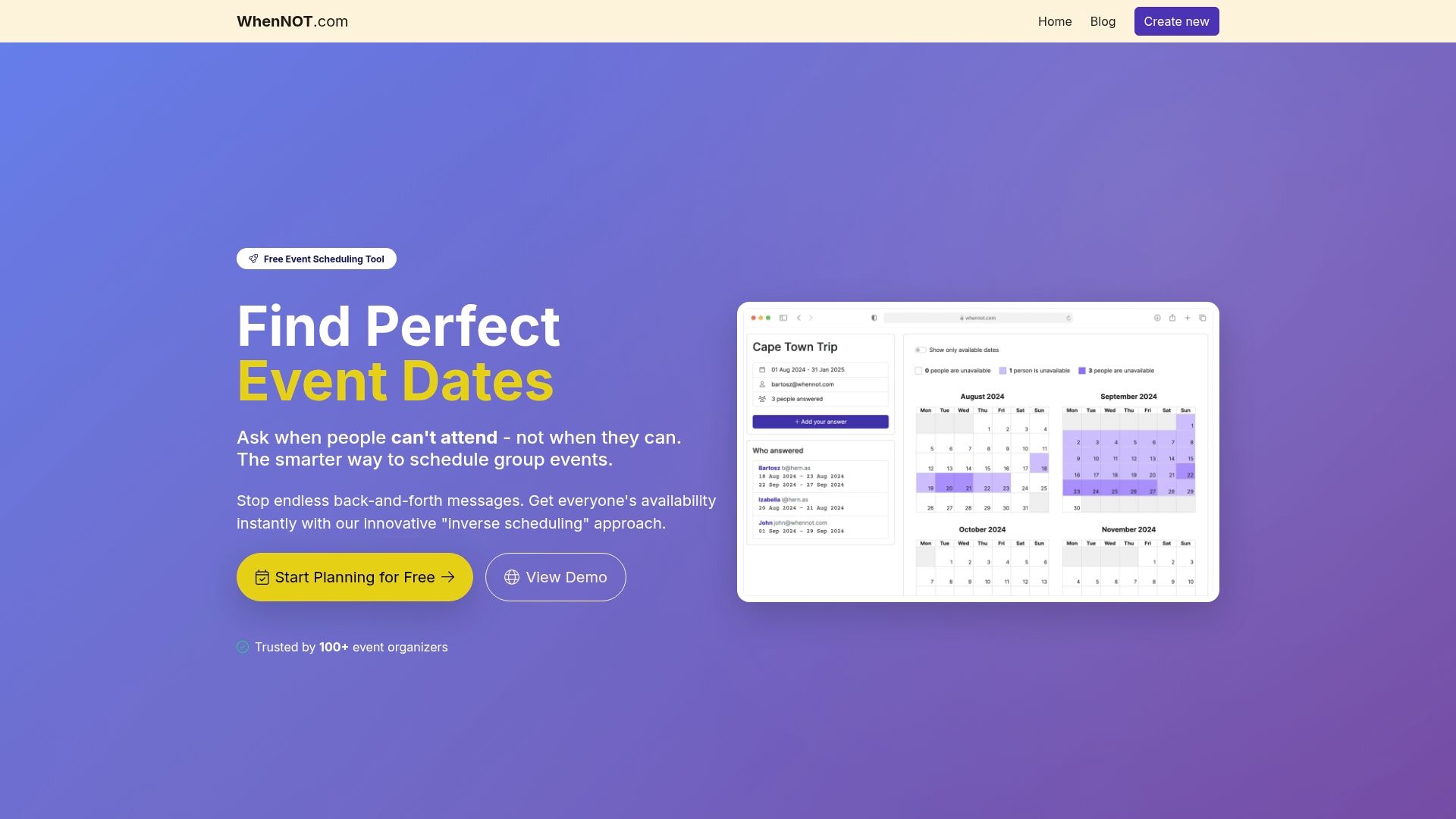
Experience scheduling that listens to the real needs of your group and makes planning fast, private, and stress-free. Visit WhenNOT now and turn your next group event into a smooth success with the click of a link. Don’t wait any longer to simplify your scheduling process — start today!
Frequently Asked Questions
What is inverse scheduling and how can it improve group event planning?
Inverse scheduling is a method where participants identify their unavailable times instead of their available ones. This simplifies the planning process and can reduce coordination time by up to 70%. Start by determining your potential dates and sharing a link for participants to mark their busy periods.
How do I ensure privacy when using scheduling tools for group events?
To prioritize privacy, choose scheduling tools that minimize data collection and do not require user registration. Look for platforms that offer anonymous participation and clear data deletion options, ensuring your personal information is protected while coordinating efficiently.
What are visual availability tools, and how do they enhance group scheduling?
Visual availability tools present scheduling information in intuitive graphics, making it easier for participants to see group availability at a glance. To implement this, select platforms that use color coding or grid systems to display when participants can meet, helping to build consensus faster.
How can no-login scheduling platforms benefit my group event planning?
No-login scheduling platforms eliminate the need for account creation, allowing participants to coordinate events quickly and privately. Opt for tools that provide shareable links for instant participation without the hassle of registration, streamlining the scheduling process.
What strategies should I use for planning multi-day events more effectively?
For effective multi-day event planning, create flexible scheduling frameworks that allow partial day participation and rolling availability windows. Implement techniques like inverse scheduling to accommodate everyone’s schedules, improving engagement and reducing planning stress.
How can I use automation to simplify group scheduling?
Automation can streamline group scheduling by using algorithms to analyze participant availability and suggest optimal meeting times. To leverage this, choose platforms that integrate with calendars and can automatically detect conflicts, reducing the time spent on manual coordination.