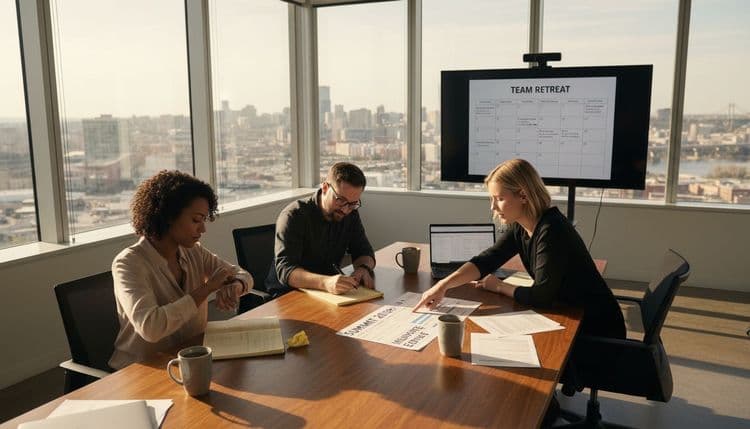
Over one third of American organizers say multi-day events are more challenging to plan than single-day ones. When it comes to coordinating group activities across multiple days, the complexities can catch even experienced planners off guard. Misconceptions about resources, participant needs, and scheduling often lead to surprises. This guide untangles the structure of multi-day events and clears up myths that may be holding your American gatherings back, helping you create more successful and engaging experiences.
Table of Contents
- Defining Multi-Day Events And Common Misconceptions
- Types Of Multi-Day Events And Their Purposes
- How Inverse Scheduling Simplifies Coordination
- Benefits For Group Engagement And Availability
- Challenges, Risks, And Common Mistakes To Avoid
Key Takeaways
| Point | Details |
|---|---|
| Understanding Multi-Day Events | Multi-day events can encompass a range of gatherings and are not limited to large organizations; they require strategic scheduling and planning to accommodate diverse participants. |
| Inverse Scheduling Benefits | Inverse scheduling simplifies coordination by focusing on when participants are unavailable, streamlining the process and reducing the complexity of traditional scheduling methods. |
| Importance of Engagement | Extended timeframes in multi-day events foster deeper connections and collaboration among participants, enhancing both personal and professional relationships. |
| Challenges in Planning | Effective planning for multi-day events involves addressing potential logistical challenges, ensuring flexible scheduling, and maintaining participant energy to avoid burnout. |
Defining Multi-Day Events and Common Misconceptions
Multi-day events are comprehensive gatherings or activities that extend beyond a single day, requiring intricate planning and coordination across multiple timeframes. These complex events can range from professional conferences and team retreats to family reunions and sporting competitions. Understanding their nuanced structure is critical for successful group planning.
Contrary to popular belief, multi-day events are not exclusively reserved for large organizations or professional settings. They span a diverse spectrum, including multi-sport events that engage both amateur and professional participants. The key distinction lies in their extended duration and the need for strategic scheduling that accommodates multiple participants' varying availability and preferences.
Common misconceptions often emerge around the complexity and feasibility of multi-day events. Many people assume such events require extensive resources or are only suitable for specific contexts like academic conferences or athletic competitions. However, multiday races demonstrate that these events can challenge traditional assumptions about participant endurance and event design. Whether organizing a weekend workshop, a family vacation, or a community festival, multi-day events offer unique opportunities for deeper engagement and meaningful interactions.
Pro Tip for Event Planning: Break complex multi-day events into manageable segments with clear objectives for each day, allowing flexibility and preventing participant fatigue while maintaining overall event momentum.
Types of Multi-Day Events and Their Purposes
Multi-day events encompass a wide range of gatherings designed to achieve specific objectives across extended timeframes. These events are categorized by their purpose, complexity, and participant engagement, offering unique opportunities for deep collaboration, learning, and shared experiences. From professional development to recreational activities, each type of multi-day event serves a distinct function in bringing people together.
Some notable types of multi-day events include professional conferences, team retreats, educational workshops, and cultural festivals. Adventure racing represents a fascinating example of a multi-disciplinary team event that pushes participants' endurance and collaborative skills over multiple days. These events challenge participants physically and mentally, requiring strategic planning and sustained effort across extended periods.
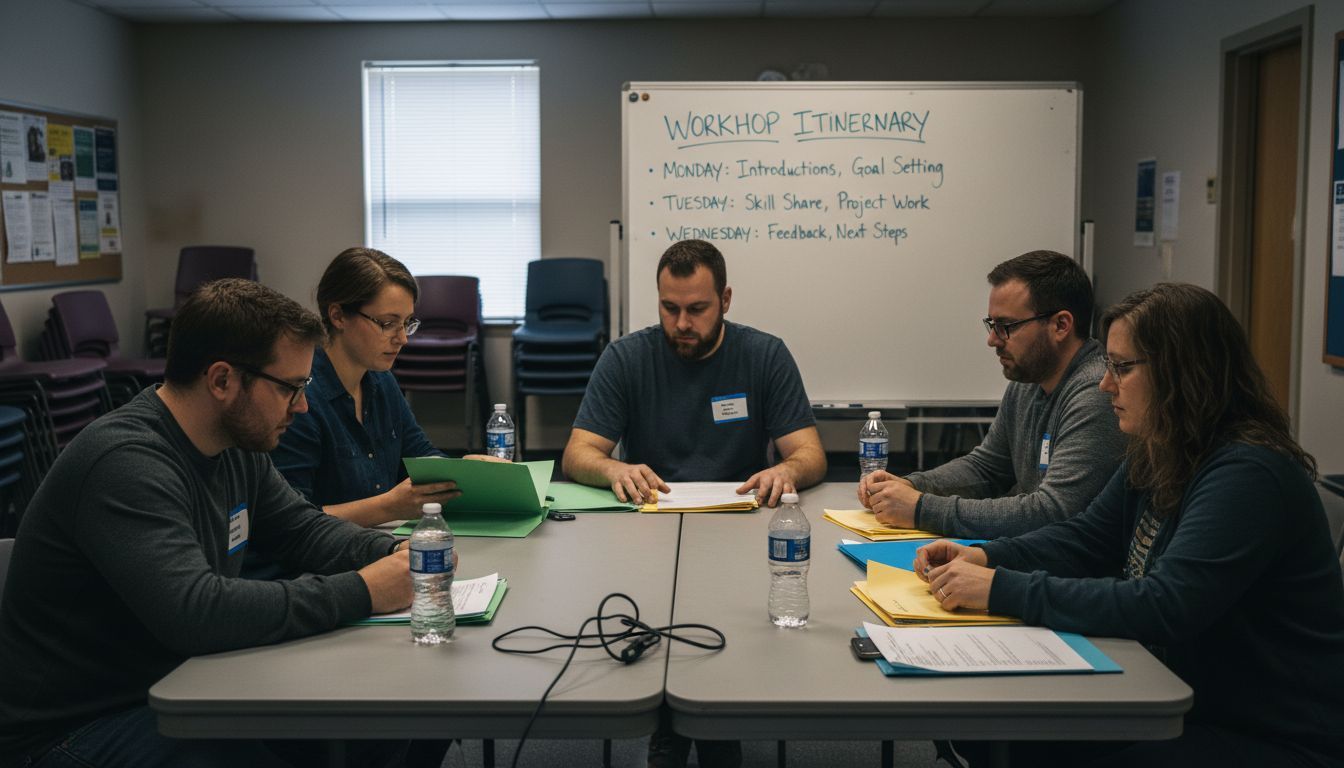
Historical reenactments demonstrate another compelling type of multi-day event focused on educational and cultural preservation. These immersive experiences allow participants and audiences to deeply engage with different time periods, learning through interactive and experiential methods. Other significant multi-day event categories include scientific symposiums, music festivals, sports tournaments, corporate training programs, and family reunions.
Each multi-day event type requires careful consideration of participants' needs, logistical challenges, and overarching goals. The duration allows for more comprehensive interactions, deeper learning opportunities, and meaningful relationship building that cannot be achieved in single-day gatherings.
Pro Tip for Event Diversity: Select multi-day event formats that align with your specific objectives, ensuring participant engagement remains high through varied activities and purposeful scheduling.
Here is a comparison of common types of multi-day events and their primary focus:
| Event Type | Main Purpose | Key Activities Involved |
|---|---|---|
| Professional Conference | Knowledge sharing | Networking, lectures, panels |
| Team Retreat | Team building | Workshops, group exercises |
| Music Festival | Entertainment | Live performances, social events |
| Family Reunion | Social connection | Shared meals, group outings |
How Inverse Scheduling Simplifies Coordination
Inverse scheduling represents a revolutionary approach to group event coordination that fundamentally transforms traditional planning methods. Unlike conventional scheduling techniques that ask participants when they are available, this innovative strategy flips the process by identifying when participants are unavailable. The result is a more streamlined, efficient method of finding optimal meeting times that reduces communication complexity and saves significant time.
Advanced event detection networks demonstrate the potential for sophisticated coordination strategies, highlighting how technological approaches can simplify complex scheduling challenges. Inverse scheduling leverages this principle by allowing participants to quickly mark their unavailable periods, creating a comprehensive view of collective time constraints without the exhaustive back-and-forth communication typical of traditional scheduling methods.
Exploring networks of recurrent events provides deeper insights into scheduling optimization, revealing how intelligent coordination can transform group planning. The inverse scheduling approach minimizes participant effort by requiring minimal input - instead of proposing multiple potential times and waiting for consensus, organizers can instantly see overlapping available windows. This method is particularly powerful for multi-day events where coordinating multiple schedules becomes exponentially more challenging.
The core benefit of inverse scheduling lies in its simplicity and user-centric design. By shifting the scheduling paradigm from identifying availability to marking unavailability, the process becomes more intuitive and less time-consuming. Participants can quickly input their constraints, allowing event organizers to rapidly identify the most suitable time slots without endless email chains or complex negotiation processes.
Pro Tip for Scheduling Efficiency: Communicate the inverse scheduling approach clearly to participants, emphasizing how marking unavailable times is faster and more straightforward than traditional scheduling methods.
Benefits for Group Engagement and Availability
Multi-day events offer unprecedented opportunities for enhanced group engagement, creating environments that foster deeper connections, more meaningful interactions, and comprehensive collaborative experiences. Unlike single-day gatherings, these extended events provide participants with extended time to build relationships, share insights, and develop a more nuanced understanding of shared goals and individual perspectives.
Research analyzing mobility patterns and group interactions reveals critical insights into how strategic event scheduling can significantly impact participant engagement. The extended timeframe of multi-day events allows for more organic relationship building, breaking down initial communication barriers and creating spaces where participants can move beyond surface-level interactions. This approach enables deeper networking, more substantive knowledge exchange, and a more holistic group dynamic.
Comprehensive event management strategies demonstrate that thoughtful planning can dramatically enhance group availability and participation. By designing events with participant flexibility in mind, organizers can create more inclusive experiences that accommodate diverse schedules and personal constraints. The key is to provide structured yet adaptable frameworks that allow participants to engage meaningfully without feeling overwhelmed or constrained.
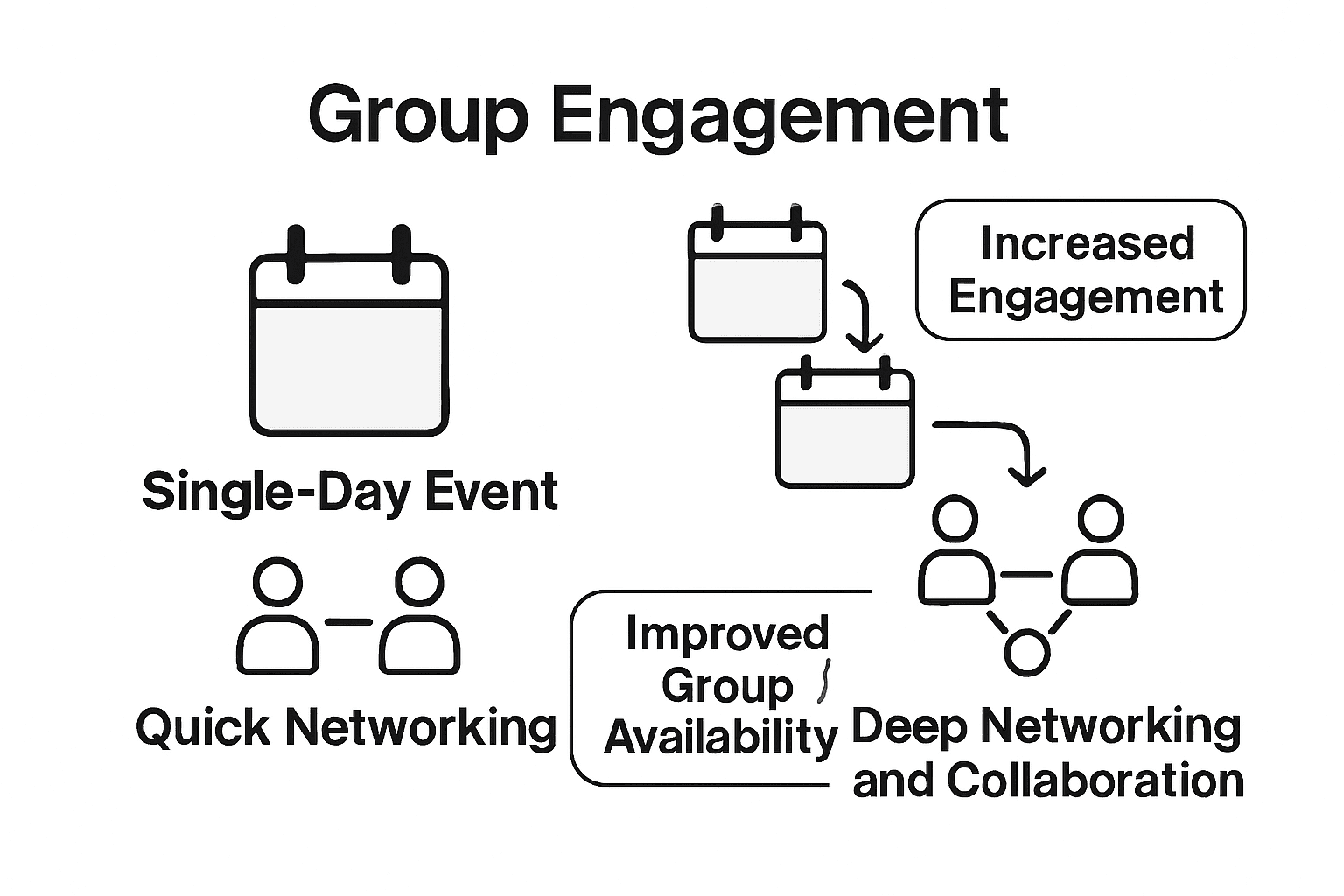
The psychological and professional benefits of extended group events extend far beyond simple time management. These gatherings create immersive environments where participants can develop trust, collaborate more effectively, and gain insights that would be impossible in shorter, more fragmented interactions. The extended duration allows for a more natural progression of group dynamics, enabling more profound personal and professional connections.
Pro Tip for Engagement Maximization: Design multi-day events with intentional break periods and flexible scheduling options to maintain high participant energy and enthusiasm throughout the entire event duration.
Challenges, Risks, and Common Mistakes to Avoid
Planning multi-day events involves navigating a complex landscape of logistical challenges and potential pitfalls that can derail even the most meticulously organized gatherings. Event organizers must anticipate and proactively address potential obstacles to ensure smooth execution and participant satisfaction. The risks range from practical logistical issues to more nuanced interpersonal and engagement-related concerns.
Multiday events present unique challenges in managing participant energy, resources, and logistical support over extended periods. Common mistakes include inadequate planning for rest periods, underestimating participants' physical and mental endurance, and failing to create flexible scheduling frameworks. Organizers often miscalculate the intensity of sustained group interactions, leading to participant burnout and reduced engagement.
Media events demonstrate how carefully planned activities can quickly lose authenticity if not managed thoughtfully, a principle equally applicable to multi-day group events. Critical risks include losing participant motivation, creating overly rigid schedules that stifle organic interaction, and neglecting individual participants' diverse needs and preferences. The most successful events balance structured programming with sufficient flexibility to allow natural group dynamics to emerge.
Technical and administrative challenges can also significantly impact multi-day event success. These include inefficient communication channels, poor time management, inadequate contingency planning, and failure to establish clear expectations. Successful event organizers recognize that comprehensive preparation involves not just scheduling, but creating comprehensive support systems that anticipate and mitigate potential disruptions.
Pro Tip for Risk Mitigation: Develop a flexible contingency plan that includes backup scheduling options, alternative activity pathways, and clear communication protocols to address unexpected challenges during multi-day events.
Challenges and solutions for multi-day event planning are summarized below:
| Challenge | Potential Solution | Benefit of Solution |
|---|---|---|
| Participant burnout | Schedule intentional breaks | Maintains high energy |
| Overly rigid scheduling | Allow flexible activity windows | Supports organic interaction |
| Communication breakdown | Use clear protocols and updates | Reduces confusion and delays |
| Unanticipated disruptions | Prepare contingency plans | Enables fast recovery |
Simplify Your Multi-Day Event Planning with WhenNOT
Planning multi-day events means juggling multiple schedules and managing participant availability to avoid burnout and communication overload. The article shows how inverse scheduling and careful coordination can make these events more engaging and less stressful. WhenNOT directly addresses these challenges by allowing organizers to collect participants' unavailable times instead of available ones. This approach eliminates endless back-and-forth emails and helps you quickly find the best dates across multiple days.
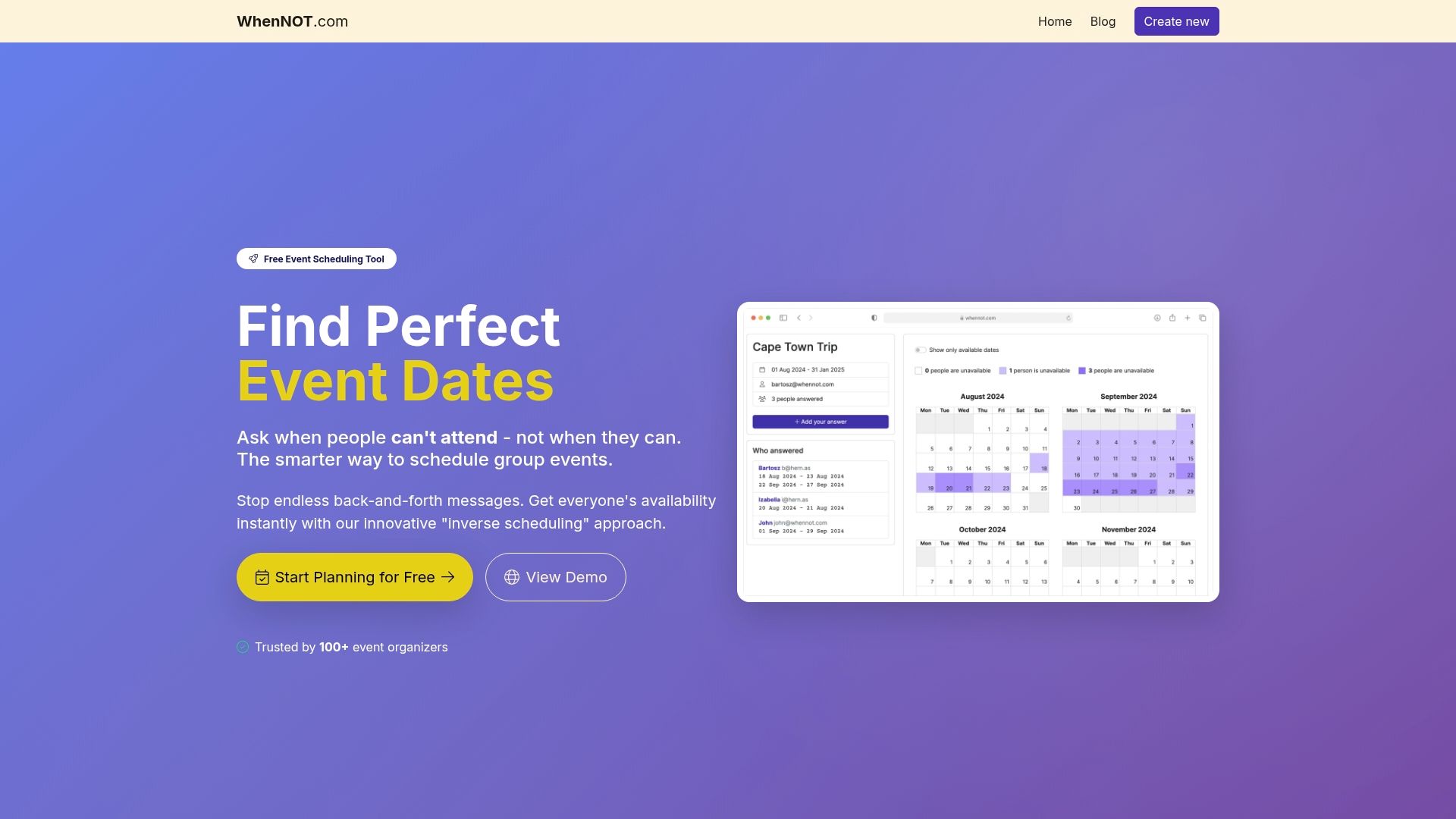
Ready to take the hassle out of your group event coordination? Visit WhenNOT to experience a faster, clearer way to schedule your multi-day gatherings. Whether it is a corporate retreat, family reunion, or an adventurous workshop, you can create your event, share a simple link, and watch optimal dates appear based on real participant input. Discover how easy group planning can be with WhenNOT and start scheduling smarter today.
Frequently Asked Questions
What are multi-day events?
Multi-day events are gatherings that extend beyond a single day, requiring detailed planning and coordination. They can include professional conferences, team retreats, family reunions, and sporting competitions.
How does inverse scheduling improve event planning for multi-day events?
Inverse scheduling allows participants to indicate when they are unavailable, streamlining the planning process. This approach reduces the need for back-and-forth communication, making it easier to find optimal meeting times for all attendees.
What are the benefits of scheduling multi-day events?
Scheduling multi-day events enhances group engagement and allows for deeper connections among participants. The extended duration helps create meaningful interactions, comprehensive learning experiences, and collaborative opportunities that are rarely achieved in single-day events.
What are common challenges when planning multi-day events?
Common challenges include managing participant energy, addressing logistical issues, and avoiding participant burnout. It is crucial to create flexible schedules that accommodate varying needs while maintaining participant interest and engagement.