
Most multi-day retreat organizers in Europe spend over 30 percent of their planning time managing communication delays and last-minute schedule shifts. When organizing corporate events with American partners or international teams, these issues multiply and threaten participant engagement. This article explores how advanced scheduling strategies in 2025 empower event organizers to minimize delays, involve participants more actively, and avoid the common pitfalls that disrupt productivity and satisfaction.
Table of Contents
- What Scheduling Strategies Mean In 2025
- Emerging Trends For Modern Event Planning
- Types Of Scheduling Approaches For Groups
- How Inverse Scheduling Tools Speed Up Consensus
- Common Pitfalls And How To Avoid Them
Key Takeaways
| Point | Details |
|---|---|
| Evolution of Scheduling Strategies | Scheduling in 2025 has transformed into adaptive, data-driven systems prioritizing flexibility and user engagement. This shift emphasizes comprehensive planning that aligns with organizational goals. |
| Technological Integration | Modern event planning incorporates AI, AR, and VR to enhance participant engagement through hyper-personalized and interactive experiences. These technologies facilitate real-time adaptability and global participation. |
| Advanced Group Scheduling | Group scheduling now relies on intelligent software that resolves conflicts and maps availability, streamlining coordination and enhancing collaboration among diverse teams. |
| Common Scheduling Challenges | Event organizers face pitfalls such as inadequate planning and poor communication, which can be mitigated by using centralized, automated scheduling systems to improve efficiency and engagement. |
What Scheduling Strategies Mean in 2025
Scheduling strategies in 2025 represent a profound transformation from traditional time management approaches to intelligent, adaptive systems that prioritize flexibility, participant engagement, and data-driven decision making. No longer are events planned through rigid, linear processes. Instead, modern scheduling has become a dynamic, collaborative framework that responds to complex human needs and technological capabilities.
The emergence of advanced scheduling methodologies reflects a significant shift toward more strategic planning models. According to the 2025 Course Scheduling Playbook, organizations are moving beyond simple time allocation toward comprehensive change management strategies that integrate stakeholder perspectives and optimize capacity. This approach recognizes that effective scheduling is not just about marking dates on a calendar, but about creating meaningful experiences that align with broader organizational objectives.
Key characteristics of scheduling strategies in 2025 include hyper-personalization, real-time adaptability, and inclusive design. Event planners now leverage sophisticated tools that allow participants to indicate unavailability transparently, enabling more intuitive coordination. Technology has transformed scheduling from a logistical challenge into a collaborative, user-centric process that respects individual constraints while maintaining collective momentum.
Pro tip: Invest in scheduling platforms that offer inverse availability mapping, allowing participants to quickly communicate their constraints without complex sign-up processes.
Emerging Trends for Modern Event Planning
Modern event planning is undergoing a revolutionary transformation, driven by technological innovations and changing participant expectations. The landscape of event management has shifted dramatically, moving beyond traditional approaches toward more dynamic, interactive, and personalized experiences that leverage cutting-edge technologies and data-driven insights.
According to leading event technology research, 2025 is marked by hyper-personalization powered by artificial intelligence, which enables unprecedented levels of customization in event experiences. AI-driven platforms now offer intelligent networking recommendations, session curation, and personalized follow-ups that transform how participants engage with events. These technological advancements are not just incremental improvements but represent a fundamental reimagining of event interaction models.
The integration of immersive technologies like augmented reality (AR) and virtual reality (VR) is creating multi-dimensional event experiences that transcend traditional physical and digital boundaries. Emerging event industry trends demonstrate how 5G connectivity, machine learning algorithms, and AI-powered chatbots are enabling real-time interaction adjustments and global participation. These technologies allow event planners to create more inclusive, accessible, and responsive environments that adapt instantly to participant needs and preferences.
Pro tip: Invest in flexible event technologies that support seamless hybrid experiences and provide robust data analytics to continuously improve participant engagement.
Types of Scheduling Approaches for Groups
Group scheduling has evolved dramatically, transforming from manual coordination processes to sophisticated technology-driven approaches that streamline complex planning challenges. Modern organizations now recognize scheduling not just as a logistical task, but as a strategic tool for maximizing collaboration and participant engagement.
Advanced scheduling research demonstrates that contemporary group scheduling approaches leverage intelligent software tools designed to synchronize calendars, resolve potential conflicts, and accommodate intricate scheduling constraints. These sophisticated systems minimize traditional time-consuming communication cycles by providing real-time availability mapping and intelligent conflict resolution mechanisms that adapt to diverse group dynamics.

The landscape of group scheduling now encompasses multiple sophisticated approaches, ranging from automated timetabling to collaborative platforms that prioritize participant flexibility. Comparative studies of scheduling methodologies reveal that automated systems significantly improve resource utilization, reduce administrative overhead, and generate more diverse scheduling options compared to traditional manual processes. Key approaches include inverse availability mapping, consensus-based scheduling, AI-powered recommendation systems, and hybrid coordination models that blend technological intelligence with human decision making.
Here's a comparison of popular group scheduling approaches and their business impact:
| Approach | How It Works | Benefits | Typical Use Cases |
|---|---|---|---|
| Inverse Availability | Users mark when they are unavailable | Faster consensus, less email | Remote team meetings |
| Consensus-Based Scheduling | Group votes on preferred times | High engagement, fair process | Collaborative projects |
| AI-Powered Recommendation | Software suggests optimal slots using AI | Improved resource use, less conflict | Large organization planning |
| Hybrid Coordination Models | Combines tech tools with manual adjustments | Flexibility, custom solutions | Cross-department events |
Pro tip: Select scheduling tools that offer transparent availability tracking and minimize manual communication steps to streamline group coordination efforts.
How Inverse Scheduling Tools Speed Up Consensus
Inverse scheduling represents a paradigm shift in group coordination, fundamentally transforming how teams negotiate and align their availability. Unlike traditional scheduling methods that require participants to identify when they are free, inverse scheduling flips the approach by asking participants to mark their unavailable times, creating a more efficient path to consensus.
The breakthrough in this methodology lies in its ability to dramatically reduce communication complexity. Advanced consensus technologies demonstrate how intelligent systems can rapidly synthesize constraints and identify optimal meeting windows, eliminating the exhausting back-and-forth typically associated with group scheduling. By focusing on unavailability rather than availability, these tools create a transparent, streamlined process that minimizes cognitive load and accelerates decision making.
Modern inverse scheduling platforms leverage sophisticated algorithms that instantly visualize collective constraints, allowing groups to quickly identify potential collaboration windows. This approach is particularly powerful for distributed teams, international collaborations, and complex scheduling scenarios where participants have varied time zones and intricate personal commitments. The technology effectively transforms scheduling from a negotiation challenge into a data-driven, efficient problem-solving exercise that respects individual time boundaries while facilitating collective progress.
Pro tip: Prioritize scheduling tools that offer real-time constraint visualization and minimize manual communication steps to streamline group coordination efforts.
Common Pitfalls and How to Avoid Them
Event scheduling is a complex process fraught with potential challenges that can derail even the most meticulously planned gatherings. Understanding and anticipating these potential obstacles is crucial for creating smooth, successful events that meet participant expectations and organizational goals.
Event planning research reveals several critical pitfalls that event organizers frequently encounter. The most common challenges include inadequate early planning, poor communication channels, inflexible scheduling approaches, and a failure to incorporate participant preferences. These issues can lead to low engagement, scheduling conflicts, and ultimately, events that fail to deliver intended value.
Moreover, comprehensive scheduling analysis highlights the dangers of relying on outdated manual processes. Organizations that continue using spreadsheets or email-based coordination methods risk creating inefficient, error-prone scheduling workflows. Modern event planners must embrace data-driven platforms that automate conflict resolution, provide real-time visibility into availability, and support diverse participant needs across different time zones and personal constraints.
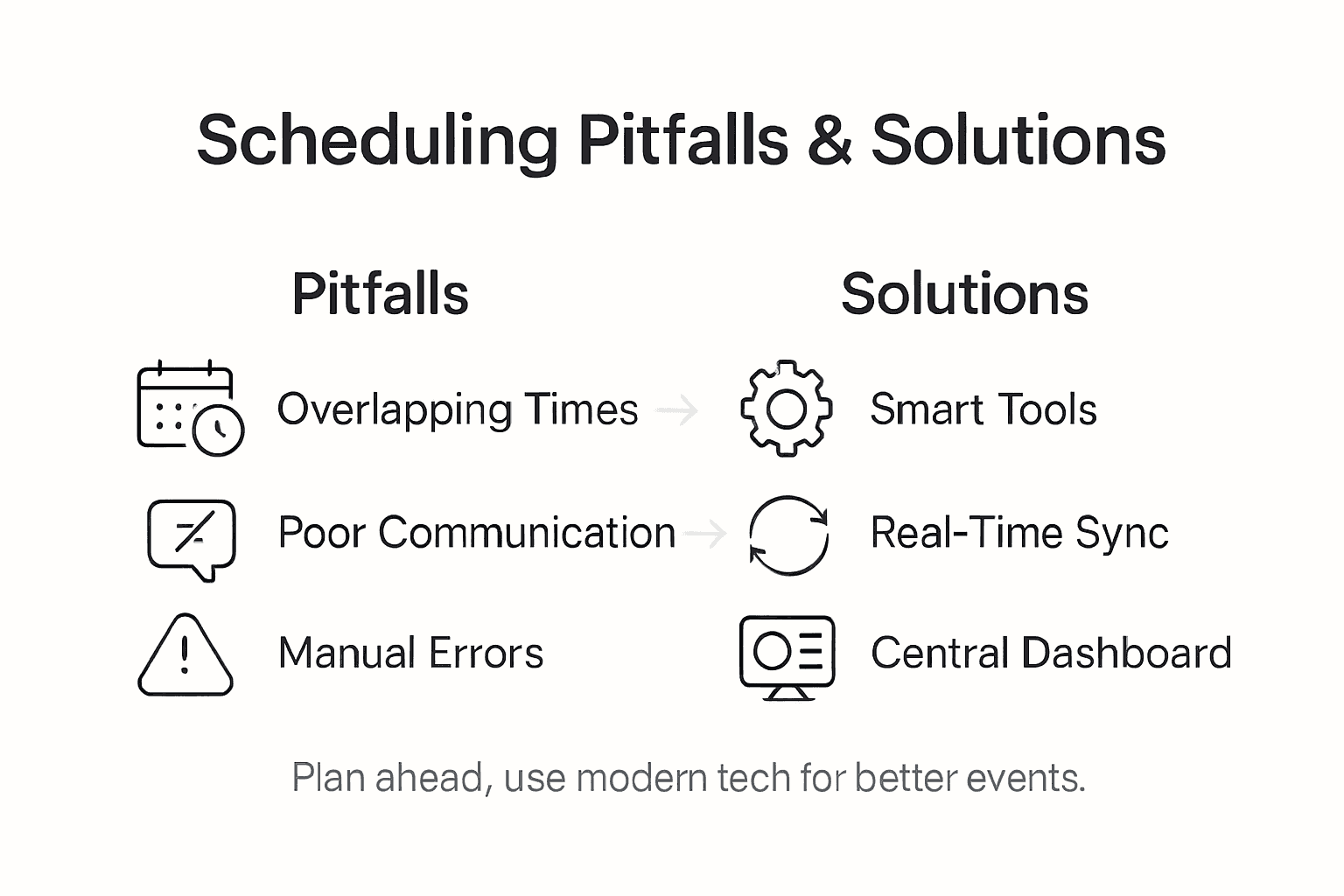
Key pitfalls in event scheduling and solutions for overcoming them:
| Challenge | Impact | Preventive Strategy |
|---|---|---|
| Lack of early planning | Last-minute conflicts | Build timelines well in advance |
| Poor communication channels | Misunderstandings, missed info | Use centralized, transparent tools |
| Inflexible scheduling | Low participant engagement | Enable real-time adaptability |
| Ignoring preferences | Low attendance, dissatisfaction | Collect and analyze feedback |
Pro tip: Implement a centralized scheduling system that allows transparent availability tracking and provides automated conflict resolution to minimize manual coordination efforts.
Simplify Your Group Scheduling with Inverse Availability
The article highlights how innovative scheduling strategies in 2025 focus on inverse availability mapping, real-time adaptability, and reducing communication overload. If you've struggled with coordinating complex group events or felt frustrated by endless back-and-forth emails, you are not alone. Key challenges like managing multi-day event options, respecting individual constraints, and swiftly reaching consensus are exactly where modern tools must deliver.
WhenNOT offers a powerful solution based on inverse scheduling that transforms the way you plan. Instead of asking participants when they are free, WhenNOT lets everyone mark the times they are not available, making it fast and effortless to identify optimal dates for your event. This aligns perfectly with the strategies described in the article to minimize scheduling conflicts and maximize engagement through transparency and simplicity.
Ready to bypass scheduling headaches and speed up decision-making for your next group event?
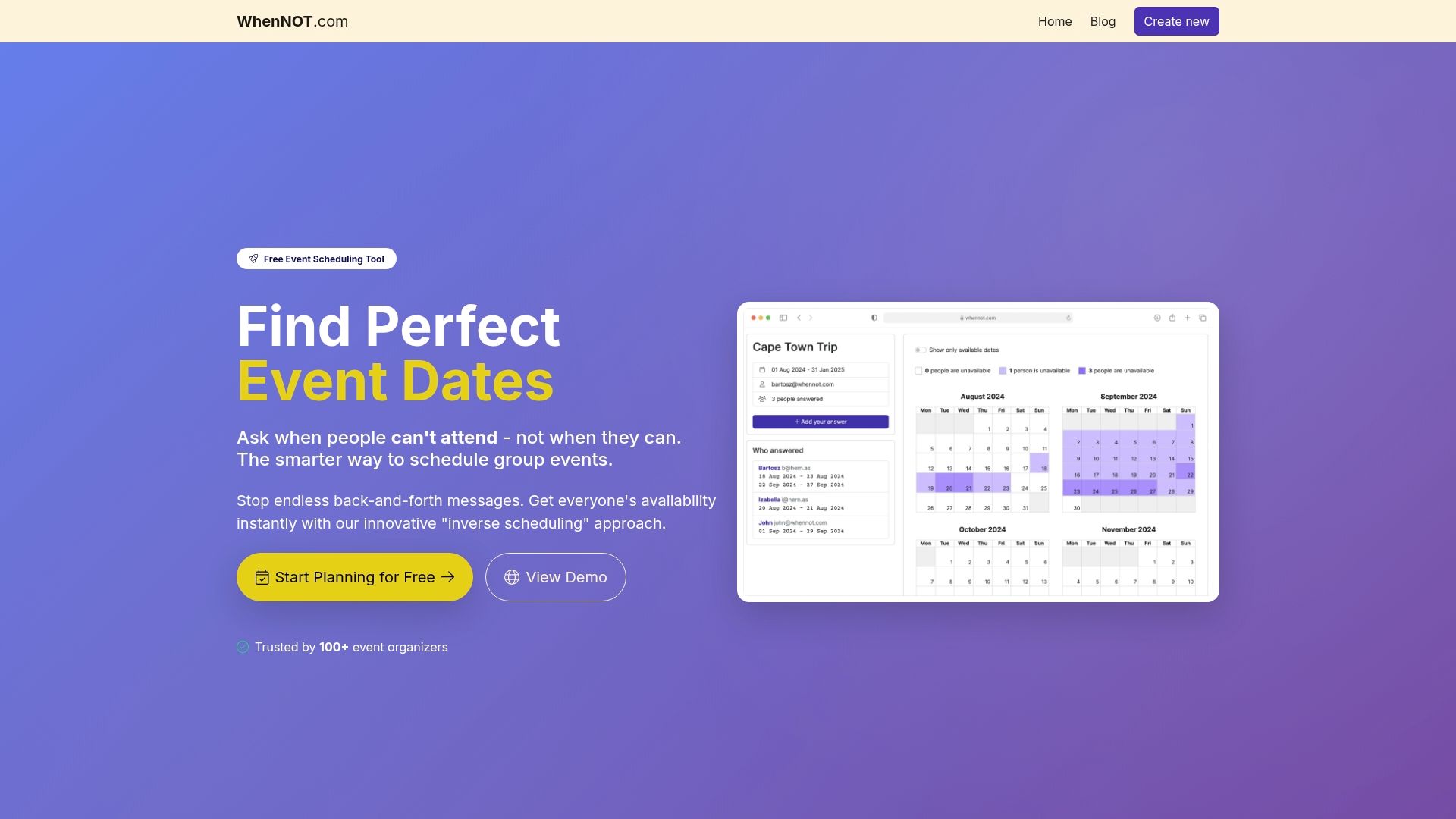
Experience the ease of intelligent group scheduling yourself by visiting WhenNOT. Discover how our free, user-friendly platform brings clarity to complex planning. Don’t let scheduling complexity hold you back – take advantage of the innovative approach highlighted in Top Scheduling Strategies 2025 today and start coordinating smarter at WhenNOT.
Frequently Asked Questions
What are the key characteristics of scheduling strategies in 2025?
The key characteristics of scheduling strategies in 2025 include hyper-personalization, real-time adaptability, and inclusive design, focusing on creating meaningful experiences that align with organizational objectives.
How can inverse scheduling tools improve group coordination?
Inverse scheduling tools improve group coordination by allowing participants to mark their unavailability, which simplifies the process of identifying collective meeting windows and reduces communication complexity.
What are some common pitfalls in event scheduling and how can they be avoided?
Common pitfalls in event scheduling include inadequate planning, poor communication, inflexible scheduling, and ignoring participant preferences. To avoid these, implement centralized scheduling systems that allow for transparent tracking and automated conflict resolution.
How does technology enhance modern event planning in 2025?
Technology enhances modern event planning through AI-driven platforms for hyper-personalization, immersive technologies like AR and VR for dynamic experiences, and data analytics to continuously improve engagement and adapt to participant needs.