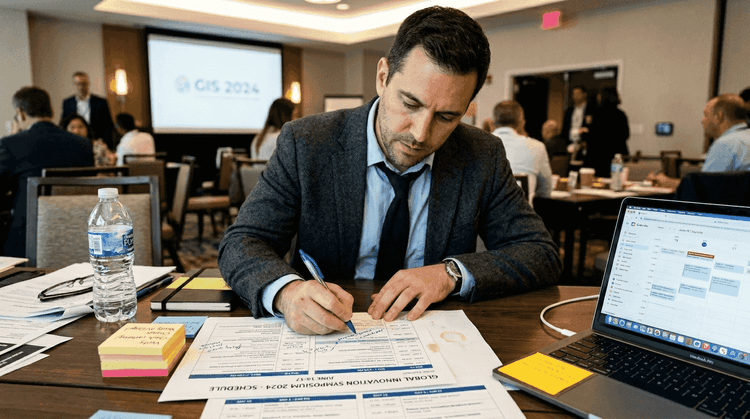
Planning a multi-day event can feel overwhelming, but the right scheduling approach transforms complexity into opportunity. Multi-day events see 20-30% higher satisfaction compared to single-day gatherings, proving that extended experiences create deeper engagement when structured thoughtfully. Whether you're organizing a corporate retreat, family reunion, or group travel adventure, understanding how to leverage time across multiple days unlocks participant satisfaction and measurable success. This guide reveals proven strategies that turn scheduling challenges into competitive advantages, helping you create memorable experiences that attendees actively want to repeat.
Table of Contents
- How Multi-Day Scheduling Enhances Attendee Engagement And Event Success
- Strategic Planning Essentials For Effective Multi-Day Scheduling
- Leveraging Ai And Advanced Techniques To Optimize Multi-Day Schedules
- Practical Tips For Planning Multi-Day Events Across Corporate, Family, And Group Travel Settings
- Explore Scheduling Solutions With WhenNot
Key takeaways
| Point | Details |
|---|---|
| Enhanced engagement | Multi-day formats allow diverse session types that boost satisfaction by 20-30% and engagement by 15-25% |
| Strategic balance | Proper sequencing with breaks increases subsequent day attendance by 10-15% while preventing burnout |
| AI optimization | Advanced tools reduce scheduling conflicts by 10-12% and cut operational costs by 30% |
| Early planning | Family reunions need 9-18 months lead time while group lodging books 6-14 months ahead |
| Repeat attendance | Thoughtful multi-day scheduling drives 15% higher return rates for future events |
How multi-day scheduling enhances attendee engagement and event success
Extended event formats create opportunities impossible in compressed timeframes. When you spread content across multiple days, participants absorb information more effectively and form stronger connections with both material and fellow attendees. The data backs this up: multi-day events see 20-30% higher satisfaction rates and generate 15-25% more engagement than their single-day counterparts.
This advantage stems from psychological principles of learning and social bonding. Spacing content allows mental processing between sessions, improving retention dramatically. Attendees return each day refreshed rather than mentally exhausted, ready to engage deeply with new material. The multi-day format also enables varied session types that cater to different learning styles and interest levels within your group.
Consider how this plays out across event types. Corporate teams benefit from alternating intensive workshops with collaborative problem-solving sessions. Family reunions can mix structured activities with free time for spontaneous connections. Group travel coordinators create itineraries balancing guided experiences with independent exploration. Each approach leverages the why schedule multi-day events framework to match content delivery with participant capacity.
The satisfaction boost translates directly to business outcomes. Repeat attendance increases by 15% when organizers implement effective multi-day scheduling, creating sustainable event communities. Participants who feel energized rather than drained become advocates, expanding your reach through genuine recommendations.
Key engagement drivers in multi-day formats:
- Spaced learning enhances knowledge retention and application
- Social bonds deepen through repeated informal interactions
- Varied content types maintain interest across diverse participant groups
- Natural rhythm prevents the fatigue common in marathon single-day events
- Participants self-select into relevant sessions, increasing perceived value
Pro Tip: Track engagement metrics across each day to identify energy patterns in your specific audience, then adjust future schedules to amplify high-engagement periods and redesign lower-performing segments.
Strategic planning essentials for effective multi-day scheduling
Successful multi-day events follow deliberate sequencing principles that maintain participant energy from opening to closing sessions. The foundation lies in balancing high-impact content with necessary recovery periods. Research confirms that well-structured schedules increase attendance on subsequent days by 10-15%, while poorly planned events see dramatic drop-off as fatigue accumulates.
Start by mapping content intensity across your timeline. Place demanding cognitive sessions during peak alertness windows, typically mid-morning after participants have settled in but before lunch energy dips. Reserve afternoons for interactive workshops or networking that leverage social energy without requiring sustained concentration. Evening programming should emphasize connection over content density, allowing informal relationship building that participants genuinely enjoy.
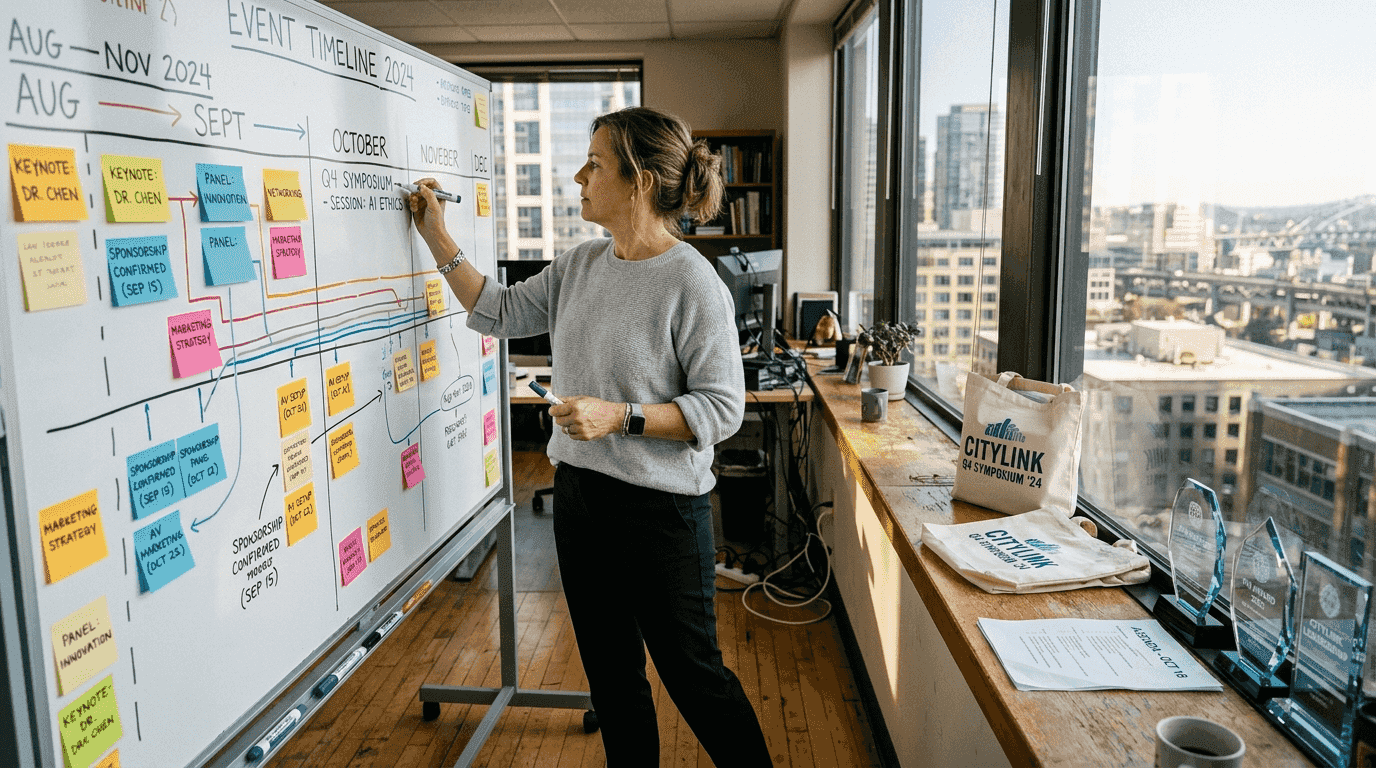
The biggest planning mistake? Overbooking the schedule with back-to-back sessions. Over-scheduling leads to burnout because humans need processing time between information inputs. Build in 15-20 minute transitions between major sessions, and schedule at least one extended break daily for participants to decompress, check messages, or simply rest. These gaps aren't wasted time; they're essential infrastructure for sustained engagement.
Logical flow matters as much as pacing. Sequence content so each session builds on previous knowledge without requiring participants to mentally backtrack. For multi-day event planning, this means clustering related topics within the same day or consecutive days, creating clear thematic arcs that feel purposeful rather than random.
Sequencing best practices:
- Open with energizing, big-picture content that sets context
- Progress from foundational concepts to advanced applications
- Alternate presentation formats to maintain sensory variety
- Schedule collaborative sessions after participants have bonded
- Reserve final slots for synthesis and actionable takeaways
Pro Tip: Survey past attendees about scheduling fatigue group planning to identify specific pain points in your event format, then redesign those segments using participant feedback rather than assumptions.
Avoid the trap of assuming more content equals more value. Participants remember and apply focused, well-delivered material far better than rushed coverage of excessive topics. Quality of experience trumps quantity of sessions every time.
Leveraging AI and advanced techniques to optimize multi-day schedules
Traditional scheduling methods struggle with the exponential complexity of multi-day events involving dozens or hundreds of participants with competing constraints. AI-powered tools transform this challenge by processing variables simultaneously that would take humans days to reconcile manually. The results speak clearly: AI tools reduce scheduling conflicts by 10-12% while increasing participant satisfaction by up to 8%.
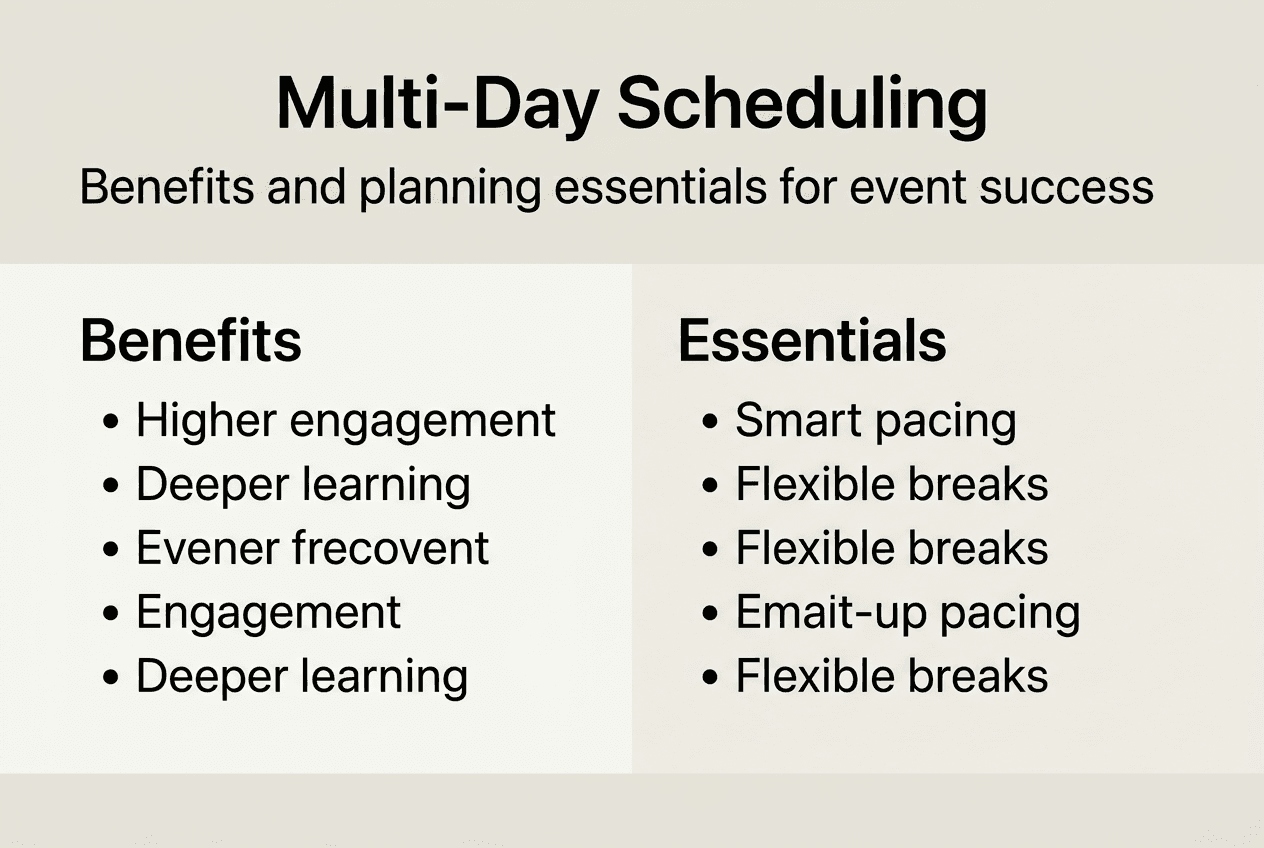
Machine learning algorithms analyze historical attendance patterns, participant preferences, venue capacities, and resource availability to generate optimized schedules in minutes. These systems identify conflicts invisible to manual planning, such as competing sessions that split key audience segments or timing that creates bottlenecks at shared resources. Early adopters report that AI scheduling cuts costs by 30% through better resource allocation and improves workforce efficiency by 20% by eliminating redundant coordination tasks.
The technology excels at dynamic adjustments. When last-minute changes occur, AI instantly recalculates optimal configurations rather than forcing organizers into reactive scrambling. This agility proves invaluable for multi-day events where speaker cancellations, room changes, or attendance fluctuations require rapid replanning.
| Traditional Scheduling | AI-Powered Scheduling |
|---|---|
| Manual conflict identification | Automated constraint analysis |
| Hours or days to create schedules | Minutes to generate optimized plans |
| Limited scenario testing | Instant comparison of multiple options |
| Static once published | Dynamic real-time adjustments |
| High error rates with complexity | Consistent accuracy across scale |
Implementation requires upfront investment in tool selection and data preparation, but payoffs compound across multiple events. Start by digitizing participant preferences and historical performance data. Feed this information into scheduling platforms that support multi-day complexity, ensuring the system understands your specific constraints like venue transitions, equipment needs, and mandatory breaks.
Pro Tip: Integrate AI scheduling tools during initial planning phases rather than after manual drafts, allowing algorithms to explore configuration possibilities unconstrained by human anchoring biases that limit creative solutions.
The multi-day event scheduling guide framework works synergistically with AI tools. Use technology for optimization while applying human judgment to qualitative factors like thematic flow and emotional pacing that algorithms can't fully capture. This hybrid approach delivers schedules that are both mathematically sound and experientially compelling.
Practical tips for planning multi-day events across corporate, family, and group travel settings
Different event types demand tailored planning timelines and coordination strategies. Understanding these distinctions prevents common pitfalls that derail well-intentioned organizers. The research provides clear benchmarks: family reunions require 9-18 months advance planning for effective coordination and cost savings, while properties for groups book 6-14 months ahead during peak seasons.
Corporate retreat planning sequence:
- Define objectives and success metrics 6-8 months out
- Survey team preferences for location and activities
- Secure venue and accommodations 4-6 months ahead
- Finalize agenda with stakeholder input 3 months prior
- Communicate detailed schedule 6 weeks before event
- Conduct final logistics review 2 weeks out
Corporate events benefit from clear decision frameworks that balance professional development with team building. Involve participants early through surveys about preferred topics and formats, creating buy-in that boosts attendance and engagement. Budget transparency matters; communicate costs upfront to avoid surprises that create resentment.
Family reunions present unique challenges around diverse age groups, geographic dispersion, and varying financial situations. Start conversations early to gauge interest and gather input on dates, locations, and budget constraints. Assign planning responsibilities across multiple family members to distribute workload and ensure representation of different household needs.
Family reunion coordination essentials:
- Poll extended family on blackout dates before selecting final dates
- Choose centrally located venues that minimize travel burden
- Offer tiered participation options for varying budgets
- Plan activities spanning age ranges from toddlers to seniors
- Build in unstructured time for spontaneous family bonding
Group travel requires balancing structured itineraries with flexibility for individual exploration. Book accommodations offering both communal spaces and private retreats. Research group rates aggressively, as bulk bookings often unlock significant savings on lodging, transportation, and activities.
| Event Type | Lead Time | Key Challenge | Success Factor |
|---|---|---|---|
| Corporate Retreat | 6-8 months | Aligning schedules | Early stakeholder input |
| Family Reunion | 9-18 months | Budget diversity | Tiered participation options |
| Group Travel | 6-12 months | Individual preferences | Flexible itinerary design |
| Conference | 12-18 months | Venue capacity | Early venue commitment |
The step by step event planning multi-day retreats approach emphasizes iterative planning with participant feedback loops. Don't finalize details in isolation; test ideas with your target audience and adjust based on their responses. This collaborative method surfaces concerns early when solutions are still flexible rather than discovering problems after commitments lock you into suboptimal choices.
Pro Tip: Create a shared digital hub where all participants access schedules, venue information, packing lists, and contact details, reducing repetitive questions and ensuring everyone has current information regardless of when they check in.
Explore scheduling solutions with WhenNot
Coordinating availability across multiple participants remains one of the most time-consuming aspects of multi-day event planning. Traditional back-and-forth emails create confusion and delays that frustrate organizers and participants alike. WhenNot scheduling solutions flip this dynamic by asking participants when they're not available rather than when they are, dramatically simplifying the coordination process.
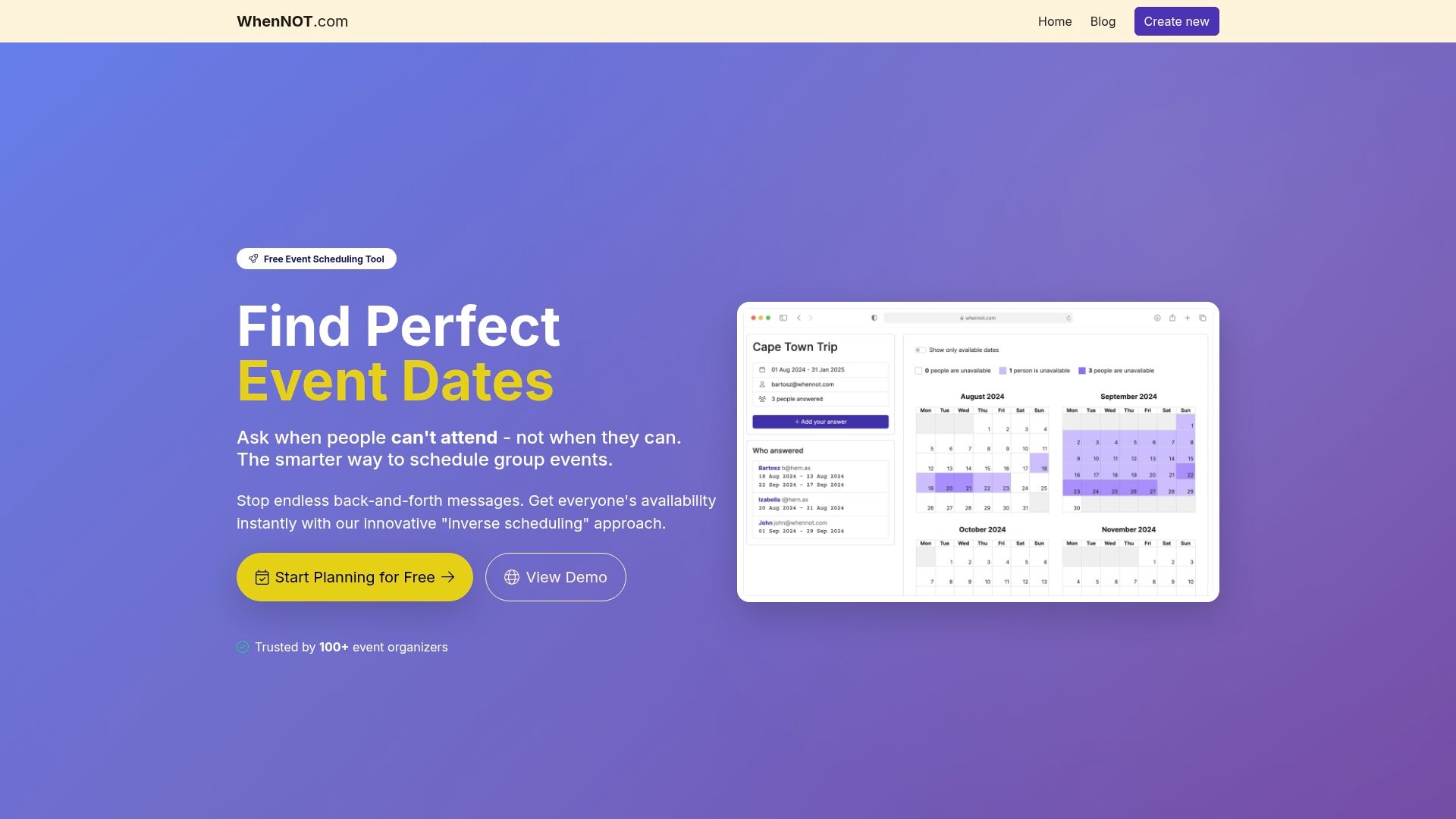
The platform visualizes everyone's conflicts simultaneously, revealing optimal date ranges at a glance. No accounts required for participants means zero friction in gathering responses. Whether you're planning a corporate retreat, family reunion, or group travel adventure, WhenNot's inverse scheduling approach saves hours of coordination time while ensuring you find dates that work for maximum attendance. The tool handles the logistics complexity so you can focus on creating memorable experiences rather than chasing calendar confirmations.
FAQ
What makes multi-day scheduling different from single-day planning?
Multi-day scheduling introduces complexity around pacing, energy management, and content sequencing that single-day events avoid. You must balance intensive sessions with recovery periods across multiple days to prevent cumulative fatigue. The format enables deeper exploration of topics and stronger relationship building but requires careful attention to daily rhythms and participant capacity. Successful multi-day schedules treat each day as a chapter in a larger narrative rather than standalone events.
How can AI tools reduce scheduling conflicts in multi-day events?
AI analyzes thousands of constraint combinations simultaneously, identifying conflicts that manual planning misses. The technology processes participant preferences, venue availability, resource limitations, and timing requirements to generate optimized schedules in minutes. By reducing conflicts by up to 12%, AI eliminates the frustrating overlaps that force participants to choose between desired sessions. The systems also enable instant replanning when last-minute changes occur, maintaining schedule integrity without manual recalculation.
What are the key challenges in planning family reunions as multi-day events?
Family reunions struggle with coordinating across diverse schedules, budgets, and geographic locations spanning multiple generations. The 9-18 month planning timeline reflects the difficulty of finding dates that work for extended family with varying work commitments, school calendars, and financial constraints. Securing group lodging requires early booking, especially during peak seasons when properties fill months in advance. Success depends on inclusive planning that gathers input from different family branches and offers participation options fitting various budget levels.
Why is balancing session content and breaks important in multi-day scheduling?
Human cognitive capacity diminishes without recovery periods between information-dense sessions. Continuous programming creates mental fatigue that reduces retention and engagement, causing attendance to drop on subsequent days. Strategic breaks allow participants to process new information, form social connections, and return to sessions refreshed rather than overwhelmed. Research shows well-paced schedules increase next-day attendance by 10-15%, proving that less packed programming often delivers more actual learning and satisfaction than overstuffed agendas.