
Juggling schedules for a multi-day corporate retreat often turns into a mental marathon, with endless emails, conflicting calendars, and mounting frustration. When every conversation about dates drains energy and postpones decisions, the toll becomes clear. Scheduling fatigue can creep in, quietly reducing focus and leading to more errors, as shown in recent research on workforce performance. Discover practical insights that help organizers reclaim time, restore focus, and reduce the stress of planning complex corporate gatherings.
Table of Contents
- Defining Scheduling Fatigue In Modern Planning
- Main Causes And Common Triggers
- Signs Of Fatigue In Group Scheduling
- Consequences For Multi-Day Event Organizers
- Effective Strategies To Minimize Scheduling Burnout
Key Takeaways
| Point | Details |
|---|---|
| Understanding Scheduling Fatigue | Scheduling fatigue is a mental exhaustion from complex event coordination, resulting from constant communication and conflicting schedules. |
| Impact on Teams | Persistent scheduling challenges lead to decreased collaboration and productivity, impeding overall organizational efficiency. |
| Signs of Scheduling Fatigue | Symptoms include prolonged decision-making, irritability, and procrastination, which hinder effective coordination efforts. |
| Mitigation Strategies | Implementing structured communication protocols and rotating scheduling responsibilities can help alleviate scheduling burnout. |
Defining Scheduling Fatigue in Modern Planning
Scheduling fatigue represents a complex psychological and operational phenomenon emerging from the increasingly intricate landscape of group event coordination. At its core, scheduling fatigue occurs when event planners, team leaders, and organizational coordinators experience mental exhaustion from repetitive, complex scheduling processes that drain cognitive resources and productivity.
The phenomenon stems from multiple interconnected factors that strain mental bandwidth:
- Constant back-and-forth communication with multiple participants
- Managing competing individual availability constraints
- Tracking numerous potential date combinations
- Resolving scheduling conflicts manually
- Attempting to synchronize diverse personal calendars
Research indicates that work-related fatigue significantly impacts operational performance by disrupting cognitive efficiency and introducing substantial mental overhead. Professional coordinators frequently find themselves trapped in a cyclical process of negotiation, renegotiation, and constant communication that transforms what should be a straightforward task into an emotionally draining experience.
Beyond individual frustration, scheduling fatigue carries broader organizational implications. Teams experiencing persistent scheduling challenges often see decreased collaboration, reduced meeting participation, and diminished overall productivity. The mental energy expended on coordinating schedules could instead be redirected toward strategic objectives and creative problem-solving.
Pro tip: Break complex scheduling tasks into smaller, manageable segments and utilize systematic approaches that minimize cognitive load and communication friction.
Main Causes and Common Triggers
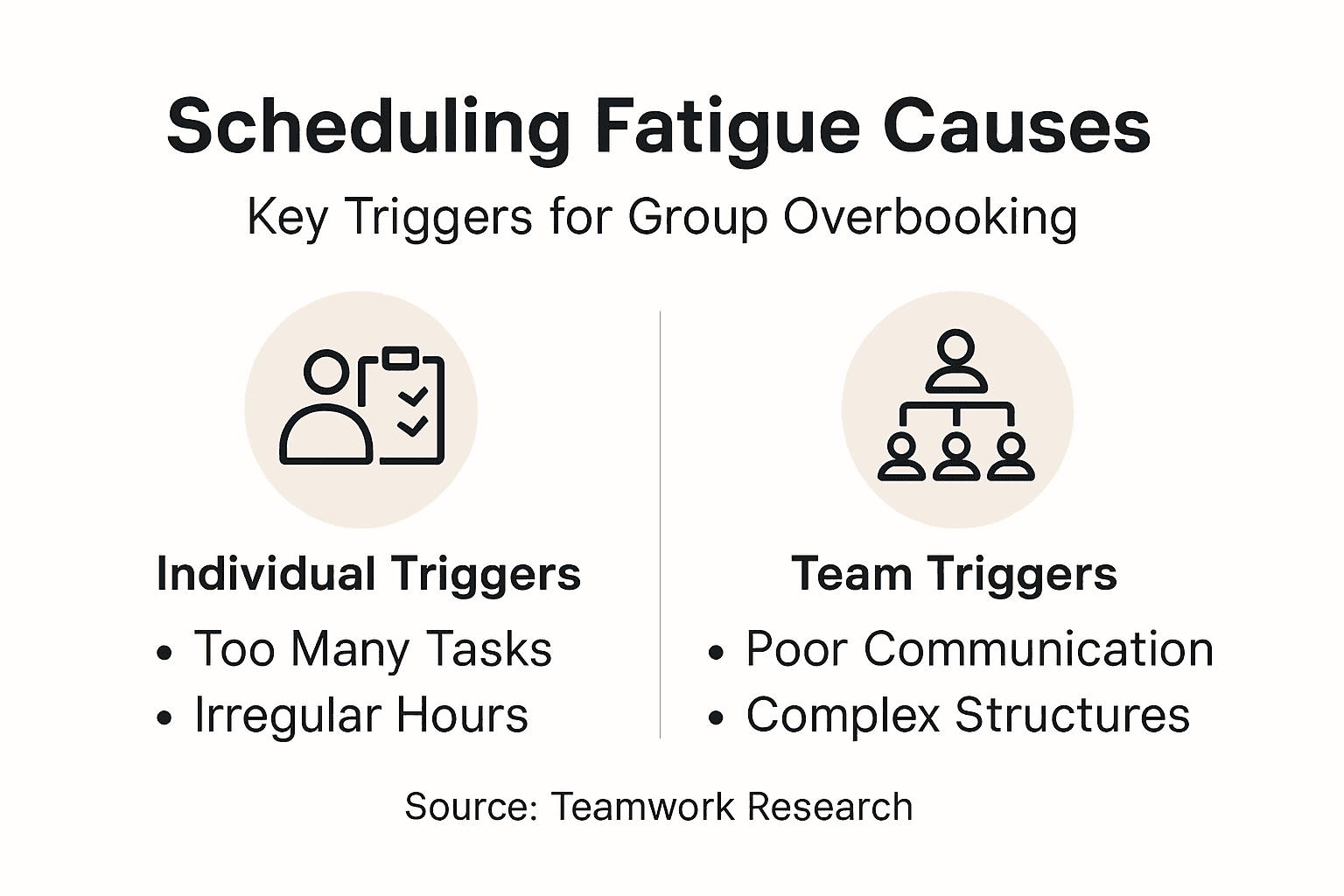
Scheduling fatigue emerges from a complex interplay of organizational, psychological, and biological factors that systematically undermine an individual's ability to efficiently coordinate group events. Workplace scheduling patterns significantly impact mental exhaustion, creating a cascading effect of cognitive and emotional drain.
The primary causes of scheduling fatigue can be categorized into several key dimensions:
- Irregular communication patterns
- Excessive cognitive load from multiple scheduling demands
- Unpredictable participant availability
- Complex coordination requirements
- Persistent time zone and geographic variations
Circadian disruption plays a critical role in scheduling challenges. Biological desynchronization from work patterns creates significant mental strain, leading to decreased attention, slower response times, and increased potential for errors. This phenomenon is particularly pronounced in scenarios involving multiple time zones, remote teams, and flexible work arrangements.
Organizational structures further compound scheduling fatigue by introducing layers of complexity. Teams with decentralized decision-making, multiple stakeholders, and conflicting priorities experience exponentially higher scheduling friction. The cumulative mental energy expended in negotiating these intricate scheduling landscapes can transform what should be a simple coordination task into an emotionally and cognitively depleting experience.
Pro tip: Implement standardized communication protocols and use collaborative scheduling tools that minimize individual cognitive load and streamline group coordination efforts.
Signs of Fatigue in Group Scheduling
Scheduling fatigue manifests through a complex array of cognitive, emotional, and physical indicators that systematically undermine group coordination efforts. Reduced alertness and cognitive function signal the early stages of scheduling exhaustion, creating significant challenges for team productivity.
The most prominent signs of scheduling fatigue include:
- Prolonged decision-making processes
- Increased communication errors
- Delayed responses to scheduling requests
- Heightened irritability during coordination attempts
- Consistent procrastination in finalizing event details
- Mental resistance to scheduling discussions
Cognitive performance becomes progressively compromised as scheduling demands escalate. Sustained attention lapses and impaired reaction times represent critical warning signs that indicate mounting psychological strain. Teams experiencing these symptoms often struggle to maintain efficient communication channels, leading to cascading coordination breakdowns.

Organizational dynamics further amplify scheduling fatigue symptoms. Remote teams, cross-functional groups, and distributed workforce models experience more pronounced cognitive depletion, with scheduling complexity directly correlating to mental exhaustion. The cumulative mental tax of constant negotiation, time zone reconciliation, and competing priorities creates a silent productivity killer that gradually erodes team cohesion and individual performance.
Here's a comparison of scheduling fatigue symptoms by their impact on individuals and teams:
| Symptom Type | Individual Impact | Team Impact |
|---|---|---|
| Cognitive | Reduced focus, slow decision | Missed deadlines, poor communication |
| Emotional | Irritability, frustration | Increased tension, low morale |
| Physical | Fatigue, headaches | Decreased attendance, less engagement |
| Behavioral | Procrastination, avoidance | Delayed coordination, project stalling |
Pro tip: Implement periodic scheduling breaks and rotate coordination responsibilities to distribute cognitive load and prevent individual scheduling burnout.
Consequences for Multi-Day Event Organizers
Multi-day event organizers face significant challenges when scheduling fatigue compromises their planning capabilities. Overbooking strategies introduce complex resource allocation risks that can dramatically undermine event success and participant satisfaction.
The primary consequences of scheduling fatigue for multi-day event organizers include:
- Increased operational complexity
- Higher probability of logistical errors
- Reduced attendee experience quality
- Potential financial losses from inefficient planning
- Diminished team coordination and communication
- Reputation damage from poor event management
Resource management becomes exponentially more challenging as scheduling complexity increases. Multi-day event capacity models must carefully balance confirmation uncertainties to prevent systemic operational breakdowns. Organizers who fail to implement robust scheduling strategies risk creating cascading coordination failures that can derail entire event experiences.
The psychological and financial toll of persistent scheduling challenges can be substantial. Organizations may experience decreased team morale, increased planning stress, and reduced efficiency across multiple planning dimensions. The cumulative impact transforms what should be a strategic coordination process into an emotionally and operationally draining endeavor that consumes disproportionate amounts of time and mental energy.
Pro tip: Develop a standardized scheduling protocol that incorporates buffer times and uses adaptive coordination tools to mitigate potential planning disruptions.
Effective Strategies to Minimize Scheduling Burnout
Navigating the complex landscape of group scheduling requires strategic approaches that systematically reduce mental strain and cognitive overload. Goal-setting and task organization techniques can significantly mitigate the psychological challenges inherent in coordinating multi-participant events.
Key strategies for minimizing scheduling burnout include:
- Implementing clear prioritization frameworks
- Establishing structured communication protocols
- Utilizing adaptive scheduling technologies
- Creating flexible time management systems
- Distributing coordination responsibilities
- Developing pre-emptive conflict resolution mechanisms
Group dynamics play a crucial role in managing scheduling stress. Psychological interventions and supportive communication strategies can transform potentially overwhelming coordination processes into collaborative, manageable experiences. Organizations that proactively design their scheduling approaches around human cognitive limitations can dramatically reduce team exhaustion and improve overall planning efficiency.
Technological and human-centered approaches must work in tandem to create sustainable scheduling ecosystems. By recognizing scheduling as a complex cognitive task rather than a simple administrative function, teams can develop more empathetic, intelligent coordination frameworks that respect individual energy levels and organizational constraints.
Below is a summary of strategic approaches to reduce scheduling burnout and their key benefits:
| Strategy Type | Example Practice | Key Benefit |
|---|---|---|
| Technological | Use smart calendar tools | Reduces manual work |
| Procedural | Structured protocols | Streamlines communication |
| Human-Centered | Rotate responsibilities | Balances cognitive load |
| Preventive | Scheduling breaks | Supports sustained productivity |
Pro tip: Rotate scheduling responsibilities among team members and implement regular "scheduling recovery" breaks to prevent cognitive depletion and maintain team coordination quality.
Overcome Scheduling Fatigue with Smarter Planning Solutions
Scheduling fatigue can drain your mental energy and slow down group event coordination through constant back-and-forth and complex availability conflicts. If you are tired of prolonged decision-making and the stress of juggling multiple dates and participants, it's time to simplify your planning process. WhenNOT tackles these exact challenges by focusing on when participants are busy rather than when they are free, reducing communication overload and cognitive strain.
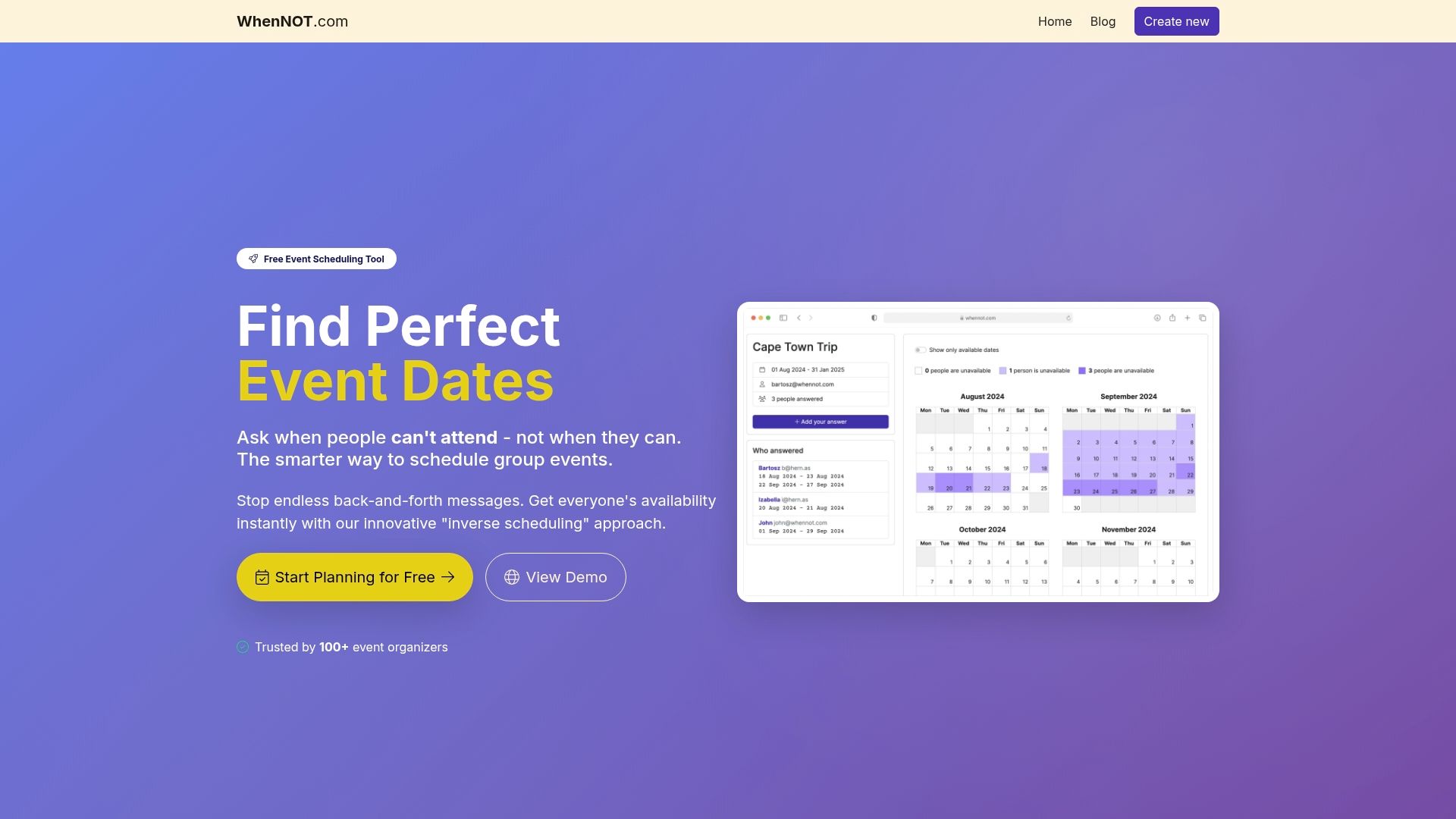
Discover how WhenNOT makes event scheduling effortless and fast. You can create an event on WhenNOT, set your preferred date range, and share a unique link with participants who mark their unavailable dates without creating an account. This approach minimizes scheduling burnout and helps you find optimal dates for multi-day and flexible events in seconds. Take control of your group planning today by visiting WhenNOT's free scheduling tool and experience a seamless coordination process designed to save your time and energy.
Frequently Asked Questions
What is scheduling fatigue?
Scheduling fatigue refers to the mental exhaustion experienced by event planners and coordinators due to repetitive and complex scheduling processes that drain cognitive resources.
What are the main causes of scheduling fatigue?
The primary causes include irregular communication patterns, excessive cognitive load from multiple scheduling demands, unpredictable participant availability, and complex coordination requirements.
How can I minimize scheduling fatigue in my team?
To minimize scheduling fatigue, implement clear prioritization frameworks, use adaptive scheduling technologies, establish structured communication protocols, and distribute coordination responsibilities among team members.
What are the signs that my team is experiencing scheduling fatigue?
Signs include prolonged decision-making processes, increased communication errors, delayed responses, heightened irritability during coordination discussions, and consistent procrastination in finalizing event details.