
You need to coordinate a volunteer event with 30 participants, but the scheduling tool demands everyone create accounts first. Half your invitees abandon the process before even viewing available dates. This scenario plays out daily for event planners who face unnecessary barriers in group coordination. No-signup scheduling tools eliminate these friction points entirely, allowing participants to respond instantly without creating accounts, passwords, or profiles. For event planners managing tight timelines and diverse participant groups, these tools transform coordination from a multi-day hassle into a streamlined process that respects everyone's time and increases actual participation rates.
Table of Contents
- Why No-Signup Tools Matter For Event Planners
- Core Advantages Of No-Signup Scheduling Tools
- Comparing No-Signup Tools With Traditional Signup Systems
- How To Apply No-Signup Tools Effectively In Your Event Planning
- Discover Hassle-Free Scheduling With WhenNOT
- Frequently Asked Questions About No-Signup Scheduling Tools
Key takeaways
| Point | Details |
|---|---|
| Speed advantage | No-signup tools reduce coordination time by eliminating account creation barriers that slow participant responses |
| Higher participation | Removing sign-in requirements increases response rates by up to 40% for volunteer and parent events |
| Simplified logistics | Event planners manage scheduling without tracking user accounts, passwords, or login issues |
| Instant accessibility | Participants view and respond to scheduling requests immediately from any device without technical setup |
| Privacy benefits | No-signup tools protect participant data by not requiring personal information storage or account management |
Why no-signup tools matter for event planners
Traditional scheduling platforms create unnecessary obstacles between your invitation and participant responses. When you send a scheduling link that requires account creation, you introduce multiple failure points: email verification delays, forgotten passwords, form fatigue, and technical confusion. Each barrier reduces your response rate and extends your coordination timeline. If account walls and ads are what pushed you to look elsewhere, see our breakdown of a free Doodle alternative without ads or account limits.
Event planners managing volunteer coordination or parent-teacher conferences face particularly acute challenges with signup-based systems. Your participants often have limited time and patience for administrative tasks. A parent juggling work calls and school pickups will not spend five minutes creating an account just to indicate availability for a 15-minute conference slot. Similarly, volunteers motivated by community service lose enthusiasm when faced with registration forms requesting unnecessary personal details.
No-signup tools address these pain points directly by removing authentication requirements entirely. Participants click your link, view the proposed dates, mark their availability or conflicts, and submit their response in under 30 seconds. This frictionless approach respects participant time while delivering the coordination data you need to finalize event dates.
The impact extends beyond convenience. Signup-free scheduling eliminates barriers that disproportionately affect certain participant groups. Older adults unfamiliar with account management systems participate more readily. International participants avoid timezone confusion in registration processes. Tech-averse volunteers engage without intimidation. By removing these barriers, you expand participation across demographic boundaries.
Consider the practical workflow differences:
- Traditional signup tool: Send invite, participants create accounts, verify emails, log in, navigate interface, respond, manage passwords for future access
- No-signup tool: Send invite, participants click link, mark availability, submit response
The streamlined process reduces coordination time from days to hours. For events requiring quick turnaround, like emergency volunteer shifts or last-minute venue changes, this speed advantage becomes mission-critical. You gather responses while momentum remains high rather than watching engagement decay during prolonged signup processes.
"Practical for practitioners: Use for volunteer coordination, parent-teacher events where speed trumps persistence. The reduced friction translates directly into higher completion rates and faster consensus on optimal dates."
Event planners also benefit from reduced technical support burden. Signup-based systems generate constant requests for password resets, account recovery, and login troubleshooting. No-signup tools eliminate these administrative headaches entirely, freeing you to focus on actual event logistics rather than participant account management.
Core advantages of no-signup scheduling tools
The benefits of no-signup scheduling extend across multiple dimensions of event coordination, each contributing to more efficient planning workflows and better participant experiences.
-
Instant response capability: Participants engage with your scheduling request within seconds of receiving your link. No account creation means no delay between invitation and action. This immediacy captures participant attention while your event remains top of mind, preventing the procrastination that occurs when people must complete registration steps before responding.
-
Universal accessibility: Anyone with internet access can participate regardless of technical skill level. Elderly participants, international collaborators, and technology novices all engage on equal footing. The absence of passwords, usernames, and verification emails removes barriers that exclude less tech-savvy individuals from participation.
-
Privacy protection: No-signup tools enhance scheduling efficiency by not collecting or storing unnecessary personal information. Participants appreciate not adding another service to their digital footprint. You avoid data management responsibilities associated with storing user credentials and personal details.
-
Reduced abandonment rates: Each required field in a signup form increases abandonment probability. Studies show that removing account requirements can increase completion rates by 40% or more. For event planners, this translates to gathering responses from participants who would otherwise drop out during registration.
-
Simplified follow-up: Without user accounts to manage, you communicate with participants through direct channels like email or messaging apps. This approach feels more personal and generates higher engagement than platform-specific notifications that participants might miss or ignore.
-
Mobile optimization: No-signup tools work seamlessly on smartphones without app downloads or mobile-specific login processes. Participants respond during commutes, breaks, or other micro-moments throughout their day, increasing overall response velocity.
Pro Tip: When sending no-signup scheduling links to large groups, include a response deadline in your message. The combination of easy access and clear timeframe maximizes participation while maintaining your planning timeline.
The administrative advantages for event planners prove equally compelling. You avoid managing user databases, handling password reset requests, or troubleshooting login issues. Your coordination workflow remains clean and focused on actual scheduling rather than platform administration. This efficiency becomes particularly valuable when managing multiple events simultaneously or coordinating with participants who engage infrequently.
Improved event coordination stems from removing unnecessary complexity. Participants who find scheduling easy become more reliable attendees. The positive initial experience with your coordination process sets a collaborative tone that carries through to event execution. Conversely, frustrating signup experiences create negative associations that can affect participant enthusiasm and commitment.

For recurring events, no-signup tools prevent the password fatigue that plagues signup-based systems. Participants who schedule monthly volunteer shifts or quarterly team events appreciate not managing yet another set of login credentials. This sustained ease of use maintains high participation rates across multiple coordination cycles.
Comparing no-signup tools with traditional signup systems
Understanding the practical differences between no-signup and traditional signup scheduling tools helps event planners select appropriate solutions for specific coordination needs.
| Feature | No-Signup Tools | Traditional Signup Systems |
|---|---|---|
| Time to first response | Under 1 minute | 5-15 minutes including account creation |
| Participant barriers | None beyond link access | Account creation, email verification, password management |
| Mobile accessibility | Immediate via any browser | Often requires app download or complex mobile login |
| Privacy requirements | Minimal data collection | Extensive personal information storage |
| Administrative overhead | Link generation only | User account management, password resets, data security |
| Ideal use cases | Quick coordination, infrequent participants, volunteer events | Long-term scheduling, recurring participants, complex permissions |
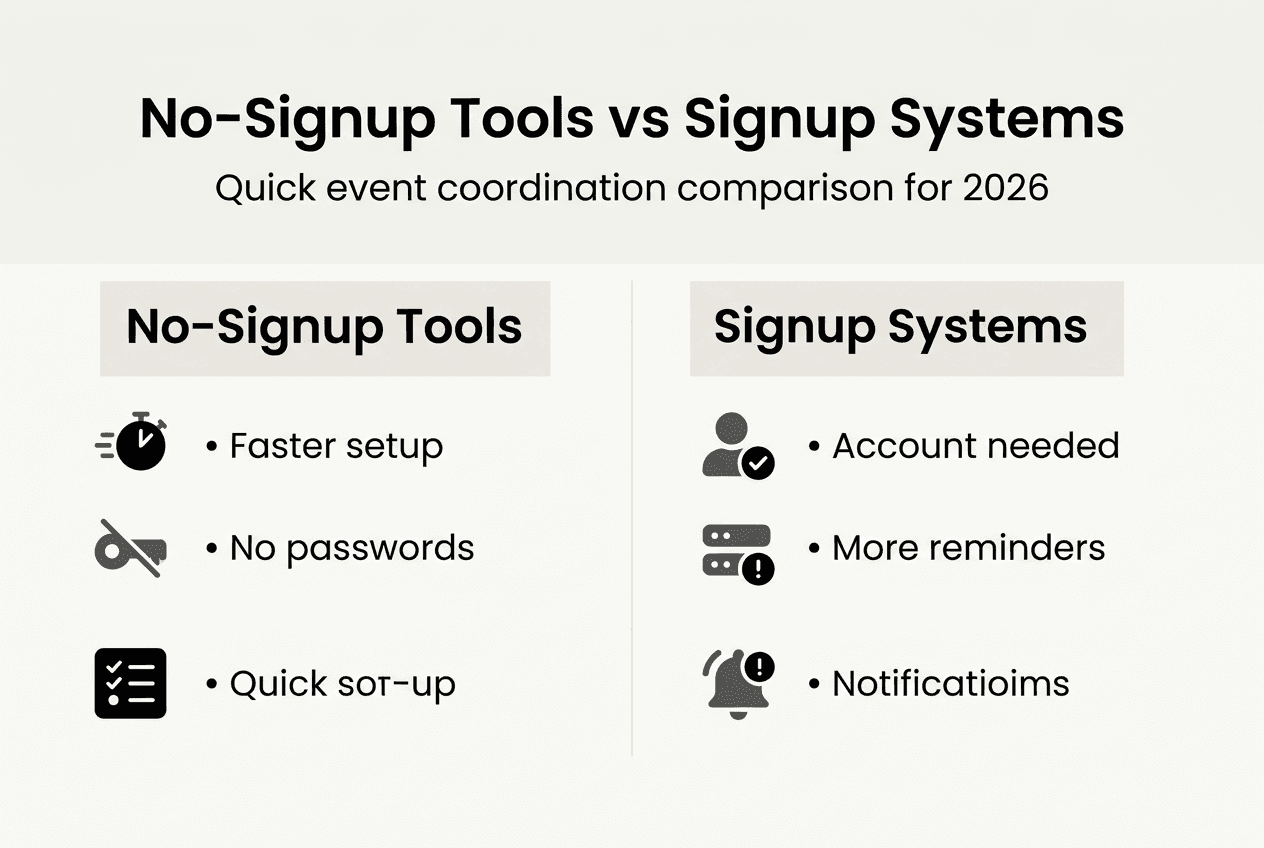
Traditional signup systems excel in specific scenarios where persistent user accounts provide genuine value. Organizations managing ongoing scheduling with the same participant pool benefit from saved preferences, historical data, and personalized dashboards. Corporate environments with existing authentication infrastructure can integrate signup-based tools into broader systems.
However, sign-up free tools deliver superior results for event planners coordinating one-time or infrequent gatherings. Parent-teacher conferences, volunteer appreciation events, community fundraisers, and social gatherings all benefit from the reduced friction of no-signup approaches. Participants engage more readily when coordination feels effortless rather than bureaucratic.
The trade-offs merit consideration. Signup systems offer features like automated reminders tied to user accounts, detailed analytics on individual participant behavior, and integration with calendar systems requiring authentication. No-signup tools prioritize immediate access over these advanced features, focusing on core scheduling functionality without administrative complexity. For a side-by-side look at how the no-signup model plays out in practice, see our When2Meet alternative comparison.
Pro Tip: Evaluate your participant relationship duration when choosing between approaches. For groups you coordinate with once or twice yearly, no-signup tools optimize for immediate engagement. For weekly or monthly scheduling with consistent participants, signup systems may justify their additional complexity.
Event planners should also consider participant demographics. Younger, tech-savvy groups may tolerate signup requirements more readily than older or less technically inclined participants. However, even digital natives appreciate streamlined processes that respect their time. The universal appeal of simplicity makes no-signup tools effective across demographic boundaries.
Context determines optimal tool selection. Emergency response coordination, last-minute venue changes, or rapid volunteer mobilization all demand the speed advantages of no-signup tools. Conversely, managing complex multi-day conferences with tiered access levels might justify signup-based systems despite their friction.
How to apply no-signup tools effectively in your event planning
Successful implementation of no-signup scheduling tools requires strategic planning and clear communication to maximize their coordination benefits.
Start by identifying events where speed and accessibility matter most. Volunteer coordination, parent engagement activities, community events, and informal social gatherings all benefit significantly from no-signup approaches. These scenarios typically involve diverse participant groups with varying technical skills and limited patience for administrative processes.
Select tools that integrate smoothly with your existing communication channels. The best no-signup scheduling platform works within your current workflow rather than requiring process changes. Look for solutions that generate shareable links you can distribute through email, text messages, social media, or printed materials. This flexibility ensures you reach participants through their preferred communication methods.
Communicate clearly how participants should engage with your scheduling request. Your invitation message should explain that no account creation is required and highlight the quick response process. Transparency about the effortless nature of participation increases initial engagement and sets positive expectations.
- Craft concise invitation messages emphasizing the 30-second response time
- Include the scheduling link prominently in all communication channels
- Specify your response deadline to create appropriate urgency
- Provide brief instructions for participants unfamiliar with link-based scheduling
- Offer alternative response methods for participants without reliable internet access
Implement follow-up messaging strategically to boost participation without creating annoyance. Efficient event coordination balances reminder frequency with participant patience. Send an initial invitation, a midpoint reminder to non-responders, and a final deadline notice. This three-touch approach maximizes responses while respecting participant time.
Track participation patterns to refine your scheduling approach over time. Monitor which communication channels generate fastest responses, what times of day yield highest engagement, and how different message frameworks affect completion rates. This data-driven approach helps optimize future coordination efforts.
| Coordination Phase | Action Items | Success Metrics |
|---|---|---|
| Pre-event | Select appropriate no-signup tool, craft clear invitation, distribute through multiple channels | Link distribution reach, initial response rate |
| Active coordination | Monitor responses, send targeted reminders, answer participant questions | Response completion percentage, time to majority consensus |
| Post-coordination | Confirm final dates, communicate decisions, gather feedback on process | Participant satisfaction, actual attendance vs. scheduled |
Pro Tip: When coordinating with groups new to no-signup tools, include a brief video or screenshot showing the simple response process. Visual demonstration reduces hesitation and increases first-time user confidence.
Hassle-free scheduling advantages compound when you establish consistent coordination practices. Participants who experience easy scheduling once become more responsive in future coordination efforts. This positive reinforcement cycle builds trust and improves long-term coordination efficiency.
Consider accessibility needs when implementing no-signup tools. Ensure your chosen platform works with screen readers for visually impaired participants. Verify mobile responsiveness for participants who primarily use smartphones. Test link functionality across different browsers and devices to prevent technical barriers that undermine the no-signup advantage.
Maintain backup coordination methods for participants who encounter technical difficulties. While no-signup tools eliminate most barriers, internet connectivity issues or device limitations occasionally prevent participation. Offering phone or email alternatives ensures inclusive coordination that reaches every participant.
Discover hassle-free scheduling with WhenNOT
Transform your event coordination with a platform designed specifically for planners who value speed and simplicity. WhenNOT eliminates signup requirements entirely, allowing participants to mark their availability in seconds without creating accounts or managing passwords.
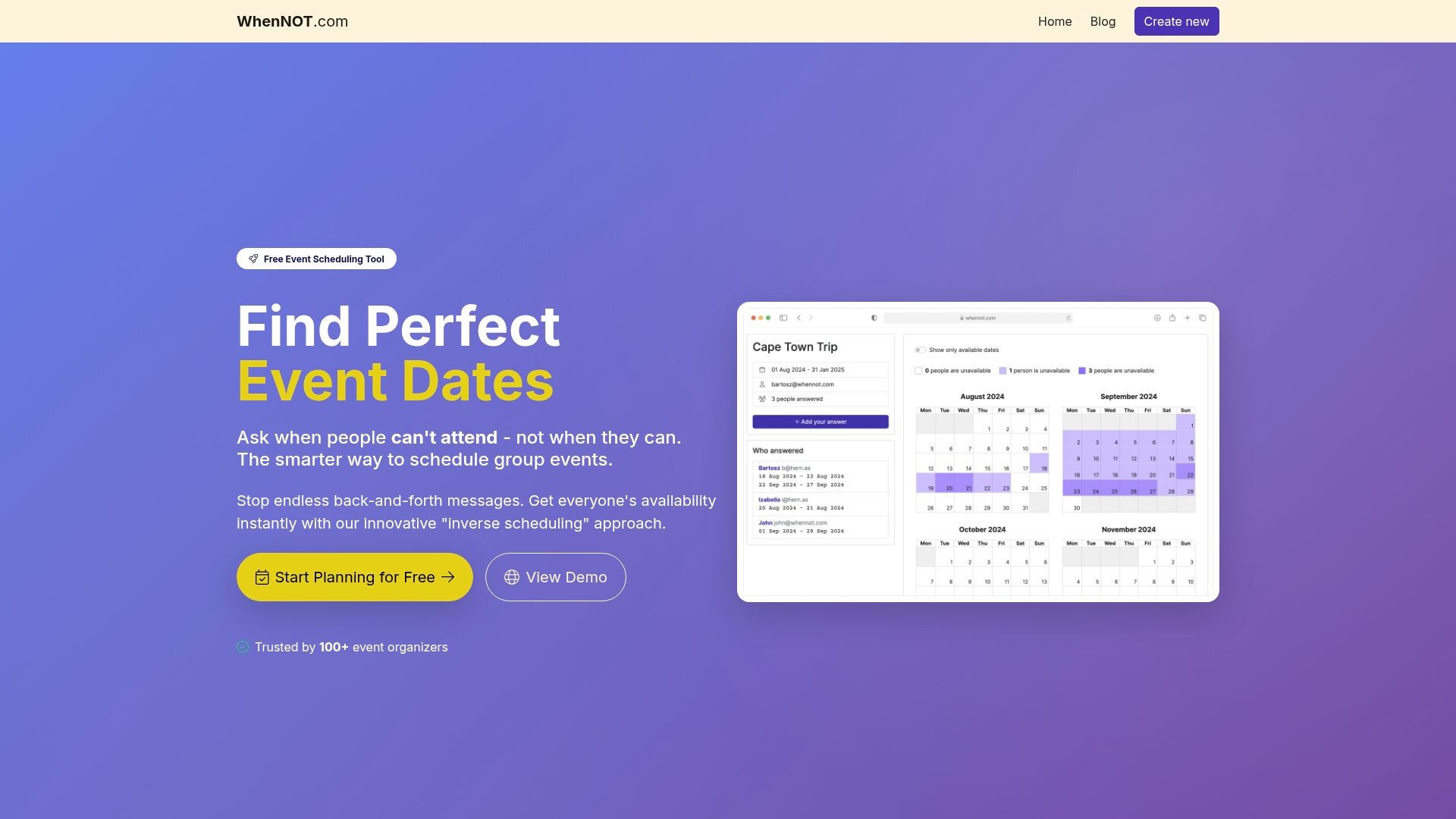
The no-signup scheduling platform uses an innovative inverse scheduling approach where participants indicate when they are not available rather than listing free times. This method proves particularly effective for multi-day events and flexible date coordination, reducing the back-and-forth communication that extends planning timelines. You create an event, set your potential date range, and share a unique link with participants who mark their busy dates instantly.
WhenNOT visualizes everyone's conflicts simultaneously, making optimal date identification immediate rather than requiring manual comparison of individual responses. The platform emphasizes privacy and accessibility while maintaining robust data security, giving you professional coordination capabilities without administrative complexity. No-signup tools streamline coordination for volunteer events, parent gatherings, team retreats, and social occasions alike.
Frequently asked questions about no-signup scheduling tools
Can no-signup tools handle large event groups efficiently?
Yes, quality no-signup scheduling platforms manage groups ranging from small teams to hundreds of participants without performance degradation. The absence of account management actually improves scalability since the system does not maintain user databases or authentication overhead. Response aggregation and visualization work identically whether coordinating 10 or 100 participants.
Are no-signup tools secure for sensitive event data?
Reputable no-signup tools implement robust security measures including encrypted data transmission, secure link generation, and limited data retention policies. Since these platforms collect minimal personal information compared to signup-based systems, they actually reduce privacy risk exposure. Verify that your chosen tool uses HTTPS encryption and clearly states data handling practices.
How do no-signup tools prevent scheduling conflicts?
No-signup platforms visualize participant availability or conflicts in aggregate views that make optimal dates immediately apparent. You see which dates work for the most participants without manually comparing individual responses. This visual approach prevents the coordination errors that occur when manually synthesizing multiple availability statements.
Can participants modify responses without creating accounts?
Most no-signup tools provide unique response links that allow participants to update their availability after initial submission. Some platforms email confirmation links that enable future edits, while others allow modifications through the original scheduling link. This flexibility maintains the no-signup advantage while accommodating changing participant schedules.
What types of events benefit most from no-signup scheduling?
Volunteer coordination, parent-teacher conferences, community gatherings, social events, and any coordination involving infrequent participants or tight timelines benefit significantly from no-signup tools. Events where speed and accessibility outweigh the need for persistent user accounts, detailed analytics, or complex permission structures achieve better outcomes with no-signup approaches. One-time or occasional gatherings particularly excel with this coordination method.