
Most American teams waste countless hours just trying to settle on a meeting time. Coordinating events or get-togethers often turns into a headache with endless emails and conflicting schedules. As work and social calendars get busier, finding smarter ways to organize becomes essential. This guide uncovers the science behind hassle-free scheduling, revealing how a few simple changes can save groups up to 75 percent of their planning time while protecting privacy and promoting true collaboration.
Table of Contents
- Hassle-Free Scheduling Defined and Debunked
- How Inverse Scheduling Simplifies Group Planning
- Key Time-Saving and Efficiency Benefits
- Privacy, Data Security, and Accessibility
- Comparing Hassle-Free Scheduling Alternatives
Key Takeaways
| Point | Details |
|---|---|
| Hassle-free Scheduling Reduces Complexity | This approach simplifies event planning by focusing on when participants are unavailable, reducing cognitive load and communication overhead. |
| Inverse Scheduling Simplifies Decision Making | By allowing participants to mark unavailable times, groups can quickly find optimal meeting windows, streamlining the planning process. |
| Time-Saving as a Strategic Advantage | Innovative scheduling techniques can reduce coordination efforts significantly, redirecting energy toward productive collaboration. |
| Emphasis on Privacy and Accessibility | Modern scheduling tools prioritize user privacy and ease of participation, ensuring a comfortable environment for sharing availability. |
Hassle-Free Scheduling Defined and Debunked
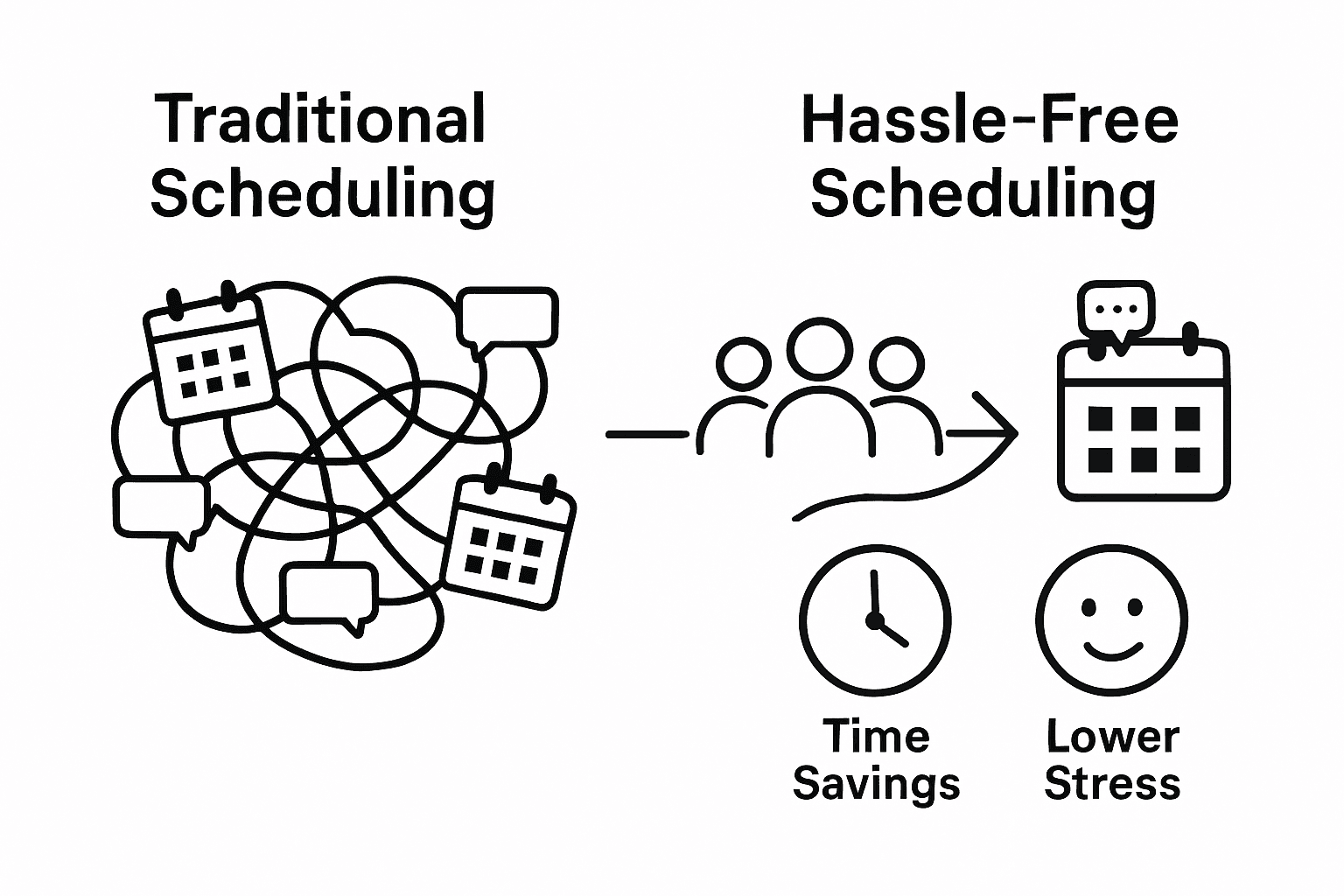
Hassle-free scheduling represents an innovative approach to coordinating group events by minimizing traditional planning complexities. Unlike conventional scheduling methods that require extensive back-and-forth communication, this strategy focuses on simplifying the coordination process. Systematic timetabling research reveals that effective scheduling isn't just about finding a time - it's about reducing cognitive load and streamlining group decision making.
At its core, hassle-free scheduling eliminates common pain points by inverting traditional scheduling approaches. Instead of asking participants when they are available, modern tools prompt individuals to indicate when they are unavailable. This subtle shift dramatically reduces communication overhead. Healthcare scheduling studies demonstrate how such efficiency can prevent no-show rates and improve overall coordination effectiveness.
Key characteristics of hassle-free scheduling include:
- Minimal participant effort
- No requirement for account creation
- Instant visual representation of group availability
- Privacy-focused design
- Zero cost to users
Understanding hassle-free scheduling means recognizing that good coordination isn't about complexity - it's about creating seamless, intuitive processes that respect everyone's time and preferences. By removing friction from event planning, groups can focus on what truly matters: connecting and enjoying shared experiences.
How Inverse Scheduling Simplifies Group Planning
Inverse scheduling represents a revolutionary approach to group planning that transforms traditional coordination methods. Optimization research demonstrates how this technique flips conventional scheduling strategies by focusing on identifying unavailable time slots rather than available ones. This subtle shift dramatically reduces the complexity of group event planning, making coordination more intuitive and efficient.

The core principle of inverse scheduling lies in its ability to simplify decision-making processes. Multi-objective optimization studies reveal that by allowing participants to quickly mark their unavailable times, groups can rapidly converge on optimal meeting windows. This approach eliminates the exhausting back-and-forth communication that typically plagues traditional scheduling methods.
Key advantages of inverse scheduling include:
- Reduced cognitive load for participants
- Faster time-to-resolution for group planning
- Minimized communication overhead
- Enhanced privacy by limiting shared information
- Simplified decision-making process
Understanding inverse scheduling means recognizing that group coordination doesn't have to be complicated. By collaborative scheduling workflows that prioritize simplicity and efficiency, teams can transform what was once a time-consuming process into a streamlined, stress-free experience. The goal is not just to find a time that works, but to make the entire scheduling process as frictionless as possible.
Key Time-Saving and Efficiency Benefits
Time-saving in group scheduling isn't just a convenience - it's a strategic advantage that can transform how teams and organizations coordinate. Collaborative scheduling research reveals that innovative approaches can dramatically reduce the time traditionally spent negotiating meeting times, cutting coordination efforts by up to 75% in dynamic work environments.
The efficiency gains extend far beyond simple time reduction. Multi-agent scheduling studies demonstrate that optimized scheduling techniques can minimize total operational costs while maximizing group productivity. By eliminating repetitive communication cycles and providing instant visual clarity, hassle-free scheduling methods fundamentally redesign how groups make collective time-based decisions.
Key time-saving and efficiency benefits include:
- Reducing email and message threads about scheduling
- Eliminating manual calendar cross-referencing
- Providing instant group availability insights
- Minimizing scheduling-related stress and frustration
- Creating transparent, fair scheduling processes
Team productivity strategies highlight that effective scheduling is more than a technical process - it's about creating space for meaningful collaboration. By streamlining the coordination mechanism, groups can redirect their energy from logistical challenges to actual productive work, ultimately transforming scheduling from a tedious task into a strategic advantage.
Privacy, Data Security, and Accessibility
Privacy in group scheduling goes beyond simple data protection - it's about creating a secure environment where participants feel comfortable sharing their availability. Preference-based scheduling research demonstrates that innovative scheduling systems can balance individual privacy concerns with the need for efficient coordination.
Accessibility is a critical component of modern scheduling solutions. Healthcare scheduling studies reveal that effective scheduling systems must remove barriers that prevent participants from easily engaging in the planning process. This means designing platforms that require minimal personal information, eliminate mandatory account creation, and provide intuitive interfaces for users of all technological skill levels.
Key privacy and accessibility principles include:
- Minimal personal data collection
- No mandatory account registration
- Transparent data handling practices
- User control over shared information
- Compatibility with multiple devices and platforms
Scheduling efficiency guides emphasize that true accessibility means creating systems that work for everyone. By prioritizing user privacy, reducing friction, and ensuring easy participation, group scheduling tools can transform how teams and organizations coordinate while respecting individual boundaries and preferences.
Comparing Hassle-Free Scheduling Alternatives
Scheduling alternatives vary widely, but not all methods are created equal. Periodic scheduling research demonstrates that innovative approaches can dramatically transform how groups coordinate, revealing significant differences between traditional and modern scheduling techniques. The key lies in understanding the unique strengths and limitations of each method.
Group scheduling studies highlight critical factors that distinguish effective scheduling alternatives. Traditional methods often rely on extensive email chains, spreadsheet comparisons, and manual coordination - processes that consume significant time and energy. In contrast, modern hassle-free scheduling approaches prioritize simplicity, user experience, and minimal participant effort.
Key comparison points for scheduling alternatives include:
- Communication overhead
- User privacy protection
- Ease of participation
- Visual clarity of results
- Flexibility for multi-day events
- Technical barriers to entry
Understanding efficient scheduling methods reveals that the best solutions minimize friction while maximizing group coordination. The ideal scheduling alternative should feel almost invisible - a seamless process that gets out of the way and lets teams focus on what truly matters: collaboration and productivity.
Experience Effortless Group Planning with WhenNOT
The article highlights the common challenges of coordinating group events such as communication overload, privacy concerns, and the exhausting back-and-forth of traditional scheduling. If you want to transform these pain points into a seamless, stress-free experience, consider the power of inverse scheduling. By asking participants when they are unavailable instead of available, you reduce cognitive load and accelerate decision-making. This approach perfectly aligns with modern needs for simplicity, privacy, and accessibility.
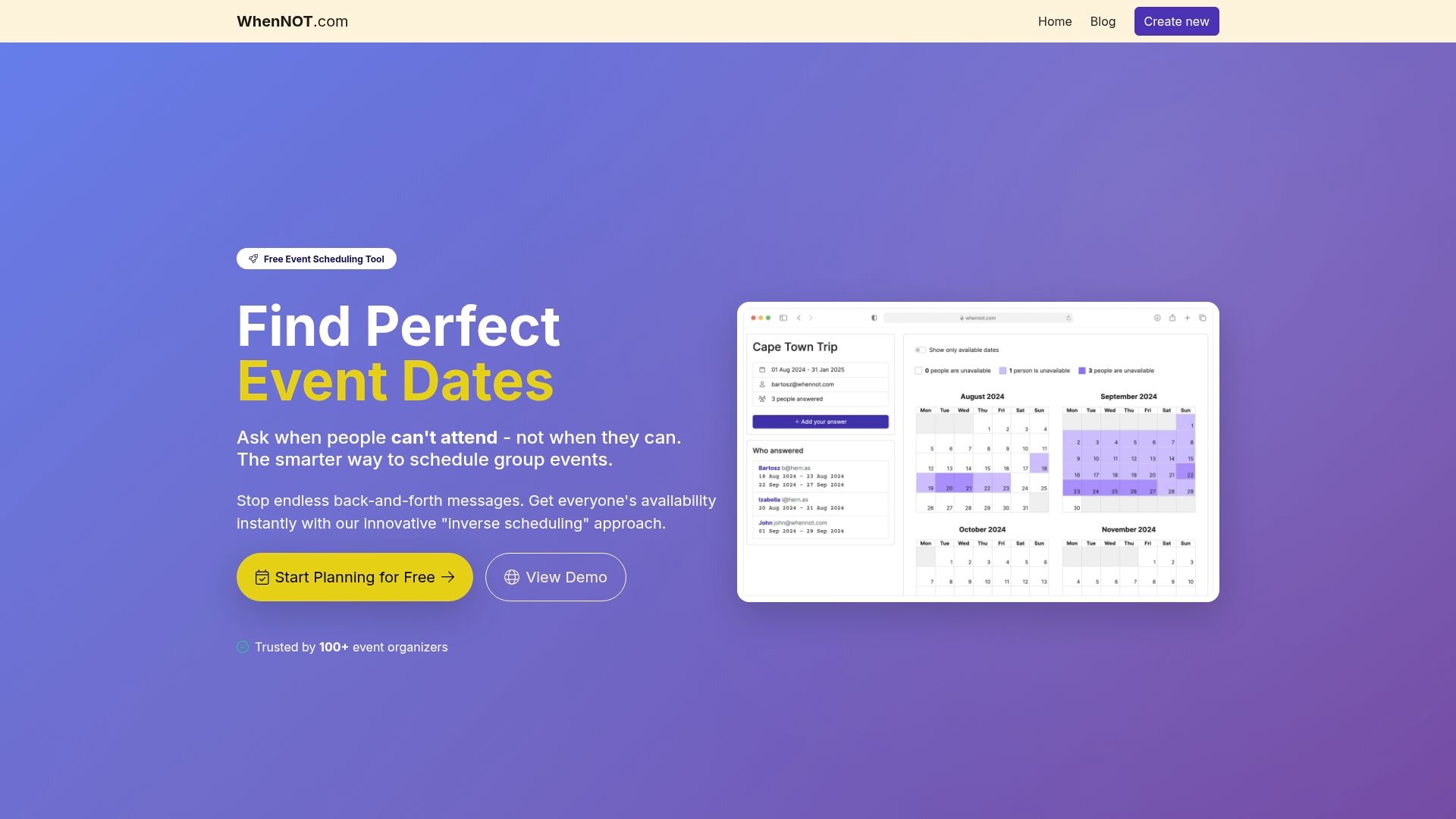
Discover how WhenNOT simplifies your group scheduling by allowing participants to mark unavailable dates without requiring accounts or complicated setups. Whether planning a family gathering, corporate retreat, or group travel event, WhenNOT's visual and intuitive platform helps you quickly identify the best dates with minimal effort. Start saving time and ending scheduling frustrations today by visiting WhenNOT and experience hassle-free scheduling that respects everyone's time and preferences.
Frequently Asked Questions
What is hassle-free scheduling?
Hassle-free scheduling is an innovative approach that simplifies the process of coordinating group events by minimizing traditional planning complexities, allowing participants to indicate their unavailable times instead of their available ones.
How does inverse scheduling work?
Inverse scheduling flips conventional scheduling methods by focusing on identifying when participants are unavailable, which reduces complexity and enhances the efficiency of group event planning.
What are the benefits of hassle-free scheduling for group coordination?
Hassle-free scheduling saves time, minimizes communication overhead, reduces cognitive load for participants, and leads to faster decision-making, ultimately transforming scheduling into a more efficient process.
How does privacy factor into hassle-free scheduling solutions?
Privacy is crucial in hassle-free scheduling, as effective solutions prioritize minimal data collection, no mandatory account registration, and user control over shared information to ensure a secure environment for participants.