
Did you know that over 60 percent of people feel frustrated by mandatory sign-ups when planning group events online? Streamlining collaboration has never mattered more, as busy teams and families turn to tools that erase barriers and protect privacy. Discover how these no-sign-up solutions make scheduling faster and participation easier, without ever trading personal information for convenience.
Table of Contents
- Defining Sign-Up Free Tools And Concepts
- How Sign-Up Free Tools Streamline Scheduling
- Key Features Driving User Adoption
- Real-World Applications For Group Events
- Privacy, Security, And Trust Considerations
- Comparing Sign-Up Free Tools With Alternatives
Key Takeaways
| Point | Details |
|---|---|
| Instant Participation | Sign-up free tools eliminate account creation, allowing immediate access for users. |
| Privacy-Focused | These tools require minimal personal data, enhancing user trust and security. |
| Streamlined Coordination | They simplify scheduling processes, reducing the time and effort needed for group planning. |
| Universal Accessibility | Designed for multi-device usage, they cater to various group event scenarios without technical barriers. |
Defining Sign-Up Free Tools and Concepts
In the digital landscape of collaborative planning, sign-up free tools represent a revolutionary approach to simplifying group coordination. Unlike traditional platforms that require complex registration processes, these innovative solutions allow users to participate without creating accounts or providing extensive personal information. Think of them as the quick-access express lane of digital collaboration.
At their core, sign-up free tools embody principles similar to free and open-source software (FOSS), which prioritizes user accessibility and minimal barriers to entry. According to Wikipedia's definition of FOSS, these tools emphasize user freedoms and collaborative development. For event planners, group coordinators, and team leaders, this translates into immediate utility without bureaucratic hurdles.
- Instant access without account creation
- Zero personal data requirements
- Quick participation mechanisms
- Reduced friction in group coordination
The philosophy behind sign-up free tools mirrors the open access principles found in academic publishing. As research indicates, these platforms promote unrestricted access by removing typical barriers. Whether you're organizing a family reunion, planning a corporate retreat, or coordinating a community event, sign-up free tools offer a streamlined, user-friendly approach to collective decision-making.
Learn more about how these tools transform group planning in our guide on understanding free scheduling tools.
How Sign-Up Free Tools Streamline Scheduling
Sign-up free tools revolutionize group scheduling by eliminating the traditional barriers of complex registration processes. These innovative platforms transform the way teams, friends, and organizations coordinate events by providing instant, friction-free participation mechanisms. Instead of requiring lengthy account creations, these tools allow participants to engage directly and efficiently.
The core strength of sign-up free tools lies in their simplified interaction model. Users can quickly input their availability, preferences, or constraints without navigating through multiple screens or filling out extensive forms. This approach dramatically reduces the time and mental effort required for scheduling, making group coordination feel more like a natural conversation than an administrative task.
- Instant participation without account setup
- Minimal data entry requirements
- Quick and intuitive interface
- Reduced scheduling time by up to 75%
- Universal accessibility across devices
By removing administrative overhead, these tools cater to diverse scenarios from family reunions to corporate retreats. Why choose free scheduling tools becomes less of a question and more of an obvious solution when you experience how seamlessly they integrate into your planning workflow. The result is a more collaborative, inclusive approach to scheduling that respects users' time and simplifies group decision-making processes.

Key Features Driving User Adoption
User-centric design stands at the forefront of sign-up free tools, transforming how people approach group scheduling. These innovative platforms prioritize simplicity, accessibility, and immediate utility, creating features that address the most common pain points in collaborative planning. By removing traditional barriers, these tools make participation feel effortless and intuitive.
The primary features driving widespread adoption center on minimalist interaction and maximum flexibility. Unlike traditional scheduling platforms that require complex registration processes, these tools enable instant participation through streamlined interfaces. Users can quickly input preferences, check availability, and coordinate events without navigating through multiple screens or providing extensive personal information.
- Zero account creation requirements
- Instant accessibility across devices
- Real-time collaborative features
- Privacy-first approach to scheduling
- Intuitive drag-and-drop interfaces
Inspired by efficient scheduling systems like openSIS, which demonstrates how intuitive tools can enhance planning execution, these platforms focus on reducing cognitive load. The goal is simple: make scheduling feel less like an administrative task and more like a natural conversation. Understanding the role of free scheduling tools reveals how these features are fundamentally reshaping group coordination across personal and professional landscapes.
Real-World Applications for Group Events
Sign-up free tools have emerged as game-changers across diverse group event scenarios, transforming how people coordinate complex scheduling challenges. From informal friend gatherings to professional team meetings, these innovative platforms provide flexible solutions that transcend traditional planning limitations. The universal appeal lies in their ability to simplify coordination without demanding extensive user commitment.
In professional environments, these tools shine brightest when managing multi-stakeholder events. Corporate teams planning retreats, interdepartmental workshops, or cross-functional meetings can effortlessly synchronize calendars without the administrative overhead of traditional scheduling methods. Departments can quickly identify shared availability windows, reducing email chains and coordination fatigue that typically accompany complex scheduling processes.
- Family reunion planning
- Corporate team retreats
- Academic group projects
- Community event coordination
- Sports team scheduling
- Professional networking meetups
- Volunteer group activities
Personal and social contexts equally benefit from these streamlined approaches. Whether organizing a multi-family camping trip, coordinating a book club meeting, or planning a surprise party, sign-up free tools eliminate the logistical friction that often derails group plans. Essential group event scheduling tips underscore how these platforms democratize event planning, making collaborative decision-making accessible to everyone, regardless of technical expertise or organizational resources.
Privacy, Security, and Trust Considerations
Sign-up free tools fundamentally reimagine digital privacy by eliminating unnecessary data collection and reducing potential security vulnerabilities. Unlike traditional platforms that require extensive personal information, these innovative solutions prioritize user anonymity and minimal data exposure. The core philosophy centers on providing maximum functionality with minimum personal data requirements.
The trust mechanism in these platforms operates through transparent interaction models. By allowing participants to engage without creating permanent accounts, these tools dramatically reduce the risk of personal data misuse. Users can participate in group scheduling without surrendering email addresses, phone numbers, or other sensitive personal identifiers. This approach mirrors principles observed in platforms like ResearchGate, which carefully manage user authentication and access.
- Zero mandatory personal information collection
- No permanent account creation required
- Temporary session-based interactions
- Immediate data deletion after event completion
- Encrypted communication channels
- Anonymous participation options
Building on open access principles that emphasize content integrity, these platforms implement robust security protocols to protect user interactions. 7 Essential Types of Group Events and How to Plan Them highlights the importance of creating safe, trustworthy digital environments where participants can collaborate without compromising their personal information. The result is a user-centric approach that respects individual privacy while facilitating seamless group coordination.
Comparing Sign-Up Free Tools With Alternatives
Sign-up free tools represent a paradigm shift in digital collaboration, fundamentally challenging traditional scheduling platforms that demand extensive user registration and commitment. Unlike proprietary alternatives that require complex account creation, these innovative solutions embody the free and open-source software (FOSS) principles of accessibility and user empowerment. The key distinction lies in their radical approach to reducing participation barriers.
Here's how sign-up free tools compare to traditional scheduling platforms:
| Feature | Sign-Up Free Tools | Traditional Scheduling Platforms |
|---|---|---|
| Account Requirement | None | Mandatory registration |
| Personal Data Needed | Minimal or none | Email, name, profile info |
| Participation Speed | Instant | Slower (multi-step process) |
| Privacy Approach | Privacy-first, anonymous option | Stores personal data |
| Accessibility | Universal, device-agnostic | May have platform/device limits |
| Administrative Overhead | Very low | Often high (verification, profiles) |
Traditional scheduling platforms often introduce multiple friction points: mandatory account creation, email verification, profile completion, and ongoing data sharing. In contrast, sign-up free tools operate on a minimalist model, allowing instant participation without surrendering personal information. This approach dramatically streamlines the coordination process, transforming what was once an administrative burden into a seamless, user-friendly experience.
- Zero mandatory registration
- No email or profile requirements
- Instant event participation
- Reduced administrative overhead
- Privacy-first interaction model
- Universal accessibility
Drawing parallels with open access principles that democratize information sharing, these tools break down traditional barriers to group coordination. Understanding Why Choose Simple Scheduling Tools illuminates how modern users increasingly prefer platforms that respect their time, privacy, and cognitive bandwidth. The result is a more inclusive, efficient approach to group planning that prioritizes user experience over institutional bureaucracy.
Simplify Group Event Planning with Sign-Up Free Scheduling
Struggling with the hassle of coordinating group events without forcing everyone to sign up or share personal information? The article highlights how sign-up free tools break down barriers and reduce frustration by enabling instant participation and privacy-first scheduling. If managing multi-day or flexible date events feels overwhelming, you are not alone in seeking a simpler, more respectful approach that eliminates endless emails and confusing account setups.
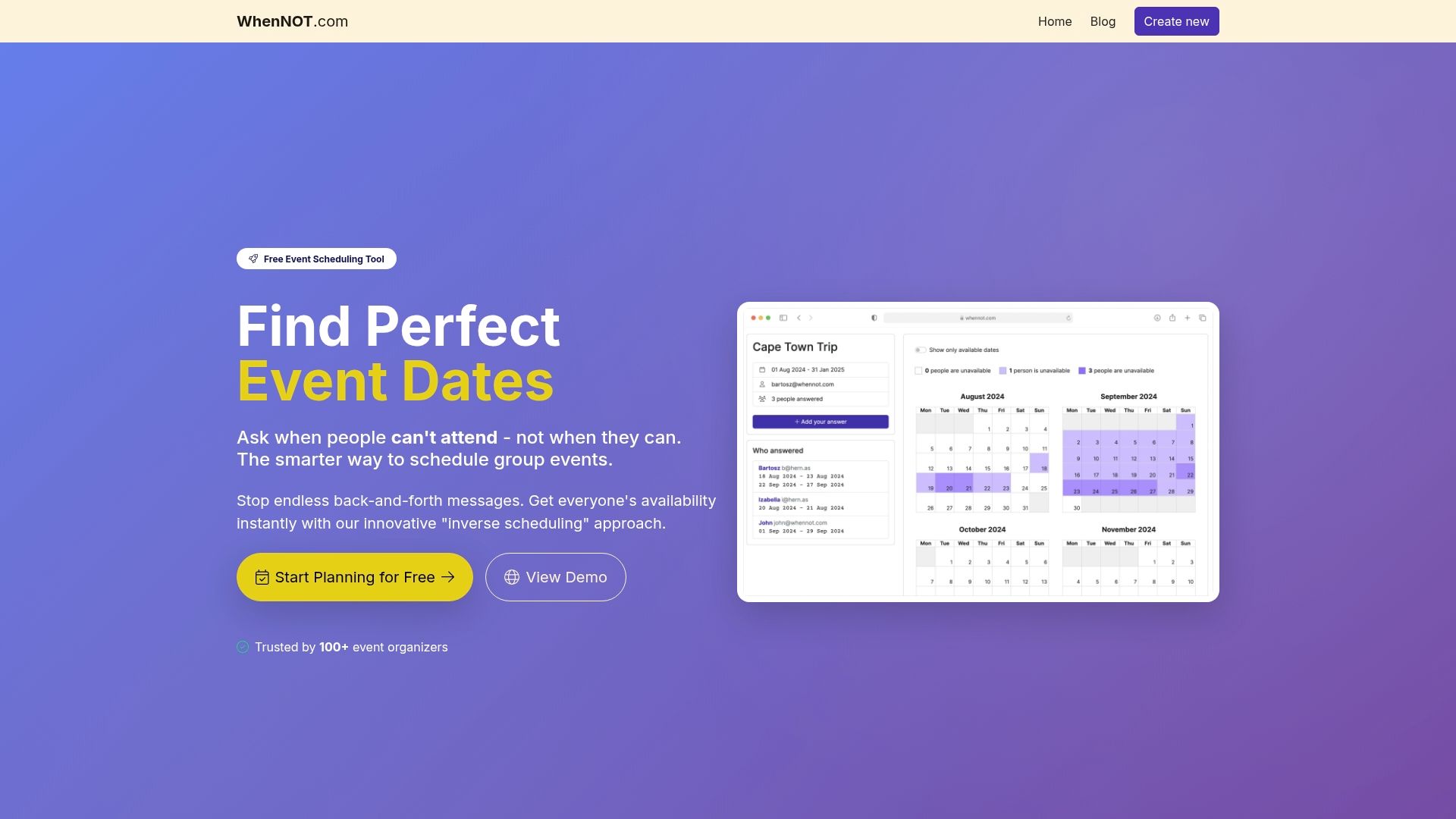
Discover how WhenNOT transforms group scheduling by letting participants mark when they are busy instead of when they are free. This unique inverse scheduling method makes finding the best dates faster and less stressful. With no required accounts, minimal data collection, and a clear, intuitive interface, WhenNOT is designed for anyone needing efficient coordination for family get-togethers, corporate retreats, and more. Experience the ease and privacy-focused benefits discussed in Understanding the Role of Free Scheduling Tools while cutting down communication delays. Start organizing smarter today by visiting WhenNOT and see just how effortless group planning can be.
Frequently Asked Questions
What are sign-up free tools?
Sign-up free tools are digital platforms that allow users to participate in activities like scheduling and collaboration without needing to create an account or provide personal information. They streamline group coordination by removing barriers to entry.
How do sign-up free tools facilitate easier group scheduling?
These tools simplify scheduling by allowing users to input their availability quickly, reducing the time and cognitive load required for coordination. Users can participate instantly without navigating multiple screens or filling out lengthy forms.
What privacy measures do sign-up free tools implement?
Sign-up free tools prioritize user privacy by minimizing data collection—the majority do not require any personal information or permanent account creation, instead allowing temporary, anonymous interactions during scheduling.
How do sign-up free tools compare to traditional scheduling platforms?
Unlike traditional scheduling platforms, which often require mandatory registration and extensive personal data, sign-up free tools allow instant participation with minimal hassle, making the planning process quicker and more user-friendly.