
Coordinating a multi-day retreat or global meeting often turns into a web of emails, login prompts, and scheduling delays that frustrate even the most seasoned corporate event planners. These common hurdles highlight why easy access and user privacy matter in gathering busy teams across countries and time zones. Discover how no-signup scheduling tools offer instant, hassle-free coordination by skipping traditional account setups, making your event planning simpler and more secure.
Table of Contents
- What Are No-Signup Tools and How They Work
- Types of No-Signup Tools for Scheduling
- Key Benefits: Simplicity, Speed, and Accessibility
- Privacy and Data Security Without Account Creation
- Comparing No-Signup Versus Traditional Scheduling Methods
Key Takeaways
| Point | Details |
|---|---|
| No-Signup Tools Simplify Scheduling | These platforms allow users to coordinate events without creating accounts, streamlining the scheduling process. |
| Enhanced Privacy Protection | Minimal data collection ensures participants can engage anonymously, reducing privacy risks. |
| Quick and Easy Access | Users can generate shareable scheduling links instantly, facilitating faster coordination. |
| Diverse Tool Options Available | Various no-signup tools cater to different scheduling needs, enhancing flexibility for users. |
What Are No-Signup Tools and How They Work
No-signup tools are digital platforms that enable group scheduling and event coordination without requiring participants to create user accounts or provide extensive personal information. These innovative scheduling solutions simplify collaboration by removing traditional registration barriers.
The core mechanism of no-signup tools involves generating unique, shareable links that allow immediate access to scheduling interfaces. Efficient scheduling platforms operate through simple, intuitive processes that prioritize user convenience and privacy.
Here's how no-signup tools typically function:
- Generate a unique event link without user registration
- Allow participants to input availability directly
- Provide instant visibility into group scheduling options
- Protect user privacy by minimizing data collection
- Enable quick coordination across multiple participants
These tools work by creating temporary, anonymous interaction spaces where people can collaborate without the friction of account creation. Participants simply click a shared link, input their preferences, and view collective scheduling insights.
Key advantages of no-signup scheduling platforms include reduced onboarding complexity, faster coordination, and enhanced privacy protection. By eliminating account creation requirements, these tools dramatically streamline group event planning processes.
Pro tip: When using no-signup scheduling tools, always verify the link's security and expiration policy to ensure your event details remain protected.
Types of No-Signup Tools for Scheduling
No-signup scheduling tools represent a diverse ecosystem of digital solutions designed to simplify group coordination without traditional registration hurdles. Free scheduling platforms have evolved to offer multiple specialized approaches for different group planning scenarios.
The primary types of no-signup scheduling tools include:
- Availability Polls: Anonymous voting mechanisms that allow participants to indicate their preferred time slots
- Calendar Sharing Links: Lightweight interfaces enabling quick meeting coordination
- Anonymous Voting Platforms: Tools that collect preferences without capturing personal identifiers
- Instant Booking Links: One-click scheduling solutions with minimal information requirements
- Group Coordination Interfaces: Collaborative platforms prioritizing privacy and ease of use
These tools cater to different scheduling needs, from corporate team meetings to casual social event planning. By eliminating complex registration processes, they dramatically reduce friction in group coordination efforts.

Here's a quick comparison of no-signup scheduling tool types and their ideal use cases:
| Tool Type | Best For | Unique Advantage |
|---|---|---|
| Availability Polls | Gathering group time slots | Fast collective input |
| Calendar Sharing Links | Small team meetings | Seamless calendar integration |
| Anonymous Voting Platforms | Private group choices | Maximum participant privacy |
| Instant Booking Links | Quick one-on-one meetings | Fastest appointment set-up |
| Group Coordination Interfaces | Large event planning | Advanced collaboration features |
Unique features distinguish different no-signup scheduling solutions. Some focus on minimalistic design, while others provide advanced visualization of collective availability. Group scheduling tools continue to innovate, developing increasingly user-friendly interfaces that protect participant privacy.
Key characteristics of effective no-signup scheduling platforms include instant accessibility, privacy protection, and streamlined user experience. These tools transform group scheduling from a complex administrative task into a simple, intuitive process.
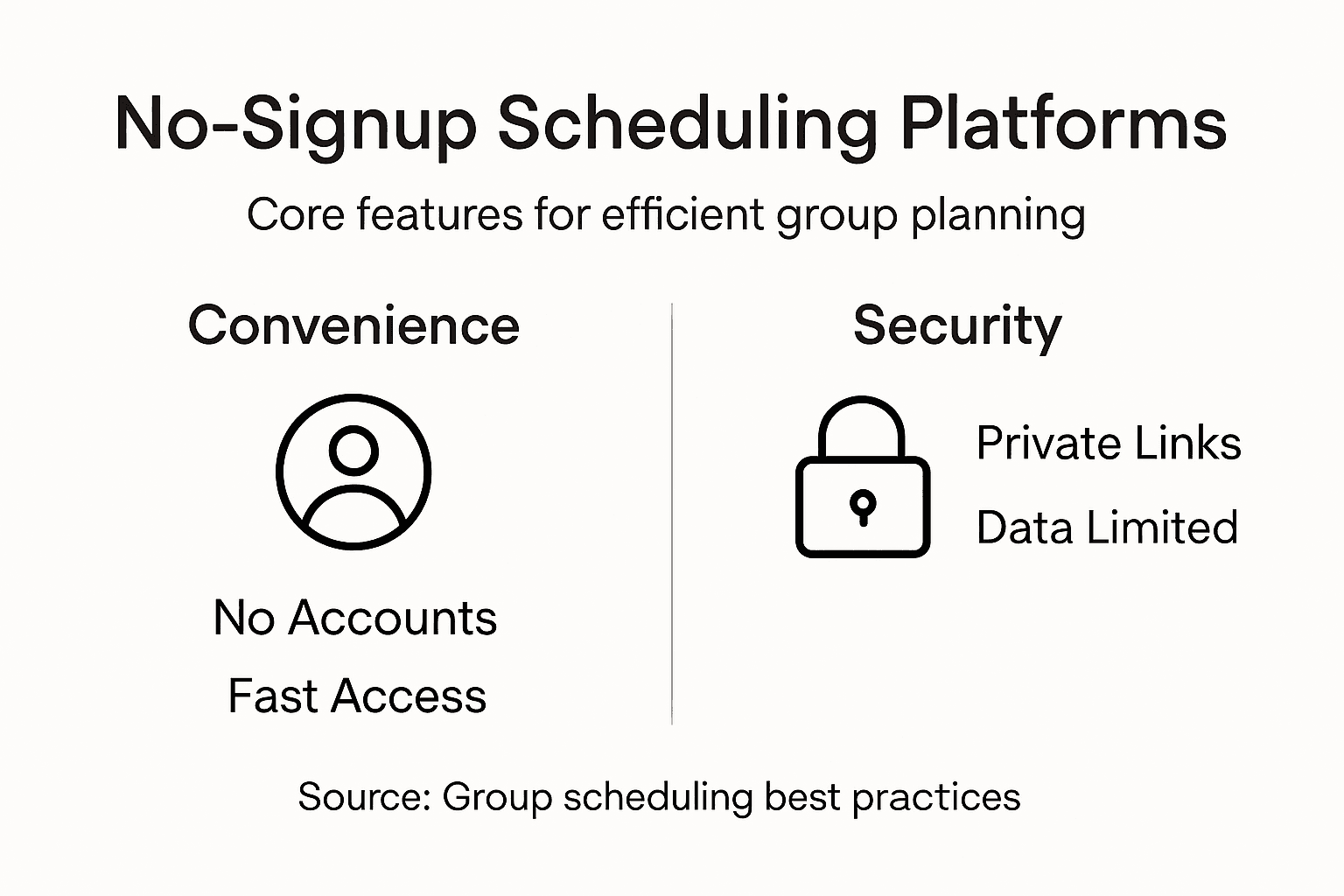
Pro tip: Select a no-signup scheduling tool that matches your specific coordination complexity and prioritizes participant privacy.
Key Benefits: Simplicity, Speed, and Accessibility
No-signup scheduling tools revolutionize group coordination by eliminating traditional barriers to efficient planning. Free scheduling solutions fundamentally transform how teams and individuals approach event management by prioritizing user experience.
The key benefits of these innovative platforms can be categorized into three critical dimensions:
- Simplicity: Minimal steps to create and share scheduling links
- Speed: Instant setup and real-time collaboration
- Accessibility: Universal device compatibility and inclusive design
- Privacy: Zero personal data collection requirements
- Flexibility: Adaptable to various group sizes and event types
These tools dramatically reduce the cognitive load associated with traditional scheduling methods. By removing login requirements and complex registration processes, scheduling tools enable participants to focus on coordinating effectively rather than navigating technical hurdles.
This table highlights key impacts of no-signup scheduling on event organization:
| Impact Area | No-Signup Tools Effect | Business Benefit |
|---|---|---|
| User Experience | Reduces complexity | Higher participant engagement |
| Onboarding Speed | Enables immediate scheduling | Shorter planning cycles |
| Data Protection | Limits shared information | Reduced privacy risk |
| Device Access | Universal compatibility | Consistent access for all users |
Rapid deployment is perhaps the most significant advantage of no-signup scheduling platforms. Users can generate a unique link within seconds, instantly share it across multiple communication channels, and begin collecting availability without requiring any participant to create an account or download additional software.
Efficiency isn't about doing more—it's about removing unnecessary complexity from collaborative processes.
Pro tip: Choose a no-signup scheduling tool that offers link customization and provides clear, intuitive interfaces for maximum participant engagement.
Privacy and Data Security Without Account Creation
No-signup tools fundamentally redefine digital privacy by eliminating traditional data collection methods. Privacy-focused scheduling solutions represent a revolutionary approach to protecting user information during group coordination.
The key privacy advantages of no-signup platforms include:
- Minimal Data Exposure: Zero personal information required
- Anonymous Participation: No email or account credentials needed
- Temporary Access: Links expire after event coordination
- Limited Server Storage: No persistent user data maintained
- Reduced Tracking: No user profiles or digital footprints created
These platforms transform data security by creating temporary interaction spaces that vanish after use. By scheduling tools avoiding traditional registration processes, users retain complete control over their personal information.
Privacy isn't a feature—it's a fundamental right in digital interactions.
Unlike conventional scheduling platforms, no-signup tools generate unique, time-limited links that provide momentary access without permanent data retention. This approach significantly minimizes potential security vulnerabilities associated with traditional account-based systems.
Pro tip: Always verify the data deletion policies of no-signup tools to ensure complete privacy protection during group scheduling.
Comparing No-Signup Versus Traditional Scheduling Methods
Digital scheduling platforms have significantly evolved, presenting two distinct approaches to group coordination. Scheduling tool comparisons reveal critical differences between traditional account-based systems and modern no-signup solutions.
Key comparative aspects between these scheduling methods include:
- User Onboarding: - Traditional: Complex registration process
- No-Signup: Instant access
- Privacy Protection:
- Traditional: Extensive data collection
- No-Signup: Minimal personal information
- Time Investment:
- Traditional: Lengthy setup
- No-Signup: Immediate coordination
- Participant Friction:
- Traditional: Multiple barriers to entry
- No-Signup: Seamless participation
- Data Security:
- Traditional: Persistent user profiles
- No-Signup: Temporary, ephemeral interactions
Scheduling methods demonstrate that no-signup tools prioritize user convenience and privacy over complex feature sets. Traditional platforms often require extensive personal information, creating unnecessary friction in group coordination processes.
Simplicity in scheduling isn't about fewer features—it's about removing unnecessary complexity.
Technological evolution continues to push scheduling platforms toward more user-centric designs. No-signup tools represent a paradigm shift, challenging long-standing assumptions about user authentication and data management in collaborative environments.
Pro tip: Select scheduling tools that balance ease of use with the specific collaborative needs of your group.
Discover Effortless Group Scheduling with WhenNOT
The article highlights key challenges in group scheduling such as reducing participant friction, ensuring privacy, and speeding up event coordination without requiring account creation. Many users struggle with traditional tools that demand time-consuming signups and complicated availability inputs. WhenNOT addresses these pain points by offering a no-signup scheduling solution that focuses on simplicity and privacy, perfectly aligning with the concepts of "no-signup tools" discussed.
With WhenNOT, you set the potential date range and share a unique link where participants mark only their unavailable dates. This inverse scheduling method visualizes everyone's busy days concurrently, eliminating confusion and accelerating decision-making. Its commitment to privacy protection and instant accessibility ensures that your group coordination is both secure and fast. Experience an intuitive approach suited for family gatherings, corporate planning, or group travel.
Take control of your scheduling challenges today. Explore how no-signup scheduling tools can be more effective with WhenNOT’s innovative platform.
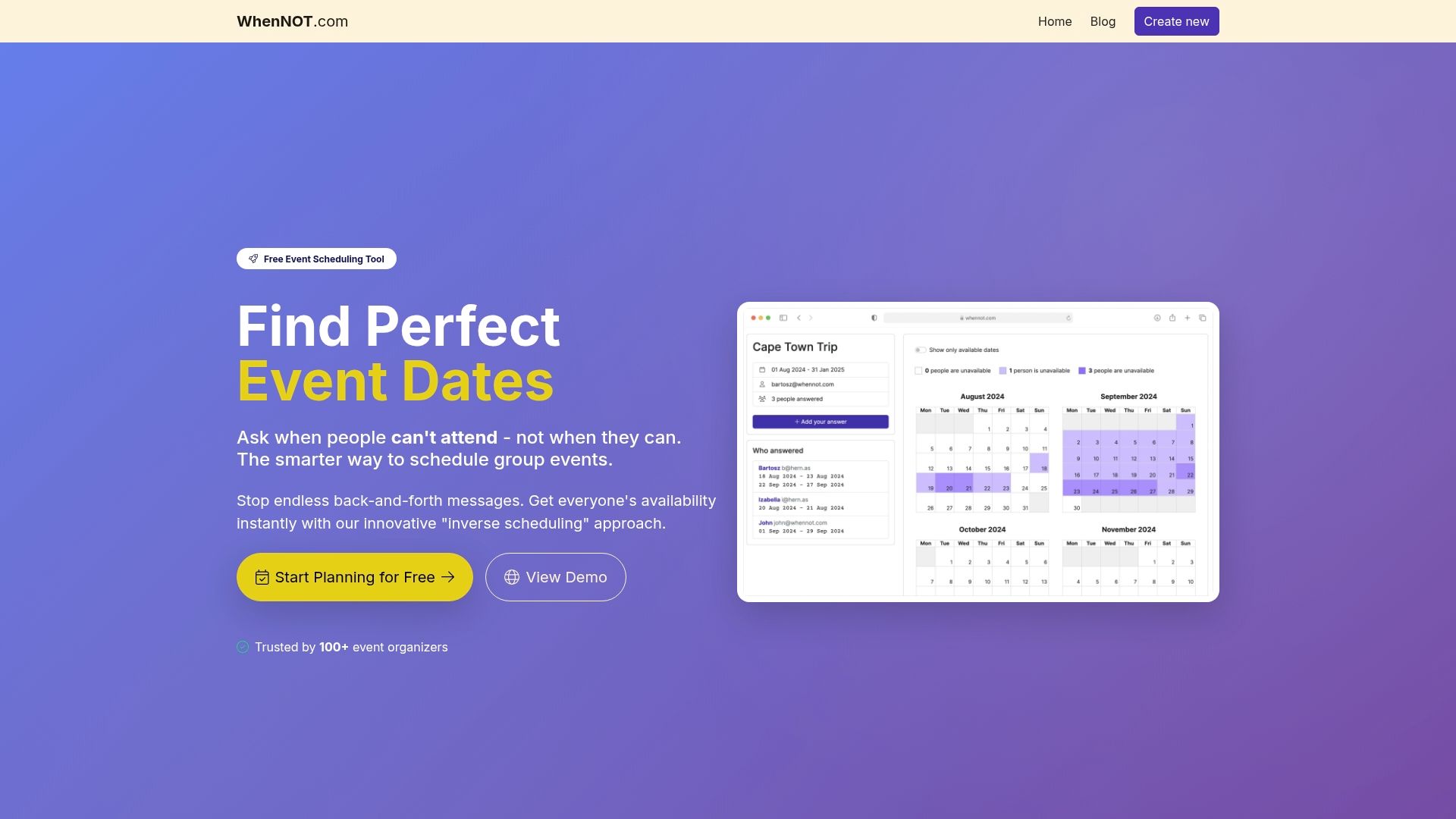
Ready to simplify your event planning without compromising privacy or speed? Visit WhenNOT now to create your first event and share hassle-free scheduling links with your group instantly.
Frequently Asked Questions
What are no-signup tools for scheduling?
No-signup tools are digital platforms that allow for group scheduling and event coordination without requiring users to create accounts or provide personal information. They use unique shareable links for easy access and collaboration.
How do no-signup scheduling tools work?
These tools generate a unique event link that participants can click on to input their availability directly, allowing for quick visibility into group scheduling options without the need for registration.
What are the benefits of using no-signup tools for scheduling?
The benefits include simplicity in creating and sharing scheduling links, speed in gathering participant availability, accessibility across devices, and enhanced privacy protection due to minimal data collection requirements.
How do no-signup tools protect user privacy?
No-signup tools minimize data exposure by not requiring personal information for participation. They also use temporary, unique links for access that expire after event coordination, ensuring that no permanent user data is stored or tracked.