
Coordinating a multi-day retreat across a busy American or Canadian team can quickly turn into a maze of calendar invites and endless email threads. Managing shifting priorities and gathering team availability often leads to wasted time and lowered motivation. By adopting systematic planning supported by collaborative scheduling tools, team leaders gain back valuable hours, reduce confusion, and ensure every participant stays engaged throughout your retreat.
Table of Contents
- Defining Streamlined Scheduling For Teams
- Scheduling Variations And Inverse Approaches
- How Streamlined Tools Enhance Retreat Planning
- Impact On Team Engagement And Collaboration
- Reducing Time And Communication Delays
- Comparing Streamlined Versus Traditional Scheduling
Key Takeaways
| Point | Details |
|---|---|
| Streamlined Scheduling Enhances Productivity | Implementing collaborative scheduling tools reduces administrative overhead and fosters team engagement by providing real-time visibility into member availability. |
| Adaptive Scheduling Techniques | Inverse scheduling allows teams to prioritize objectives first, promoting flexibility and responsiveness in planning activities. |
| Holistic Approach Required | Successful scheduling implementations depend on clear communication protocols and consistent practices among team members for shared understanding. |
| Transition from Traditional to Streamlined | Organizations should pilot streamlined scheduling with small teams before full-scale implementation to ensure effective integration into existing workflows. |
Defining Streamlined Scheduling for Teams
Streamlined scheduling represents a strategic approach to team time management that goes beyond traditional calendar coordination. At its core, it involves systematic planning that minimizes administrative overhead while maximizing team productivity and collaboration. High-performing teams leverage scheduling techniques that create clarity around roles, timelines, and shared objectives.
The key components of streamlined scheduling include:
- Reducing communication complexity
- Establishing transparent availability windows
- Minimizing scheduling conflicts
- Creating unified time management practices
- Enabling quick decision-making
Modern streamlined scheduling incorporates technology to simplify these processes. Collaborative scheduling tools help teams transcend traditional barriers by providing real-time visibility into team members' availability. Innovative scheduling approaches now focus on reducing back-and-forth communications and enhancing calendar synchronization across diverse work environments.
Successful implementation requires more than just technological solutions. Teams must develop a shared understanding of scheduling protocols, establish clear communication norms, and commit to consistent practices. This involves creating predictable meeting rhythms, defining response expectations, and using tools that integrate seamlessly with existing workflow systems.
Pro tip: Implement a 15-minute weekly team sync to proactively discuss and align scheduling priorities, reducing potential conflicts before they emerge.
Scheduling Variations and Inverse Approaches
Scheduling methodologies have evolved significantly beyond traditional linear approaches, introducing sophisticated techniques that adapt to modern team dynamics. Inverse scheduling represents a cutting-edge strategy that fundamentally reimagines how teams allocate time and resources. Complex scheduling approaches now prioritize outcomes and constraints first, allowing for more flexible and responsive planning.
The primary scheduling variations include:
- Traditional fixed scheduling
- Dynamic scheduling
- Inverse scheduling
- Constraint-based scheduling
- Outcome-driven scheduling
Inverse scheduling distinguishes itself by flipping conventional planning models. Instead of starting with available time slots, teams begin by defining critical objectives and working backward to identify optimal scheduling windows. This approach proves particularly effective in environments with complex dependencies, such as project management, academic research, and collaborative team settings.
Successful implementation of inverse scheduling requires a sophisticated understanding of team dynamics and technological support. Teams must develop robust communication protocols, leverage advanced scheduling tools, and maintain a flexible mindset that prioritizes collective goals over rigid time allocations. By embracing these adaptive scheduling techniques, organizations can create more resilient and responsive workflow systems.
Pro tip: Conduct quarterly scheduling audits to reassess and realign your team's scheduling approach, ensuring continued effectiveness and adaptability.
How Streamlined Tools Enhance Retreat Planning
Modern retreat planning demands sophisticated technological solutions that transform complex logistical challenges into seamless experiences. Collaborative platforms have revolutionized how corporate teams coordinate multi-day events, dramatically reducing administrative overhead and communication friction. Integrated project management tools now enable teams to centralize scheduling, resource allocation, and participant communication with unprecedented efficiency.
Key benefits of streamlined planning tools include:
- Real-time collaboration and communication
- Centralized document and resource sharing
- Transparent task and deadline tracking
- Automated scheduling and reminder systems
- Simplified participant coordination
Successful retreat planning tools go beyond simple scheduling. They create comprehensive ecosystems that support every stage of event preparation, from initial brainstorming to post-event follow-up. Advanced platforms provide visualization tools that help teams understand complex scheduling dynamics, identify potential conflicts, and make data-driven decisions about retreat logistics.

The most effective tools integrate multiple functionalities, allowing teams to move beyond traditional linear planning. They support dynamic adjustments, enable quick communication, and provide insights that help teams optimize their retreat experiences. By leveraging technology, organizations can transform retreat planning from a logistical challenge into a strategic opportunity for team building and alignment.
The following table highlights how popular scheduling tools support modern team needs:
| Tool Feature | Impact on Team Productivity | Integration Potential |
|---|---|---|
| Real-time availability | Faster meeting coordination | Syncs with major calendars |
| Automated reminders | Reduces missed appointments | Connects to workflow tools |
| Centralized schedule access | Fewer communication errors | Integrates with cloud sharing |
| Visual schedule dashboards | Improves time allocation | Customizable for team needs |
Pro tip: Select scheduling tools that offer flexible integration capabilities, ensuring seamless communication across your existing workplace platforms.
Impact on Team Engagement and Collaboration
Streamlined scheduling transcends mere logistical coordination, emerging as a powerful catalyst for team engagement and collaborative success. Team performance fundamentally depends on clear communication channels and synchronized expectations, making effective scheduling a critical strategic tool for modern organizations.
Key engagement benefits include:
- Enhanced trust through transparent planning
- Reduced administrative friction
- Improved communication clarity
- Increased team accountability
- Greater psychological safety
Effective scheduling practices create a foundation of mutual understanding and respect among team members. By minimizing uncertainty and providing predictable collaboration frameworks, organizations can transform routine planning into an opportunity for building stronger interpersonal connections. Teams that leverage advanced scheduling tools report higher levels of motivation and collective responsibility, as members feel genuinely valued and strategically aligned.
The most significant impact emerges when scheduling becomes more than a mechanical process. It transforms into a dynamic communication strategy that reflects organizational culture, respects individual preferences, and creates space for meaningful interactions. Modern teams require flexible, intuitive scheduling approaches that recognize the human element of collaboration, moving beyond rigid time blocks to create genuine engagement opportunities.
Pro tip: Implement a quarterly scheduling review that includes team feedback, ensuring your scheduling approach evolves with your team's changing dynamics.
Reducing Time and Communication Delays
Modern organizations require sophisticated strategies to minimize scheduling friction and communication overhead. Automated scheduling software dramatically reduces administrative bottlenecks by eliminating manual coordination processes and providing real-time updates across teams. These technological solutions transform how organizations approach time management and collaborative planning.
Critical strategies for reducing communication delays include:
- Implementing centralized scheduling platforms
- Utilizing role-based access controls
- Establishing clear communication protocols
- Automating routine scheduling tasks
- Creating transparent availability tracking
Shared calendars with sophisticated access controls enable teams to update availability instantaneously, dramatically cutting down coordination time. By providing immediate visibility into team schedules, organizations can prevent prolonged email exchanges and reduce the complex back-and-forth typically associated with scheduling multiple participants. This approach not only saves time but also creates a more responsive and agile work environment.
The most effective communication reduction strategies go beyond simple technological solutions. They require a holistic approach that combines intuitive tools, clear organizational guidelines, and a culture of proactive communication. Successful teams develop streamlined processes that prioritize efficiency, respect individual schedules, and create seamless collaborative experiences.
Pro tip: Conduct a monthly audit of your scheduling processes to identify and eliminate communication bottlenecks before they become systemic problems.
Comparing Streamlined Versus Traditional Scheduling
The landscape of organizational planning has dramatically transformed with the emergence of streamlined scheduling methodologies. Advanced scheduling techniques fundamentally reshape how teams coordinate complex activities, moving far beyond rigid, linear planning approaches. Where traditional methods relied on manual input and fixed timelines, modern strategies leverage technology to create more adaptive, responsive workflows.
Key differences between streamlined and traditional scheduling include:
- Automation versus manual coordination
- Flexible versus rigid time allocation
- Real-time adaptability versus static planning
- Algorithm-driven versus hierarchical decision-making
- Transparent versus opaque scheduling processes
Traditional scheduling typically operates through hierarchical structures, where decisions flow from top management downward, creating potential bottlenecks and communication delays. In contrast, streamlined approaches empower teams with greater autonomy, enabling more independent decision-making while maintaining overall coordination. This shift represents a fundamental reimagining of how organizations approach time management and collaborative planning.
The most significant advantage of streamlined scheduling lies in its ability to integrate multifunctional team needs with adaptive workflows. By utilizing advanced optimization algorithms and centralized data platforms, these approaches reduce administrative overhead, minimize scheduling conflicts, and create more transparent, efficient organizational processes.
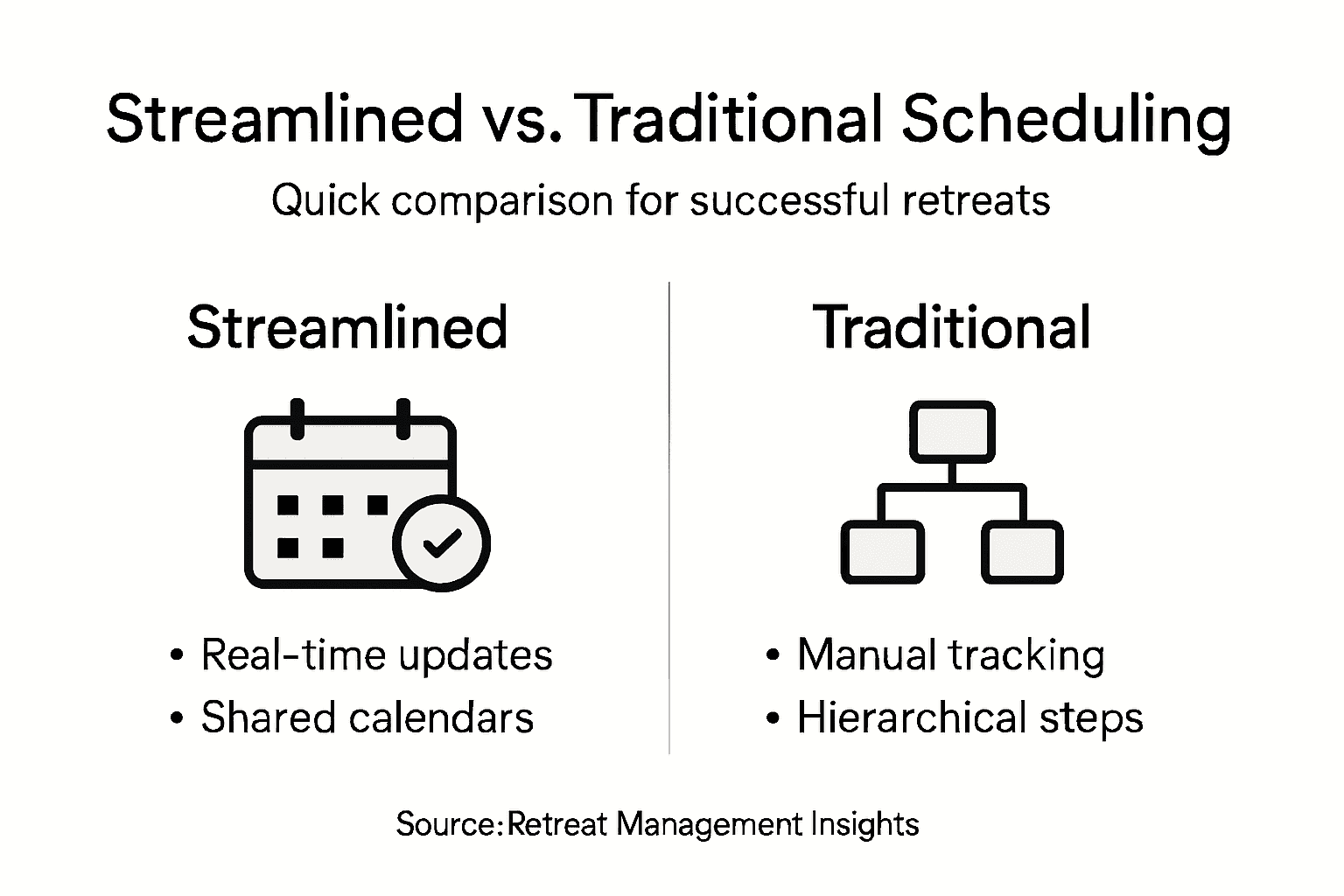
Here is a quick comparison of streamlined and traditional scheduling approaches:
| Aspect | Streamlined Scheduling | Traditional Scheduling |
|---|---|---|
| Decision-making | Team-empowered, decentralized | Top-down, management-driven |
| Adaptability | Rapid adjustments supported | Fixed plans, difficult to change |
| Use of Technology | Relies on automation and AI | Manual calendar management |
| Transparency | High visibility for all members | Limited access, less visible |
Pro tip: Gradually transition from traditional to streamlined scheduling by piloting new approaches with a small, adaptable team before organization-wide implementation.
Streamline Your Retreat Planning with WhenNOT
The article highlights how streamlined scheduling and inverse scheduling approaches are crucial for reducing communication delays and managing complex multi-day events effectively. If coordinating team availability, minimizing administrative hassle, and maintaining transparent scheduling feel overwhelming for your next retreat, you are not alone. Many organizers struggle with traditional methods that create scheduling conflicts and slow decision-making.
WhenNOT offers an innovative solution that aligns perfectly with these modern planning challenges. Instead of asking participants when they are available, WhenNOT reverses the process by collecting when participants are unavailable. This unique approach simplifies coordination for flexible and multi-day events, helping your team quickly identify optimal retreat dates with minimal back-and-forth communication and clear visualization of everyone’s busy days. Experience greater engagement, reduce friction, and confidently plan your retreat with fewer headaches by using WhenNOT’s easy and secure platform.
Ready to transform your retreat success with a smart, efficient scheduling tool that embraces the principles of streamlined and inverse scheduling? See how effortless it can be to gather team input and finalize dates without requiring signups or complicated steps. Explore WhenNOT online scheduling and bring clarity and simplicity to your next team event.
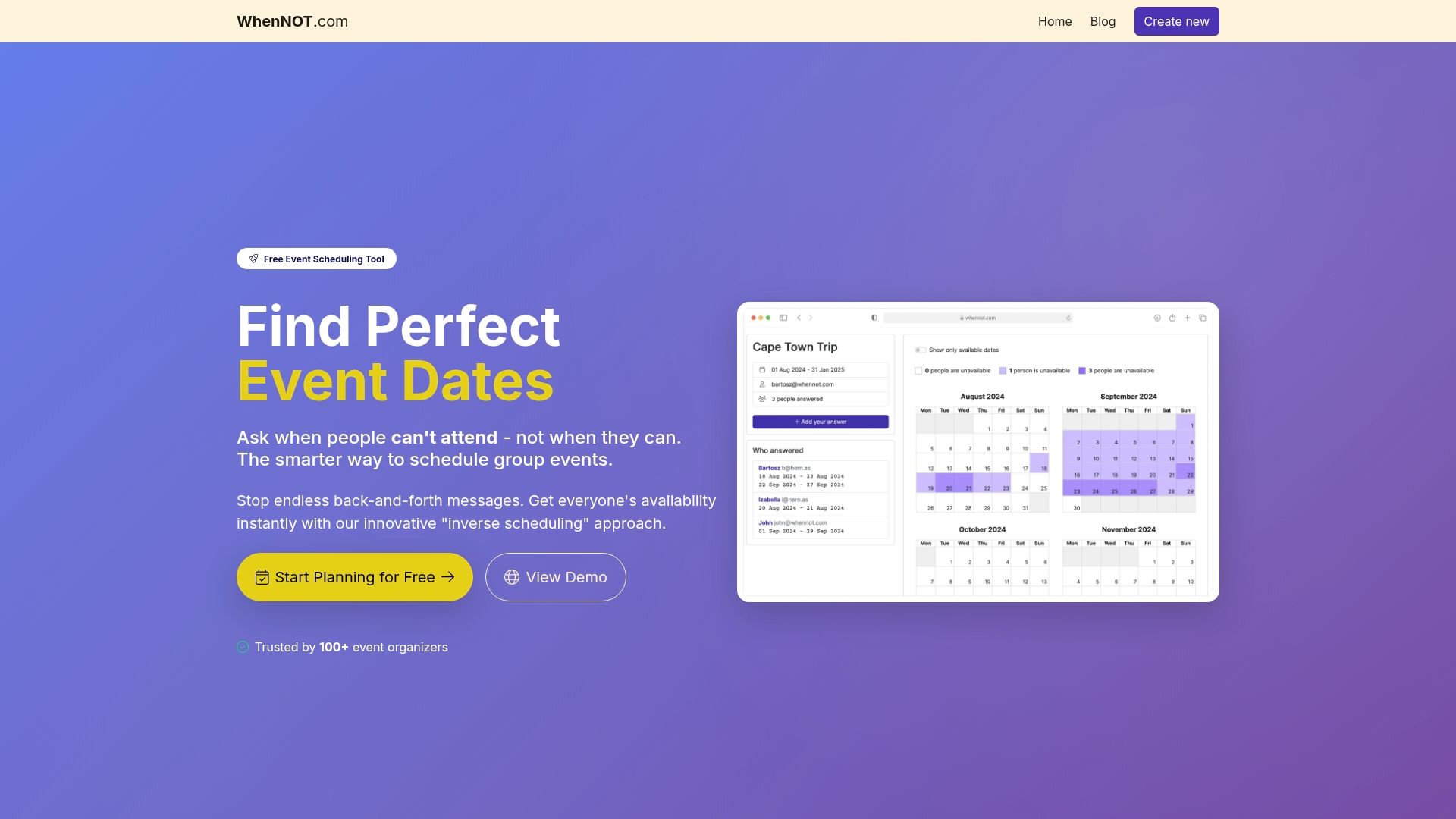
Take control of your team’s retreat planning today and unlock success through smarter scheduling. Visit WhenNOT now to get started and experience the advantage of effortless group coordination.
Frequently Asked Questions
What is streamlined scheduling?
Streamlined scheduling is a strategic approach to team time management that minimizes administrative overhead while maximizing productivity and collaboration. It involves systematic planning to create clarity around roles, timelines, and objectives.
How can technology support streamlined scheduling for retreats?
Technology enhances streamlined scheduling by providing collaborative platforms that enable real-time visibility into team members' availability, automate scheduling tasks, and centralize communication, significantly reducing logistical challenges during retreat planning.
What are the benefits of using collaborative scheduling tools?
Collaborative scheduling tools offer benefits such as real-time collaboration, centralized document sharing, transparent task tracking, automated reminders, and simplified participant coordination, leading to more efficient and effective retreat planning.
How does inverse scheduling differ from traditional scheduling methods?
Inverse scheduling flips traditional planning models by starting with defining critical objectives instead of available time slots. This allows for more flexible and responsive planning, particularly in complex environments that rely on project management and collaboration.