
Coordinating a team retreat often feels overwhelming when schedules clash, objectives remain fuzzy, or decisions drag on for weeks. It is easy for planning sessions to get lost in endless communication loops and unclear priorities. The right approach makes all the difference. With strategies that emphasize clear objectives and flexible coordination, you can transform group planning into a focused, productive experience. This guide will show you straightforward ways to align your team, minimize scheduling headaches, and create a retreat everyone is eager to attend. Prepare to discover practical methods that will upgrade every step of your planning process and help you lead your group with confidence.
Table of Contents
- 1. Setting Clear Objectives Before Group Planning
- 2. Using Inverse Scheduling For Flexible Date Coordination
- 3. Visualizing Team Availability To Minimize Overlaps
- 4. Simplifying Participation With Easy-To-Use Tools
- 5. Protecting Privacy During Group Scheduling
- 6. Maximizing Engagement Through Transparent Communication
- 7. Reviewing And Optimizing Past Planning Results
Quick Summary
| Takeaway | Explanation |
|---|---|
| 1. Set Specific Objectives | Establish precise goals using the SMART framework to align team activities and enhance outcomes. |
| 2. Use Inverse Scheduling | Focus on participant unavailability to simplify date coordination and quickly identify optimal scheduling windows. |
| 3. Visualize Team Availability | Implement visual tools that graphically represent team schedules to easily identify conflicts and optimal meeting times. |
| 4. Choose User-Friendly Tools | Select scheduling platforms that are intuitive and require minimal technical expertise for seamless participation. |
| 5. Prioritize Privacy | Ensure data protection by minimizing personal information collection and using secure scheduling tools for participant comfort. |
1. Setting Clear Objectives Before Group Planning
Successful team retreats start with crystal clear objectives that connect every activity to meaningful outcomes. By establishing precise goals upfront, you transform a standard gathering into a strategic opportunity for organizational alignment and team growth.
Defining objectives goes beyond simply listing generic wishes. It requires a deliberate process of identifying strategic priorities that drive real organizational impact. These objectives should address multiple dimensions: company vision, team dynamics, skill development, and strategic planning. Think of objectives as a roadmap that guides every discussion, activity, and interaction during the retreat.
To craft effective objectives, start by involving key stakeholders in brainstorming sessions. Ask critical questions: What specific challenges are we addressing? What skills do we want to develop? What strategic discussions must happen? These questions help create objectives that are not just aspirational but actionable and measurable.
Consider structuring your objectives using the SMART framework: Specific, Measurable, Achievable, Relevant, and Time-bound. This approach ensures your team retreat goals are concrete and trackable. For instance, instead of a vague objective like "improve teamwork," aim for "develop three cross functional collaboration strategies by end of retreat that can reduce interdepartmental communication gaps by 25%."
Key Areas to Define in Retreat Objectives: • Strategic alignment • Team skill enhancement • Communication improvement • Leadership development • Innovation and problem solving
Pro tip: Distribute a pre retreat survey to team members asking about their specific goals and challenges to ensure the objectives resonate with everyone's expectations and needs.
2. Using Inverse Scheduling for Flexible Date Coordination
Traditional scheduling approaches often create unnecessary complexity when coordinating team retreats. Inverse scheduling represents a revolutionary method that flips the standard coordination process by focusing on participant unavailability instead of availability.
With crowd-sourced scheduling techniques, teams can dramatically simplify the date selection process. Instead of asking participants when they are free, inverse scheduling prompts team members to indicate when they are not available. This approach reduces communication overhead and accelerates decision making.
The key advantage of inverse scheduling lies in its ability to quickly reveal optimal meeting windows. By mapping out everyone's blocked dates simultaneously, organizers can instantly identify the most compatible timeframes for the entire group. This method proves especially effective for multi day retreats where individual schedules might have complex constraints.
Benefits of Inverse Scheduling: • Reduces back and forth communication • Minimizes scheduling conflicts • Provides instant visual clarity of group availability • Saves significant time in coordination efforts • Empowers participants with flexible input methods
Practical Implementation Steps:
- Create a comprehensive list of potential retreat dates
- Share an inverse scheduling link with all participants
- Ask participants to mark their unavailable dates
- Identify the most open time windows
- Confirm final dates based on maximum group availability
Pro tip: Use digital tools that automatically aggregate unavailability data and generate visual scheduling insights to streamline the entire coordination process.
3. Visualizing Team Availability to Minimize Overlaps
Team retreats demand precision in scheduling that goes beyond simple calendar checking. Visualizing team availability transforms complex scheduling challenges into clear actionable insights that prevent potential conflicts.
Effective availability visualization provides an immediate snapshot of team schedules, allowing organizers to identify potential scheduling conflicts before they become problematic. By mapping out individual team member schedules graphically, you can quickly spot overlaps, gaps, and optimal meeting windows that might otherwise remain hidden.
The goal of visualization is not just tracking time but understanding team dynamics. Modern scheduling tools create color coded maps that instantly reveal when team members are available, partially available, or completely blocked. This approach reduces communication noise and accelerates decision making by presenting complex scheduling information in an intuitive format.
Key Visual Scheduling Elements: • Color coded availability zones • Clear time window indicators • Individual and collective schedule overlays • Quick conflict identification mechanisms • Transparent collaborative view
Visualization Strategies:
- Use digital tools with real time graphing
- Create transparent shared calendars
- Implement color coding for availability status
- Enable instant conflict detection
- Allow easy schedule adjustments
Pro tip: Select visualization tools that automatically highlight scheduling conflicts and provide drag and drop rescheduling capabilities to minimize manual coordination efforts.
4. Simplifying Participation with Easy-to-Use Tools
Group scheduling does not have to be complicated. Modern digital tools have transformed team retreat planning from a complex administrative task into a streamlined collaborative process.
The key to successful group participation is selecting online scheduling tools with intuitive interfaces that require minimal technical expertise. Effective tools eliminate barriers by providing simple user experiences that allow every team member to contribute easily regardless of their technological comfort level.
When evaluating scheduling solutions, prioritize platforms that offer seamless participation features. Look for tools with zero login requirements, mobile compatibility, and straightforward input methods. The most effective platforms allow participants to update their availability quickly without navigating complex interfaces or creating multiple accounts.
Essential Features for Participation Friendly Tools: • One click availability updates • Mobile responsive design • No account creation required • Clear visual scheduling interfaces • Automatic timezone conversion • Instant group synchronization
Participation Simplification Strategies:
- Select tools with minimal input requirements
- Ensure cross platform accessibility
- Prioritize visual scheduling interfaces
- Minimize technical complexity
- Support multiple device types
Pro tip: Choose scheduling platforms that offer preview links allowing participants to view and update availability without mandatory account registration or complex onboarding processes.
5. Protecting Privacy During Group Scheduling
Privacy is not an afterthought in group scheduling it is a fundamental requirement. Modern team retreats demand sophisticated approaches to protecting participant information while maintaining efficient coordination.
Understanding and implementing best practices for data protection ensures that your team retreat scheduling remains secure and respects individual privacy boundaries. This means minimizing data collection, controlling access, and maintaining transparency about how participant information will be used.
Effective privacy protection starts with intentional platform selection. Choose scheduling tools that inherently prioritize data security through features like anonymous participation options, encrypted communications, and minimal personal data requirements. The goal is creating an environment where team members feel comfortable sharing their availability without compromising personal information.
Key Privacy Protection Strategies: • Limit personally identifiable data collection • Use anonymous scheduling links • Encrypt participant communication • Enable granular access controls • Provide clear data usage policies • Offer opt out options • Delete unnecessary participant data
Privacy Implementation Steps:
- Select platforms with robust security features
- Create transparent data handling policies
- Minimize required participant information
- Implement secure sharing mechanisms
- Regularly audit data access protocols
Pro tip: Always provide participants with clear information about how their scheduling data will be used and stored, and offer simple mechanisms for them to review or delete their personal information.
6. Maximizing Engagement Through Transparent Communication
Team retreats thrive on open and honest communication that builds trust and creates a collaborative environment. Transparent communication is not just about sharing information it is about creating meaningful connections that drive team success.
Understanding organizational communication dynamics reveals how openness directly impacts team engagement and productivity. When team members feel informed and heard, they become more invested in collective goals and more willing to contribute actively during retreat planning and execution.
Transparent communication requires intentional strategies that go beyond simple information sharing. It involves creating safe spaces for dialogue, providing context for decisions, and ensuring every team member understands the broader objectives of the retreat. This approach transforms communication from a transactional process into a collaborative experience that builds mutual understanding and respect.
Key Transparent Communication Strategies: • Establish clear communication channels • Provide context for retreat objectives • Encourage open feedback mechanisms • Share decision making rationales • Create psychological safety • Practice active listening • Maintain consistent information flow
Communication Implementation Steps:
- Define clear communication protocols
- Create inclusive discussion forums
- Use multiple communication platforms
- Validate and acknowledge team input
- Follow up on discussed topics
Pro tip: Create a shared digital workspace where all retreat related communications and updates are transparently documented and easily accessible to all participants.
7. Reviewing and Optimizing Past Planning Results
Successful team retreats are not one time events but part of a continuous improvement cycle. By systematically reviewing and analyzing previous retreat experiences, organizations can create increasingly effective and meaningful group planning strategies.
Effective retrospectives help maintain team accountability and drive performance improvements. This process involves critically examining what worked well, identifying areas for enhancement, and developing actionable insights that can be applied to future retreat planning.
The review process goes beyond simple feedback collection. It requires a structured approach that captures nuanced insights from multiple perspectives, ensuring that every team member has an opportunity to contribute to future planning improvements. This comprehensive evaluation helps transform past challenges into strategic opportunities for growth.
Key Review and Optimization Strategies: • Collect comprehensive participant feedback • Analyze retreat objectives and outcomes • Identify successful and challenging elements • Document lessons learned • Create actionable improvement recommendations • Establish metrics for future retreat success • Implement iterative planning improvements
Retrospective Implementation Steps:
- Schedule a dedicated review session
- Use structured feedback templates
- Encourage honest and constructive input
- Prioritize actionable insights
- Develop clear improvement plans
Pro tip: Create a standardized retreat review template that captures both quantitative metrics and qualitative insights to ensure a comprehensive and actionable evaluation process.
Below is a comprehensive table summarizing the main strategies and methods discussed throughout the article.
| Key Topic | Description | Benefits/Outcomes |
|---|---|---|
| Setting Clear Objectives | Establish goals that are Specific, Measurable, Achievable, Relevant, and Time-bound (SMART). | Align team efforts with organizational priorities and achieve measurable retreat success. |
| Inverse Scheduling Method | Participants indicate unavailable dates to streamline scheduling. | Reduces scheduling conflicts and accelerates date selection. |
| Team Availability Visualization | Use tools for graphical schedule overlays and availability indicators. | Quickly spot scheduling conflicts, improving planning efficiency. |
| Utilizing User-Friendly Tools | Adopt intuitive scheduling solutions to simplify participation. | Enhances team involvement and reduces technical barriers. |
| Emphasizing Privacy in Planning | Implement methods to ensure participants' data security. | Fosters trust and compliance with data protection standards. |
| Transparent Communication | Create clear, open communication throughout planning stages. | Increases team engagement and shared understanding. |
| Reviewing Past Events | Conduct retrospectives to analyze and learn from past retreats. | Drives continuous improvement for future retreats. |
Streamline Your Team Retreat Planning with WhenNOT
Planning an effective team retreat requires clear objectives, precise scheduling, and seamless communication. This article highlights the challenges of coordinating multiple schedules, visualizing team availability, and protecting privacy—all critical to creating a productive retreat. WhenNOT understands these pain points and offers a smart solution using inverse scheduling to simplify date coordination. By focusing on when participants are not available instead of when they are, you can effortlessly identify the best dates without endless back and forth.
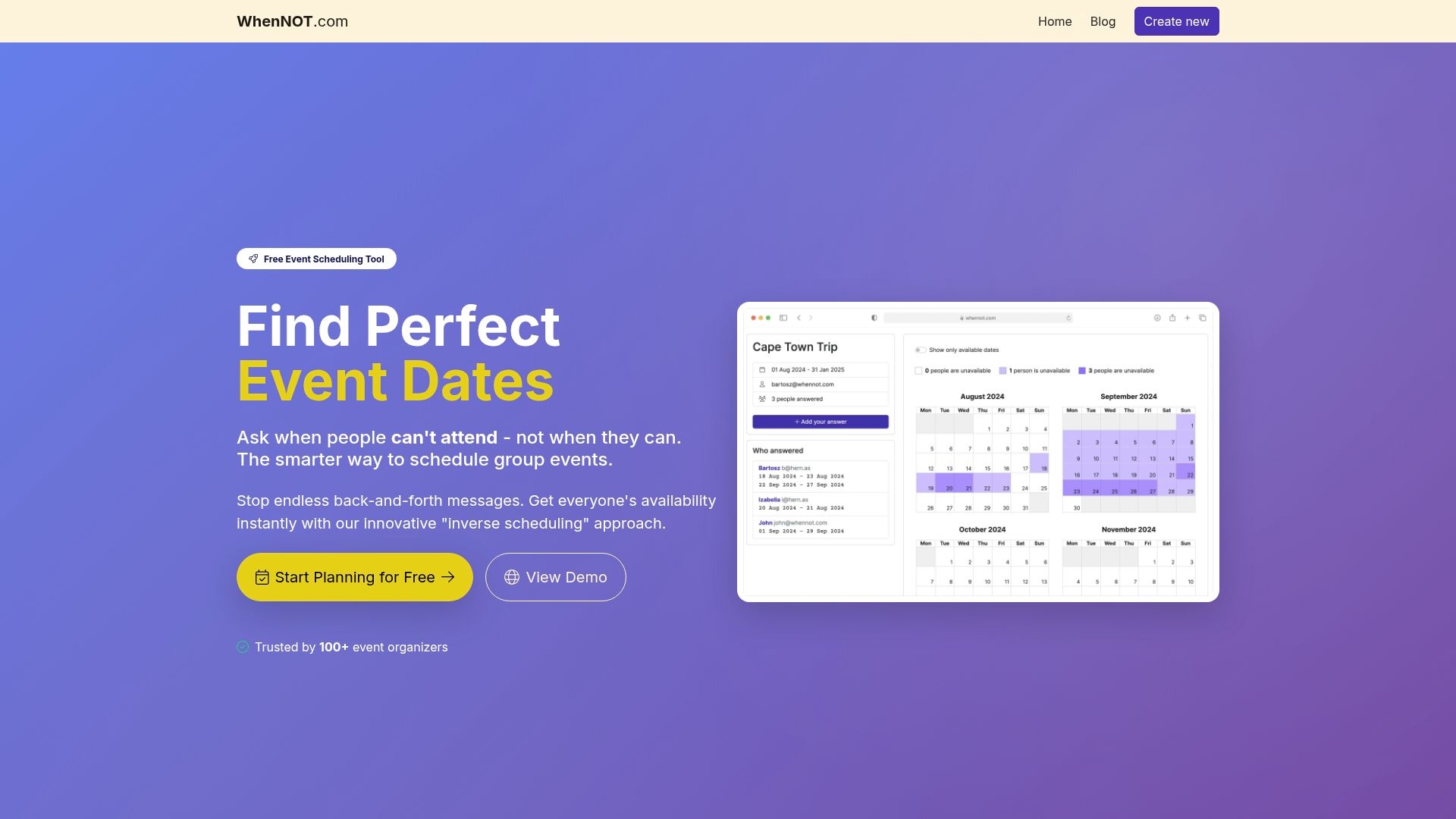
Discover how WhenNOT’s intuitive, privacy-focused platform can transform your group planning experience by reducing complexity, saving time, and maximizing engagement. Whether you are aligning strategic goals or scheduling multi-day retreats, start streamlining your process today with WhenNOT. Ready to eliminate scheduling confusion and boost team collaboration? Visit WhenNOT now and create your first event in minutes.
Learn more about the power of inverse scheduling and embrace a better way to plan your next team retreat.
Frequently Asked Questions
What are clear objectives for team retreats?
Establishing clear objectives involves defining specific, measurable goals that guide the retreat's activities. To create effective objectives, involve key stakeholders in brainstorming and focus on what challenges need to be addressed, such as improving teamwork or developing skills, to ensure that the retreat has tangible outcomes.
How can I efficiently coordinate dates for a team retreat?
Utilize inverse scheduling to identify when team members are unavailable instead of checking everyone’s availability. By collecting blocked dates from participants, you can quickly find the optimal meeting windows that accommodate the most people.
What are the benefits of visualizing team availability?
Visualizing team availability provides a clear picture of everyone’s schedules, allowing you to spot conflicts and ideal meeting times more easily. Create color-coded maps of individual schedules to identify overlaps and gaps, making the scheduling process much smoother.
How can I simplify participation for my team during retreat planning?
Select online scheduling tools that are user-friendly and require minimal technical expertise from team members. Look for platforms that allow for one-click availability updates and do not require account creation to ensure maximum participation and ease of use.
How do I ensure participant privacy during group scheduling?
Implement privacy measures by using scheduling tools that prioritize data security through features like anonymous participation and encrypted communication. Limit the collection of personally identifiable information to maintain participant comfort and trust throughout the scheduling process.
What steps can I take to review the effectiveness of past team retreats?
Conduct a structured review session where team members can provide feedback on previous retreats. Focus on identifying what worked well and areas for improvement, then document lessons learned and develop actionable insights for future planning to enhance the retreat experience.