
Coordinating a corporate retreat can quickly shift from exciting to overwhelming as you juggle venue choices, multiple schedules, and communication across locations. In today’s fast-paced business environment, retreat planning is more than just ticking off logistics—it’s a strategic way to shape company culture and strengthen teams. By focusing on efficient event planning and clear communication, you gain tools that help you manage every detail with confidence, reduce scheduling headaches, and create a more impactful experience for your entire team.
Table of Contents
- What Efficient Event Planning Means Today
- Event Planning Types and Key Distinctions
- Smart Scheduling Tools for Team Retreats
- Critical Steps for Streamlined Coordination
- Risks, Common Mistakes, and How to Avoid Them
Key Takeaways
| Point | Details |
|---|---|
| Strategic Planning is Essential | Efficient event planning requires clarity in purpose and objectives to align all subsequent decisions effectively. |
| Use Smart Scheduling Tools | Implementing dedicated scheduling tools can significantly reduce planning time and improve coordination among participants. |
| Recognize Event Type Differences | Understanding the distinctions between various event types ensures appropriate resource allocation and planning methods. |
| Continuous Evaluation is Key | Post-event evaluations capture learnings and insights, helping to prevent repeated mistakes in future retreats. |
What Efficient Event Planning Means Today
Efficient event planning in the corporate world has transformed from a simple logistics exercise into a strategic business function. Your corporate retreat is no longer just about booking a venue and scheduling activities. Modern event planning operates as a deliberate tool to strengthen team relationships, enhance company reputation, and drive measurable business outcomes. The difference between a well-executed retreat and a missed opportunity often comes down to how deliberately you approach the planning process.
At its core, efficient event planning requires strategic coordination of multiple moving parts simultaneously. You're managing venue logistics, participant schedules, vendor communications, budget constraints, and countless other variables that all intersect at one moment in time. Corporate retreat planning specifically demands precision because your participants aren't just attendees—they're employees with competing priorities, existing commitments, and expectations tied to their work schedules. This is where clarity becomes your greatest asset. You need to define your retreat's purpose upfront: Are you building team cohesion? Launching a new strategy? Celebrating milestones? Once that purpose is clear, every subsequent decision flows from it.
Today's efficient event planning also recognizes that managing complex variables with strategic focus/Version-2/A5320107.pdf) on coordination and communication creates competitive advantage for organizations. The best corporate retreats don't happen by accident. They require structured processes, clear communication protocols, realistic budget planning, and practical tools that remove friction from coordination. When you're juggling schedules across departments, time zones, and competing demands, the planning process itself becomes the first test of your execution capability. Your team is watching how you organize the retreat before they even arrive at the venue. Effective planning demonstrates organizational excellence and sets the tone for what participants can expect during the actual event.
One critical aspect that separates efficient planning from chaotic scrambling is how you handle the scheduling component. Getting everyone in a room at the same time requires knowing when people are actually available—and more importantly, when they're not. This is where traditional scheduling methods often fail. You ask people when they can attend, you get vague responses, you chase follow-ups, and weeks pass before you have clarity. Modern retreat coordinators approach this differently by identifying unavailable dates upfront, which accelerates decision-making and reduces the back-and-forth communication that consumes planning cycles. For team leaders managing 20-200 participants across departments, this shift from "when are you available?" to "when are you not available?" can recover dozens of hours lost to scheduling friction.
Pro tip: Define your retreat's core objective first—everything from venue selection to activity design should align with this single purpose, making your planning decisions faster and your retreat more impactful.
Event Planning Types and Key Distinctions
Not all events are created equal, and understanding the different types of events you might organize is crucial to planning effectively. The corporate retreat sits within a broader universe of event types, each with its own demands, constraints, and planning requirements. When you understand what distinguishes a corporate retreat from a conference, a festival, or a social gathering, you can apply the right planning framework and allocate resources appropriately. The differences aren't just semantic—they affect everything from your budget structure to your communication timeline to the regulatory considerations you need to navigate.
Corporate events occupy a distinct category because they serve specific business objectives. Your retreat exists to strengthen team relationships, align employees on organizational direction, or celebrate achievements. This is fundamentally different from a festival designed to entertain the general public or a conference focused on knowledge transfer among industry professionals. Corporate events prioritize stakeholder engagement and branding/Version-2/A5320107.pdf), which means your planning must account for how the event reflects on your organization's culture and values. The people attending aren't random—they're your employees, and their experience directly impacts retention, morale, and internal perception of leadership. This creates planning pressures that social events don't face. You can't simply book a fun venue and hope everyone shows up. You need to ensure participation from specific departments, manage scheduling across competing work demands, and design activities that advance business goals while still feeling enjoyable.
Understanding the key distinctions between event types helps you make smarter decisions throughout your planning process. Scale matters dramatically. A 30-person team retreat operates completely differently from a 500-person annual conference. Audience composition affects logistics. A retreat with employees from one office runs simpler than one requiring cross-country travel and time zone accommodation. Purpose determines your success metrics. If your retreat aims to improve cross-departmental collaboration, you measure success by whether people from different teams actually connected. If it's about announcing a strategic pivot, success looks like clear understanding and buy-in from participants. Distinctions among event types are based on scale, purpose, audience, logistics complexity, and regulatory considerations. A corporate retreat might not involve the same regulatory environment as a public festival, but it has different constraints around data privacy, accessibility requirements, and duty of care to employees.
The specifics of your event type also shape how you handle the scheduling challenge. Your corporate retreat requires coordination across busy professionals with existing commitments. A social gathering of friends might tolerate more flexibility. A conference with speakers and structured sessions demands specific date parameters. When you're planning your retreat, recognizing it as a corporate event with unique scheduling pressures helps you choose the right approach. You need to identify unavailable dates across your participant pool quickly because delaying a retreat decision cascades into vendor booking delays and reduces time for logistics preparation. The planning framework for a corporate retreat emphasizes speed, clarity, and precision in getting everyone aligned on dates before moving forward with venue selection and activity planning.
Here's a comparison of how different event types influence the planning approach:
| Event Type | Primary Objective | Audience | Planning Complexity |
|---|---|---|---|
| Corporate Retreat | Team building or strategy | Employees | High—multiple departments |
| Conference | Knowledge sharing | Industry peers | Very high—many logistics |
| Festival | Public entertainment | General public | Complex—regulations, permits |
| Social Gathering | Recreation/celebration | Friends/family | Low—flexible coordination |
Pro tip: Identify your event's primary purpose first, then map how that purpose requires different planning steps than other event types—this clarity prevents you from applying social event planning methods to a corporate retreat that has very different stakeholder expectations.
Smart Scheduling Tools for Team Retreats
The scheduling component of retreat planning can consume disproportionate amounts of your time if you approach it without the right tools. Coordinating availability across dozens or hundreds of employees scattered across departments, offices, and time zones creates a coordination challenge that spreadsheets and email chains simply cannot handle efficiently. This is where the right scheduling tool becomes transformational. The difference between manually tracking responses and using a dedicated scheduling approach is the difference between spending weeks on logistics and wrapping up the scheduling phase in days. The right tool removes friction, eliminates back-and-forth communication, and gives you clarity fast.
Professional event management software centralizes planning and participant management to streamline the entire retreat coordination process. These tools are specifically designed to handle the complexity of group scheduling by automating workflows, reducing manual errors, and enabling clear communication across all participants. When you use a scheduling tool built for team retreats, you gain visibility into unavailable dates across your entire participant pool simultaneously. Instead of waiting for responses to "When can you attend?" questions and chasing people who haven't replied, you see immediately which dates work for the maximum number of people. The tool facilitates quick identification of optimal dates by visualizing everyone's constraints at once, which accelerates your decision-making timeline significantly. Features like automated notifications, deadline tracking, and task assignments keep the process moving forward without requiring constant personal follow-up from you.
The key advantage of using a smart scheduling tool is how it transforms the planning experience for both you and your participants. Traditional scheduling methods burden participants with the cognitive load of checking their calendars, thinking through future availability, and typing out multiple time slots. They also burden you with the tedious work of collecting responses, compiling data, and determining consensus. A well-designed scheduling approach inverts this dynamic by asking participants to simply mark when they are not available. This seems like a subtle difference, but it dramatically reduces friction. People find it much easier to identify their blocked time than to project their availability weeks in advance. You get faster responses, fewer "I'm not sure yet" replies, and the information you need to move forward confidently. When scheduling is frictionless, the entire retreat planning timeline compresses.
Beyond just scheduling, the best tools for team retreats provide features that support the entire planning workflow. Task assignment capabilities ensure accountability for different planning components. Deadline tracking prevents important vendor confirmations or participant reminders from falling through the cracks. Notification systems keep everyone informed about decisions and next steps without requiring you to manually send updates. Collaboration features allow multiple team members to participate in planning without creating confusion about who is responsible for what. When you have these capabilities coordinated in one platform rather than scattered across email, spreadsheets, and calendar invitations, your planning becomes more organized and your stress decreases. The tool becomes the centralized hub where all retreat planning information lives and moves forward systematically.
Pro tip: Choose a scheduling tool designed specifically for group events rather than trying to adapt general calendar or project management tools, since retreat-specific tools have features optimized for the unique constraint of coordinating busy professionals across multiple time zones.
Critical Steps for Streamlined Coordination
Streamlined coordination doesn't happen by accident. It requires a deliberate sequence of steps that build on each other, each one setting the foundation for the next phase. When you skip steps or try to handle multiple phases simultaneously, you create confusion and rework. The teams that execute retreats successfully follow a structured approach that keeps everyone aligned and prevents critical details from falling through the cracks. Understanding this framework transforms retreat planning from a chaotic juggling act into a manageable, predictable process.
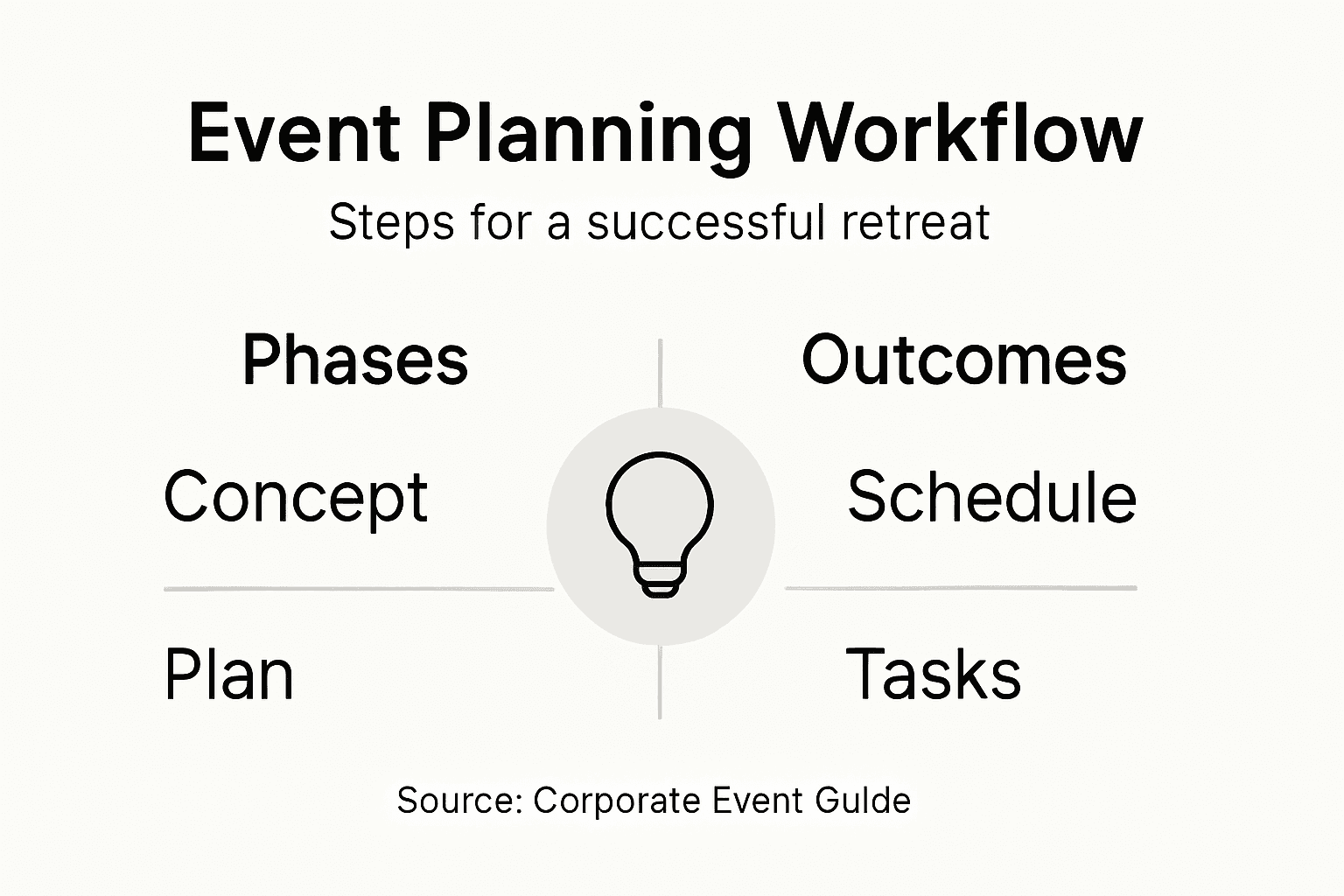
Successful event planning requires a step-by-step approach that includes conceptualizing the event, detailed operational and strategic planning, contingency preparation, execution, and closing. For corporate retreats specifically, this translates into five critical coordination phases. First comes conceptualization, where you define your retreat's purpose, target participants, desired outcomes, and approximate budget parameters. This foundation determines everything downstream. Second is strategic planning, where you identify dates, select a venue, book key vendors, and establish the event structure. This phase requires clear role assignments so everyone knows who owns which decision. Third is operational planning, where you handle the logistics details: registration systems, activity schedules, meal planning, transportation arrangements, and contingency scenarios. Fourth is execution, where your team runs the retreat and manages real-time adjustments. Fifth is closing, where you evaluate outcomes and document learnings. Most coordinators focus heavily on phases two and three but underestimate the importance of phase one. Spending extra time upfront clarifying your retreat's actual purpose prevents you from booking a beautiful mountain lodge that doesn't actually support your objectives.
Within each phase, precision matters. Clear role assignments prevent duplicate work and ensure accountability. When multiple team members are planning a retreat, ambiguity about who owns vendor communication or participant registration creates delays and frustration. Specify exactly who is responsible for each component. Timeline management keeps everyone moving at the same pace. If your vendor confirmation deadline passes but nobody noticed, you lose negotiating leverage and may face cancellation fees. Use a shared timeline that everyone can see and reference. Vendor communication requires consistent point of contact and clear expectations. Vendors need to know your retreat date is firm, your participant count is accurate, and your budget constraints are real. When you communicate clearly upfront, vendors respect your timeline and prioritize your event. Post-event evaluation closes the loop and captures insights for your next retreat. Most coordinators skip this step, which means they repeat the same mistakes next year. Spending two hours with your planning team identifying what worked, what didn't, and what you'll do differently transforms your next retreat.
The coordination framework also emphasizes contingency preparation, which many coordinators treat as optional. This is a mistake. What happens if your primary venue suddenly becomes unavailable due to construction? What if a key vendor cancels? What if weather threatens an outdoor component? Having contingency plans doesn't jinx your event. It gives you confidence and flexibility. Build contingency thinking into your planning by identifying the three highest-risk scenarios and having backup options ready. This doesn't require extensive work. It requires acknowledging that uncertainties exist and planning accordingly.
Below is a quick-reference to critical phases and actions for streamlined corporate retreat coordination:
| Coordination Phase | Key Focus Area | Success Factor |
|---|---|---|
| Conceptualization | Purpose and outcomes | Clear objectives definition |
| Strategic Planning | Dates, venue, vendors | Accurate assignment of roles |
| Operational Planning | Logistics and contingencies | Detailed timeline management |
| Execution | Event delivery | Real-time problem handling |
| Closing | Evaluation | Immediate team debriefing |
Pro tip: Invest significant time in phase one (conceptualization) to define your retreat's specific purpose and success metrics before moving to planning phases, since this clarity prevents you from optimizing for the wrong outcomes or booking resources that don't align with your actual goals.
Risks, Common Mistakes, and How to Avoid Them
Every corporate retreat carries inherent risks, and the difference between a successful event and a problematic one often comes down to whether you anticipated those risks and prepared accordingly. The risks aren't exotic or unpredictable. They're the same patterns that emerge across retreat planning year after year. Budget overruns, scheduling chaos, unclear objectives, miscommunication between team members, and neglect of what actually happened—these are the culprits that derail otherwise well-intentioned retreats. The good news is that most of these risks are entirely preventable if you recognize them upfront and build countermeasures into your planning process.
Common risks in event planning include budget overruns, miscommunication, unclear objectives, poorly defined roles, and neglect of post-event evaluation. Budget overruns happen when you don't establish firm pricing agreements early or when you add features without adjusting your budget. Miscommunication occurs when multiple team members are planning without a single source of truth about decisions, timelines, and responsibilities. Unclear objectives leave you optimizing for the wrong outcomes—you might create a fun event that doesn't actually accomplish your business goals. Poorly defined roles create duplicate work, gaps in accountability, and frustration among planning team members. Post-event evaluation neglect means you repeat the same mistakes at your next retreat because nobody documented what actually happened. These aren't mysterious problems. They're systematic failures of planning discipline. The avoidance strategies are equally straightforward. Conduct thorough pre-event analysis before committing to dates or venues. Establish clear goals and communicate them relentlessly. Define roles explicitly so everyone knows their responsibilities. Implement feedback loops after your retreat to capture learnings while details are fresh.
Beyond these foundational risks, major mistakes in large-scale event planning involve logistical complexities, financial mismanagement, stakeholder coordination failures, and risk mitigation oversights. Logistical complexities compound when you don't establish clear vendor communication protocols. You book a venue without confirming parking, confirm the caterer without checking dietary restrictions in advance, arrange transportation without building in buffer time. Each logistical gap creates stress during execution and diminishes the attendee experience. Financial mismanagement stems from treating your budget as flexible rather than fixed. Once you approve a budget, that becomes your constraint. Every additional expense must come from somewhere else. Stakeholder coordination failures happen when the participants who need to approve retreat dates or budgets aren't involved in planning conversations early. You finalize logistics only to discover a key executive has a conflict. Risk mitigation oversights occur when you plan for the happy path and ignore scenarios where things go wrong. What if your keynote speaker cancels? What if your venue loses power? What if attendance is significantly lower than expected? Having contingency plans for the highest-probability, highest-impact risks prevents scrambling during execution.
The path to avoiding these mistakes requires specific actions. First, document your retreat's purpose and success metrics in writing before you make any logistical decisions. Second, establish a shared project tracker that every planning team member can access and update. Third, assign explicit ownership for each component and establish decision deadlines. Fourth, build contingency scenarios for your three highest-risk factors. Fifth, schedule a post-retreat debrief with your planning team within two weeks of the event while memories are accurate. These aren't complex interventions. They're systematic practices that prevent predictable failures. Teams that implement these practices consistently execute better retreats with less stress because they're working from a framework rather than improvising.
Pro tip: Create a simple one-page document early that captures your retreat's specific purpose, success metrics, target budget, and date parameters, then share it with all stakeholders before making any vendor commitments or scheduling decisions to prevent misalignment.
Streamline Your Corporate Retreat Planning with WhenNOT
Planning a corporate retreat involves managing complex schedules, coordinating across departments, and defining clear objectives to ensure success. As highlighted in "Defining Efficient Event Planning: Streamlining Corporate Retreats" the challenge lies in swiftly identifying unavailable dates to avoid endless back-and-forth and scheduling friction. Traditional methods can drain your team’s energy and delay critical vendor bookings, risking your retreat’s impact and timelines.
WhenNOT offers a revolutionary solution designed specifically to tackle this pain point by asking participants when they are not available instead of when they are free. This inverse scheduling approach accelerates decision-making and simplifies coordination for busy professionals across multiple time zones. With no registration required for participants and a user-friendly interface that visualizes everyone’s conflicts at once, you gain clarity faster and reduce communication delays that often cause overwhelm during the planning phases. Discover how a smart scheduling tool can empower your team to meet tight deadlines and uphold high organizational standards when planning retreats by visiting WhenNOT.
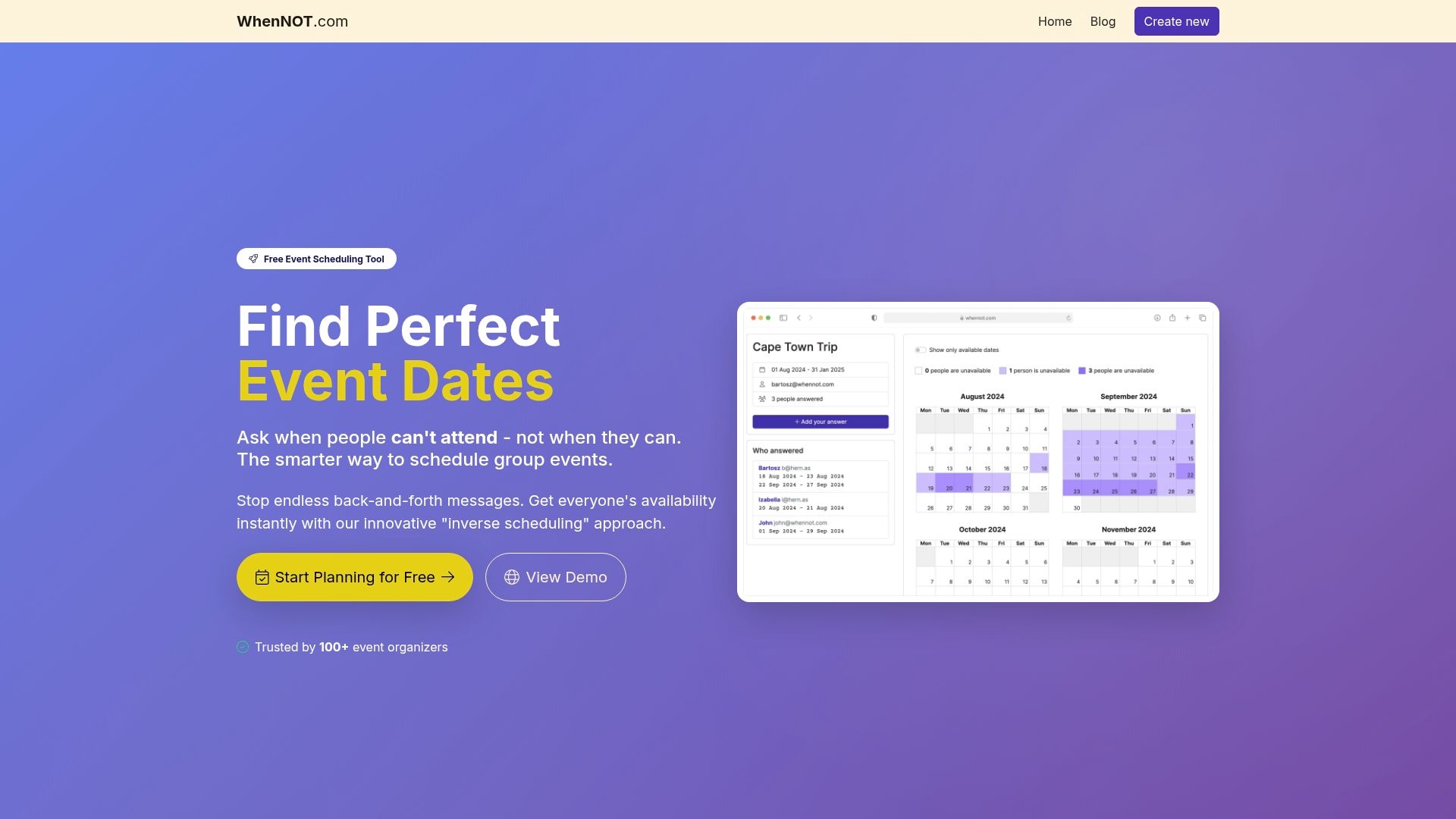
Experience firsthand how WhenNOT transforms your coordination workflow into a seamless, stress-free process. Start achieving clarity on dates in days instead of weeks. Visit WhenNOT Landing Page to create your event today and unlock the key to streamlined corporate retreat success. Don’t let scheduling chaos jeopardize your next retreat’s impact—take control now.
Frequently Asked Questions
What are the key steps in efficient corporate retreat planning?
Efficient corporate retreat planning involves a structured approach with five key steps: conceptualization, strategic planning, operational planning, execution, and closing. Each step builds on the previous one to ensure clarity, accountability, and effective outcomes.
How can I effectively manage scheduling for a large corporate retreat?
To manage scheduling effectively for a large corporate retreat, use smart scheduling tools that allow participants to mark when they are unavailable. This approach reduces back-and-forth communication and speeds up the decision-making process, making it easier to find optimal dates.
What distinguishes a corporate retreat from other types of events?
A corporate retreat focuses on specific business objectives, such as team building or strategy alignment, whereas other events like festivals or conferences serve different purposes, like public entertainment or knowledge sharing. Understanding these distinctions helps in applying the right planning framework and allocating resources appropriately.
What are common risks in corporate retreat planning, and how can they be avoided?
Common risks include budget overruns, scheduling chaos, and unclear objectives. These can be avoided by conducting thorough pre-event analysis, setting clear goals, defining roles explicitly, and implementing feedback loops after the event to capture lessons learned.