
Scheduling a cross-departmental retreat in New York or coordinating a virtual meeting across American and European offices brings unique challenges that go far beyond casual social gatherings. For many corporate event planners, the pressure to design effective workflows and manage logistics worldwide is relentless. By clarifying common misconceptions, highlighting the strategic role of corporate event scheduling, and exploring tailored solutions for global teams, this guide empowers you to enhance organizational alignment and build meaningful professional connections.
Table of Contents
- Core Definition And Common Misconceptions
- Types Of Corporate Event Scheduling Workflows
- Essential Phases And Technology Integration
- Roles And Responsibilities Across Teams
- Common Mistakes And How To Avoid Them
Key Takeaways
| Point | Details |
|---|---|
| Corporate Events are Strategic | They serve specific business objectives and facilitate communication, team cohesion, and professional development. |
| Proper Event Planning is Complex | Successful corporate events require detailed coordination and a clear understanding of logistical needs for both in-person and virtual formats. |
| Team Roles are Crucial | Clear role definitions and interdepartmental collaboration enhance the effectiveness of corporate event execution. |
| Avoid Common Mistakes | Effective communication and proactive planning are essential to prevent pitfalls that can disrupt corporate events. |
Core Definition and Common Misconceptions
Corporate events are strategic professional gatherings meticulously designed to achieve specific business objectives beyond simple social interactions. These structured meetings serve as powerful tools for organizational communication, team alignment, and strategic networking across global business environments.
Contrary to popular belief, corporate events are far more sophisticated than casual parties or unnecessary expenses. Strategic organizational gatherings represent intentional investments in professional development, employee engagement, and corporate culture enhancement. They play a critical role in driving business success by creating structured environments for knowledge exchange, relationship building, and strategic planning.
Common misconceptions about corporate events include:
- Viewing them as purely social occasions
- Considering them unnecessary financial expenditures
- Believing they lack meaningful professional purpose
- Assuming they are simple to organize without complex logistics
Event planning requires intricate coordination that extends well beyond basic logistics. Comprehensive event management involves strategic alignment, detailed resource allocation, and precise execution to meet specific organizational goals.
Corporate events are not just gatherings—they are deliberate instruments of organizational strategy and communication.
The core purpose of these professional gatherings encompasses multiple critical functions:
- Facilitating internal communication
- Fostering team cohesion
- Sharing strategic organizational vision
- Providing professional development opportunities
- Creating networking platforms for employees
Pro tip: Always approach corporate event planning with a strategic mindset, focusing on measurable outcomes and clear organizational objectives rather than treating them as routine social activities.
Types of Corporate Event Scheduling Workflows
Corporate event scheduling workflows encompass diverse approaches tailored to different organizational objectives and event formats. Corporate event planning strategies reveal significant variations across different event types, requiring specialized scheduling methodologies to ensure successful execution.
Event scheduling workflows can be broadly categorized into several distinct types, each with unique characteristics and logistical requirements:
-
In-Person Event Workflows
- Detailed venue selection and coordination
- Physical logistics management
- Attendee registration and tracking
- On-site resource allocation
-
Virtual Event Workflows
- Digital platform selection
- Online participant engagement strategies
- Technical infrastructure preparation
- Remote communication management
Event management approaches demonstrate that different event categories demand specialized scheduling techniques. The primary event types requiring distinct workflow considerations include:
- Product Launch Events
- Conferences and Seminars
- Trade Shows
- Team Building Retreats
- Annual Awards Ceremonies
- Training and Professional Development Sessions
Successful corporate event scheduling requires understanding the unique requirements of each event type and developing flexible, adaptive workflows.
Each event type presents unique scheduling complexities. Virtual events, for instance, require sophisticated digital coordination strategies that differ dramatically from traditional in-person gatherings. These digital environments demand precise technological integration, real-time participant management, and seamless digital communication protocols.
Physical events, conversely, involve intricate logistical planning including venue selection, physical resource allocation, transportation coordination, and on-site management strategies. The scheduling workflow must account for multiple simultaneous operational requirements and potential contingencies.
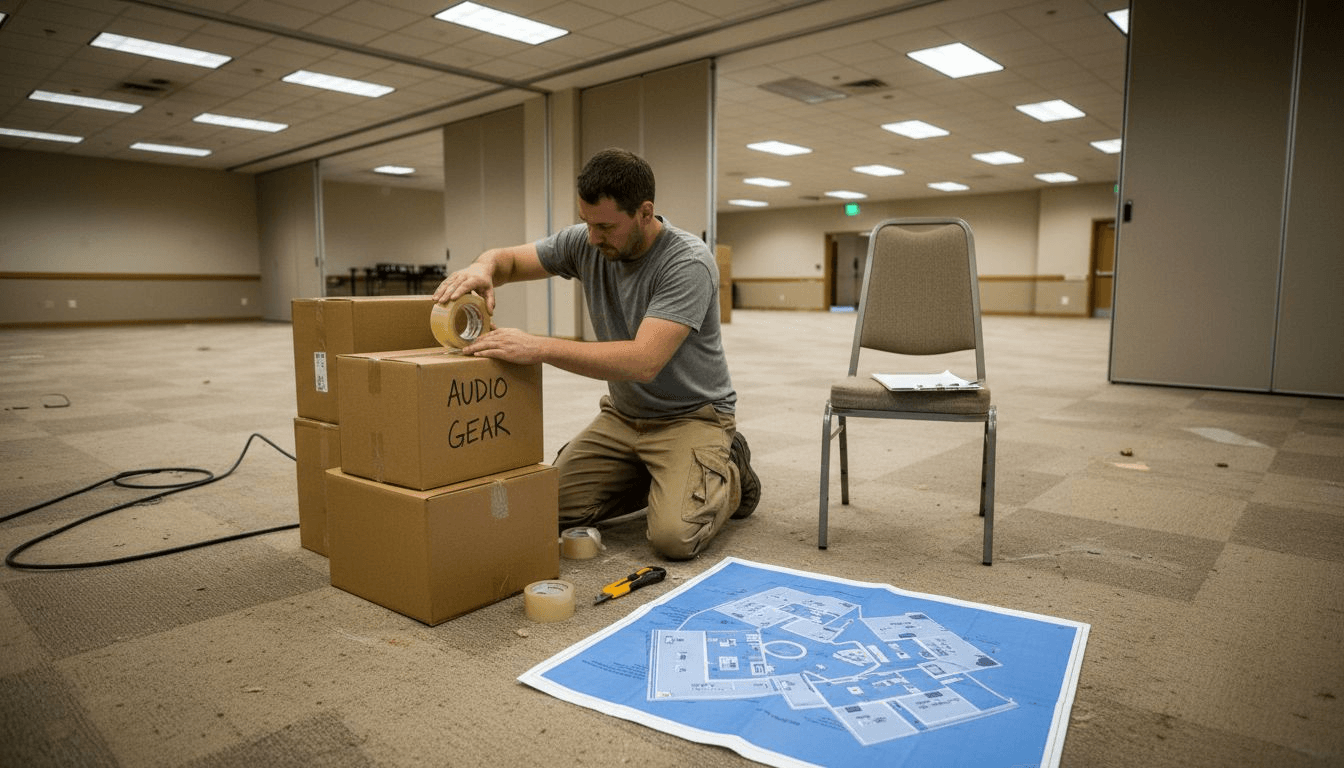
Here's a comparison of in-person and virtual event scheduling workflows to clarify their distinct requirements:
| Aspect | In-Person Events | Virtual Events |
|---|---|---|
| Venue selection | Physical location research | Digital platform evaluation |
| Resource management | On-site staff and materials | Technical support and software |
| Attendee experience | Hospitality, transportation | Interactive online features |
| Contingency planning | Weather, travel, logistics risks | Platform downtime, connectivity |
Pro tip: Develop a flexible scheduling framework that can be quickly adapted to accommodate the specific requirements of different corporate event types, ensuring comprehensive coverage and minimal logistical friction.
Essential Phases and Technology Integration
Corporate event project management requires a comprehensive understanding of the critical phases that transform an initial concept into a successful professional gathering. The event lifecycle encompasses multiple interconnected stages that demand strategic planning, precise execution, and adaptive technological integration.
Event scheduling workflows typically involve four primary phases:
-
Conceptualization Phase
- Initial objective definition
- Target audience identification
- Preliminary budget assessment
- High-level event vision development
-
Planning and Preparation Phase
- Detailed logistical planning
- Resource allocation
- Technology platform selection
- Comprehensive risk management
-
Execution Phase
- Real-time event management
- On-site coordination
- Participant engagement
- Immediate problem resolution
-
Post-Event Evaluation Phase
- Performance metric analysis
- Participant feedback collection
- Return on investment assessment
- Future improvement strategies
Technological integration transforms event scheduling from a manual, time-consuming process into a streamlined, data-driven strategic initiative.
Modern technological solutions play a crucial role in enhancing each phase of the event workflow. Advanced scheduling platforms enable real-time collaboration, automated communication, and dynamic resource management. These digital tools provide unprecedented visibility into event planning processes, allowing teams to make informed decisions quickly and efficiently.
The integration of sophisticated software platforms allows for seamless communication, precise tracking, and adaptive management across all event stages. Digital technologies enable event planners to create more responsive, flexible workflows that can rapidly adjust to changing circumstances and organizational requirements.
Pro tip: Select technology platforms that offer comprehensive integration capabilities, ensuring smooth data flow and communication across different phases of your corporate event scheduling workflow.
Roles and Responsibilities Across Teams
Corporate event team roles represent a complex ecosystem of specialized responsibilities that ensure seamless event execution. Each team member plays a critical part in transforming event concepts into successful professional gatherings, requiring precise coordination and clear communication channels.
Key team roles in corporate event scheduling include:
-
Logistics Lead
- Overall event coordination
- Venue and resource management
- Transportation and accommodation planning
- Vendor contract negotiations
-
Program Coordinator
- Session scheduling
- Speaker management
- Content development
- Agenda optimization
-
Technical Coordinator
- Digital platform management
- Audio-visual setup
- Technology infrastructure
- Remote participation support
-
Communications Officer
- Stakeholder communication
- Marketing and promotion
- Participant engagement strategy
- Messaging and branding consistency
Effective event management processes demand clear role definition and strategic interdepartmental collaboration. The workflows require dynamic interaction between planning committees, project managers, technical teams, and support staff to maintain synchronization throughout the event lifecycle.
Successful corporate events emerge from synchronized teamwork, where each role contributes its unique expertise toward a collective objective.
Cross-functional communication becomes paramount in modern event scheduling. Team members must maintain transparency, share real-time updates, and remain adaptable to evolving project requirements. This approach prevents siloed working environments and ensures holistic event management.
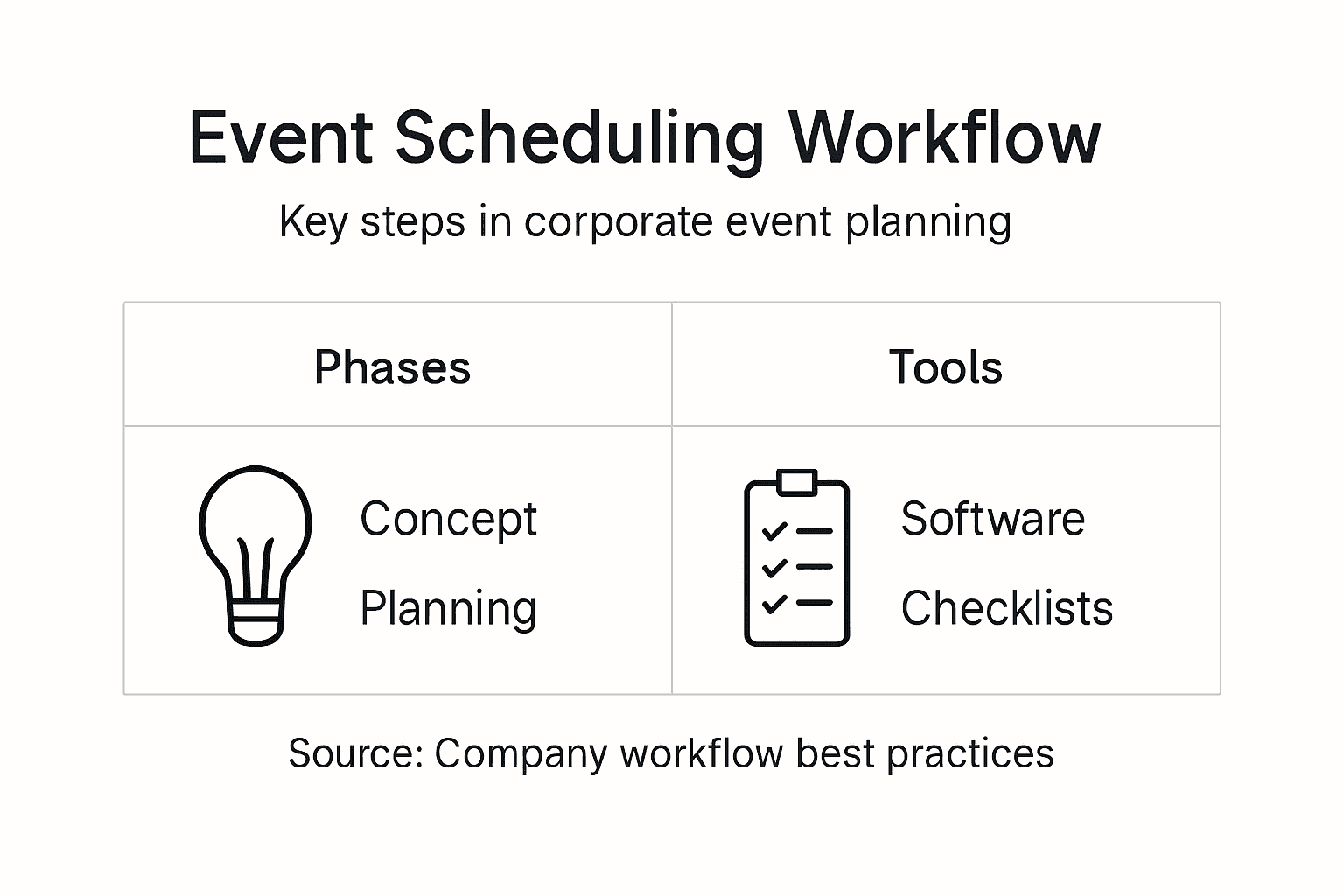
Technological platforms now enable unprecedented levels of collaboration, allowing team members to track progress, share resources, and make collective decisions efficiently. The integration of collaborative tools transforms traditional hierarchical structures into more flexible, responsive event planning ecosystems.
Below is a summary of key team roles and their primary business impact in successful corporate event scheduling:
| Team Role | Core Responsibility | Business Impact |
|---|---|---|
| Logistics Lead | Coordinates all logistics | Ensures smooth event flow |
| Program Coordinator | Develops content and agenda | Drives audience engagement |
| Technical Coordinator | Manages tech infrastructure | Enhances event accessibility |
| Communications Officer | Oversees messaging | Boosts brand and attendance |
Pro tip: Establish clear communication protocols and define explicit responsibilities for each team role before initiating event planning to minimize potential workflow disruptions.
Common Mistakes and How to Avoid Them
Corporate event planning mistakes can derail even the most meticulously planned professional gatherings. Understanding these potential pitfalls is crucial for creating successful, seamless event experiences that meet organizational objectives and participant expectations.
Critical mistakes in corporate event scheduling include:
-
Poor Communication
- Unclear role assignments
- Inconsistent messaging
- Lack of interdepartmental transparency
- Miscommunication of event goals
-
Inadequate Planning
- Insufficient timeline development
- Overlooking contingency scenarios
- Weak risk management strategies
- Incomplete resource allocation
-
Stakeholder Engagement Failures
- Neglecting participant preferences
- Minimal feedback mechanisms
- Limited audience interaction planning
- Disconnected communication channels
Workflow disruption prevention requires strategic approaches to mitigate potential errors. Event planners must develop comprehensive strategies that anticipate and address common organizational challenges.
Proactive planning and robust communication frameworks are the most effective defenses against corporate event scheduling complications.
Technological solutions play a critical role in minimizing workflow disruptions. Advanced scheduling platforms enable real-time tracking, transparent communication, and dynamic adaptation to changing event requirements. These tools provide event managers with unprecedented visibility and control over complex scheduling processes.
Successful event management demands a holistic approach that integrates detailed planning, clear communication protocols, and adaptive technological infrastructure. Organizations must cultivate a culture of continuous improvement, leveraging post-event evaluations to refine future scheduling strategies and minimize recurring operational challenges.
Pro tip: Implement a comprehensive pre-event checklist that systematically addresses potential risks and establishes clear communication protocols across all team members and stakeholders.
Simplify Your Corporate Event Scheduling With WhenNOT
Planning complex corporate events involves juggling multiple phases from conceptualization to execution while coordinating diverse team roles and managing specialized workflows. Common challenges in corporate event scheduling include poor communication delays and the difficulty of aligning busy stakeholders on optimal dates without creating workflow disruptions. Using tools that support strategic scheduling and clear communication is essential to keep your events on track.
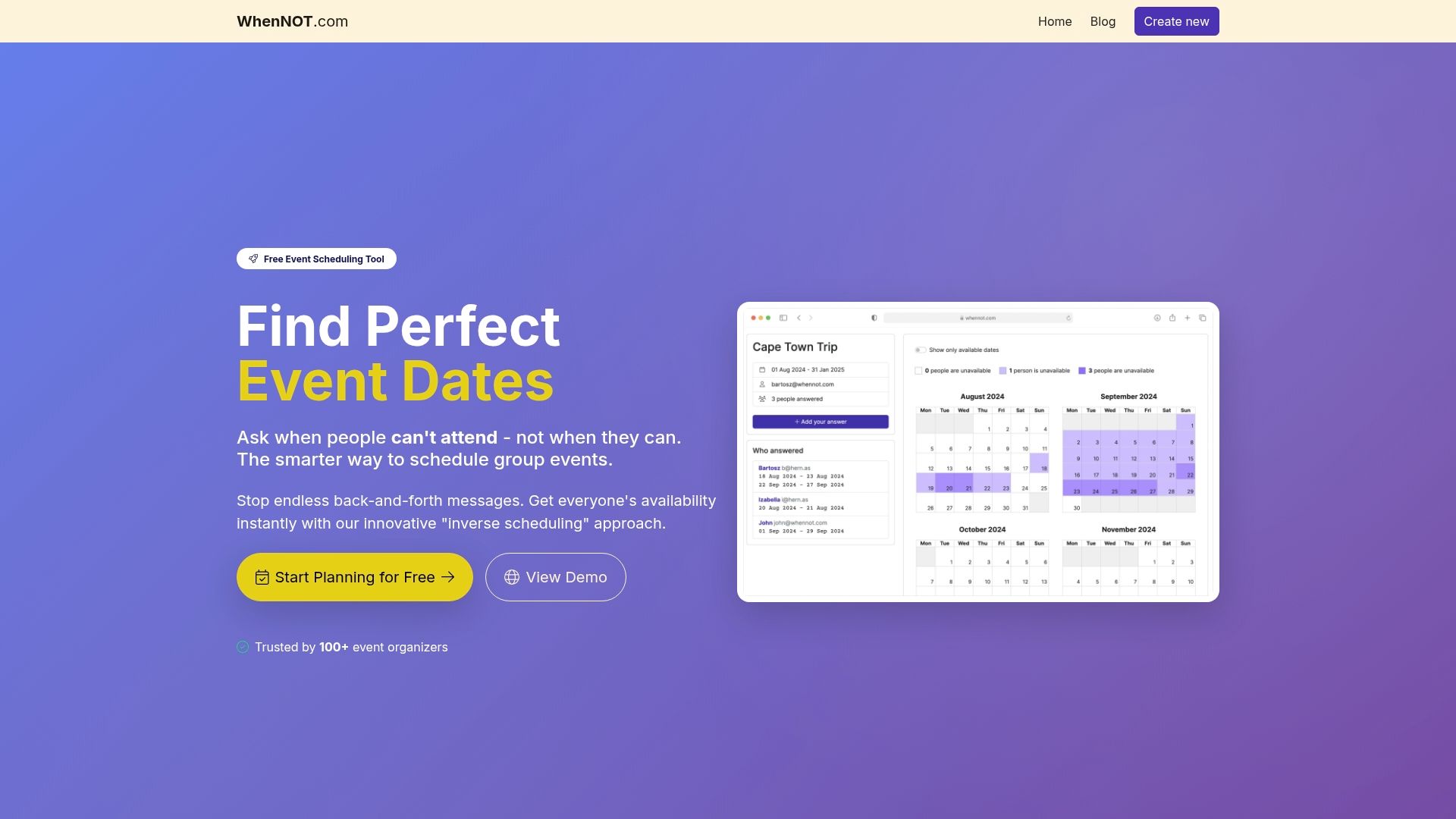
WhenNOT is built to tackle exactly these pain points by offering an intuitive inverse scheduling approach. Instead of asking participants when they are free, WhenNOT asks when they are not available—making it remarkably easier to plan multi-day or flexible-date events especially common in product launches, conferences, and team retreats. This method reduces scheduling bottlenecks and promotes transparency, aligning perfectly with the article's emphasis on effective event scheduling workflows and cross-functional team collaboration.
Discover how WhenNOT streamlines your corporate event planning and eliminates time-consuming back-and-forth communication.
Learn more about efficient group coordination and experience how this free, user-friendly platform enhances your planning process by visualizing everyone's unavailable dates concurrently.
Get started today with WhenNOT and transform your corporate scheduling challenges into seamless success.
Frequently Asked Questions
What are the main phases of a corporate event scheduling workflow?
The main phases include the Conceptualization Phase, Planning and Preparation Phase, Execution Phase, and Post-Event Evaluation Phase, each requiring strategic planning and precise execution.
How do in-person and virtual event scheduling workflows differ?
In-person events require venue selection and on-site resource management, while virtual events focus on digital platform selection and online participant engagement strategies. Each necessitates unique logistical considerations.
What common mistakes should be avoided in corporate event scheduling?
Common mistakes include poor communication, inadequate planning, and failures in stakeholder engagement. Addressing these areas proactively can reduce the risk of event complications.
Why is technology integration important in corporate event scheduling?
Technology integration streamlines the event workflow, enabling real-time collaboration, automated communication, and effective resource management. It helps transform scheduling from a manual process into a data-driven initiative.