
Coordinating multi-day team retreats for American and global tech startups can feel like solving a puzzle with missing pieces. With over 60 percent of event coordinators reporting wasted hours due to clunky scheduling tools, the need for smarter solutions is clear. Online event scheduling now empowers teams to organize retreats across regions without the typical hassle, offering time-saving features and greater accuracy. Discover how new digital approaches transform event planning for tech teams worldwide.
Table of Contents
- Defining Online Event Scheduling Today
- Comparing Traditional and Inverse Scheduling
- How Inverse Scheduling Enhances Efficiency
- Privacy, Security, and Cost Implications
- Top Mistakes When Scheduling Events Online
Key Takeaways
| Point | Details |
|---|---|
| Embrace Online Event Scheduling | Utilize advanced scheduling platforms to improve coordination for multi-day events, especially for geographically dispersed teams. |
| Adopt Inverse Scheduling | Focus on marking unavailability rather than availability to streamline the scheduling process and reduce cognitive load. |
| Prioritize Security Measures | Choose scheduling tools that implement robust security protocols and transparent privacy policies to protect participant data. |
| Avoid Common Pitfalls | Thoroughly evaluate scheduling platforms and provide clear communication to prevent technical issues and enhance participant engagement. |
Defining Online Event Scheduling Today
Online event scheduling represents a sophisticated digital approach to coordinating complex group activities, transforming how teams and organizations plan multi-day retreats and gatherings. At its core, this technology enables seamless communication and coordination across geographically dispersed participants by providing intuitive platforms that simplify date selection and availability tracking. Comprehensive event management systems have evolved to address the intricate challenges of modern collaborative planning.
The contemporary landscape of online event scheduling goes far beyond simple calendar sharing. These advanced systems incorporate intelligent features like participant availability mapping, conflict resolution mechanisms, and interactive scheduling interfaces that allow groups to identify optimal meeting times with unprecedented efficiency. By leveraging web-based technologies, organizations can now coordinate team retreats, conferences, and group events without the traditional communication bottlenecks that once made such planning arduous and time-consuming.
Modern scheduling platforms prioritize user experience, offering intuitive interfaces that minimize friction in the coordination process. Key features typically include real-time collaboration, automated conflict detection, timezone synchronization, and flexible invitation mechanisms that do not require participants to create accounts or download specialized software. The goal is to streamline complex scheduling scenarios, particularly for global teams where traditional methods become unwieldy and inefficient.
Pro tip: When selecting an online scheduling tool, prioritize platforms that offer maximum flexibility and minimal friction for participants, ensuring high engagement and accurate availability tracking.
Comparing Traditional and Inverse Scheduling
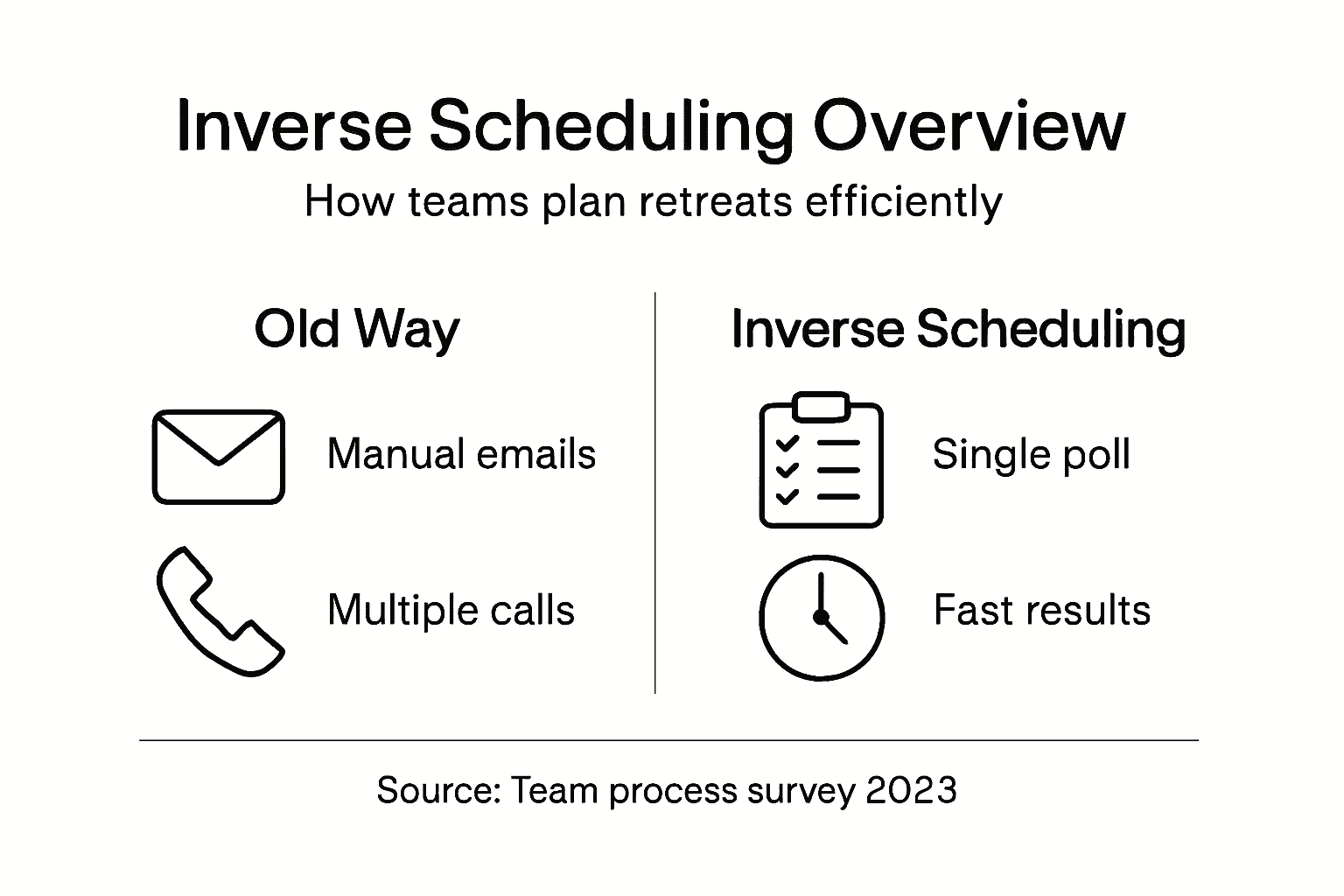
Traditional scheduling methods have long relied on deterministic approaches that require participants to manually indicate their available times, creating complex communication cycles and potential coordination challenges. In contrast, inverse scheduling represents a revolutionary paradigm that fundamentally transforms how groups identify optimal meeting times. Comparative studies of scheduling approaches demonstrate significant efficiency gains by shifting from traditional manual methods to more intelligent, technology-driven solutions.
Traditional scheduling typically involves participants responding to multiple communication rounds, sharing their available times, and negotiating potential meeting slots. This process is inherently time-consuming and prone to miscommunication. Inverse scheduling, by contrast, inverts this model by asking participants to mark their unavailable times, dramatically simplifying the coordination process. The fundamental difference lies in the approach: traditional methods require active availability confirmation, while inverse scheduling allows participants to quickly indicate when they cannot meet, automatically revealing optimal time windows.
The technological evolution of scheduling platforms has further highlighted the limitations of traditional methods. Modern crowd-sourced scheduling techniques leverage advanced algorithms that can automatically detect time conflicts, synchronize across different time zones, and provide real-time optimization. These systems reduce the cognitive load on participants, eliminate endless email chains, and create a more streamlined, user-friendly experience for coordinating complex multi-day events like team retreats.
Here's a comparison of traditional versus inverse scheduling methods and their impact on event coordination:
| Aspect | Traditional Scheduling | Inverse Scheduling | Business Impact |
|---|---|---|---|
| Participant Input | Mark available times | Mark unavailable times | Reduces effort and coordination time |
| Communication Rounds | Multiple rounds often required | Fewer rounds, more streamlined | Improves decision speed |
| Cognitive Load | High, tracks everyone's options | Low, focuses on exceptions | Eases participant engagement |
| Conflict Resolution | Manual and time-consuming | Automated via algorithms | Increases scheduling accuracy |
Pro tip: When organizing team events, adopt an inverse scheduling approach that minimizes participant effort and maximizes collective efficiency by focusing on marking unavailable times rather than hunting for shared availability.
How Inverse Scheduling Enhances Efficiency
Inverse scheduling represents a transformative approach to organizational time management, fundamentally reimagining how teams coordinate complex events and workflows. Unlike traditional methods that demand extensive back-and-forth communication, this innovative technique dramatically reduces coordination overhead by focusing on participants' unavailability rather than seeking universal availability. Dynamic scheduling models demonstrate significant improvements in resource allocation and decision-making efficiency across various organizational contexts.
The core efficiency of inverse scheduling stems from its ability to minimize cognitive load and streamline communication processes. By asking participants to mark only their unavailable times, the system automatically generates optimal meeting windows without requiring multiple rounds of negotiation. This approach is particularly powerful for global teams spanning different time zones, where traditional scheduling methods often break down. Advanced algorithms can quickly synthesize individual constraints, revealing precise time slots that work for everyone with minimal participant effort.

Technology-driven scheduling efficiency strategies have proven particularly effective in reducing coordination friction. These systems leverage machine learning and intelligent algorithms to dynamically adjust schedules, accounting for complex constraints like individual preferences, recurring commitments, and unexpected changes. The result is a more adaptive, responsive scheduling approach that can handle the nuanced realities of modern distributed workforces, eliminating the endless email chains and calendar ping-pong that traditionally consume significant professional time.
Pro tip: Implement inverse scheduling by clearly communicating the process to participants and emphasizing the simplicity of marking unavailable times rather than hunting for shared availability.
Privacy, Security, and Cost Implications
Online event scheduling platforms must navigate a complex landscape of data protection and cybersecurity challenges that directly impact user trust and organizational risk management. Data security for event platforms has become increasingly critical, with stringent requirements for protecting participant information and maintaining robust privacy standards. Modern scheduling solutions must implement comprehensive security protocols that address potential vulnerabilities while ensuring seamless user experience.
The financial implications of privacy and security extend beyond direct implementation costs. Potential data breaches can result in significant financial penalties, reputation damage, and loss of user confidence. Successful platforms prioritize end-to-end encryption, minimal data collection, and transparent privacy policies that comply with global regulations like GDPR and CCPA. This approach not only protects user information but also demonstrates a commitment to responsible data handling that can become a significant competitive advantage for scheduling platforms.
Technology-driven scheduling solutions are increasingly adopting advanced security measures to mitigate risks. These include multi-factor authentication, anonymized data processing, secure cloud infrastructure, and regular security audits. Virtual event security practices have evolved to create sophisticated defense mechanisms that protect user data while maintaining the flexibility and convenience that modern teams require. The goal is to create a security framework that feels invisible to users but provides comprehensive protection against potential cyber threats.
Below is a summary of crucial privacy and security features in online scheduling platforms:
| Security Feature | Description | Business Benefit |
|---|---|---|
| End-to-end Encryption | Secures all user data during transit | Protects sensitive information |
| Multi-factor Authentication | Requires multiple ID methods at login | Prevents unauthorized access |
| Minimal Data Collection | Limits personal data stored by the platform | Reduces risk and compliance burden |
| Regular Security Audits | Frequent checks for vulnerabilities | Enhances trust and platform reliability |
Pro tip: Prioritize scheduling platforms that offer transparent privacy policies, provide clear data usage explanations, and demonstrate proactive security measures before committing to their service.
Top Mistakes When Scheduling Events Online
Online event scheduling can quickly become a minefield of potential errors that derail team coordination and event success. Virtual conference planning mistakes often stem from overlooking critical technical and communication details that can significantly impact participant engagement and overall event effectiveness. Understanding these common pitfalls is crucial for event coordinators seeking to create seamless, productive team retreats.
One of the most prevalent mistakes involves inadequate platform selection and technical preparation. Many teams rush into scheduling without thoroughly evaluating their chosen platform's capabilities, leading to connectivity issues, poor audio/video quality, and participant frustration. Complex scheduling challenges emerge when organizers fail to consider factors like timezone differences, participant availability ranges, and potential technical limitations. This can result in missed connections, incomplete participation, and unnecessary communication overhead that undermines the entire event's purpose.
Top scheduling mistakes frequently include overlooking participant preferences and failing to provide clear, detailed communication about event expectations. Vague invitation guidelines, unclear time zone specifications, and lack of comprehensive event information can dramatically reduce participant engagement and commitment. Successful online event scheduling requires meticulous attention to detail, proactive communication, and a user-centric approach that prioritizes participant experience and convenience.
Pro tip: Always conduct a comprehensive technical rehearsal and communication test at least 48 hours before your event to identify and resolve potential scheduling and technical barriers.
Simplify Your Team Retreat Planning with Inverse Scheduling
Coordinating multi-day team retreats can be exhausting when trying to balance everyone's schedules using traditional methods. The article highlights how inverse scheduling, where participants only mark when they are unavailable, dramatically reduces the back-and-forth communication and cognitive load. If you have faced frustration managing complex group availability or dreaded multiple rounds of scheduling emails, you are not alone. Achieving seamless coordination without wasting time is crucial for your event's success.
WhenNOT brings this innovative concept to life. Our platform lets you create an event, define potential date ranges, and share a simple link so participants can quickly mark their unavailable days with no signups or accounts required. This approach instantly visualizes overlapping busy dates and pinpoints optimal meeting windows — saving you hours in planning. With a focus on privacy, accessibility, and zero cost, WhenNOT is the efficient alternative to traditional scheduling tools for your corporate retreat or group event.
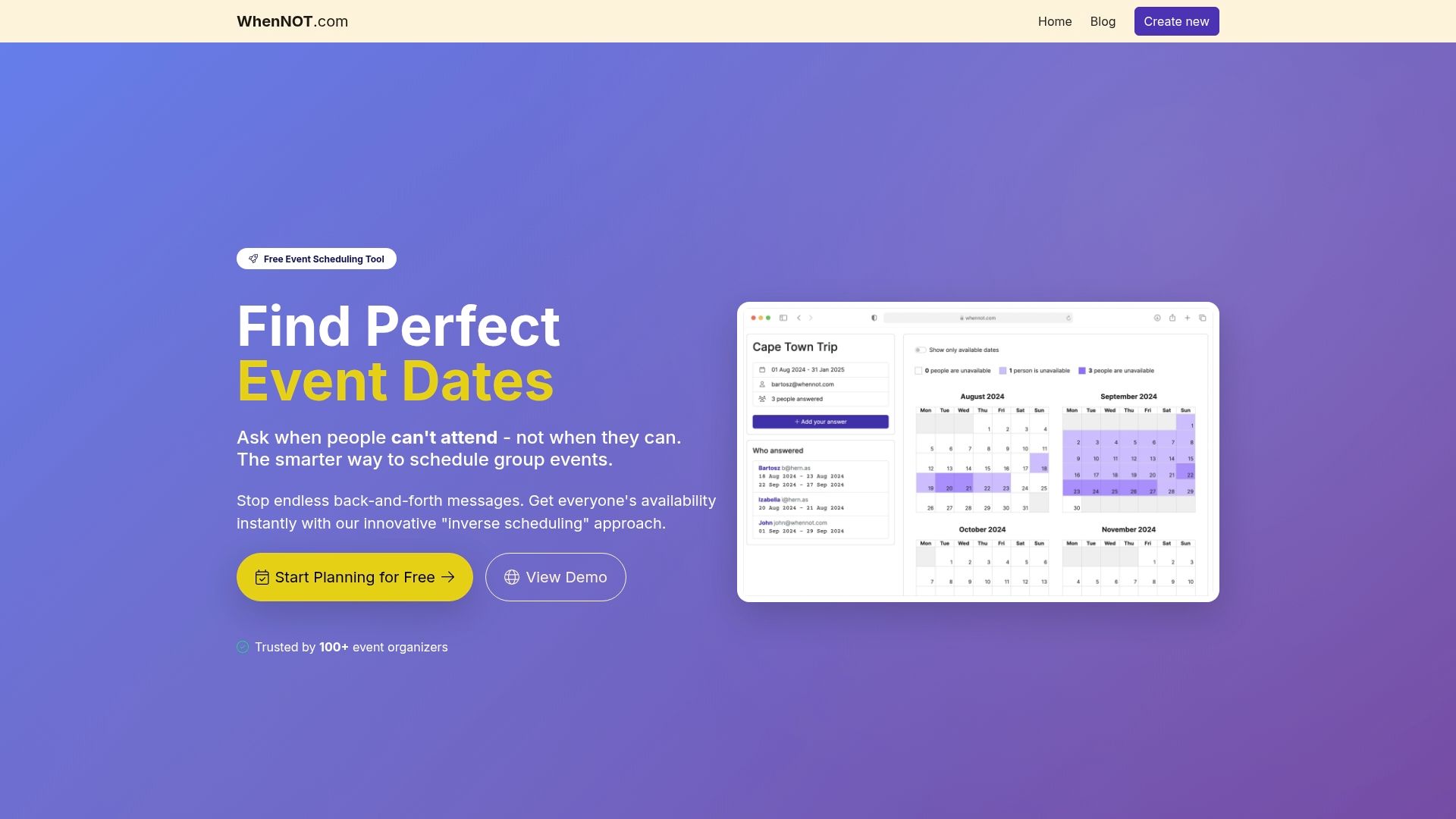
Ready to experience stress-free event scheduling first-hand? Discover how WhenNOT transforms team retreat planning by embracing inverse scheduling at WhenNOT.com. Join thousands who have streamlined their scheduling process and enjoy faster decisions, less hassle, and happier teams. Get started today and reclaim your valuable time!
Frequently Asked Questions
What is online event scheduling?
Online event scheduling is a digital system that helps teams and organizations coordinate group activities efficiently. It allows participants to manage their availability, simplifying the planning process for events like team retreats and conferences.
How does inverse scheduling differ from traditional scheduling methods?
Inverse scheduling differs from traditional methods by asking participants to mark their unavailable times instead of their available times. This approach simplifies the coordination process and reduces communication cycles, making it faster and more efficient to find optimal meeting times.
What are the key features of modern online scheduling platforms?
Modern online scheduling platforms typically include features like real-time collaboration, automated conflict detection, timezone synchronization, and user-friendly interfaces that minimize the need for participants to create accounts or use specialized software.
What are common mistakes when scheduling events online?
Common mistakes include inadequate platform selection, overlooking participant preferences, lack of clear communication regarding event details, and failing to conduct technical rehearsals. These errors can lead to connectivity issues and reduced participant engagement.