
Coordinating schedules for multi-day corporate retreats can quickly turn into a maze of emails and endless calendar checks. The pressure to satisfy every attendee’s constraints makes planning in the United States or Canada feel overwhelming. Powerful automated scheduling decisions are changing this reality by replacing manual guesswork with intelligent, conflict-free solutions. Discover how these systems use advanced algorithms to handle complex scheduling, freeing event planners to focus on creating standout experiences instead of juggling dates.
Table of Contents
- Defining Automated Scheduling Decisions
- Types Of Scheduling Automation Tools
- How Scheduling Automation Works
- Key Benefits For Corporate Event Planners
- Risks And Common Mistakes To Avoid
- Comparing Manual Versus Automated Scheduling
Key Takeaways
| Point | Details |
|---|---|
| Automated Scheduling Efficiency | Automated scheduling significantly reduces time spent on scheduling tasks, completing them in minutes rather than hours. |
| Error Reduction | This approach minimizes human error and conflicts in scheduling, resulting in higher accuracy. |
| Dynamic Adaptability | Automated systems adapt in real-time to new information, enhancing organizational responsiveness. |
| Strategic Resource Allocation | These tools optimize resource allocation, ultimately maximizing productivity and stakeholder satisfaction. |
Defining Automated Scheduling Decisions
Automated scheduling decisions represent a transformative approach to managing complex time-based resource allocation challenges across various domains. At its core, this strategy leverages advanced computational techniques to transform what was once a manual, time-consuming process into a streamlined, intelligent workflow.
Specifically, automated scheduling involves intelligent algorithmic approaches that evaluate multiple constraints and preferences simultaneously. These systems use sophisticated methods like genetic algorithms and optimization techniques to create efficient schedules without extensive human intervention. The primary goal is to replace error-prone manual scheduling with a data-driven, precise decision-making process.
The key components of automated scheduling decisions include:
- Constraint Evaluation: Analyzing complex requirements like resource availability, timing conflicts, and individual preferences
- Optimization Algorithms: Using computational methods to generate the most efficient schedule possible
- Machine Learning Integration: Continuously improving scheduling accuracy through pattern recognition
- Real-time Adaptability: Dynamically adjusting schedules as new information becomes available
Performance Benefits emerge from this approach. Traditional scheduling methods often consume significant human hours and introduce substantial error risks. In contrast, automated systems can process complex scheduling scenarios in minutes, reducing administrative overhead and minimizing potential conflicts.
Automated scheduling transforms scheduling from a manual task into an intelligent, efficient process that adapts to changing organizational needs.
Pro tip: Start by mapping out your current scheduling constraints and bottlenecks before implementing an automated solution to ensure maximum effectiveness.
Types Of Scheduling Automation Tools
Scheduling automation tools have evolved dramatically, offering sophisticated solutions for complex time management challenges across various sectors. Multi-objective optimization tools represent a cutting-edge approach to generating intelligent, conflict-free schedules that adapt to dynamic organizational needs.
These advanced tools can be categorized into several primary types, each with unique capabilities and strategic advantages:
- Genetic Algorithm Tools: Utilize evolutionary computing principles to generate optimal schedules
- Rule-Based Systems: Apply predefined constraints and logical rules for scheduling decisions
- Heuristic Optimization Tools: Use adaptive algorithms to find efficient scheduling solutions quickly
- Machine Learning Schedulers: Continuously improve scheduling accuracy through pattern recognition
- Constraint Satisfaction Platforms: Evaluate multiple variables simultaneously to create balanced schedules
Each tool type offers distinct benefits depending on organizational complexity. Academic institutions, for instance, might prefer genetic algorithm-based scheduling systems that can simultaneously manage faculty assignments, course timings, and room allocations.
Effective scheduling automation transforms time management from a manual, error-prone process into an intelligent, adaptive workflow.
Performance Comparison reveals significant advantages of automated tools over traditional scheduling methods. Computational approaches reduce human error, minimize scheduling conflicts, and dramatically decrease administrative time investment.
Here's how common scheduling automation tool types differ in focus and impact:
| Tool Type | Core Strategy | Typical Use Case | Business Impact |
|---|---|---|---|
| Genetic Algorithm | Evolution-based optimization | Large-scale shift planning | Maximizes resource utilization |
| Rule-Based System | Predefined logic & rules | Routine task scheduling | Consistent and predictable outcomes |
| Heuristic Optimization | Adaptive quick solutions | Meeting time selection | Fast response in dynamic settings |
| ML Scheduler | Pattern learning for accuracy | Personalized shift schedules | Improved accuracy and adaptability |
| Constraint Satisfaction | Balance multiple variables | Academic course allocation | Reduced conflicts, better balance |
Pro tip: Evaluate your specific organizational constraints before selecting a scheduling automation tool to ensure maximum compatibility and efficiency.
How Scheduling Automation Works
Scheduling automation operates through sophisticated computational techniques that transform complex time management challenges into streamlined, intelligent processes. AI-powered scheduling systems leverage advanced algorithms to analyze multiple constraints and generate optimized scheduling solutions with remarkable precision.
The core mechanics of scheduling automation involve several critical stages:
- Data Input: Administrators provide initial constraints and preferences
- Constraint Analysis: System evaluates multiple variables simultaneously
- Algorithmic Processing: Machine learning models generate optimal schedules
- Conflict Resolution: Automatically identifying and resolving scheduling conflicts
- Real-Time Adaptation: Continuously adjusting schedules based on emerging changes
These systems employ multiple sophisticated approaches to schedule generation. Machine learning models analyze historical data, current constraints, and potential conflicts to create dynamic, personalized scheduling solutions that adapt in real-time.
Scheduling automation transforms complex administrative tasks from manual, time-consuming processes into intelligent, efficient workflows that minimize human error and maximize resource utilization.
Key Performance Indicators demonstrate the substantial benefits of automated scheduling. By reducing manual intervention, these systems can decrease scheduling time by up to 80% while simultaneously improving overall scheduling accuracy and organizational efficiency.

Pro tip: Implement a phased approach when introducing scheduling automation, starting with a pilot program to validate system effectiveness and gather user feedback.
Key Benefits For Corporate Event Planners
Corporate event planners face increasingly complex scheduling challenges that demand sophisticated, efficient solutions. Automated scheduling tools offer substantial strategic advantages that transform traditional event management approaches, enabling professionals to navigate intricate planning requirements with unprecedented precision and ease.
The key benefits for corporate event planners include:
- Dramatic Time Savings: Reduce scheduling preparation time by up to 70-80%
- Enhanced Resource Optimization: Intelligently allocate meeting spaces, personnel, and logistics
- Real-Time Conflict Resolution: Automatically detect and resolve scheduling overlaps
- Increased Stakeholder Satisfaction: Provide more responsive and adaptive scheduling experiences
- Comprehensive Constraint Management: Handle multiple complex scheduling variables simultaneously
Strategic Efficiency represents the most compelling advantage of scheduling automation. By minimizing manual coordination efforts, event planners can redirect their energy toward high-value strategic activities that directly impact event success and organizational objectives.
Scheduling automation transforms event planning from a labor-intensive process into an intelligent, streamlined workflow that maximizes organizational productivity and participant engagement.
Operational Impact goes beyond simple time savings. Automated scheduling enables corporate event planners to create more personalized, responsive event experiences while maintaining unprecedented levels of logistical precision and adaptability.
Pro tip: Implement a pilot automated scheduling program with a small, representative event to validate system effectiveness and gather meaningful performance insights.
Risks And Common Mistakes To Avoid
Automated scheduling systems, while powerful, are not infallible. Common risks in scheduling automation can undermine their effectiveness if organizations fail to implement strategic safeguards and maintain rigorous oversight.
The most critical risks and mistakes include:
- Over-Reliance on Technology: Completely eliminating human judgment and contextual understanding
- Data Quality Challenges: Inputting inaccurate or incomplete information that skews scheduling results
- Inadequate User Training: Failing to properly educate team members on system capabilities
- Inflexible Constraint Handling: Not accounting for nuanced scheduling exceptions
- Poor System Integration: Disconnected workflows that create operational friction
Technical Vulnerabilities emerge when organizations treat automated scheduling as a set-it-and-forget-it solution. Dynamic workflow platforms require continuous monitoring, periodic recalibration, and adaptive configuration to maintain reliability.
Successful scheduling automation demands a balanced approach that combines technological intelligence with human oversight and contextual understanding.
Mitigation Strategies are crucial for minimizing potential risks. Organizations must develop comprehensive implementation plans that include ongoing training, regular system audits, and mechanisms for manual intervention when algorithmic decisions seem suboptimal.
Pro tip: Establish a hybrid scheduling approach that allows manual review and adjustment of automated recommendations to maintain operational flexibility.
Comparing Manual Versus Automated Scheduling
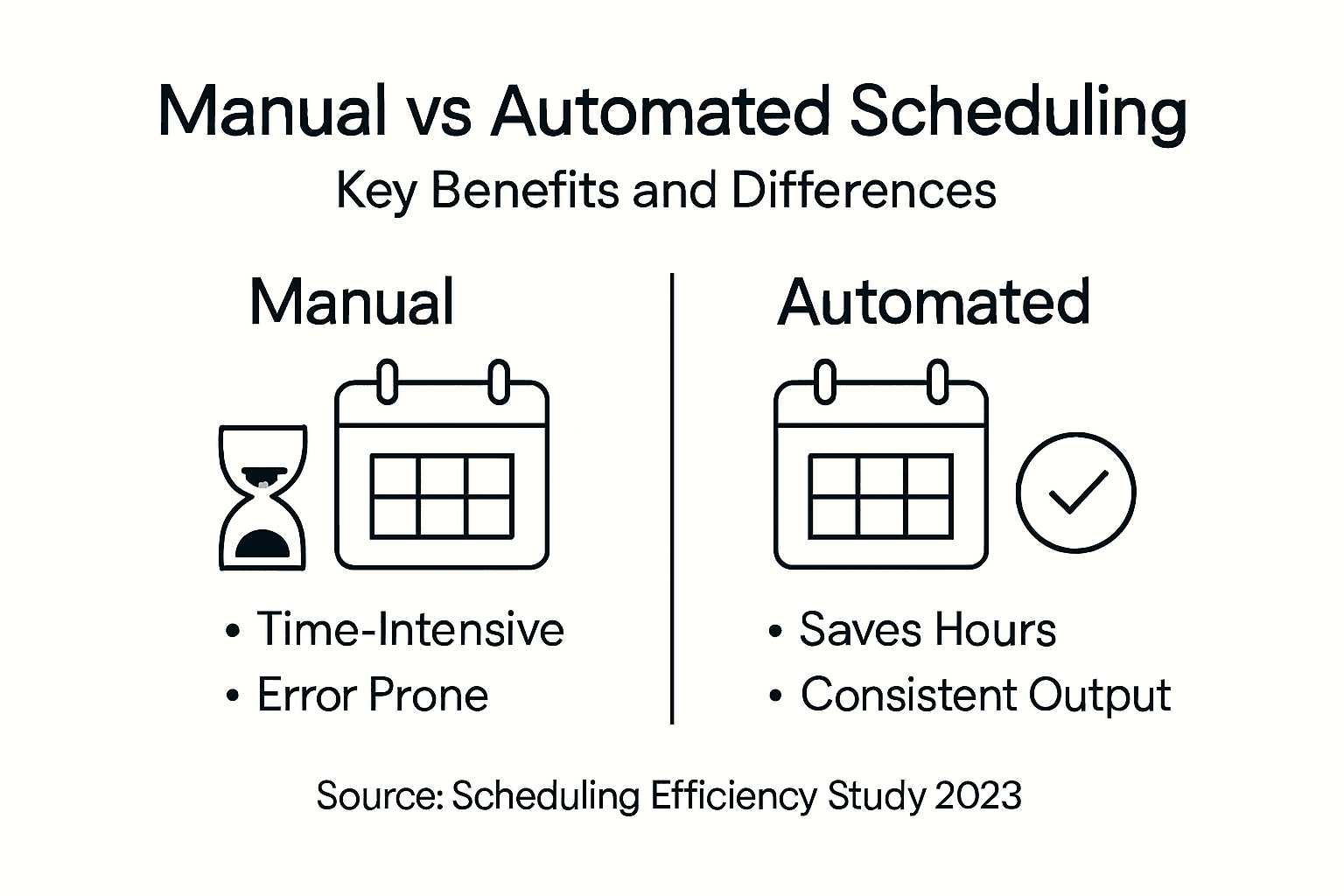
Scheduling methodologies have undergone a dramatic transformation with the advent of technological solutions. Automated scheduling significantly outperforms manual methods by introducing unprecedented efficiency and precision into complex time management processes.
A comprehensive comparison reveals stark differences between manual and automated approaches:
- Time Investment:
- Manual Scheduling: Hours of labor-intensive coordination
- Automated Scheduling: Minutes of intelligent processing
- Error Potential:
- Manual Scheduling: High probability of human error
- Automated Scheduling: Systematic conflict prevention
- Resource Optimization:
- Manual Scheduling: Limited flexibility
- Automated Scheduling: Dynamic, adaptive allocation
- Scalability:
- Manual Scheduling: Difficult to manage complex constraints
- Automated Scheduling: Handles intricate scheduling scenarios effortlessly
Performance Metrics demonstrate the revolutionary impact of automation. Traditional manual scheduling requires significant personnel time, creates administrative bottlenecks, and frequently produces suboptimal outcomes. In contrast, automated systems generate more sophisticated, flexible schedules with minimal human intervention.
Automated scheduling transforms scheduling from a time-consuming administrative task into a strategic, intelligent workflow that maximizes organizational efficiency.
Strategic Implications extend beyond simple time savings. Automated scheduling enables organizations to redirect human capital toward high-value strategic activities, creating a more agile and responsive operational environment.
See how manual and automated scheduling approaches compare in measurable business outcomes:
| Attribute | Manual Scheduling | Automated Scheduling | Impact on Operations |
|---|---|---|---|
| Time to Complete | Several hours | Under 30 minutes | Faster project turnaround |
| Error Rates | High incidence | Low, algorithm-based | Fewer conflicts, less rework |
| Flexibility | Limited | Real-time adjustments | Adaptable to change |
| Stakeholder Satisfaction | Often low | Significantly improved | Higher productivity and morale |
Pro tip: Implement a gradual transition from manual to automated scheduling, maintaining hybrid approaches that leverage technological intelligence while respecting human contextual understanding.
Streamline Your Scheduling and Save Valuable Time with WhenNOT
The challenge of managing complex scheduling decisions without errors or endless back-and-forth is real for event organizers, just as the article "Why Automate Scheduling Decisions: Save Time, Boost Engagement" highlights. WhenNOT addresses these specific pain points by using an innovative inverse scheduling approach that flips the usual process on its head, asking participants when they are not busy instead of when they are available. This method simplifies multi-day and flexible date event planning by instantly visualizing all unavailable dates, eliminating conflicts and reducing communication delays.

Experience a tool designed for real-world scheduling difficulties that transforms a time-consuming task into a swift and engaging process. Whether you manage corporate retreats, social gatherings, or family events, WhenNOT offers you privacy, accessibility, and speed without any signups or account creation. Take control of your scheduling today with WhenNOT and discover how effortless intelligent scheduling can be. Start now and see how you can save hours by making intelligent, automated scheduling decisions with ease.
Frequently Asked Questions
What are the benefits of automating scheduling decisions?
Automating scheduling decisions offers dramatic time savings, enhanced resource optimization, real-time conflict resolution, and increased stakeholder satisfaction, transforming scheduling into a streamlined process.
How does scheduling automation improve accuracy?
Scheduling automation improves accuracy through advanced algorithms and machine learning models that analyze multiple constraints simultaneously, reducing the likelihood of human error and optimizing schedules dynamically.
What types of tools are available for scheduling automation?
Common types of scheduling automation tools include genetic algorithms, rule-based systems, heuristic optimization tools, machine learning schedulers, and constraint satisfaction platforms, each catering to different organizational needs.
What common mistakes should organizations avoid when implementing scheduling automation?
Organizations should avoid over-relying on technology, ensuring data quality, providing adequate user training, allowing for flexible constraint handling, and integrating the system properly to minimize operational risks.