
Coordinating multi-day events drains time and tests patience when traditional scheduling methods create confusion. Communication delays increase planning time by 40%, frustrating organizers and participants alike. This guide reveals how simplified scheduling transforms complex coordination into smooth, efficient planning that boosts participation and saves valuable hours.
Table of Contents
- Understanding The Complexity Of Multi-Day Event Planning
- Why Traditional Scheduling Methods Complicate Planning
- How Inverse Scheduling Simplifies The Process
- Benefits Of Visual Scheduling And Privacy-Focused Tools
- Common Misconceptions About Event Planning Complexity
- Practical Frameworks For Effective Event Planning
- Real-World Applications And Case Studies
- Conclusion: Making Event Planning Streamlined And Stress-Free
- Streamline Your Event Planning With WhenNOT
Key takeaways
| Point | Details |
|---|---|
| Simplified scheduling cuts coordination time dramatically | Inverse methods and visual tools reduce organizer workload by up to 75% compared to traditional approaches. |
| Asking when participants are unavailable improves responses | This inverse approach lowers cognitive load and boosts participation rates by approximately 25%. |
| Visual calendars accelerate decision making | Organizers identify optimal dates 60% faster using visual conflict resolution versus manual coordination. |
| Privacy-focused tools increase completion rates | No-signup solutions lift scheduling completion by around 20% while building participant trust. |
| Structured frameworks minimize coordination errors | Step-by-step planning models reduce scheduling mistakes by 25% and smooth multi-day event logistics. |
Understanding the complexity of multi-day event planning
Multi-day event planning complexity increases exponentially as participant numbers grow. Traditional approaches amplify this challenge by requiring extensive availability data from every attendee. The coordination burden becomes overwhelming quickly.
Each person added beyond five participants raises scheduling difficulty by more than 50%. Personal constraints overlap in unpredictable ways, creating intricate puzzles organizers must solve. Work commitments, family obligations, and prior engagements layer complexity onto already challenging coordination tasks.
Communication overhead compounds these difficulties significantly. Messages multiply as organizers chase responses, clarify conflicts, and negotiate alternatives. This back-and-forth adds roughly 40% more time to the planning process on average.
Several factors drive scheduling complexity:
- Collecting complete availability from multiple people requires extensive data management
- Personal constraints create overlapping conflicts that demand careful resolution
- Traditional methods force organizers to manually compare dozens of availability windows
- Delayed responses from even one participant stall progress for entire groups
- Miscommunication about dates or times causes confusion and restart cycles
Understanding these root causes reveals why multi-day event planning demands smarter approaches. Recognizing why schedule multi-day events matters helps, but knowing the pitfalls guides better solutions.
Why traditional scheduling methods complicate planning
Traditional scheduling approaches create unnecessary friction at every step. Asking participants to enumerate full availability across multiple days overwhelms them with cognitive burden. People struggle to recall and communicate complex calendar details accurately.
Signup requirements reduce participant engagement substantially. Creating accounts feels like extra work, prompting many to delay or skip responding entirely. This dropout problem leaves organizers with incomplete data and forces repeated follow-ups.
Communication delays average 40% longer with conventional methods. Organizers send requests, wait for responses, identify conflicts, propose alternatives, and repeat the cycle. Each iteration adds days to what should be quick coordination.
Low engagement produces unreliable scheduling data. Participants who feel burdened provide hasty, inaccurate responses or ignore requests altogether. Incomplete information forces organizers to make assumptions or restart collection efforts.
Traditional methods fail through several mechanisms:
- Requiring full availability listing increases effort and discourages participation
- Account creation barriers cause immediate dropoff before scheduling even begins
- Email chains and message threads scatter information across platforms
- Manual comparison of availability windows consumes hours and invites errors
- Participant fatigue from lengthy processes reduces response quality
Pro Tip: Choose scheduling tools that eliminate signup requirements completely to maximize participant completion rates and data accuracy.
These challenges explain why group event coordination explained through traditional lenses often emphasizes complexity. Modern group event logistics guide simplify planning approaches recognize these limitations and offer alternatives.
How inverse scheduling simplifies the process
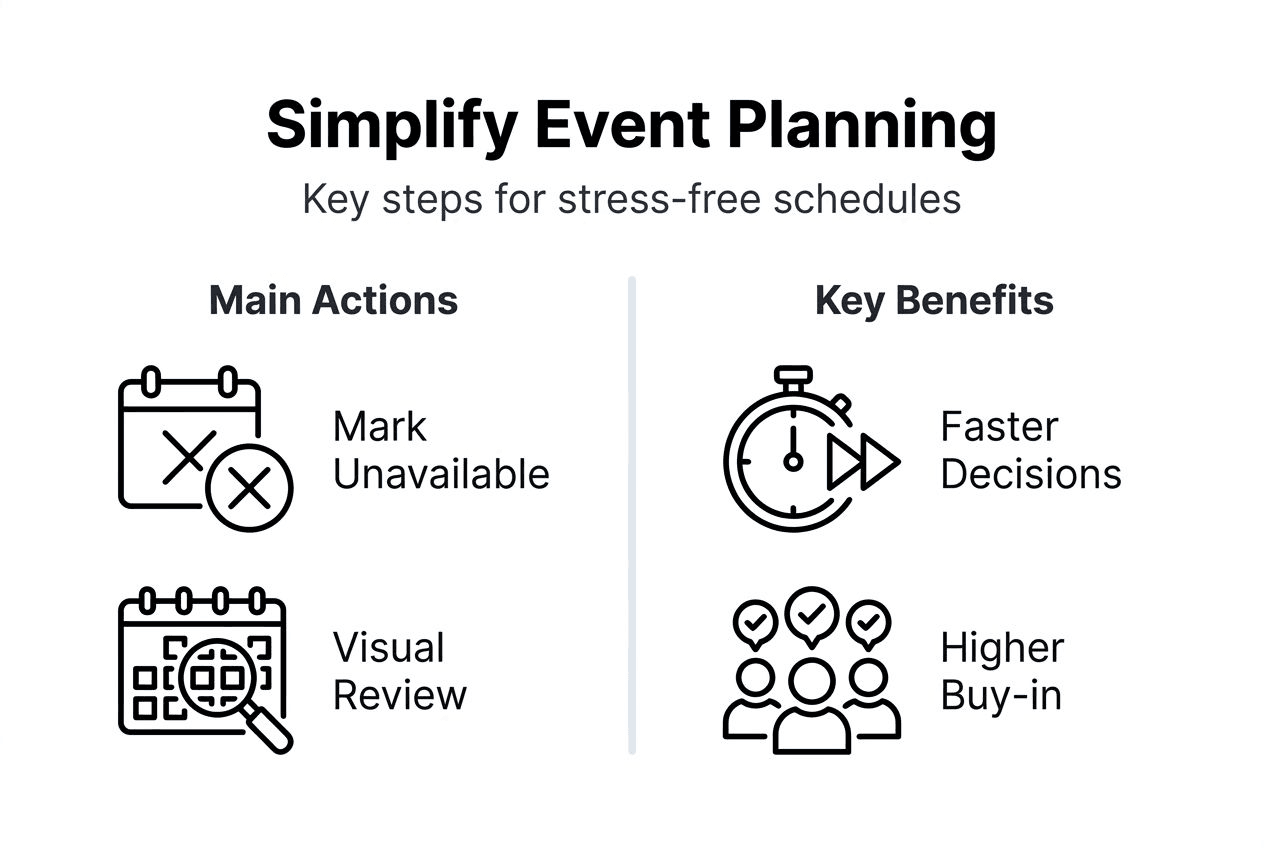
Inverse scheduling flips the coordination question completely. Instead of asking when people are available, it asks when they are not. This simple reversal transforms the participant experience and dramatically improves outcomes.

Marking unavailable dates requires far less effort than listing all available options. Participants quickly block out committed times and submit responses in minutes rather than deliberating over complex calendars. The cognitive load drops substantially.
Inverse scheduling improves participation rates by 25% compared to traditional availability queries. People find the task intuitive and complete it promptly. Higher completion rates give organizers reliable data faster.
Data accuracy improves when participants focus on definite conflicts rather than tentative availability. People know their commitments with certainty but often feel unsure about future flexibility. Asking about constraints captures solid information.
Several advantages make inverse scheduling superior:
- Participants provide only essential conflict data instead of exhaustive availability lists
- Cognitive burden decreases because blocking committed dates feels simpler than proposing options
- Response times accelerate as people quickly mark obvious unavailable periods
- Organizers receive clearer signals about genuine constraints versus preferences
- Visual aggregation of unavailability reveals free windows automatically
Pro Tip: Apply inverse scheduling especially for groups with varied schedules or complex commitments to reach consensus faster and reduce coordinator stress.
This methodology powers why schedule asynchronously event approaches. Studies on scheduling efficiency group events consistently validate inverse methods as game changers for multi-day coordination.
Benefits of visual scheduling and privacy-focused tools
Visualization transforms raw scheduling data into actionable insights instantly. Visual scheduling tools reduce organizer time by 60% by displaying unavailable periods graphically. Patterns emerge immediately that would take hours to identify in text responses.
Organizers scan visual calendars to spot date ranges where most participants remain available. This speeds decision making dramatically while minimizing manual comparison errors. The brain processes visual patterns faster than lists or tables.
Privacy considerations significantly impact participation willingness. Privacy concerns drive 35% of users away from traditional scheduling platforms that demand personal information. Tools respecting privacy boundaries build trust immediately.
No-signup tools increase completion rates by 20% by removing barriers before participants even start. People appreciate frictionless experiences that respect their time and data preferences. This translates directly to faster, more complete scheduling.
| Feature | Traditional Tools | Inverse + Visual + Privacy Tools |
|---|---|---|
| Signup required | Yes | No |
| Data input burden | High (full availability) | Low (conflicts only) |
| Completion rate | Baseline | 20% higher |
| Organizer time | Baseline | 60% reduction |
| Privacy protection | Limited | Strong |
| Participant trust | Lower | Higher |
Key advantages of modern tools include:
- Visual conflict displays eliminate manual calendar comparison work
- Privacy-first design removes signup friction and builds immediate trust
- Faster pattern recognition helps organizers identify optimal dates in minutes
- Reduced errors from visual verification versus text interpretation
- Higher participant satisfaction from respectful, streamlined experiences
Comparing multi-day event schedulers comparison reveals substantial differences in approach. Smart group calendar tips effortless event planning strategies prioritize these visual and privacy advantages.
Common misconceptions about event planning complexity
Many planners assume sophisticated features create better scheduling outcomes. Reality proves the opposite. Simplicity leads to 30% higher success rates than feature-heavy alternatives that overwhelm users with options.
The belief that adding complexity solves scheduling problems persists despite evidence. Complex interfaces confuse participants and slow responses. Organizers spend more time learning tools than actually coordinating events.
Privacy and ease of use drive adoption far more powerfully than feature counts. Prioritizing user privacy improves adoption by 15% because participants feel respected and secure. Simple, transparent processes inspire confidence.
Several myths deserve debunking:
- More features equal better results (false, simplicity wins)
- Participants need detailed calendars and advanced options (false, minimal input works better)
- Privacy matters less than functionality (false, privacy builds essential trust)
- Complex tools appear more professional (false, usability trumps appearance)
- Traditional methods work fine with enough effort (false, structural inefficiency remains)
Planners should prioritize approaches reducing cognitive load over those adding capabilities. The best solutions feel invisible, requiring minimal learning while delivering maximum value. Participants complete tasks quickly without consulting help documentation.
This connects to broader key challenges in event planning where simplification consistently outperforms complication. Understanding these misconceptions helps organizers choose effective tools.
Practical frameworks for effective event planning
Structured planning frameworks reduce errors by 25% by providing clear steps organizers follow systematically. Breaking coordination into phases prevents missed details and keeps progress visible.
A four-phase model streamlines multi-day scheduling:
- Collect inverse availability by sharing a simple link where participants mark unavailable dates only
- Resolve conflicts visually by reviewing aggregated unavailability to identify free windows automatically
- Select optimal dates based on maximum participation and minimal disruption to attendees
- Confirm details by communicating final dates clearly and collecting any remaining logistics
Collecting unavailability first minimizes participant burden immediately. People invest minimal time blocking conflicts, creating positive momentum from the start. Quick wins encourage continued engagement.
Visual conflict resolution accelerates organizer decisions dramatically. Instead of comparing text responses manually, organizers scan graphical displays to spot patterns instantly. This phase moves from hours to minutes.
Clear confirmation streamlines final communication and locks plans. Participants receive definite dates with context about why those options work best. This reduces confusion and builds confidence in the planning process.
Following this framework systematically prevents common pitfalls like incomplete data collection, delayed decisions, or miscommunication about final plans. Each phase builds on the previous one logically.
This structured approach aligns with step by step event planning multi day retreats best practices that emphasize clarity and sequential progress.
Real-world applications and case studies
Corporate retreat organizers report dramatic improvements with inverse scheduling. Corporate scheduling time reduced by 75% using visual, privacy-focused tools versus traditional email coordination. Days of work compressed into hours.
Family gatherings benefit equally from simplified approaches. Privacy-friendly tools that skip signup requirements see higher participation from older relatives and busy parents. Confusion drops when interfaces stay simple and tasks stay minimal.
Group travel planning becomes manageable when visual calendars display conflicts clearly. Organizers identify workable date ranges quickly even with diverse participant schedules across time zones. Booking confidence increases when coordination feels solid.
User testimonials consistently praise intuitive interfaces that respect their time. Participants appreciate tools that ask only essential questions and protect personal information. Organizers value the speed and reliability of modern scheduling methods.
Real outcomes across event types include:
- Corporate events scheduled in hours instead of weeks through visual conflict resolution
- Family gatherings achieving near-complete participation with no-signup tools
- Group travel plans confirmed faster with asynchronous inverse scheduling
- Reduced coordinator stress from simplified workflows and automated aggregation
- Higher satisfaction ratings from both organizers and participants
These cases validate simplified scheduling across diverse contexts. Whether coordinating professional retreats or casual gatherings, the principles remain consistent. Efficiency comes from respecting participant time and cognitive capacity.
Practical multi-day event tips easy group planning build on these proven results. Comprehensive group event logistics guide simplify planning resources document similar successes.
Conclusion: Making event planning streamlined and stress-free
Simplified scheduling eliminates delays and participant confusion that plague traditional coordination. Inverse methods asking for unavailability rather than availability reduce cognitive burden substantially. Response rates climb while organizer workload plummets.
Visual tools and privacy-focused design empower both planners and participants. Seeing conflicts graphically accelerates decisions. Respecting privacy builds trust and completion rates. These advantages compound into dramatically better experiences.
Adopting structured frameworks that prioritize simplicity leads to smoother, faster coordination. Multi-day events that once took weeks to schedule now resolve in days or hours. Participants feel respected rather than burdened.
The evidence overwhelmingly supports moving beyond traditional scheduling approaches. Modern tools delivering inverse scheduling, visual conflict resolution, and privacy protection consistently outperform conventional methods across every metric that matters.
Start simplifying your multi-day event scheduling today to experience these benefits firsthand. The transformation from frustrating coordination to effortless planning happens quickly once you embrace methods designed around participant needs and organizer efficiency.
Streamline your event planning with WhenNOT
Tired of scheduling headaches eating your time? WhenNOT applies inverse scheduling principles that ask participants only when they are unavailable, cutting coordination time dramatically. Visual calendars show conflicts instantly, helping you identify perfect dates without endless back-and-forth messages.
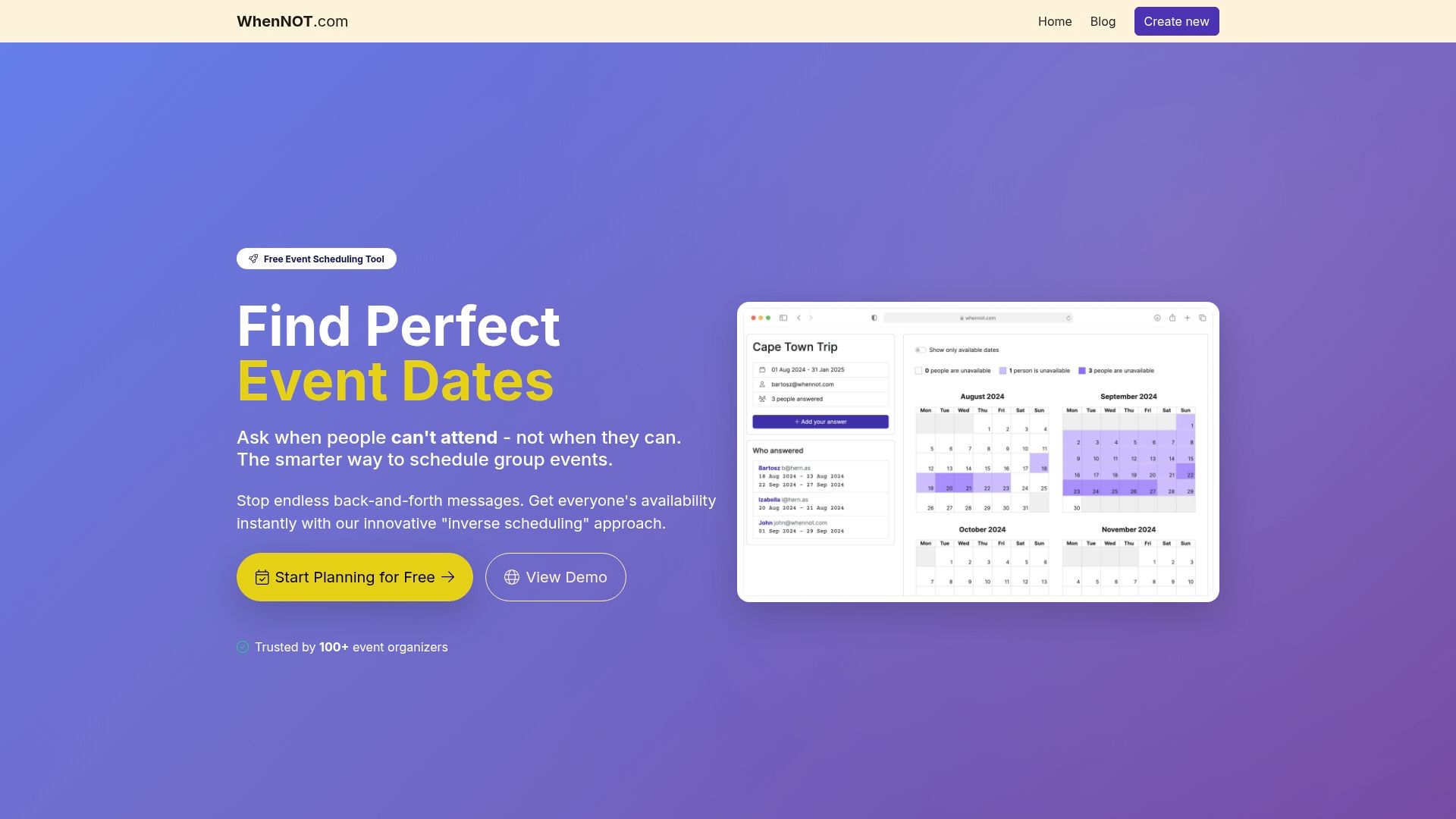
No signup required means participants respond immediately without friction. Your privacy stays protected while completion rates soar. Whether planning corporate retreats, family gatherings, or group travel, WhenNOT delivers the simplicity and speed modern event coordination demands. Try WhenNOT today and discover how fast multi-day scheduling becomes when tools work with you, not against you.
Frequently asked questions
What is inverse scheduling and how does it work?
Inverse scheduling collects when participants are not available instead of requesting full availability listings. This approach reduces cognitive load substantially because marking definite conflicts requires less thought than proposing tentative options. Organizers receive clearer data faster, then identify optimal dates by finding gaps in unavailability patterns visually.
Why do traditional scheduling tools reduce participant engagement?
Signup friction lowers engagement rates by 20% because creating accounts feels burdensome before tasks even begin. Traditional tools also require participants to enumerate all available times, which demands extensive mental effort and calendar review. No-signup tools with simpler input methods dramatically improve completion rates and response speed.
How can visual scheduling tools improve event planning?
Visual calendars cut organizer time by 60% by aggregating unavailable periods into graphical displays that reveal patterns instantly. Organizers spot free date ranges immediately without manually comparing text responses or spreadsheets. This visual approach reduces errors substantially while accelerating decisions from hours to minutes.