
Coordinating multi-day corporate retreats across time zones and varied work styles is often an exercise in frustration for North American event planners. Balancing everyone's availability can mean long email chains and constant rescheduling. Temporal flexibility with asynchronous scheduling turns this challenge into an opportunity, making group participation possible without the need for everyone to meet at the same hour. Discover practical models and smart strategies that simplify planning, reduce stress, and help each participant contribute on their own terms.
Table of Contents
- Asynchronous Scheduling Defined for Groups
- Types of Asynchronous Scheduling Models
- How Inverse Scheduling Streamlines Planning
- Advantages Over Traditional Synchronous Methods
- Common Barriers and Solutions in Practice
Key Takeaways
| Point | Details |
|---|---|
| Asynchronous Scheduling Benefits | Enhances group collaboration by allowing members to engage on their own time, thereby reducing scheduling conflicts and increasing productivity. |
| Diverse Scheduling Models | Various models like Fully Self-Paced and Hyflex support different group needs, enabling tailored approaches to collaboration. |
| Inverse Scheduling Strategy | Focusing on desired outcomes before scheduling promotes efficient planning and minimizes conflicts, aligning with participant requirements. |
| Addressing Barriers | Proactive solutions to challenges such as technology access and reduced motivation enhance participant engagement and collaboration in asynchronous settings. |
Asynchronous Scheduling Defined for Groups
Asynchronous scheduling represents a revolutionary approach to coordinating group activities where participants engage and contribute on their own time, without requiring simultaneous participation. Unlike traditional scheduling methods that mandate everyone being available at the exact same moment, this strategy provides temporal flexibility that accommodates diverse schedules and working styles.
In group contexts, asynchronous scheduling enables diverse participation across different time zones, work patterns, and personal constraints. This approach offers several critical advantages:
- Eliminates rigid time requirements
- Supports global team collaboration
- Allows individual contribution windows
- Reduces scheduling conflicts
- Increases overall group productivity
The core principle of asynchronous scheduling revolves around creating structured yet flexible interaction frameworks. Participants can access materials, contribute inputs, and engage with group tasks according to their individual availability. Collaborative learning becomes more accessible through personalized engagement without compromising communication quality.
Asynchronous scheduling transforms rigid time constraints into adaptive collaboration opportunities.
Successful implementation requires thoughtful design, clear communication protocols, and technological tools that facilitate seamless information sharing. Event planners must establish clear expectations, deadlines, and documentation processes to maintain accountability and momentum.
Pro tip: Implement clear response windows and use collaborative platforms that timestamp and track individual contributions to maintain group accountability.
Types of Asynchronous Scheduling Models
Asynchronous scheduling offers multiple sophisticated models designed to accommodate diverse group dynamics and collaboration needs. Multiple approaches exist for structuring flexible interactions that prioritize individual participant availability and engagement.
The primary asynchronous scheduling models include:
- Fully Self-Paced Model: Participants progress independently without fixed meeting times
- Instructor-Guided Model: Structured with set deadlines but flexible access windows
- Blended Interaction Model: Combines asynchronous content with occasional synchronous check-ins
- Hyflex Model: Allows participants to choose synchronous or asynchronous participation
Course modalities demonstrate significant variations in how these models can be implemented. Each approach requires careful design to balance participant autonomy with collaborative requirements.

Here's a comparison of major asynchronous scheduling models and when each excels:
| Model Name | Best Use Case | Key Flexibility Aspect |
|---|---|---|
| Self-Paced | Independent learning or research | No set deadlines, complete autonomy |
| Instructor-Guided | Coursework with clear milestones | Flexible access, structured timelines |
| Blended Interaction | Team projects needing occasional sync | Mix of flexible work and brief meetings |
| Hyflex | Mixed-format teams or classes | Choice of live or on-demand participation |
Effective asynchronous models transform rigid schedules into adaptive collaborative experiences.
Successful implementation demands robust communication protocols, clear expectations, and technological platforms that facilitate seamless information sharing across different time zones and individual schedules. Event planners must strategically select models that align with their specific group's characteristics and objectives.
Pro tip: Evaluate your group's unique needs and select an asynchronous scheduling model that provides maximum flexibility while maintaining clear accountability mechanisms.
How Inverse Scheduling Streamlines Planning
Inverse scheduling transforms traditional planning approaches by fundamentally rethinking how event coordination occurs. Instead of starting with available time slots, this method begins with desired outcomes and participant constraints, creating a more strategic and efficient planning process.
The key characteristics of inverse scheduling include:
- Goal-First Approach: Define end objectives before scheduling
- Constraint-Driven Design: Prioritize participant requirements
- Conflict Minimization: Systematically reduce scheduling conflicts
- Dynamic Adaptation: Flexible framework for changing needs
- Efficient Resource Allocation: Optimize time and participant engagement
Academic scheduling demonstrates precise algorithmic optimization through this innovative method. By reversing traditional scheduling logic, planners can generate more intelligent, responsive event structures that align closely with group dynamics and individual preferences.
Inverse scheduling turns rigid time management into a strategic, participant-centric planning tool.
Successful implementation requires advanced technological platforms that can process complex scheduling constraints and generate optimal time allocations. Event planners must develop sophisticated understanding of participant needs, technological capabilities, and strategic planning techniques.
Pro tip: Map out your event's core objectives and participant constraints before attempting to schedule, creating a more intentional and flexible planning framework.
Advantages Over Traditional Synchronous Methods
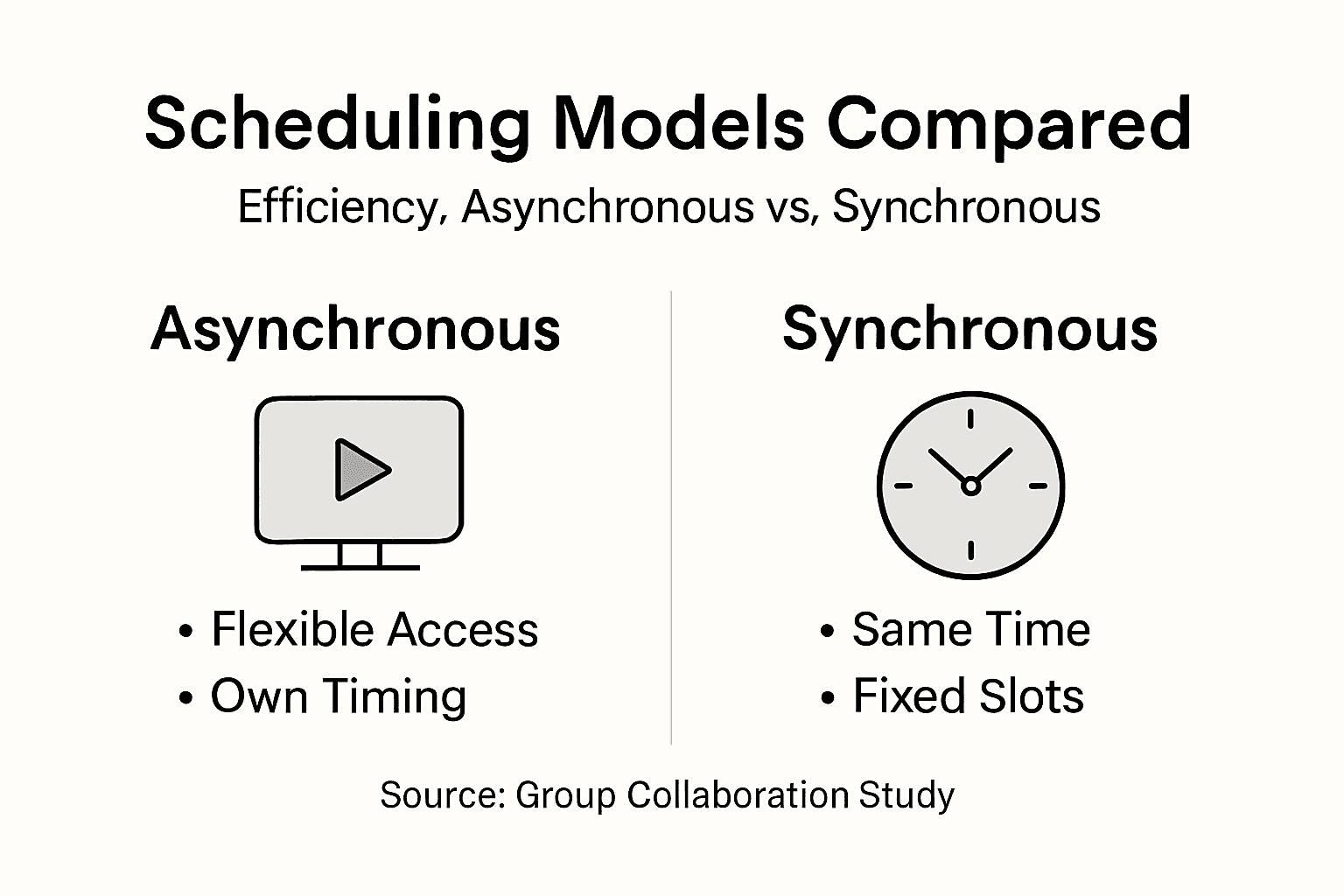
Asynchronous methods fundamentally transform group interaction dynamics by eliminating the rigid constraints of simultaneous participation. Unlike traditional synchronous approaches that demand everyone be present at identical moments, these innovative strategies prioritize individual flexibility and personalized engagement.
Key advantages of asynchronous scheduling include:
- Flexible Time Management: Participants contribute according to their own schedules
- Reduced Scheduling Conflicts: Eliminates time zone and availability barriers
- Enhanced Individual Reflection: Allows deeper processing of information
- Lower Cognitive Load: Removes real-time response pressure
- Improved Accessibility: Supports diverse participant needs
Comparative studies reveal significant performance benefits for learners and teams utilizing asynchronous methods. By decoupling time from participation, these approaches create more inclusive and adaptable collaborative environments that respect individual working rhythms and personal constraints.
Asynchronous methods transform rigid scheduling from a constraint into a strategic advantage.
Successful implementation requires robust technological platforms and intentional design that compensates for potential limitations in immediate interaction. Event planners must develop sophisticated strategies that maintain group cohesion while providing maximum individual flexibility.
Pro tip: Design asynchronous interactions with clear guidelines and structured checkpoints to maintain accountability and ensure consistent group progress.
Common Barriers and Solutions in Practice
Technological and motivational challenges persist in asynchronous scheduling methods, requiring strategic interventions and thoughtful design to ensure successful implementation across diverse group contexts. Understanding these barriers is crucial for developing robust, adaptive scheduling approaches that maintain participant engagement and productivity.
Key barriers and corresponding solutions include:
-
Technological Access Limitations
- Solution: Provide multiple platform options
- Ensure cross-device compatibility
- Offer technical support resources
-
Motivation and Self-Discipline Challenges
- Solution: Create structured participation guidelines
- Design engaging, interactive content
- Implement regular feedback mechanisms
-
Reduced Social Interaction
- Solution: Foster virtual community engagement
- Use collaborative tools
- Design interactive group activities
Semi-automated scheduling systems offer promising optimization strategies that balance institutional requirements with individual preferences. These advanced platforms can dynamically adjust schedules, reducing manual coordination efforts while maintaining flexibility for unique participant needs.
The table below highlights typical challenges in asynchronous scheduling and how proactive measures can address them:
| Challenge | Proactive Solution | Positive Outcome |
|---|---|---|
| Limited tech accessibility | Offer device-agnostic platforms | Broader, more inclusive access |
| Decreased motivation | Provide regular feedback loops | Higher participant engagement |
| Weak social connection | Schedule virtual networking events | More connected remote teams |
Effective asynchronous scheduling transforms barriers into opportunities for innovative collaboration.
Successful implementation demands a holistic approach that combines technological solutions, clear communication protocols, and adaptive design strategies. Event planners must continuously evaluate and refine their approaches to address emerging challenges and participant feedback.
Pro tip: Develop a comprehensive onboarding process that introduces participants to asynchronous scheduling tools and establishes clear expectations for engagement and communication.
Simplify Your Group Event Planning with WhenNOT's Inverse Scheduling
The article highlights how asynchronous and inverse scheduling solve the pain of coordinating multiple participants with complex and conflicting availabilities. If you find traditional scheduling methods frustrating because they demand everyone to reply with their full availability, WhenNOT offers a stress-free alternative. It addresses key challenges such as reducing scheduling conflicts, eliminating rigid time constraints, and boosting overall event efficiency by focusing on when participants are not busy rather than when they are free.
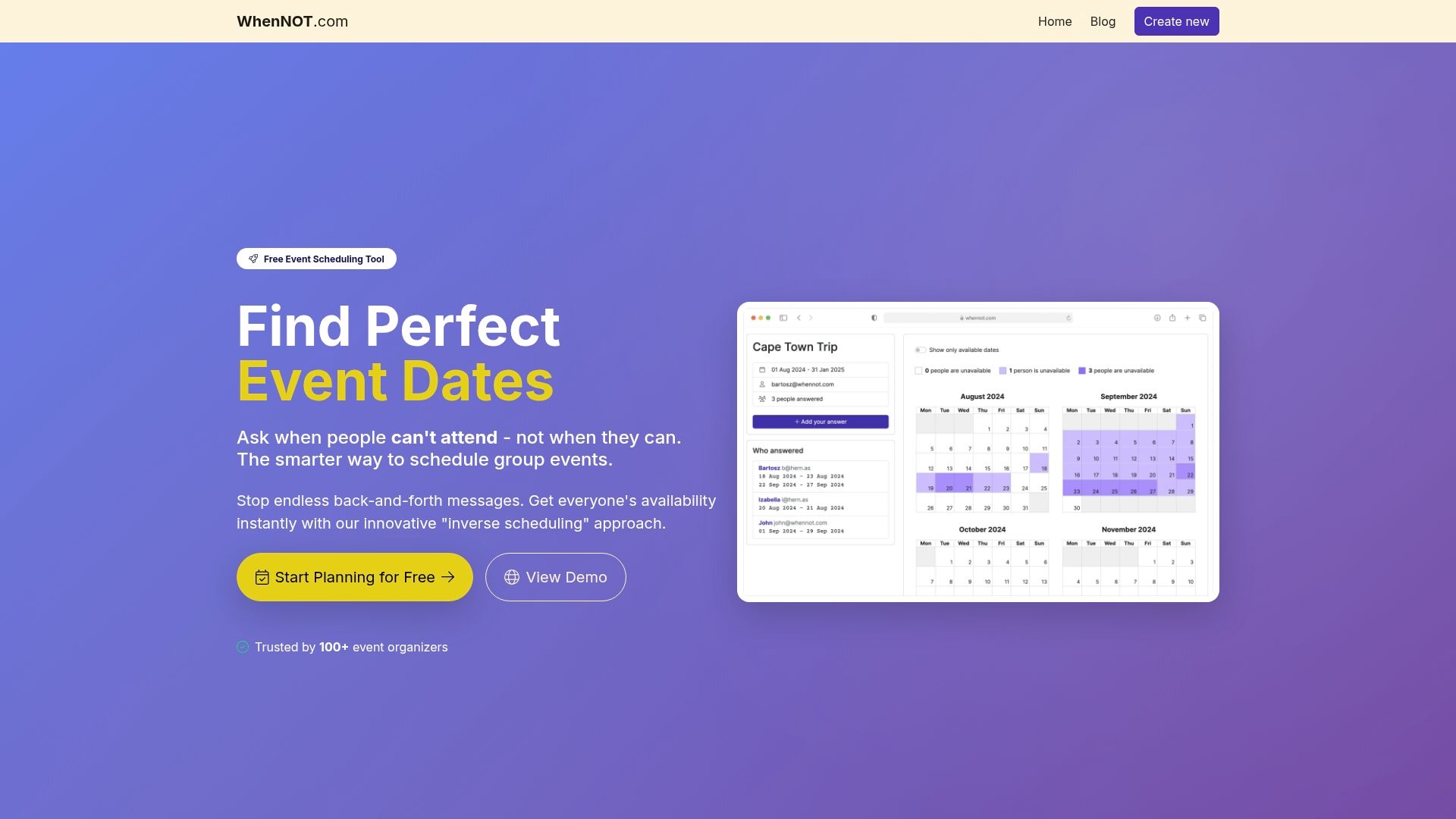
Experience the power of an innovative scheduling tool that uses the inverse scheduling approach to streamline your planning process. With WhenNOT, you can create events, set flexible date ranges, and share unique links with participants who simply mark their unavailable times without needing accounts or lengthy back-and-forths. This makes it ideal for complex, multi-day, or flexible date events mentioned in the article. Don’t let rigid scheduling hold your events back. Visit WhenNOT now to simplify coordination and save valuable time with asynchronous scheduling made effortless.
Frequently Asked Questions
What is asynchronous scheduling?
Asynchronous scheduling is a method that allows participants to engage in group activities and contribute on their own timelines, rather than requiring everyone to be present simultaneously.
What are the benefits of using asynchronous scheduling for events?
The benefits include greater flexibility, reduced scheduling conflicts, enhanced individual reflection, improved productivity, and the ability to accommodate diverse time zones and personal schedules.
How do I implement asynchronous scheduling effectively?
To implement asynchronous scheduling effectively, ensure clear communication protocols, set expectations and deadlines, and use technological tools that facilitate collaboration and information sharing among participants.
What are some common challenges with asynchronous scheduling and how can I overcome them?
Common challenges include technological access limitations, motivation issues, and reduced social interaction. To overcome these, provide tech support, create engaging content, and foster virtual community engagement.