
Juggling calendars and tracking availability for a multi-day corporate retreat can quickly become overwhelming, especially when working with busy teams from across the world. The challenge of avoiding scheduling conflicts and meeting everyone’s needs makes group event coordination a high-stakes task for any planner or team leader. By embracing multidimensional coordination strategies that factor in timing, objectives, and team dynamics, you can simplify even the most complex events while fostering genuine collaboration.
Table of Contents
- Defining Group Event Coordination Methods
- Key Event Types And Scheduling Models
- How Inverse Scheduling Simplifies Planning
- Tools For Efficient Multi-Day Coordination
- Avoiding Common Pitfalls And Missteps
Key Takeaways
| Point | Details |
|---|---|
| Flexible Coordination Methods | Prioritize methods that adapt to individual participant constraints while achieving group objectives. |
| Technological Integration | Utilize advanced tools for real-time scheduling, communication, and resource management to streamline planning. |
| Outcome-Oriented Planning | Begin with desired event outcomes and work backward to create an efficient and adaptable scheduling framework. |
| Clear Communication Protocols | Establish specific communication channels and protocols to prevent misunderstandings and enhance coordination. |
Defining Group Event Coordination Methods
Group event coordination represents a strategic approach to synchronizing multiple participants' schedules, availability, and logistical requirements for successful multi-day gatherings. By integrating comprehensive planning techniques, teams can minimize scheduling conflicts and maximize collaborative potential.
Researchers have developed sophisticated frameworks for understanding group coordination, exploring multiple dimensions beyond traditional scheduling methods. Multidimensional coordination strategies now incorporate semantic, social, and temporal relationship analysis to create more nuanced event planning approaches. These advanced techniques go far beyond simple calendar matching, considering complex interpersonal dynamics and contextual constraints.
Key dimensions of effective group event coordination include:
Here is a comparison of core group event coordination methods and their strategic impact:
| Coordination Method | Main Focus | Business Impact |
|---|---|---|
| Temporal Synchronization | Aligning participant timing | Reduces scheduling conflicts |
| Spatial Considerations | Location and logistics | Improves attendance and access |
| Semantic Alignment | Matching event objectives | Boosts engagement and relevance |
| Social Network Dynamics | Interpersonal relationships | Enhances collaboration potential |
- Temporal Synchronization: Identifying overlapping availability windows
- Spatial Considerations: Understanding geographical and logistical constraints
- Semantic Alignment: Matching participant goals and event objectives
- Social Network Dynamics: Evaluating interpersonal relationships and communication patterns
Modern coordination methods leverage technology to streamline these complex interactions, transforming traditional planning processes. Event coordination techniques now utilize advanced data integration strategies that help teams quickly identify optimal meeting times and locations.
Pro tip: Prioritize flexible coordination methods that accommodate individual participant constraints while maintaining overall group objectives.
Key Event Types and Scheduling Models
Event coordination encompasses a diverse range of gathering types, each requiring unique scheduling approaches and logistical considerations. From corporate conferences to social gatherings, understanding the nuanced scheduling requirements becomes critical for successful event management.
Large-scale event scheduling models demonstrate remarkable complexity across different event formats, revealing the importance of adaptable coordination strategies. Professional event planners must navigate intricate stakeholder requirements, resource allocations, and timing constraints specific to each event type.
Key event types with distinct scheduling models include:
- Corporate Conferences: Structured multi-day events with precise agenda management
- Academic Symposiums: Research-focused gatherings with complex participant availability
- Industry Trade Shows: Large-scale exhibitions requiring intricate logistics coordination
- Team Retreats: Collaborative meetings emphasizing interpersonal scheduling dynamics
- Professional Workshops: Skill-development events with specialized participant constraints
Each event type demands a tailored approach to scheduling, considering factors like participant availability, geographical constraints, and specific organizational objectives. Successful coordination requires flexible models that can adapt to unique contextual requirements while maintaining overall event goals.

To summarize, here's how major event types set unique scheduling priorities:
| Event Type | Typical Priority | Scheduling Challenge |
|---|---|---|
| Corporate Conference | Agenda structure | Coordinating large groups |
| Symposium | Speaker alignment | Researcher availability |
| Trade Show | Booth logistics | Dynamic vendor needs |
| Team Retreat | Interpersonal focus | Balancing team preferences |
| Workshop | Skill development slots | Specialized time constraints |
Pro tip: Develop a comprehensive scheduling framework that accommodates individual participant constraints while maintaining the overarching event objectives.
How Inverse Scheduling Simplifies Planning
Inverse scheduling represents a revolutionary approach to event planning that fundamentally transforms traditional coordination strategies. Instead of starting with available dates, this method begins with the desired event outcomes and works backward to identify optimal scheduling windows.
Innovative scheduling methodologies enable event planners to streamline complex multi-day gatherings by focusing on critical milestones and dependencies. This approach allows teams to navigate scheduling challenges more efficiently, reducing time spent on coordination and minimizing potential conflicts.
Key advantages of inverse scheduling include:
- Outcome-Oriented Planning: Prioritizing event goals over arbitrary time slots
- Flexible Time Management: Creating adaptable scheduling frameworks
- Conflict Reduction: Identifying potential scheduling obstacles early
- Strategic Resource Allocation: Optimizing participant and resource availability
- Simplified Decision-Making: Providing clear pathways for event coordination
The methodology breaks down traditional scheduling barriers by reframing how event planners approach time management. Emergency coordination models demonstrate how working backward from critical deadlines can dramatically improve planning efficiency and reduce overall coordination complexity.
Pro tip: Start your event planning by clearly defining end goals, then work backward to create a flexible and efficient scheduling framework.
Tools for Efficient Multi-Day Coordination
Effective multi-day event coordination requires sophisticated technological solutions that can manage complex scheduling challenges and streamline communication across diverse participant groups. Modern event planning demands tools that go beyond traditional calendar management, offering integrated approaches to synchronization and collaboration.
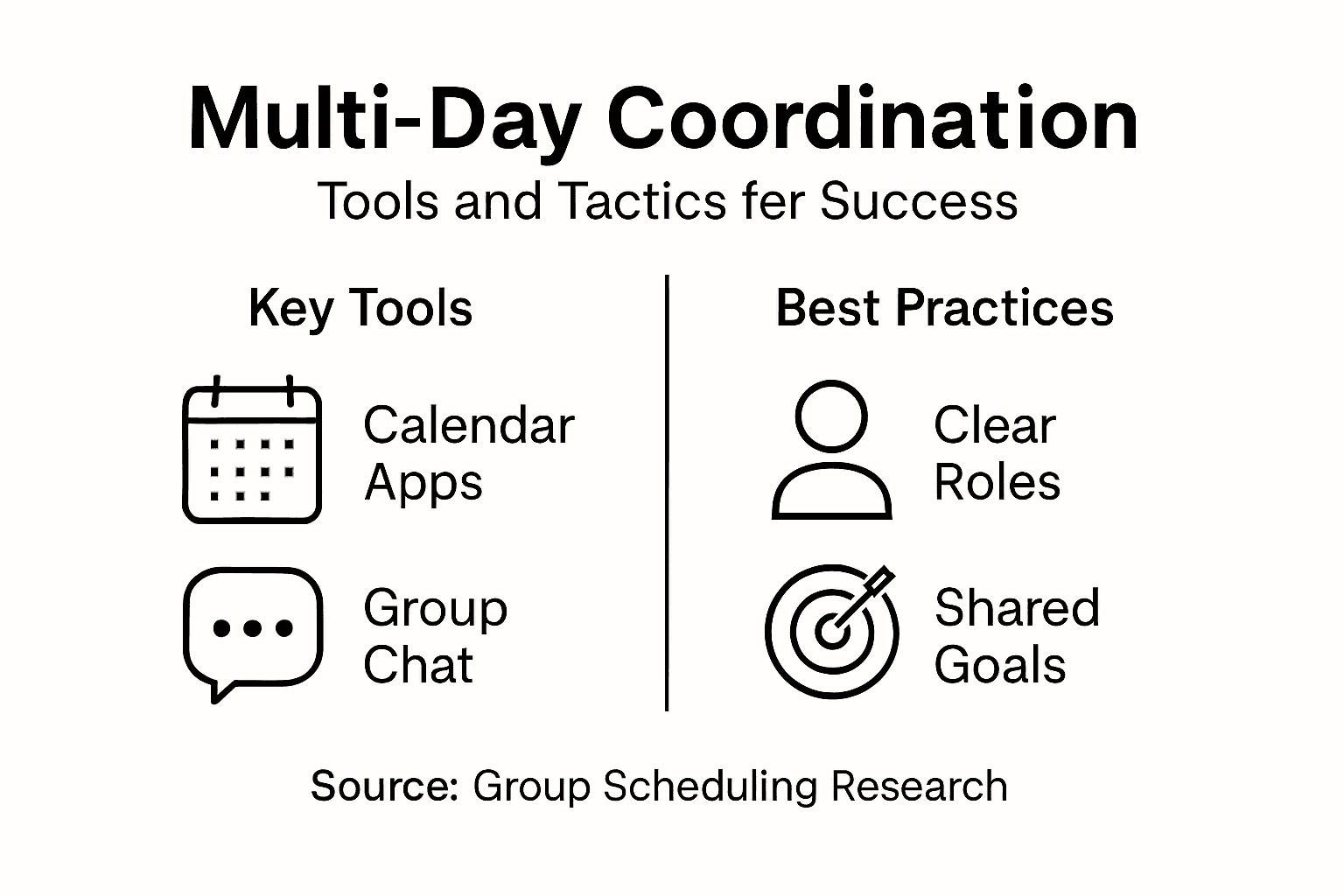
Online event management platforms have revolutionized how teams approach multi-day event planning, providing centralized systems that enable real-time updates and comprehensive resource tracking. These advanced technologies eliminate communication gaps and reduce the potential for scheduling conflicts.
Key technological tools for efficient multi-day coordination include:
- Centralized Scheduling Platforms: Enabling simultaneous availability tracking
- Real-Time Communication Dashboards: Facilitating instant participant updates
- Collaborative Resource Allocation Systems: Managing shared resources dynamically
- Automated Conflict Detection Tools: Identifying potential scheduling overlaps
- Integrated Messaging and Notification Channels: Ensuring seamless team communication
State-of-the-art coordination technologies demonstrate remarkable capabilities in supporting complex event workflows, particularly for multi-day gatherings that require intricate planning and stakeholder engagement. These tools transform traditional event management by providing unprecedented levels of flexibility and precision.
Pro tip: Select coordination tools that offer robust integration capabilities and real-time collaborative features to maximize planning efficiency.
Avoiding Common Pitfalls and Missteps
Successful group event coordination requires more than good intentions; it demands strategic planning and proactive problem prevention. Many event organizers unknowingly compromise their planning by overlooking critical coordination details that can derail even the most well-intentioned gatherings.
Large-scale event coordination challenges reveal systematic pitfalls that consistently undermine group planning efforts. These recurring issues stem from communication breakdowns, inflexible scheduling approaches, and inadequate stakeholder management strategies that create unnecessary complexity.
Common coordination missteps include:
- Poor Communication Protocols: Failing to establish clear communication channels
- Undefined Role Assignments: Lacking clarity on individual responsibilities
- Rigid Scheduling Frameworks: Implementing inflexible time management approaches
- Insufficient Contingency Planning: Neglecting potential disruption scenarios
- Inadequate Participant Tracking: Losing visibility into individual availability
Group coordination failure mechanisms demonstrate that most planning breakdowns occur when teams do not establish shared intentions and collaborative accountability. Successful coordination requires continuous monitoring and adaptive strategies that prioritize collective agency and transparent communication.
Pro tip: Develop a comprehensive communication matrix that outlines specific communication protocols, expected response times, and escalation procedures for potential coordination challenges.
Simplify Your Group Event Coordination with WhenNOT
Planning group events often means juggling complex schedules, avoiding conflicts, and managing ever-changing participant availability. The article highlights challenges such as rigid scheduling frameworks, insufficient participant tracking, and the difficulty of aligning large groups across multiple days. These pain points call for a more flexible and outcome-oriented approach like inverse scheduling, which puts your event goals first and builds the schedule backward for optimal timing.
WhenNOT offers an innovative solution tailored to these exact problems. Unlike traditional tools, it asks participants when they are busy rather than when they are free, instantly simplifying the scheduling process for multi-day events or flexible date ranges. No signups or accounts are needed. You can create an event, share a unique link, and see everyone's unavailable dates visually in one place. This approach reduces communication delays, eases logistical constraints, and enhances collaboration — key factors explained in the article's discussion of event coordination methods.
Ready to take the stress out of planning your next group event? Experience the power of inverse scheduling today.
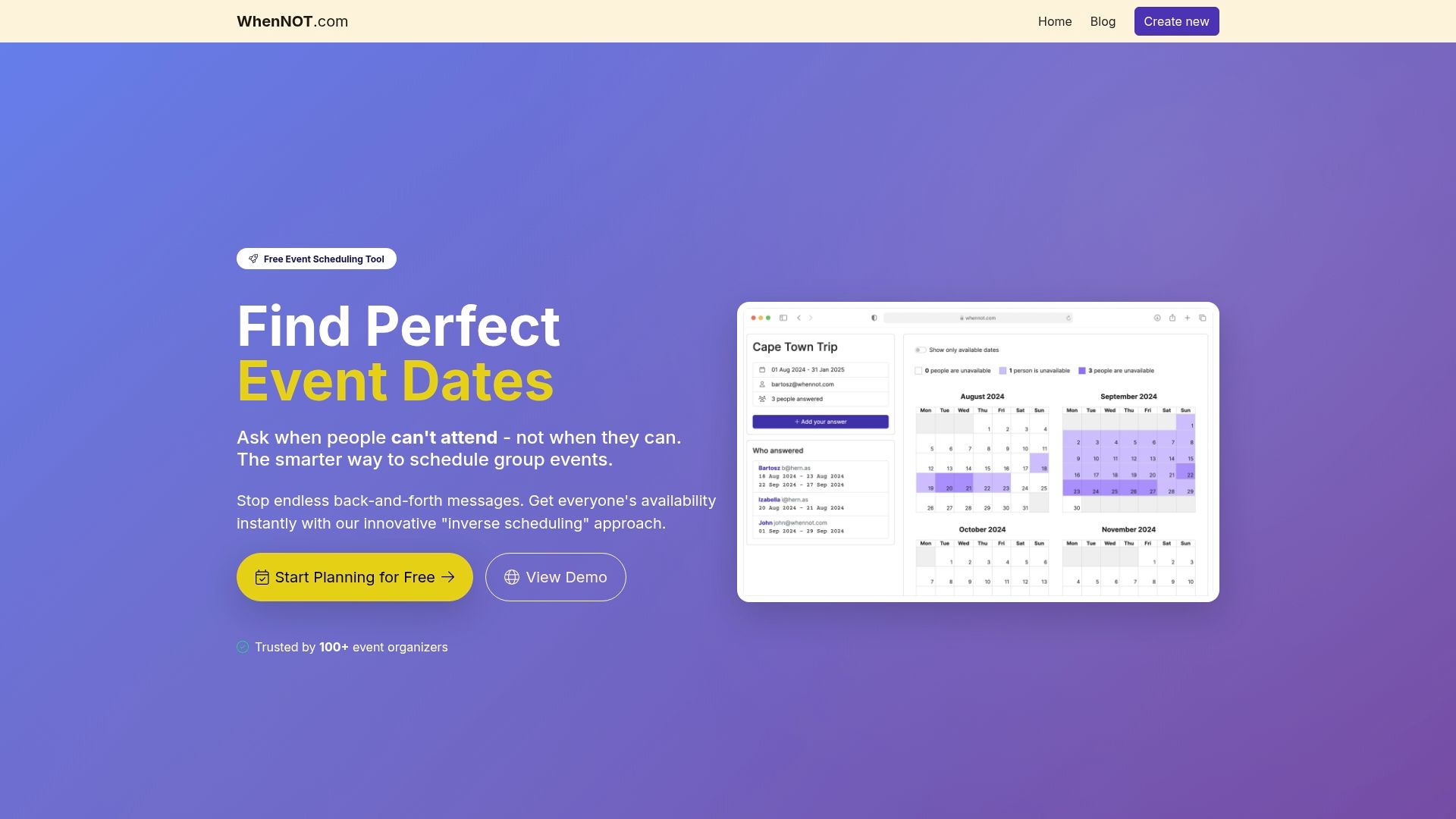
Discover how easy group coordination can be by visiting WhenNOT. Start your free event now and watch scheduling conflicts become a thing of the past. For smarter event planning driven by clear goals and transparent availability, try WhenNOT now and revolutionize your event coordination experience.
Frequently Asked Questions
What are the key methods for effective group event coordination?
The key methods include temporal synchronization for aligning participant timing, spatial considerations for logistics, semantic alignment to match event objectives, and analyzing social network dynamics to enhance collaboration.
How does inverse scheduling improve event planning?
Inverse scheduling improves event planning by starting with desired outcomes and working backward to identify optimal scheduling windows, allowing for better flexibility and reduced conflicts.
What tools can help streamline multi-day event coordination?
Key tools include centralized scheduling platforms for tracking availability, real-time communication dashboards for updates, collaborative resource allocation systems, automated conflict detection tools, and integrated messaging channels.
What common pitfalls should be avoided in group event coordination?
Common pitfalls include poor communication protocols, undefined role assignments, rigid scheduling frameworks, insufficient contingency planning, and inadequate participant tracking.