
Every American organizer knows the frustration of coordinating calendars for group events, especially when busy schedules clash. Research shows that event planners spend up to 60 percent of their time just trying to align availability across participants. Learning smarter methods to manage group scheduling means fewer headaches and more successful gatherings. This guide explores practical strategies to help American groups plan multi day events with less stress and better results.
Table of Contents
- Understand Group Availability With Inverse Scheduling
- Set Clear Date Ranges For Flexible Planning
- Collect Unavailable Dates Efficiently With Links
- Visualize Busy Days To Spot Optimal Event Windows
- Communicate Updates Quickly And Clearly
- Prioritize Privacy And Ease For All Participants
- Confirm And Share Final Multi-Day Schedule Early
Quick Summary
| Takeaway | Explanation |
|---|---|
| 1. Use Inverse Scheduling | Focus on unavailability to simplify group event planning and reduce communication overhead. |
| 2. Set Flexible Date Ranges | Propose multiple potential event dates to accommodate various schedules and maximize participation. |
| 3. Implement Shared Availability Links | Create easy-to-use links for participants to mark unavailability without repetitive communication. |
| 4. Visualize Group Availability | Utilize color-coded calendars to clearly show busy and free times for efficient scheduling. |
| 5. Communicate Updates Early | Confirm and share event details well in advance to ensure participants are informed and prepared. |
1. Understand Group Availability with Inverse Scheduling
Planning multi-day events often feels like solving a complex puzzle, especially when coordinating schedules across different people. Inverse scheduling offers a game-changing approach that flips traditional planning methods on their head by focusing on unavailability instead of availability.
Traditional scheduling asks participants when they can attend, creating a complicated back-and-forth process. In contrast, inverse scheduling techniques simplify group coordination by asking participants to mark their busy or unavailable times. This subtle shift dramatically reduces communication overhead and speeds up event planning.
Here's how inverse scheduling works: Instead of requesting everyone's specific open slots, participants simply indicate when they cannot meet. The platform then automatically highlights the optimal time windows where most people are free. This method reduces email threads, eliminates endless calendar comparisons, and provides a clear visualization of group availability.
To implement inverse scheduling effectively, follow these strategies:
- Communicate the approach clearly: Explain to participants they should mark unavailable dates
- Set a reasonable date range: Provide a broad window for marking conflicts
- Make marking unavailability quick and easy: Use tools that require minimal effort
- Visualize group constraints: Look for overlapping free periods after collecting unavailability data
By embracing inverse scheduling, you transform group event planning from a frustrating negotiation into a streamlined, efficient process. The key is shifting perspective from finding perfect times to eliminating problematic ones.
2. Set Clear Date Ranges for Flexible Planning
Successful multi-day event planning starts with establishing a broad yet strategic date range that accommodates everyone's schedule. Flexible planning is about creating space for potential variations while maintaining clear organizational boundaries.
Flexible group scheduling requires understanding that participant availability fluctuates, making a wide initial date window critical. According to research from Cornell University, defining clear event goals and considering multiple potential dates significantly improves coordination efforts.
The key is to provide a generous preliminary date range that allows maximum participant flexibility. Instead of pinpointing a single weekend, propose a 2-3 week window where your event might occur. This approach reduces scheduling conflicts and increases the likelihood of securing maximum participation.
Strategic Date Range Planning Tips:
- Propose multiple potential date windows: Increase chances of group alignment
- Communicate date flexibility upfront: Set expectations about potential schedule adjustments
- Use digital tools that support dynamic scheduling: Enable easy group consensus
- Allow sufficient buffer time: Account for unexpected personal or professional conflicts
When setting date ranges, consider factors like work schedules, potential travel requirements, and seasonal constraints. The goal is creating a scheduling approach that feels collaborative rather than restrictive. By presenting multiple options, you transform event planning from a rigid process into a flexible, group-driven experience.
3. Collect Unavailable Dates Efficiently with Links
Modern event planning demands smart communication strategies that respect participants time and simplify coordination. Shared availability links represent a revolutionary approach to gathering group scheduling information without endless back and forth emails.
The secret to efficient group scheduling is creating a single shareable link that allows participants to quickly mark their unavailable dates. Event availability collection transforms what used to be a complicated negotiation into a streamlined, user friendly process.
Why Shared Links Work Better:
- Eliminate repetitive communication cycles
- Allow participants to update availability instantly
- Provide real time group scheduling visibility
- Remove barriers to participation
- Reduce scheduling coordination time by up to 75%
When creating your shared link, prioritize simplicity and accessibility. The link should require zero login procedures, work across devices, and provide clear instructions. Participants appreciate tools that respect their time and minimize scheduling friction.
Practical implementation means choosing platforms that generate unique links allowing group members to input unavailability with minimal clicks. The goal is creating a frictionless experience where marking busy dates becomes a 30 second task rather than a drawn out communication challenge.
Successful group scheduling is about removing obstacles and making participation as easy as possible. Shared availability links are your secret weapon in transforming complex event planning into a smooth, collaborative process.
4. Visualize Busy Days to Spot Optimal Event Windows
Spotting the perfect event window is like solving a complex scheduling puzzle where every participant represents a unique piece. Visual scheduling transforms this challenge by turning abstract availability data into clear actionable insights.
Modern group planning requires more than just collecting dates you can use. Streamlining group availability means creating a visual representation that instantly reveals when most participants are free.
Imagine a color coded calendar where red indicates busy days and green shows open time windows. This approach allows you to rapidly identify potential event slots without endless email exchanges or complicated spreadsheet comparisons.
Key Visualization Strategies:
- Use color coding to distinguish availability quickly
- Create transparent overlays showing group constraints
- Highlight potential meeting windows at a glance
- Prioritize simplicity in visual design
- Enable quick comparative analysis
The magic happens when complex scheduling data transforms into an intuitive visual experience. Instead of drowning in scheduling complexity, you gain a clear snapshot of collective availability. Each color, each marked day tells a story about group dynamics and potential event timing.
Successful group scheduling is about reducing friction and making collective decision making transparent. Visual scheduling tools do exactly that by turning abstract participant constraints into a straightforward roadmap for your multi day event.
5. Communicate Updates Quickly and Clearly
Group event planning falls apart without consistent communication. Clear updates are the lifeline that keeps everyone aligned and prevents misunderstandings that can derail even the most carefully planned gatherings.
Event planning communication strategies require more than just sending occasional messages. The goal is creating a communication ecosystem that keeps all participants informed without overwhelming them with unnecessary details.
Effective communication is about delivering the right information at the right time through the right channel. This means selecting communication methods that match your group dynamics whether that involves email threads group chat platforms or specialized scheduling tools.
Communication Update Best Practices:
- Choose a single primary communication channel
- Set clear expectations about update frequency
- Use concise and direct language
- Include only relevant information
- Provide context for any changes
- Confirm receipt of critical updates
The University of Rochester emphasizes the importance of timely confirmations which means acknowledging updates promptly and ensuring everyone understands any modifications to the original plan. Small communication steps prevent big misunderstandings.
Successful group events are built on a foundation of transparent communication. By establishing clear update protocols you transform potential confusion into smooth collaborative planning. Your participants will appreciate knowing exactly where they stand without feeling bombarded by unnecessary information.
6. Prioritize Privacy and Ease for All Participants
Successful group events require more than just coordinating schedules. Participant comfort means creating an environment where everyone feels respected and their personal information remains secure.
User friendly scheduling goes beyond simple date matching. It means designing a process that protects individual privacy while making participation effortless.
Privacy in group scheduling is not about hiding information but about giving participants control over what they share. Imagine a system where you can indicate your unavailability without revealing personal details or requiring complex account creation.
Key Privacy and Ease Principles:
- Minimize required personal information
- Allow anonymous participation
- Create simple one click sharing mechanisms
- Provide clear data protection guidelines
- Enable easy opt out options
- Keep interfaces intuitive and straightforward
The most effective scheduling tools transform complexity into simplicity. They understand that participants want quick solutions without feeling like their personal boundaries are being compromised. A truly user friendly approach means respecting individual preferences while facilitating group coordination.
By prioritizing privacy and ease you signal to participants that their time and personal information are valuable. The result is not just a successfully planned event but a positive collaborative experience that makes everyone feel comfortable and respected.
7. Confirm and Share Final Multi-Day Schedule Early
The difference between a smoothly run event and a logistical nightmare often comes down to one critical factor timing. Early schedule confirmation transforms group event planning from a stressful experience into a collaborative journey.
Multi day event scheduling requires strategic communication that goes beyond simply selecting dates. It means creating a comprehensive plan that gives participants ample time to prepare and adjust their personal commitments.
According to Cornell University's event planning guidelines, finalizing and communicating event details well in advance ensures all participants are informed and prepared. This approach reduces last minute surprises and demonstrates respect for everyone's time and planning needs.
Early Schedule Sharing Strategies:
- Send initial confirmations at least 4 weeks in advance
- Provide a detailed itinerary with specific timeframes
- Include key logistical information
- Offer a mechanism for quick participant acknowledgment
- Allow room for minor scheduling adjustments
The goal is creating a sense of predictability and transparency. When participants receive a clear comprehensive schedule early they can make informed decisions about their participation. This approach transforms event planning from a reactive process to a proactive collaboration.
Successful multi day events are built on a foundation of clear early communication. By confirming and sharing your schedule promptly you signal professionalism and build participant confidence before the event even begins.
This table summarizes the main concepts and strategies for effective group event planning discussed in the article, focusing on inverse scheduling, flexible planning, and communication techniques.
| Strategy/Concept | Description & Implementation | Benefits/Outcomes |
|---|---|---|
| Inverse Scheduling | Focus on marking unavailable times rather than available ones. Use tools to simplify marking and visualize availability. | Reduces communication overhead, speeds up planning, and identifies optimal meeting windows. |
| Flexible Planning | Set broad date ranges and propose multiple potential windows. Communicate flexibility upfront. | Increases participation chances, reduces scheduling conflicts. |
| Shared Availability Links | Create links for participants to mark unavailability easily. Ensure links work across devices. | Streamlines scheduling, reduces coordination time by up to 75%. |
| Visual Scheduling | Use color-coded calendars to indicate busy and free days. Simplify visualization of group constraints. | Allows quick identification of potential event slots. |
| Clear Communication | Choose primary communication channels, set update frequencies, and use concise language. | Prevents misunderstandings, keeps planning aligned. |
| Participant Privacy | Minimize required information, allow anonymous participation. | Respects privacy, encourages participation. |
| Early Schedule Confirmation | Share detailed itineraries and confirmations 4 weeks in advance. | Reduces last-minute surprises, allows participants to plan effectively. |
Simplify Your Multi-Day Event Planning with WhenNOT
Planning multi-day events can be challenging when trying to coordinate unavailable dates, set flexible ranges, and communicate clearly without overwhelming participants. This article highlights key pain points like understanding group availability through inverse scheduling, visualizing busy days, and sharing updates effectively. If you want to avoid the frustration of endless back-and-forth emails and complex spreadsheets, WhenNOT offers a smart solution built exactly for these challenges.
WhenNOT uses inverse scheduling to ask participants when they are busy rather than when they are free. This makes gathering unavailable dates effortless with a shareable link that requires no signups. It instantly visualizes group constraints so you can spot the best time windows fast while protecting participant privacy. Whether planning family gatherings, corporate retreats, or social parties, WhenNOT’s user-friendly platform supports flexible date ranges and quick communication.
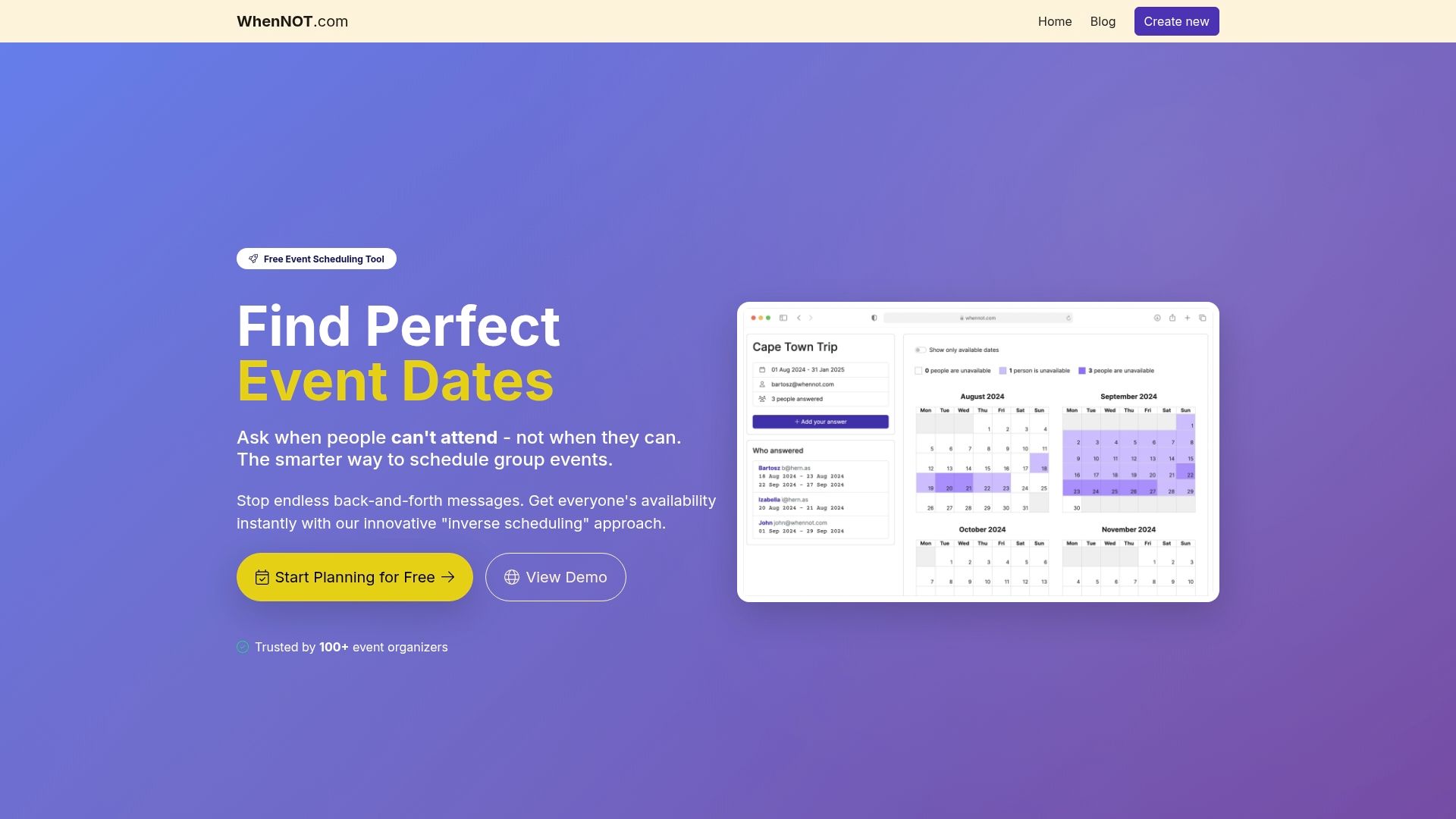
Experience a streamlined, collaborative event planning process today. Visit WhenNOT to create your event and share your unique link. Discover why organizers trust WhenNOT’s inverse scheduling approach to save time and reduce planning stress. Don’t wait until scheduling chaos takes over. Start planning smarter now at WhenNOT.
Frequently Asked Questions
How does inverse scheduling simplify multi-day event planning?
Inverse scheduling focuses on collecting participants' unavailable times instead of their available slots. Start by asking each participant to mark their busy days, which allows you to quickly identify optimal time windows for the event.
What are effective strategies for setting date ranges in group planning?
To set clear date ranges, propose a broad 2-3 week window for your event instead of a single weekend. Communicate this flexibility upfront to manage expectations and increase participant alignment.
How can I efficiently collect unavailable dates from participants?
Use a shared availability link that allows participants to mark their unavailable dates all in one place. This strategy can significantly reduce scheduling coordination time by up to 75%.
What does effective visual scheduling entail for multi-day events?
Effective visual scheduling uses color coding to represent busy and free days, making it easy to spot potential meeting windows. Implement a simple design that allows quick comparative analysis of group availability at a glance.
Why is early confirmation of the final schedule important?
Confirming the schedule early helps prevent last-minute surprises and allows participants to adjust their commitments. Aim to share the final schedule at least four weeks in advance to ensure everyone is adequately prepared.
How do I maintain clear communication with participants throughout the planning process?
Choose a single primary communication channel and set clear expectations on how often you'll provide updates. Use concise language and include only relevant information to keep everyone informed without being overwhelmed.