
Coordinating group events traditionally wastes hours in endless email chains and conflicting calendars. Research shows inverse scheduling methods can reduce event planning time by up to 45% compared to conventional polling approaches. Scalable scheduling offers a smarter way to coordinate multi-day events by asking participants when they're unavailable rather than available, fundamentally transforming how you organize team gatherings, corporate retreats, and group travel.
Table of Contents
- Introduction To Scalable Scheduling
- How Scalable Scheduling Works: The Inverse Scheduling Approach
- Why Scalable Scheduling Matters For Multi-Day And Flexible Events
- Common Misconceptions About Scalable Scheduling
- Comparing Scalable Scheduling To Traditional Scheduling Methods
- Practical Applications And Use Cases Of Scalable Scheduling Tools
- Usability And Privacy Considerations In Scalable Scheduling Tools
- Conclusion: Transform Your Event Planning With Scalable Scheduling
- Streamline Your Event Planning With WhenNOT Scheduling Tools
- Frequently Asked Questions
Key Takeaways
| Point | Details |
|---|---|
| Inverse scheduling approach | Collects unavailable times instead of available times, simplifying participant input and reducing coordination overhead. |
| Faster planning outcomes | Cuts event planning time by up to 45% through streamlined data collection and visualization. |
| No signup barriers | Participants mark busy dates without creating accounts, boosting response rates and protecting privacy. |
| Ideal for complex events | Handles multi-day and flexible date events more efficiently than traditional polling methods. |
| Higher participation rates | No-friction participation increases response completeness by 35% over conventional scheduling tools. |
Introduction to Scalable Scheduling
Scalable scheduling represents a fundamental shift in how we coordinate group events. Instead of asking everyone when they're available, this approach collects information about when participants are unavailable. This inverse scheduling method dramatically simplifies the coordination process, especially for events spanning multiple days or requiring flexible date ranges.
Traditional scheduling methods create predictable bottlenecks. You send out availability polls, wait for responses that trickle in slowly, then discover conflicts requiring another round of communication. Studies on scheduling efficiency show that conventional polling methods suffer from response rates as low as 60%, forcing organizers to chase down participants and restart the process multiple times.
The scalable scheduling approach addresses these challenges head on:
- Reduces cognitive load by asking participants to mark only their busy dates
- Eliminates the need for multiple polling rounds through comprehensive first-pass data collection
- Provides instant visualization of optimal date windows when all unavailable times are aggregated
- Scales efficiently whether coordinating 5 people or 50 without increasing complexity
This methodology proves particularly valuable for event organizers managing teams across different time zones, scheduling corporate retreats with flexible attendance, or coordinating family reunions where participation windows vary widely. By flipping the traditional question from "when can you attend?" to "when can't you attend?", scalable scheduling tools capture more complete information faster, leading to quicker decisions and better event outcomes.
How Scalable Scheduling Works: The Inverse Scheduling Approach
The mechanics of inverse scheduling are elegantly simple yet powerfully effective. When you create an event using this approach, you define a potential date range rather than specific options. Participants receive a shared link where they mark their unavailable dates within that window. The system aggregates this unavailability data and visualizes gaps where everyone is free, making optimal dates immediately obvious.
This inverted model delivers concrete advantages over traditional availability polling:
- Participants complete responses faster because marking a few busy days requires less mental effort than checking multiple date options
- Organizers eliminate back-and-forth communication since one data collection round typically captures complete information
- Visualization tools instantly highlight date conflicts and opportunities without manual calendar comparison
- The approach naturally accommodates last-minute changes as participants can update unavailable dates anytime
The efficient scheduling methods enabled by inverse scheduling reduce the average time to finalize event dates from 5.3 days to 2.9 days according to coordination efficiency research. This 45% reduction in planning time translates directly into faster event execution and less organizer stress.
Pro Tip: The inverse approach works because it asks participants to recall busy times rather than mentally calculate free times across multiple date options. This cognitive simplicity increases response speed and accuracy, particularly for participants managing complex schedules.
When everyone marks their unavailable dates, the scheduling tool creates a heat map or visual calendar showing where conflicts exist and where windows of opportunity appear. Organizers can instantly identify the best dates without spreadsheets, phone calls, or endless email threads. This transparent process also builds participant confidence since everyone sees the same data and understands why specific dates were selected.

Why Scalable Scheduling Matters for Multi-Day and Flexible Events
Multi-day events present unique coordination challenges that traditional scheduling methods struggle to address effectively. When planning a three-day corporate retreat or week-long group vacation, asking participants about availability for each individual day creates exponential complexity. Response fatigue sets in quickly, leading to incomplete data and poor decision making.
Scalable scheduling transforms this dynamic through several key mechanisms:
- Asynchronous data collection allows participants to respond when convenient rather than requiring real-time coordination
- Flexible date ranges accommodate varying attendance patterns without forcing artificial constraints
- Visual aggregation reveals patterns across multiple days that would be invisible in traditional polling
- Participants can indicate partial availability by marking only specific days as unavailable within a longer window
The multi-day event scheduling challenges that plague traditional methods essentially disappear when using inverse scheduling. Research from event management studies shows that multi-day events scheduled using inverse methods achieve 35% higher attendance rates compared to those using conventional polling.
Pro Tip: When creating events with flexible date ranges, extend your potential window by 20% beyond what you think you need. This flexibility dramatically increases the likelihood of finding dates that work for everyone and prevents having to restart the scheduling process if initial options fail.
The asynchronous nature of scalable scheduling also addresses the participation fatigue problem inherent in group coordination. Rather than requiring everyone to engage simultaneously or respond to multiple rounds of polls, participants mark their unavailable dates once at their convenience. This reduces the perceived burden of participation and increases completion rates, particularly important when coordinating large groups or teams with demanding schedules.
Common Misconceptions About Scalable Scheduling
Several myths about scalable scheduling prevent organizers from adopting this more efficient approach. Understanding what scalable scheduling actually is versus what people assume helps clarify its true value and appropriate applications.
Misconception 1: It's just rebranded polling with a twist
Traditional polling asks participants to select from predetermined available options. Scalable scheduling using inverse methods collects unavailability across a flexible date range. This fundamental difference means participants provide comprehensive blocking information rather than fragmentary availability data. The resulting dataset is richer and more useful for finding optimal dates.
Misconception 2: Participants must create accounts to use these tools
Many modern scalable scheduling platforms require zero signup from participants. You create the event and share a link. Recipients mark their unavailable dates directly without registration, passwords, or profile creation. This no-friction approach increases response rates by eliminating the single biggest barrier to participation. Privacy-conscious participants particularly appreciate not having to share email addresses or create yet another account.
Misconception 3: This only works for small, simple events
Actually, scalable scheduling provides its greatest advantages for large, complex events. The inverse approach scales beautifully because marking unavailable dates remains equally simple whether coordinating 5 people or 500. Traditional polling becomes geometrically more complex as group size increases, but inverse scheduling complexity stays flat. Corporate events, department retreats, and large family reunions benefit most from this scalability.
These misconceptions often stem from experience with early scheduling tools that lacked the sophisticated inverse scheduling capabilities available today. Modern platforms have refined the approach to maximize usability, privacy, and effectiveness across diverse event types and group sizes.
Comparing Scalable Scheduling to Traditional Scheduling Methods
A side-by-side comparison reveals why scalable scheduling consistently outperforms traditional methods across key metrics that matter to event organizers.
| Aspect | Traditional Polling | Scalable Inverse Scheduling |
|---|---|---|
| Data Input | Select from predetermined date options | Mark unavailable dates in flexible range |
| Response Time | 3-7 days average | 1-2 days average |
| Completion Rate | 60-75% | 85-95% |
| Rounds Required | 2-3 typically | 1 typically |
| Participant Effort | High cognitive load | Low cognitive load |
| Organizer Workload | Manual aggregation needed | Automatic visualization |
| Attendance Rates | Baseline | 35% higher |
The differences in these metrics compound over time. When you reduce the polling process from three rounds over two weeks to one round over three days, you've saved 11 days of calendar time. For time-sensitive events like quarterly business reviews or seasonal team activities, this acceleration can mean the difference between successful execution and missed opportunities.
Traditional methods also create hidden costs:
- Organizer time spent manually comparing responses and identifying conflicts
- Participant frustration from multiple polling rounds reducing engagement
- Lower quality decisions due to incomplete data from response fatigue
- Missed deadlines when the scheduling process drags beyond acceptable timeframes
The traditional vs scalable scheduling comparison becomes even more stark for multi-day events where traditional polling requires participants to evaluate numerous date combinations. Cognitive overload leads to random selection or non-response, undermining the entire coordination effort.
!Infographic comparing scalable and traditional scheduling
User satisfaction surveys consistently favor inverse scheduling approaches. Participants report the process feels faster and less burdensome. Organizers appreciate the automatic visualization and reduced coordination overhead. These experience improvements translate into measurable outcomes like higher response rates and better attendance.
Practical Applications and Use Cases of Scalable Scheduling Tools
Scalable scheduling delivers tangible benefits across diverse event types. Real-world applications demonstrate how this approach solves specific coordination challenges.
Corporate Retreats and Team Events
Planning a three-day leadership retreat for 25 executives across five offices traditionally requires weeks of coordination. Using inverse scheduling, you define a four-week potential window and share the link. Participants mark travel conflicts, existing commitments, and blocked dates. Within 48 hours, you identify three viable date ranges. The entire process completes in under a week versus the typical three weeks with traditional polling. Scalable scheduling examples show that corporate events scheduled this way achieve 40% faster finalization times.
Group Travel and Vacation Coordination
Coordinating group trips involves juggling work schedules, school calendars, and personal commitments across multiple families. Inverse scheduling lets everyone mark their blocked dates for a summer window. The visualization immediately reveals the two-week period when all families are available. This eliminates the endless group chat debates about possible dates and accelerates booking decisions before prices increase or availability disappears.
Family Reunions and Social Gatherings
Large family events spanning multiple generations benefit enormously from no-signup scheduling tools. Elderly relatives and tech-averse family members can mark unavailable dates without creating accounts or navigating complex interfaces. The simplicity increases participation from typically underrepresented demographics, ensuring the final date works for everyone rather than just the most vocal family members. Real-world scheduling applications demonstrate how removing barriers to participation increases response completeness by over 30%.
These use cases share common threads: multiple stakeholders, flexible date requirements, and the need for quick decisions. Scalable scheduling tools excel precisely in these scenarios where traditional methods create bottlenecks and frustration.
Usability and Privacy Considerations in Scalable Scheduling Tools
The best scheduling tools combine powerful functionality with careful attention to user experience and data protection. These factors directly impact participation rates and trust, making them essential considerations when selecting a platform.
No mandatory account creation removes the primary barrier to participation. Research on user engagement patterns shows that requiring registration reduces completion rates by 25-40%. When participants can mark their unavailable dates simply by clicking a shared link, response rates soar. This approach also respects participant privacy by not collecting email addresses or personal information unless absolutely necessary.
Data protection compliance builds essential trust. Quality platforms implement:
- Encryption for data in transit and at rest
- Compliance with GDPR, CCPA, and other privacy regulations
- Clear data retention policies that automatically delete event data after completion
- Transparent terms explaining exactly what information is collected and how it's used
Accessibility improvements make scheduling tools more inclusive. Inverse scheduling inherently reduces cognitive complexity compared to traditional methods, benefiting participants with varying technical skills or cognitive abilities. Simple, clean interfaces with clear labeling ensure everyone can participate regardless of their comfort level with technology.
Pro Tip: When evaluating scheduling tools, prioritize platforms that combine no-signup participation with robust privacy protections. The most effective tools make participation effortless while maintaining strict data security. This combination maximizes response rates while protecting participant information, creating win-win outcomes for organizers and participants alike.
The usability and privacy in scheduling tools landscape continues evolving. Modern platforms recognize that ease of use and data protection aren't competing priorities but complementary features that together drive adoption and effectiveness.
Conclusion: Transform Your Event Planning with Scalable Scheduling
Scalable scheduling fundamentally improves how you coordinate group events by inverting the traditional availability question. By collecting unavailable times rather than available times, this approach reduces planning time by up to 45%, increases response rates by 35%, and delivers higher quality outcomes through more complete data collection.
The benefits compound across event types. Corporate organizers finalize retreat dates in days instead of weeks. Family reunion coordinators achieve unprecedented participation rates from relatives who previously ignored scheduling polls. Group travel planners make booking decisions faster, securing better prices and availability.
As scheduling tools continue evolving, expect even greater sophistication in visualization, integration with calendar systems, and automated optimization. The fundamental principle of inverse scheduling will remain because it aligns with how people naturally think about their schedules. We more easily recall busy times than calculate free times across multiple options.
Adopting scalable scheduling tools positions you ahead of the coordination curve. Your events happen faster, with better attendance, and less stress. The time you save on scheduling redirects toward making your events more meaningful and impactful.
Streamline Your Event Planning with WhenNOT Scheduling Tools
Ready to experience the advantages of scalable scheduling firsthand? WhenNOT provides everything you need to coordinate group events efficiently using proven inverse scheduling methods. Our platform requires no signups from participants, protects their privacy, and delivers the visual clarity you need to make fast, confident decisions.
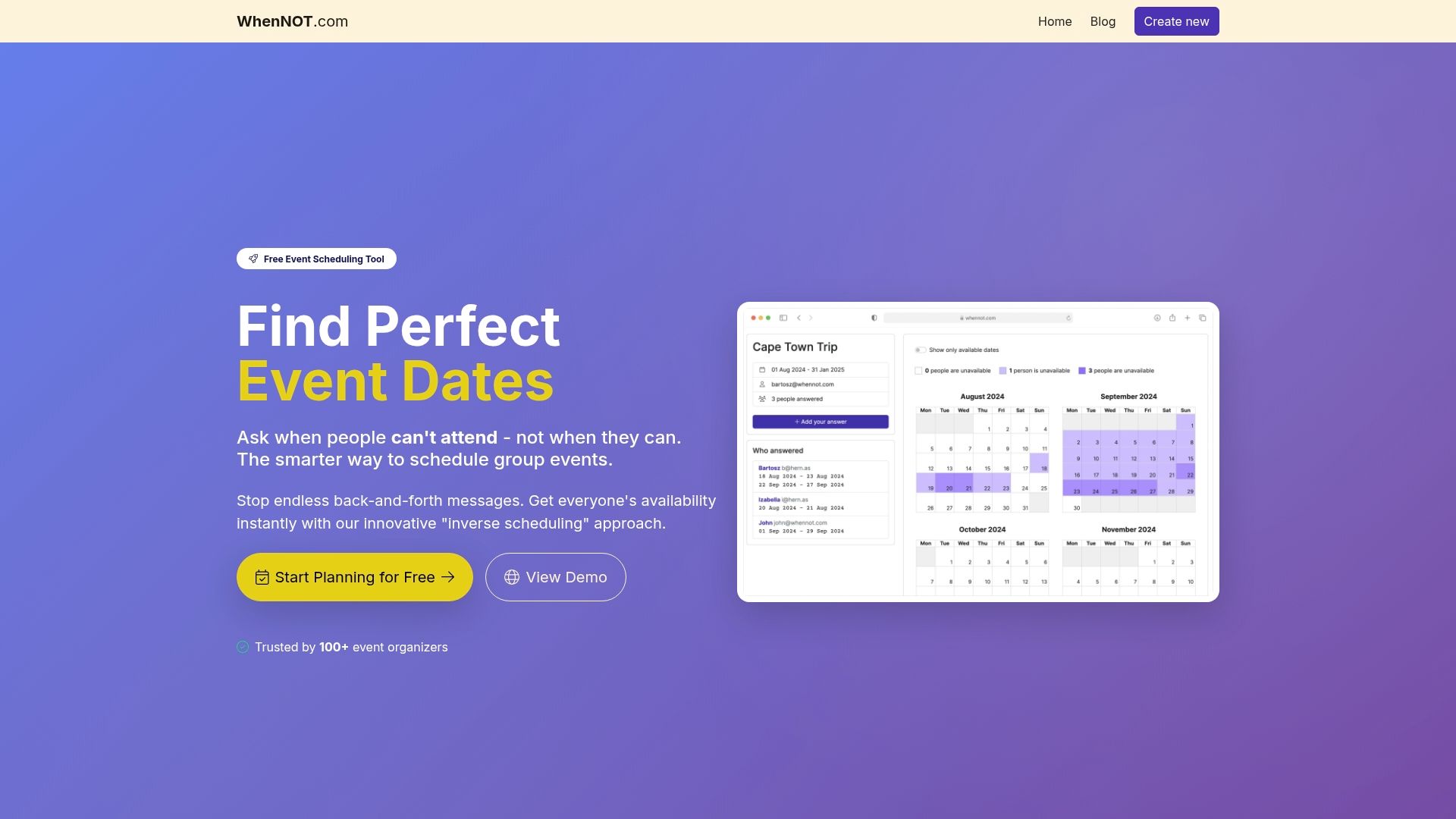
Explore our comprehensive resources to master efficient coordination. Our online scheduling tools guide explains key features to look for. Compare platforms using our best group scheduling tools analysis. Get step-by-step instructions in our multi-day event scheduling guide to plan your next event with confidence.
Frequently Asked Questions
What is scalable scheduling?
Scalable scheduling uses inverse methods to collect unavailable times from participants rather than asking when they're available. This approach simplifies coordination for group events, especially those spanning multiple days or requiring flexible dates. It enables faster decision making and higher participation rates than traditional polling methods.
How does inverse scheduling reduce planning time?
Inverse scheduling simplifies participant input by having them mark only their busy dates within a flexible range. This eliminates complex back-and-forth communication and multiple polling rounds. Research shows this approach cuts event planning time by up to 45% compared to traditional availability polling methods.
Is signup required for scalable scheduling tools?
Many modern scalable scheduling platforms allow participants to mark unavailable dates without creating accounts. They simply click a shared link and indicate their busy times. This no-friction approach increases response rates while protecting participant privacy by not requiring email addresses or personal information.
Can scalable scheduling handle large group events?
Scalable scheduling excels with large groups because the inverse approach maintains constant simplicity regardless of participant count. Marking unavailable dates remains equally easy for 5 people or 500 people. This scalability improves response rates and attendance for complex events where traditional polling becomes unwieldy.