
Trying to align calendars for a North American corporate retreat can feel like an endless series of emails and missed connections. Planners need a smarter way to find dates that work for everyone without forcing participants to reveal personal schedules or fill out lengthy forms. Consensus scheduling offers a collaborative, privacy-conscious solution that simplifies the process, maximizes attendance, and reduces the back-and-forth that usually drains your time.
Table of Contents
- Consensus Scheduling Defined and Debunked
- How Consensus Scheduling Methods Differ
- Use Cases in Corporate Event Planning
- Privacy, Efficiency, and Common Pitfalls
- Comparing Consensus Scheduling Alternatives
Key Takeaways
| Point | Details |
|---|---|
| Definition of Consensus Scheduling | Consensus scheduling is a collaborative approach where all participants agree on meeting times based on their availability, ensuring equal consideration for everyone. |
| Proven Effectiveness | This method increases attendance rates and participant satisfaction by involving them in the scheduling process and reducing frequent email exchanges. |
| Efficiency with Privacy | It collects only unavailability information, protecting participants' privacy while efficiently identifying optimal meeting times. |
| Variety of Methods | Different consensus scheduling methods (e.g., Delphi, Nominal Group) cater to various group sizes and interaction preferences, enabling tailored approaches for specific needs. |
Consensus Scheduling Defined and Debunked
Consensus scheduling is straightforward: a group agrees on meeting or event timing together, not through top-down mandates. Instead of one person deciding when everyone meets, participants collaborate to find times that work for the majority while minimizing inconvenience.
Traditional scheduling often feels one-sided. A manager picks a time, sends a calendar invite, and expects attendance. Consensus scheduling flips this approach by treating scheduling as a group decision where everyone's availability matters equally.
How Consensus Scheduling Works
The process involves several key phases:
- Information gathering: Collect when participants are unavailable, not available
- Aggregation: View all unavailability data simultaneously to identify overlapping free time
- Discussion: Allow the group to adapt preferences based on what they see
- Agreement: Reach a decision that maximizes participation and satisfaction
This collaborative approach addresses scheduling challenges many corporate retreat coordinators face, especially when managing participants across different time zones or with rigid commitments.
The Research Behind Consensus
Research on group decision-making consensus models shows that consensus approaches generate stronger group satisfaction than unilateral decisions. When people participate in scheduling choices, they feel heard—and they're more likely to actually show up.
Consensus scheduling also reduces negotiation overhead. Rather than endless back-and-forth emails asking "Can you do Tuesday?" or "How about Wednesday?", everyone submits their constraints once, and the visual overlap makes optimal dates obvious.
Common Misconceptions
Many event planners assume consensus scheduling takes forever. Actually, when structured properly, it's faster than traditional methods because participants provide complete availability information upfront rather than in fragmented responses.
Another myth: consensus requires unanimous agreement. False. Consensus means the group agrees on a decision that works for the majority while acknowledging minority concerns. For a three-day retreat, this might mean selecting dates where 85% of attendees have zero conflicts.
Consensus scheduling succeeds when organizers collect complete unavailability data upfront, eliminating repetitive back-and-forth communication.
Some planners worry consensus scheduling removes their authority. It doesn't. You still set the date range, the event parameters, and the final decision deadline. Consensus simply informs that decision with complete data.
Why This Matters for Your Retreats
When coordinating multi-day corporate retreats across North America, collecting preferences through inclusive event scheduling methods reduces scheduling conflicts and increases attendance rates. Participants feel included in the process, which builds engagement before the retreat even starts.
Consensus scheduling also protects participant privacy. Unlike traditional scheduling where attendees must create accounts or undergo verification, a simple process lets people indicate unavailable dates without exposing personal information.
Pro tip: Set your date range window tightly—suggest 2-3 potential date blocks rather than a six-month span—so consensus emerges faster without overwhelming participants with options.
How Consensus Scheduling Methods Differ
Consensus scheduling isn't a one-size-fits-all approach. Different methods exist, each with distinct processes, levels of anonymity, and participant interaction styles. Picking the right method depends on your group size, timeline, and how much direct collaboration you want.
The main scheduling consensus methods used in group decision-making include structured approaches like the Delphi technique, nominal group technique, and RAND/UCLA appropriateness method. Each handles information gathering and aggregation differently, producing different results for different situations.
Key Differences Between Methods
Consensus methods vary across several important dimensions:
- Anonymity levels: Some methods keep responses anonymous; others use face-to-face discussion
- Group size flexibility: Some work better with small groups, others scale to larger teams
- Interaction format: Options include virtual-only, in-person, or hybrid approaches
- Time commitment: Methods range from quick (one round) to iterative (multiple feedback cycles)
- Transparency: Formal methods require clear documentation; informal methods may not
These differences matter because they affect how smoothly scheduling proceeds and whether participants feel heard.
Here's a concise comparison of consensus scheduling methods for corporate retreats:
| Method | Key Strength | Ideal Group Size | Interaction Format |
|---|---|---|---|
| Delphi Technique | Thorough feedback | Large, distributed | Anonymous, virtual rounds |
| Nominal Group | Fast group decisions | Small, local | In-person, structured debate |
| RAND/UCLA | Expertise-based input | Medium to large | Hybrid, anonymous ratings |
| Inverse Scheduling | Efficient simplicity | Small to very large | Online, aggregate anonymity |
Traditional Methods vs. Modern Approaches
Formalized consensus methods like Delphi emphasize structured consensus achievement processes with multiple rounds of feedback. Participants respond anonymously, receive aggregated results, then adjust their positions based on group trends. This works well for complex decisions but takes longer.
Nominal group technique brings people together in a room, combines silent individual input with group discussion, then votes. It's faster but requires everyone physically present—challenging for distributed corporate retreat coordinators managing participants across North America.
The RAND/UCLA method blends anonymity with expertise ratings, useful when some participants have more knowledge than others. However, it assumes unequal expertise, which may not fit retreat scheduling scenarios where all attendees have equal weight.
Modern scheduling tools use efficient scheduling methods that simplify the process by collecting unavailability data upfront, then automatically identifying overlapping free dates. This approach reduces multiple rounds and speeds consensus formation.
The best consensus method balances speed, inclusivity, and transparency—choosing based on your group size and deadline, not tradition.
Simplified approaches work best for retreats because they respect people's time. Instead of asking "When are you available?" repeatedly, modern consensus scheduling asks "When are you definitely not available?" once, then shows everyone the overlapping clear dates.
Pro tip: For your retreat planning, use an inverse scheduling approach that asks participants only once when they're unavailable—this eliminates multiple rounds and gets consensus faster than traditional methods while keeping everyone informed.
Use Cases in Corporate Event Planning
Consensus scheduling shines in real-world corporate scenarios where coordinating multiple stakeholders across regions becomes complex. Your retreat planning challenges are exactly where this approach delivers measurable results—faster scheduling, higher attendance, and less back-and-forth communication.
Here are the situations where consensus scheduling proves most valuable for corporate event planners managing multi-day retreats and gatherings.
Multi-Region Corporate Retreats
Organizing a three-day retreat for teams spread across North America creates scheduling headaches. Some participants are in Eastern time, others Central or Pacific. Add in different departmental calendars, project deadlines, and vacation schedules, and finding dates feels impossible.
Consensus scheduling solves this by asking everyone once: "When are you definitely not available over the next two months?" Participants submit their unavailable dates without worrying about time zones or complex availability windows.
You then see all constraints simultaneously and spot dates where 90% of people are free. This beats the traditional approach of sending 15 calendar invites, getting scattered responses, and negotiating for weeks.
Cross-Departmental Stakeholder Alignment
Corporate retreats often require buy-in from multiple departments—HR, operations, finance, leadership. Each group has different constraints and competing priorities.
Participant-driven polling enables everyone to see others' availability and adapt their responses to find mutually agreeable timings. When Finance sees that Operations can't do Q3, they understand the constraint. When Leadership sees everyone's conflicts at once, they make better decisions about which dates actually work.
This transparency eliminates surprise conflicts that emerge after you've already booked the venue.
Distributed Global Teams
If your retreat includes participants across multiple continents, traditional scheduling becomes nearly impossible. Asking "Are you available at 2 p.m. Pacific?" requires participants to mentally convert time zones.

Inverse scheduling sidesteps this problem. You define the date range in your local time, participants mark when they're unavailable in their own time zones, and the platform handles the complexity automatically.
Quick Decision-Making on Event Changes
Sometimes venues fall through or dates shift unexpectedly. You need consensus on new dates fast.
Efficient event scheduling impacts corporate success by reducing delays in aligning stakeholder calendars. A quick consensus poll reveals new options without the overhead of rescheduling emails and phone calls.
Core benefits across all these scenarios:
- Reduces scheduling cycles from weeks to days
- Eliminates repeated availability requests
- Increases attendance through transparent consensus
- Maintains data privacy with no account requirements
- Saves hours of coordinator communication time
Consensus scheduling works best when you have 8+ participants across multiple time zones or departments—the complexity of traditional methods becomes your advantage.
Pro tip: When launching your consensus scheduling poll, set a clear deadline 48 hours out for responses, and send one reminder at the 24-hour mark—this creates urgency and gets faster consensus without pestering participants repeatedly.
Privacy, Efficiency, and Common Pitfalls
Consensus scheduling balances two competing needs: gathering enough information to find optimal dates while protecting participant privacy. Get this balance wrong, and you either expose sensitive data or fail to reach consensus. Understanding the trade-offs helps you avoid common mistakes.
The Privacy-Efficiency Balance
Traditional scheduling requires participants to share detailed availability information—their exact free hours, conflicts, and sometimes reasons for unavailability. This creates privacy concerns. People hesitate to disclose that they have doctor appointments, family obligations, or competing work projects.
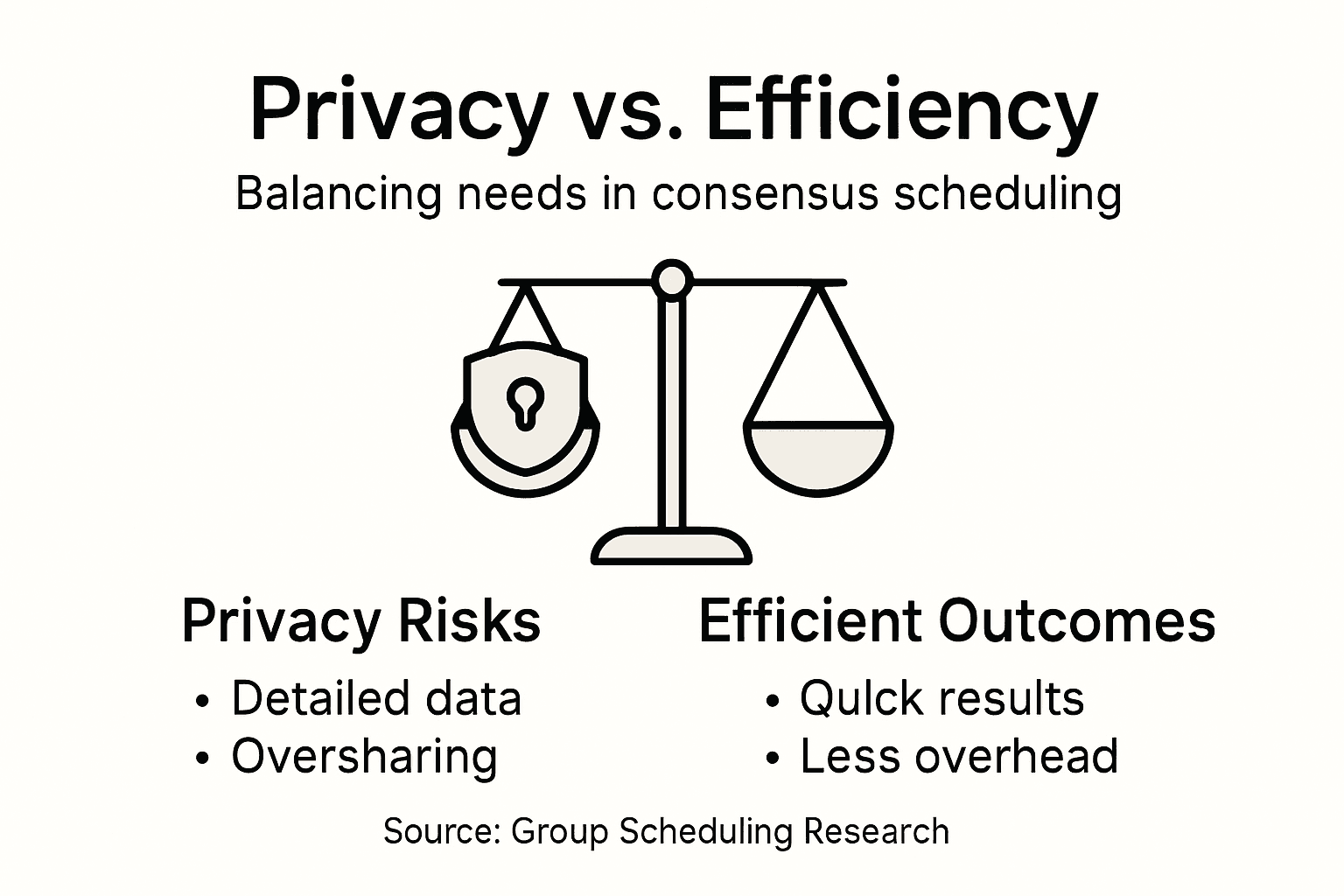
Consensus scheduling sidesteps this by asking only what participants are unavailable, not why. This minimizes sensitive data collection while still gathering scheduling constraints.
Research on privacy-preserving scheduling mechanisms shows that approaches balancing privacy and efficiency generate high-quality schedules without excessive data exposure. You get the information needed without prying into personal details.
Common Pitfalls to Avoid
Even with good intentions, scheduling processes often fail. Here's what derails consensus efforts:
- Vague date ranges: Asking for availability over a six-month window overwhelms participants and delays responses
- Multiple rounds of questions: Requesting availability, then follow-up preferences, then final confirmations exhausts people
- No visibility into group constraints: When participants can't see what others submitted, they can't adapt strategically
- Missing deadline clarity: Without a firm response cutoff, consensus drags on indefinitely
- Ignoring accessibility needs: Not accounting for time zone differences or mobility limitations excludes participants
- Data exposure: Sharing individual availability with the whole group sometimes reveals sensitive information
Maintaining Privacy While Staying Efficient
The key is collecting just enough data to solve the scheduling problem, nothing more. Ask for unavailable dates, not available times. Show aggregate patterns, not individual responses.
Privacy-preserving consensus approaches ensure system accuracy while protecting individual privacy through strategic data handling. For retreat planning, this means everyone sees that "75% of participants are free January 15-17" without knowing who specifically can't attend other dates.
When participants feel their privacy is protected, they respond faster and more honestly. This actually improves efficiency.
To help event planners, here's a summary of common pitfalls and their practical solutions:
| Pitfall | Impact on Scheduling | Simple Solution |
|---|---|---|
| Vague date ranges | Delayed responses | Limit to 2-3 date windows |
| Multiple rounds of questions | Participant fatigue | Collect constraints once |
| Lack of group constraint visibility | Surprise conflicts | Share aggregate results |
| No deadline clarity | Slow consensus | Set clear response deadlines |
| Data exposure | Privacy concerns | Use anonymous, aggregated data |
Speed Without Sacrifice
Some planners think efficiency and privacy are opposites. They're not. Fast scheduling happens when:
- Data collection is simple (one question, one answer)
- Participants understand why their information matters
- Results are transparent but anonymous
- Decision deadlines are clear
Privacy and efficiency reinforce each other—when participants trust their data is protected, they respond quickly and accurately, creating faster consensus.
The mistake many coordinators make is trying to gather "complete availability" to make better decisions. You don't need complete data. You need enough data to identify overlapping free windows. That requires far less information collection.
Pro tip: Clearly state at the outset that individual responses will never be shared publicly, only aggregated results showing group-wide availability patterns—this builds trust and encourages honest, faster responses from participants.
Comparing Consensus Scheduling Alternatives
Consensus scheduling isn't your only option for coordinating multi-day corporate retreats. Other approaches exist, each with different trade-offs in speed, complexity, and participant satisfaction. Understanding how consensus stacks up against alternatives helps you choose the right method for your situation.
Let's compare the main approaches event planners use when scheduling group events.
Traditional Hierarchical Scheduling
This is what most organizations default to: one person (usually the event coordinator or manager) selects dates and sends invitations. Participants respond yes or no, and scheduling is done.
Advantage: Speed. Decisions happen fast without negotiation.
Disadvantage: Low attendance rates. People whose schedules weren't accommodated often decline or attend reluctantly. This approach works when attendance is mandatory, but for voluntary retreats aiming to build team engagement, it falls short.
Doodle-Style Polling
Traditional poll tools ask participants to mark when they're available from a pre-set list of date options. Everyone sees the results, often with participant names visible.
Strengths and weaknesses vary:
- Shows individual responses, which helps coordination
- Takes multiple rounds if initial options don't work
- Privacy concerns when names appear next to availability
- Creates decision fatigue when choosing between many date options
Advanced Consensus Models
Research on consensus decision-making approaches reveals how different preference aggregation methods and individual centrality roles affect group recommendations. Some advanced models weight participant preferences differently, assign leadership roles to facilitate decisions, or use algorithms to measure consensus degree.
These work for complex scenarios but require sophisticated tools and often demand more participant effort.
Inverse Scheduling (Consensus Approach)
This modern alternative asks "When are you unavailable?" rather than "When are you available?" Participants submit constraints once, and the system automatically identifies overlapping free dates.
Comparison with alternatives:
- Speed: Faster than traditional methods—one submission, immediate clarity on optimal dates
- Privacy: No name-attached availability data; only aggregate patterns shown
- Simplicity: Single question eliminates decision fatigue
- Accuracy: Complete constraint data upfront beats fragmented responses
- Flexibility: Works across time zones without participant confusion
Inverse consensus scheduling wins when you need speed, privacy, and simplicity—especially for distributed teams across North America where coordination complexity typically derails traditional methods.
When comparing tools, consider whether they require account creation (they shouldn't), whether responses remain anonymous (they should), and whether results update in real-time (much better for quick decisions).
For corporate retreat planning specifically, consensus scheduling outperforms alternatives because it respects people's time, protects privacy, and actually improves attendance by making participants feel their input shaped the decision.
Pro tip: Test your chosen scheduling method with a small pilot group before launching the full retreat poll—this reveals friction points and lets you refine deadlines and instructions before asking busy executives to respond.
Transform Your Corporate Retreat Planning with Consensus Scheduling
Struggling to find the perfect dates for your multi-day corporate retreat while juggling time zones, busy schedules, and diverse team availability It does not have to be complicated or time-consuming. The article highlights how consensus scheduling simplifies event planning by gathering unavailability upfront and finding optimal dates that suit the majority. If you are aiming to reduce back-and-forth emails and increase participant engagement with privacy and speed, WhenNOT offers a seamless solution for you.
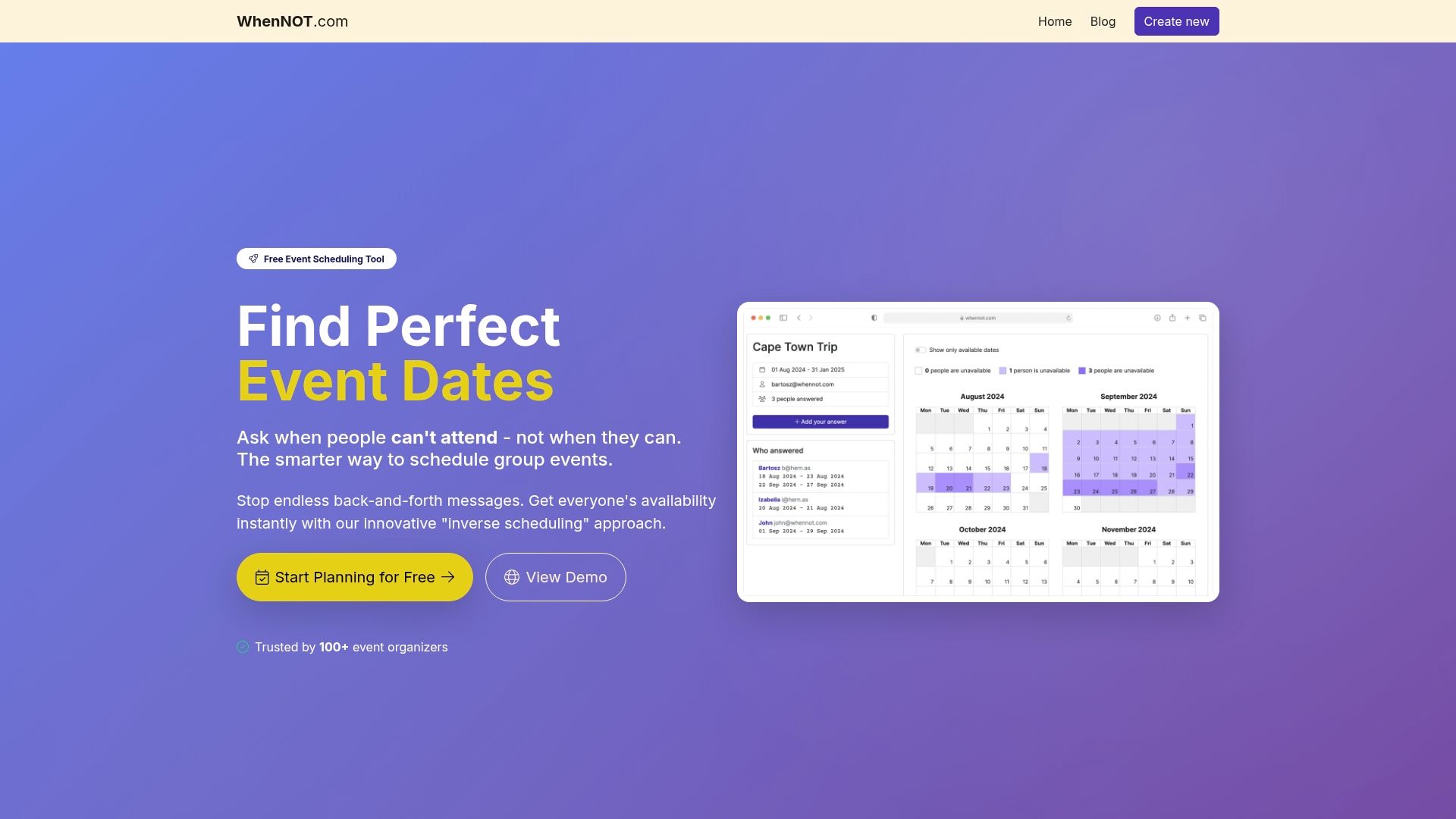
Experience the power of inverse scheduling firsthand by using WhenNOT to create your event and easily collect participant busy dates without anyone needing to sign up. This ensures transparent, efficient scheduling that respects privacy while accelerating consensus. Get ahead of scheduling delays and empower your team to contribute their availability transparently today. Visit WhenNOT to start planning your retreat effortlessly and enjoy faster confirmations with less hassle.
Frequently Asked Questions
What is consensus scheduling?
Consensus scheduling is a collaborative approach to setting meeting or event timings where participants collectively agree on the best time, rather than having a single person dictate the schedule. This method seeks to accommodate the majority's availability while minimizing inconvenience.
How does consensus scheduling improve attendance for events?
By involving participants in the scheduling process, consensus scheduling helps ensure that the selected dates work for most attendees. This inclusion boosts engagement and satisfaction, leading to higher attendance rates.
What are some common misconceptions about consensus scheduling?
One common misconception is that consensus scheduling takes longer than traditional methods. In reality, when structured properly, it can be faster as it consolidates availability data, reducing the need for back-and-forth communication. Another myth is that consensus requires unanimous agreement; it actually seeks a decision that works for the majority while considering minority concerns.
What is the privacy benefit of consensus scheduling?
Consensus scheduling protects participant privacy by requiring them to indicate only their unavailable dates, without necessitating any personal reasons for their unavailability. This helps gather necessary scheduling information while minimizing the risk of exposing sensitive personal data.