
Most people underestimate the power of effective scheduling, yet research shows strategic time management can lead to a 27.7% boost in team performance. Scheduling shapes more than just calendars—it influences productivity, reduces stress, and uncovers new opportunities for growth. Understanding what separates ordinary planning from truly impactful scheduling can help individuals and teams achieve their goals with clarity and purpose.
Table of Contents
- Defining Effective Scheduling and Its Impact
- How Inverse Scheduling Streamlines Planning
- Key Benefits of Efficient Scheduling Techniques
- Traditional Vs. Modern Scheduling Solutions Compared
- Common Mistakes That Waste Planning Time
Key Takeaways
| Point | Details |
|---|---|
| Strategic Scheduling | Effective scheduling enhances productivity by focusing on clear goals, realistic time estimates, and prioritization of tasks. |
| Inverse Scheduling | This method streamlines planning by identifying unavailability first, reducing communication overhead and enhancing flexibility. |
| Modern Techniques | Transitioning to modern scheduling solutions improves coordination efficiency by allowing real-time collaboration and reducing unnecessary time investment. |
| Common Mistakes | Avoid over-scheduling, lack of prioritization, and ignoring buffer times to enhance planning productivity and minimize stress. |
Defining Effective Scheduling and Its Impact
Effective scheduling is much more than simply marking dates on a calendar. It's a strategic approach to managing time, resources, and opportunities that can dramatically transform how groups plan and execute events or projects. Time allocation becomes a powerful tool when done thoughtfully, enabling teams and individuals to maximize productivity while minimizing stress.
According to research from CTR Journal, implementing strategic scheduling can yield significant performance improvements. Their study revealed that targeted time management strategies led to a 27.7% enhancement in team performance, particularly in academic and research contexts. This dramatic increase demonstrates how systematic scheduling isn't just about tracking time, but about creating intentional frameworks that drive meaningful outcomes.
Effective scheduling encompasses several critical elements:
- Clear Goal Setting: Defining precise objectives before allocating time
- Realistic Time Estimation: Understanding actual task requirements
- Flexibility: Building adaptability into planning processes
- Prioritization: Distinguishing between urgent and important activities
Scale Stanford's publication further emphasizes that scheduling represents more than logistical organization. It's fundamentally about resource allocation that determines potential opportunities. By strategically mapping time, money, and personnel, organizations can create environments conducive to success.
The true power of effective scheduling lies not just in tracking time, but in creating intentional structures that transform potential into tangible progress. When done right, scheduling becomes less about restriction and more about empowerment—giving individuals and teams the clarity and space to achieve their most meaningful goals.
How Inverse Scheduling Streamlines Planning
Inverse scheduling represents a revolutionary approach to time management that flips traditional planning methods on their head. Instead of asking participants when they are available, this method focuses on understanding when people are unavailable, creating a more efficient and flexible planning process.
Research from ArXiv highlights the adaptive potential of inverse scheduling, particularly in complex environments like supply chain management. The study demonstrates how this approach can generate revised plans with minimal local changes, maintaining operational continuity even during unexpected disruptions. By focusing on constraints and unavailability, teams can quickly identify optimal scheduling windows without extensive back-and-forth communication.
Key advantages of inverse scheduling include:
- Reduced Communication Overhead: Eliminates endless email chains about availability
- Faster Decision Making: Quickly identifies common free time slots
- Flexibility: Accommodates diverse schedules and personal constraints
- Minimal Friction: Participants only mark times they cannot attend
Further insights from ArXiv demonstrate the method's versatility through an innovative Integer Linear Programming model. This approach allows for sophisticated scheduling constraints, such as minimum intervals between meetings and emergency slots, showcasing how inverse scheduling can adapt to complex real-world planning scenarios.
By reimagining scheduling as a process of eliminating unavailable times rather than finding perfect matches, inverse scheduling transforms group coordination from a challenging task into a streamlined, user-friendly experience. This approach respects individual complexity while delivering remarkable planning efficiency.
For those looking to dive deeper into efficient scheduling techniques, check out our guide on optimizing event scheduling for additional strategies and insights.
Key Benefits of Efficient Scheduling Techniques
Scheduling is more than just organizing time—it's a strategic approach to maximizing personal and professional potential. Efficient scheduling techniques transform how individuals and teams approach productivity, turning time from a constraint into a powerful resource for achieving goals.
According to research from ICTSD, structured scheduling plays a critical role in optimizing workflow and preventing time wastage. The study reveals that systematic time management can significantly reduce decision fatigue, allowing individuals to focus more energy on meaningful tasks rather than constantly deliberating about what to do next.
Key benefits of efficient scheduling include:
- Reduced Stress: Provides clear roadmap and expectations
- Enhanced Productivity: Minimizes time spent on unnecessary decision-making
- Improved Focus: Creates dedicated time blocks for critical tasks
- Better Work-Life Balance: Helps allocate time across personal and professional domains
E-Learning Industry further demonstrates the transformative power of scheduling, highlighting how strategic time allocation can improve persistence rates and create balanced learning opportunities. This principle extends beyond academic settings, applying to professional and personal contexts alike.
The ultimate goal of efficient scheduling isn't about filling every minute, but about creating intentional space for what truly matters. By understanding and implementing smart scheduling techniques, individuals can unlock unprecedented levels of performance and personal satisfaction.

For those seeking to dive deeper into scheduling strategies, our guide on understanding group scheduling benefits offers additional insights into creating more effective time management approaches.
Traditional vs. Modern Scheduling Solutions Compared
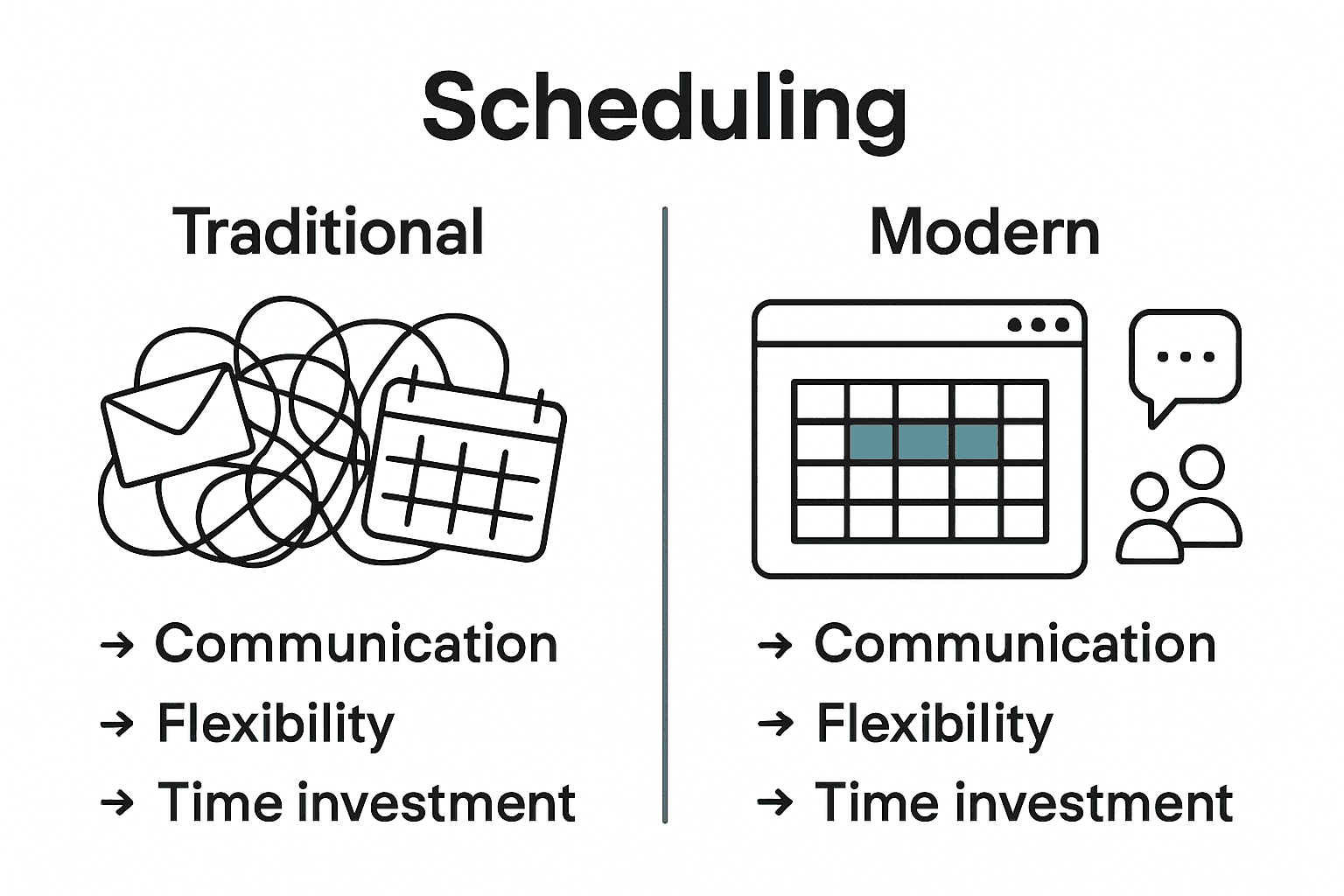
Scheduling methods have undergone a radical transformation, shifting from rigid, manual processes to flexible, technology-driven approaches that prioritize efficiency and user experience. Traditional scheduling relied heavily on manual coordination, phone calls, and endless email threads, creating significant time waste and communication barriers.
Research from E-Jurnal highlights the critical differences between traditional and modern scheduling approaches. The study demonstrates how modern scheduling solutions can dramatically enhance performance by introducing flexibility, real-time collaboration, and intuitive interfaces that simplify complex coordination challenges.
Key differences between traditional and modern scheduling solutions include:
-
Communication Approach: - Traditional: Linear, sequential communication
- Modern: Simultaneous, multi-channel coordination
-
Time Investment:
- Traditional: Hours of back-and-forth negotiations
- Modern: Minutes of streamlined decision-making
-
Flexibility:
- Traditional: Rigid, limited adaptation
- Modern: Dynamic, context-aware scheduling
-
Accessibility:
- Traditional: Location-dependent
- Modern: Device and location-independent
The IRL Dissertation further underscores the transformative potential of modern scheduling techniques, revealing how innovative approaches can positively impact organizational performance, reduce administrative overhead, and create more responsive planning environments.
Modern scheduling isn't just about technology—it's about reimagining how we allocate and respect time.
 By embracing flexible, user-centric solutions, teams and individuals can unlock unprecedented levels of coordination and productivity.
For those eager to explore the latest scheduling innovations, our guide on adopting new scheduling tools provides comprehensive insights into making the transition seamless and effective.
Common Mistakes That Waste Planning Time
Planning inefficiencies can silently drain productivity, transforming what should be straightforward coordination into a frustrating and time-consuming process. Most people unknowingly sabotage their scheduling efforts through seemingly innocent mistakes that compound over time, creating unnecessary complexity and stress.
Research from IEIA highlights the critical challenges in manual scheduling, revealing how traditional approaches lead to significant time waste. The study demonstrates that without strategic planning, organizations can become trapped in cycles of inefficient resource allocation and repetitive communication.
Common scheduling mistakes that drain time include:
- Over-Scheduling: Cramming too many tasks into limited time windows
- Lack of Prioritization: Treating all tasks with equal importance
- Ignoring Buffer Time: Not accounting for unexpected interruptions
- Manual Coordination: Relying on endless email chains and phone calls
- Failure to Review: Not periodically reassessing and adjusting schedules
ICTSD further emphasizes how unstructured scheduling creates decision fatigue, preventing individuals from focusing on high-value activities. The research reveals that without systematic approaches, people spend more time planning than actually executing tasks.
The most effective planners understand that scheduling is an art of subtraction—removing unnecessary complexity and creating space for what truly matters. By recognizing and eliminating these common mistakes, individuals can reclaim hours of lost productivity and reduce unnecessary stress.
For those looking to dive deeper into scheduling challenges and solutions, our guide on overcoming scheduling obstacles provides comprehensive strategies for more efficient planning.
Simplify Your Scheduling and Save Precious Time Today
Effective scheduling is challenging when dealing with multiple participants and flexible dates. The article highlights how traditional planning wastes time through endless back-and-forth communication and complex coordination. If you struggle with over-scheduling, prioritization, or inefficient manual processes, there is a smarter way to manage group events. By focusing on "inverse scheduling" and letting participants indicate when they are unavailable, you can transform chaos into clarity and make planning feel effortless.

Discover how WhenNOT can help you take control of group scheduling with its simple, privacy-focused platform. Create an event, share a unique link, and watch as everyone’s unavailable times come together visually to reveal the best dates instantly. Say goodbye to long email threads and last-minute changes. Learn more from our guide on overcoming scheduling obstacles and explore intuitive scheduling features that put you in charge. Start saving time and reducing stress now by visiting WhenNOT.
Frequently Asked Questions
What is effective scheduling?
Effective scheduling is a strategic approach to managing time and resources that helps individuals and teams plan and execute tasks efficiently. It involves clear goal setting, realistic time estimation, flexibility, and prioritization to maximize productivity.
How does inverse scheduling work?
Inverse scheduling focuses on identifying when participants are unavailable instead of when they are available. This method reduces communication overhead and allows for quicker decision-making, leading to more efficient and adaptable planning.
What are the main benefits of efficient scheduling techniques?
Efficient scheduling techniques lead to reduced stress, enhanced productivity, improved focus, and better work-life balance. They streamline decision-making processes and allocate time effectively across personal and professional domains.
What common mistakes should I avoid in scheduling?
Common scheduling mistakes include over-scheduling, lack of prioritization, ignoring buffer time, relying on manual coordination, and failing to periodically review and adjust schedules. Avoiding these can help reclaim lost productivity and reduce stress.