
Manual scheduling still eats up hours in many american workplaces, yet automated systems can process complex scenarios in milliseconds and cut error rates by more than half. This leap matters because missed deadlines and double-booked meetings do more than frustrate teams—they cost real time and money. Understanding how automation transforms scheduling can help any american organization move from chaotic planning to confident coordination with far less wasted effort.
Table of Contents
- Defining Automation In Scheduling Processes
- Types Of Automation Tools And Methods
- How Automation Streamlines Group Event Planning
- Key Benefits And Challenges Of Automated Scheduling
- Comparing Automation With Manual Scheduling Approaches
Key Takeaways
| Point | Details |
|---|---|
| Automation Enhances Efficiency | Automated scheduling significantly reduces manual tasks, which improves accuracy and resource allocation. |
| Diverse Tool Options Exist | Organizations can choose from various automation tools tailored to their unique scheduling needs and complexities. |
| Rapid Adaptability | Intelligent automation allows quick adjustments during group event planning, minimizing disruptions and optimizing coordination. |
| Benefits Outweigh Challenges | While implementation has challenges, the advantages of cost reduction and increased productivity make automation a strategic asset. |
Defining Automation in Scheduling Processes
Automation in scheduling processes represents a technological approach to streamlining complex coordination tasks through intelligent software systems. According to research from arxiv.org, Robotic Process Automation (RPA) involves systematically automating rule-based routine processes to enhance efficiency and significantly reduce organizational costs. This approach focuses on eliminating manual, repetitive tasks that traditionally consume substantial human time and resources.
At its core, scheduling automation transforms how groups plan and coordinate events by leveraging computational capabilities. Wikipedia explains that modern job schedulers now provide sophisticated graphical user interfaces enabling centralized control for defining and monitoring background executions across distributed networks. These systems intelligently integrate real-time business activities with traditional processing methods, creating seamless coordination environments.
Key characteristics of scheduling automation include:
- Eliminating manual data entry
- Reducing human error
- Providing real-time updates
- Enabling complex multi-party scheduling scenarios
- Offering instant conflict resolution
Practical applications span multiple domains, from corporate meeting planning to personal event coordination. By implementing intelligent automation, organizations can dramatically reduce time spent on logistical coordination while increasing overall scheduling accuracy and participant satisfaction. The technology empowers teams to focus on strategic objectives rather than getting bogged down in administrative scheduling complexities.
Types of Automation Tools and Methods
Automation technologies are diverse, with multiple approaches designed to meet specific organizational needs. Conger identifies six fundamental automation categories: fixed, programmable, flexible, integrated, robotic, and business process automation. Each type serves unique purposes, ranging from high-volume production scenarios to adaptable manufacturing environments.
In scheduling contexts, these automation methods translate into distinct tool capabilities. QServicesIT highlights several prominent automation platforms that offer specialized features for workflow management. These tools incorporate advanced functionalities like:
- Automatic task assignments
- Real-time status tracking
- Intelligent reminder systems
- Documentation management
- Goal setting and progress monitoring
The spectrum of automation tools encompasses different complexity levels. Simple tools might focus on basic task routing, while advanced platforms leverage artificial intelligence to predict scheduling conflicts, recommend optimal meeting times, and dynamically adjust team workflows. Organizations can select tools based on their specific requirements, team size, and operational complexity.
Critical considerations when choosing automation tools include scalability, integration capabilities, user interface intuitiveness, and alignment with existing technological infrastructure. Successful implementation requires thoughtful evaluation of an organization's unique scheduling challenges and selecting tools that can flexibly adapt to evolving communication and coordination needs.

How Automation Streamlines Group Event Planning
Group event planning has been dramatically transformed by intelligent automation technologies that eliminate traditional coordination challenges. QServicesIT highlights how tools like ClickUp and Wrike provide powerful automation features that streamline complex planning processes by automatically managing task assignments, tracking status updates, and generating timely reminders.
Conger emphasizes the critical role of flexible automation systems, which enable rapid adjustments and minimal disruption during event planning. This approach allows organizers to quickly modify schedules, reallocate resources, and respond dynamically to unexpected changes without extensive manual intervention.
Key automation benefits for group event planning include:
- Instant communication synchronization
- Automated conflict resolution
- Real-time participant availability tracking
- Simplified coordination across multiple participants
- Reduced administrative overhead
Successful event planning now relies on sophisticated automation strategies that transform complex logistical challenges into streamlined, efficient processes. By leveraging intelligent tools, planners can focus more on creating memorable experiences and less on administrative details. The technology empowers teams to collaborate seamlessly, ensuring that every participant's needs are considered and scheduling conflicts are minimized before they can disrupt event planning.
Key Benefits and Challenges of Automated Scheduling
Automated scheduling represents a powerful technological approach that offers significant organizational advantages while simultaneously presenting complex implementation challenges. Arxiv research on Deep Reinforcement Learning (DRL) reveals that advanced scheduling automation can dramatically reduce operational costs and substantially improve overall production efficiency.
Arxiv highlights the critical Robotic Process Automation (RPA) perspective, which demonstrates that automation enhances organizational performance by systematically addressing rule-based process inefficiencies. However, successful implementation requires navigating several intricate challenges:
Key Benefits of Automated Scheduling:
- Dramatically reduced manual coordination time
- Enhanced accuracy in scheduling processes
- Real-time conflict resolution
- Improved resource allocation
- Decreased administrative overhead
Significant implementation challenges include:
- Complex system integration requirements
- Managing organizational change resistance
- Ensuring process stability and reliability
- Handling multi-objective optimization scenarios
- Maintaining scalability across different operational contexts
Successful automated scheduling strategies demand a nuanced approach that balances technological capabilities with human adaptability. Organizations must carefully assess their specific needs, technological infrastructure, and cultural readiness to effectively leverage automation's transformative potential. By understanding both the remarkable benefits and potential implementation hurdles, teams can develop more intelligent, efficient scheduling solutions that drive meaningful productivity improvements.
Comparing Automation With Manual Scheduling Approaches
Arxiv research reveals that Deep Reinforcement Learning (DRL) scheduling methods fundamentally transform traditional scheduling paradigms by outperforming manual approaches in both computational speed and solution quality. Unlike manual scheduling, which relies heavily on human judgment and linear processing, automated systems can simultaneously analyze complex scenarios and generate optimized solutions with unprecedented efficiency.
Robotic Process Automation (RPA) provides a critical perspective on the manual versus automated scheduling debate. Arxiv highlights that while manual scheduling depends on individual performance and potential human error, automation systematically increases productivity and accuracy by eliminating repetitive administrative tasks.
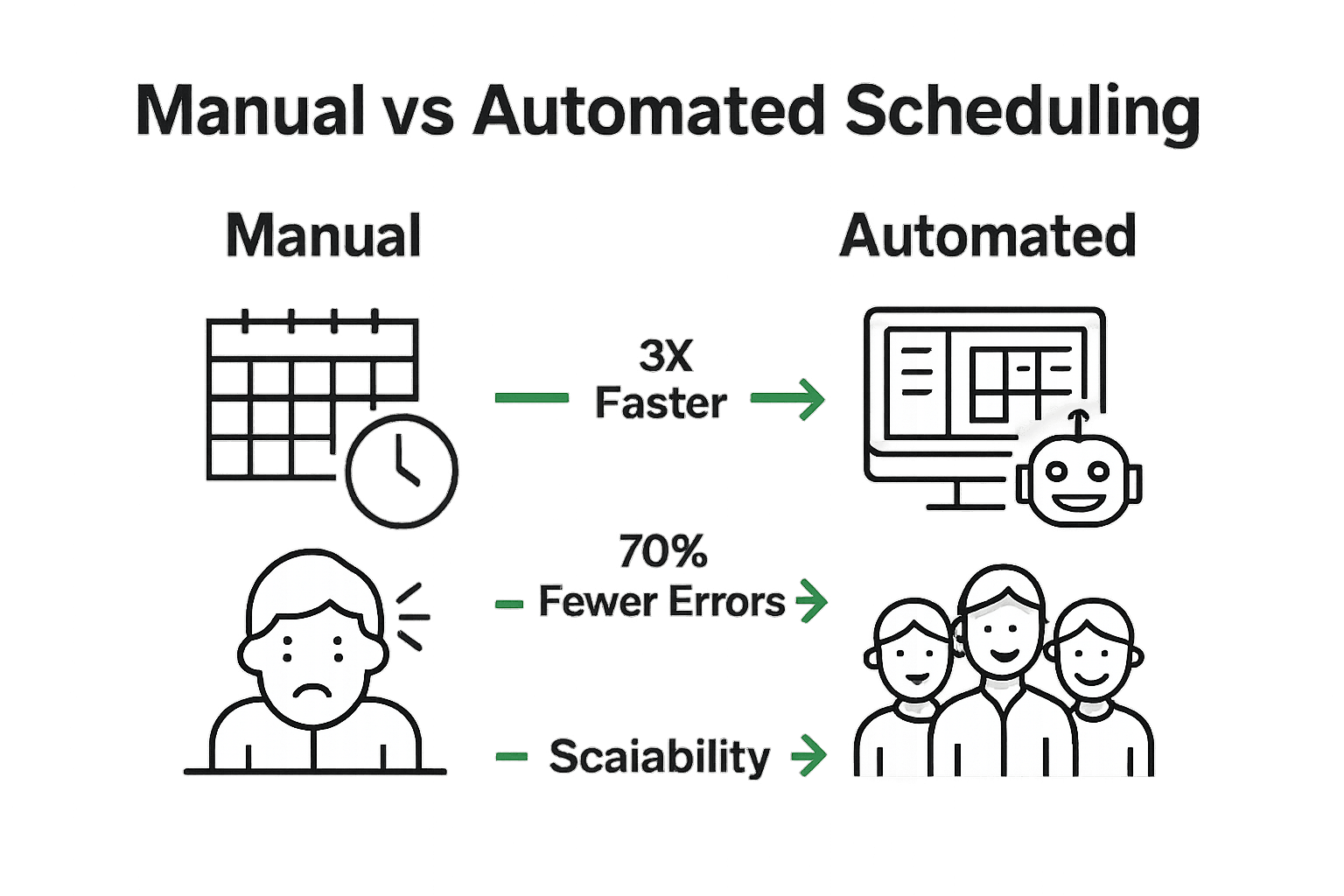
Key Differences Between Manual and Automated Scheduling:
- Computation Speed
- Manual: Linear and time-consuming
- Automated: Millisecond-level processing
- Error Rates
- Manual: High variability
- Automated: Consistently low error probability
- Scalability
- Manual: Limited by human bandwidth
- Automated: Easily adaptable to complexity
Successful scheduling strategies now recognize that automation is not about replacing human decision making, but augmenting it. The most effective approaches integrate technological efficiency with nuanced human insight, creating hybrid models that leverage the strengths of both manual expertise and computational precision. Organizations that understand this balance can transform their scheduling from a administrative burden into a strategic competitive advantage.
Transform Your Scheduling with Smart Automation
The article highlights major challenges in group event planning such as manual coordination, real-time conflict resolution, and managing participant availability for multi-day or flexible events. These pain points lead to wasted time, communication delays, and scheduling confusion. Concepts like automation in scheduling processes, reducing human error, and real-time updates resonate strongly with anyone striving for a simpler and more accurate way to organize group activities.
If you want to overcome the complexity of traditional scheduling and leverage automation that respects participant privacy without the hassle of account creation, WhenNOT offers a revolutionary solution. By using an inverse scheduling approach that asks when participants are not busy, it instantly solves the frustration of endless back-and-forth emails and clashes in availability. With its easy event creation, shareable links, and instant insight into everyone’s busy days, WhenNOT saves you time and reduces stress.
Looking to bring intelligent efficiency to your event planning today For a fast, private, and free scheduling experience explore WhenNOT now

Say goodbye to complicated coordination and discover how automated scheduling can change the way your group plans events. Start simplifying your scheduling at WhenNOT and enjoy the benefits of modern scheduling technology that acts faster and smarter so you can focus on what really matters.
Frequently Asked Questions
What is automation in scheduling processes?
Automation in scheduling processes refers to the use of technology, particularly software systems, to streamline complex coordination tasks, eliminate manual efforts, and reduce organizational costs by systematically automating rule-based routine processes.
What are the key benefits of automated scheduling?
Key benefits of automated scheduling include dramatically reduced manual coordination time, enhanced accuracy, real-time conflict resolution, improved resource allocation, and decreased administrative overhead.
What challenges might organizations face when implementing automated scheduling?
Organizations may encounter challenges such as complex system integration requirements, resistance to organizational change, ensuring process stability and reliability, managing multi-objective optimization scenarios, and maintaining scalability across different operational contexts.
How does automated scheduling compare to manual scheduling approaches?
Automated scheduling outperforms manual scheduling in terms of computation speed, error rates, and scalability. While manual approaches rely on human judgment and can be time-consuming and error-prone, automated systems provide millisecond-level processing and consistently low error probability.