
A single missed deadline can disrupt everything in a time-critical system. From medical devices to aircraft controls, precision matters where every millisecond counts. More than 90 percent of mission-critical technology depends on real-time scheduling algorithms for reliable performance. Understanding how these sophisticated scheduling methods work is essential for anyone building or maintaining high-stakes environments. This guide unpacks the foundations, algorithms, practical applications, and the main challenges that come with real-time scheduling.
Table of Contents
- Defining Real-Time Scheduling And Its Purpose
- Types Of Real-Time Scheduling Algorithms Explained
- How Real-Time Scheduling Algorithms Work
- Real-World Applications And Use Cases
- Common Challenges And Pitfalls To Avoid
Key Takeaways
| Point | Details |
|---|---|
| Real-Time Scheduling Importance | Vital for systems requiring stringent timing, ensuring tasks meet deadlines to avoid significant consequences. |
| Algorithm Types | Key algorithms like Rate Monotonic Scheduling, Earliest Deadline First, and Least Laxity First optimize task execution based on priority and deadlines. |
| Operational Mechanisms | Includes dynamic priority adjustments and resource optimization to manage complex scheduling challenges efficiently. |
| Industry Applications | Essential in fields such as healthcare, aerospace, and autonomous systems where precise task execution is critical for safety and effectiveness. |
Defining Real-Time Scheduling and Its Purpose
Real-time scheduling is a sophisticated process of managing multiple tasks and their execution to meet precise time-sensitive requirements. According to jesaun, real-time scheduling involves managing concurrent tasks to meet specific deadlines, which is essential in systems where timing is critically important.
In practical terms, real-time scheduling goes beyond traditional time management approaches. It focuses on guaranteeing that tasks are completed within strict, predefined timeframes - often measured in milliseconds or microseconds. This precision is crucial in environments like aerospace, medical devices, industrial control systems, and advanced computing platforms where even a slight delay can have significant consequences.
The core purpose of real-time scheduling can be broken down into several key objectives:
- Ensuring predictable task execution
- Minimizing response time gaps
- Prioritizing critical system functions
- Maintaining consistent performance under variable workloads
With understanding efficient scheduling methods, organizations can transform complex coordination challenges into streamlined, responsive systems that adapt quickly and maintain high reliability.
Types of Real-Time Scheduling Algorithms Explained
Real-time scheduling algorithms are specialized mechanisms designed to manage task execution in time-critical systems. According to brightmindpublishing, researchers have identified several key algorithms for managing real-time task scheduling, including Rate Monotonic Scheduling (RMS), Earliest Deadline First (EDF), and Least Laxity First (LLF).
These algorithms differ fundamentally in how they prioritize and manage tasks.
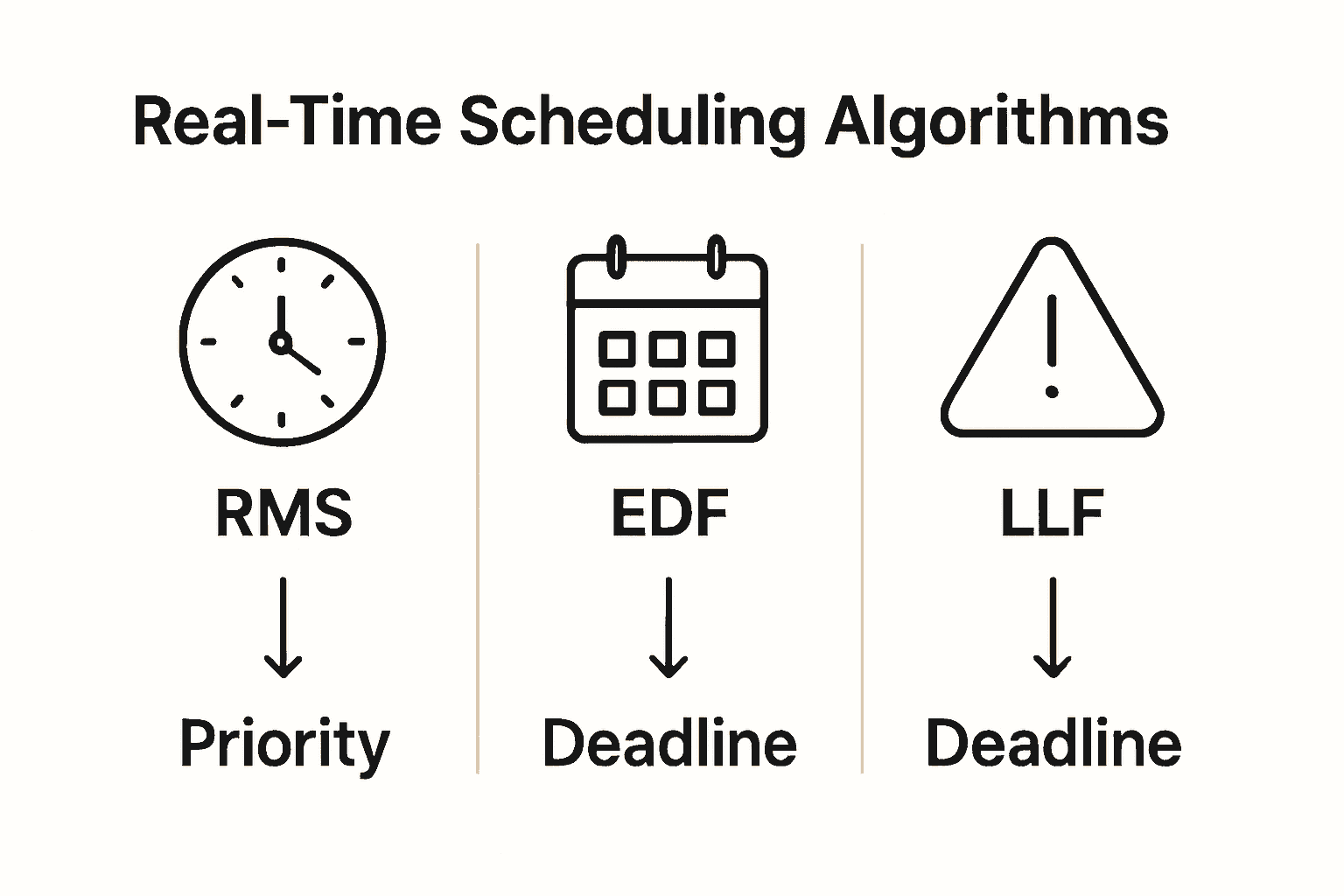 Rate Monotonic Scheduling (RMS) assigns priorities based on task frequency - higher frequency tasks receive higher priority. Earliest Deadline First (EDF) dynamically prioritizes tasks based on their upcoming deadlines, ensuring the most time-sensitive tasks are executed first. Least Laxity First (LLF) calculates task priority by measuring the remaining time before a deadline compared to the computation time needed.
Key characteristics of these real-time scheduling algorithms include:
- Dynamic priority assignment
- Deadline-driven task management
- Predictable system performance
- Minimal computational overhead
- Adaptive task sequencing
For professionals seeking deeper insights into scheduling complexities, what is automated scheduling provides comprehensive context about how these sophisticated algorithms transform task management in complex technological environments.
How Real-Time Scheduling Algorithms Work
Real-time scheduling algorithms operate through complex decision-making processes that prioritize and manage tasks with exceptional precision. Arxiv research highlights the intricate mechanisms of cutting-plane algorithms, which play a crucial role in solving schedulability problems for time-critical systems.
At the core of these algorithms are sophisticated prioritization techniques. Arxiv research introduces reservation-based federated scheduling for parallel real-time tasks, demonstrating how advanced algorithms dynamically allocate system resources. These algorithms continuously assess task characteristics such as deadline proximity, computational requirements, and system constraints to make split-second scheduling decisions.
Key operational mechanisms of real-time scheduling algorithms include:

- Preemptive task interruption
- Dynamic priority recalculation
- Resource allocation optimization
- Deadline monitoring and enforcement
- Minimal computational overhead management
To gain deeper insights into the complexities of modern scheduling strategies, 7 top scheduling challenges provides an excellent overview of the intricate challenges these algorithms are designed to overcome.
Real-World Applications and Use Cases
Real-time scheduling algorithms have become critical enablers across numerous technological domains. According to ijrar, these sophisticated scheduling mechanisms play pivotal roles in diverse fields including cloud computing, embedded systems, networking, and complex real-time systems.
In critical infrastructure and high-stakes environments, real-time scheduling ensures precision and reliability. Medical devices like cardiac monitors and surgical robots depend on millisecond-level task prioritization to maintain patient safety. Aerospace systems utilize these algorithms to manage complex flight control systems, where split-second decisions can mean the difference between successful mission execution and catastrophic failure. Autonomous vehicles similarly rely on real-time scheduling to process sensor data, make navigation decisions, and respond to dynamic road conditions.
Key application domains for real-time scheduling include:
- Industrial automation and robotics
- Telecommunications network management
- Financial trading platforms
- Healthcare monitoring systems
- Smart infrastructure and IoT networks
- Aerospace and defense systems
- Advanced computing environments
For professionals looking to understand the nuanced challenges in implementing these complex systems, why adopt new scheduling tools offers comprehensive insights into the evolving landscape of technological scheduling solutions.
Common Challenges and Pitfalls to Avoid
Real-time scheduling algorithms face numerous complex challenges that can compromise system performance and reliability. Arxiv research highlights critical issues in traditional scheduling approaches, particularly in soft real-time systems where standard methods often struggle with high context switching rates and inefficient response times.
The most significant pitfalls emerge from inadequate algorithm design and implementation. Arxiv studies reveal that standard Round Robin scheduling techniques frequently result in increased waiting times and excessive context switches, which can dramatically reduce overall system efficiency. These challenges become especially pronounced in dynamic environments where tasks have varying computational requirements and stringent deadline constraints.
Key challenges to anticipate in real-time scheduling include:
- Unpredictable task arrival patterns
- Inefficient context switching mechanisms
- Resource contention and allocation conflicts
- Deadline miss probability
- Performance degradation under high load
- Complex priority management
- Computational overhead from scheduling decisions
For professionals seeking comprehensive strategies to navigate these intricate scheduling landscapes, 7 common scheduling challenges provides an essential guide to understanding and mitigating potential systemic risks.
Simplify Your Scheduling Challenges with WhenNOT
Real-time scheduling demands precision and adaptability to meet strict deadlines and dynamic priorities. The article highlights common pain points like unpredictable task coordination and inefficient resource allocation that can lead to delays and frustration. If you are tired of juggling multiple participants' availability and trying to find that perfect date, you understand how crucial it is to have a system that cuts through complexity and saves time.

Discover how WhenNOT transforms event planning by focusing on when participants are not available rather than when they are free. This inverse scheduling method is ideal for complex group events requiring flexible date ranges. With WhenNOT, you eliminate endless back-and-forth communication and swiftly identify optimal dates everyone can agree on. Take control of your scheduling with a tool designed for simplicity, privacy, and speed. Explore more on why adopt new scheduling tools and see how it addresses common scheduling challenges. Start streamlining your event coordination today by visiting WhenNOT and experience the future of scheduling.
Frequently Asked Questions
What is real-time scheduling?
Real-time scheduling is a process that manages multiple tasks to meet precise time-sensitive requirements, ensuring tasks are completed within strict, predefined timeframes crucial in areas like aerospace and medical devices.
What are the main types of real-time scheduling algorithms?
The main types of real-time scheduling algorithms include Rate Monotonic Scheduling (RMS), Earliest Deadline First (EDF), and Least Laxity First (LLF), each prioritizing tasks based on different criteria like frequency, deadlines, and remaining time before deadlines.
How do real-time scheduling algorithms work?
Real-time scheduling algorithms operate by using complex decision-making processes to prioritize tasks based on factors like deadline proximity and computational requirements, enabling efficient execution under strict time constraints.
What are some common applications of real-time scheduling algorithms?
Real-time scheduling algorithms are used in various domains including industrial automation, telecommunications, healthcare monitoring, aerospace systems, and autonomous vehicles, ensuring precision and reliability in time-sensitive operations.