
Juggling everyone’s calendars can feel impossible in today’s busy world. Over 80 percent of groups struggle to find a meeting time that works for all participants, often leading to stress and confusion. Flexible group scheduling methods offer a smarter solution by letting people simply mark when they cannot join and streamlining the process for everyone. Discover how these dynamic approaches make planning less frustrating and turn group coordination into a smoother, more collaborative experience.
Table of Contents
- Defining Flexible Group Scheduling Methods
- Types of Flexible Group Scheduling Approaches
- How Flexible Group Scheduling Platforms Work
- Benefits and Real-World Applications
- Comparing Flexible and Traditional Scheduling
Key Takeaways
| Point | Details |
|---|---|
| Flexible Scheduling Approach | Focuses on adaptability and collaboration, empowering participants to highlight their unavailability. |
| Key Strategies | Utilizes techniques like inverse availability marking and collaborative preference mapping to enhance scheduling efficiency. |
| Applications Across Domains | Effective in corporate, academic, healthcare, and remote work environments, improving coordination and productivity. |
| Benefits Over Traditional Methods | Reduces communication overload and simplifies multi-participant scheduling, making it user-friendly and dynamic. |
Defining Flexible Group Scheduling Methods
Flexible group scheduling is a dynamic approach to coordinating events, meetings, and activities that prioritizes adaptability over rigid time constraints. Unlike traditional scheduling methods that demand precise time slots, flexible scheduling allows participants to indicate their unavailable periods, creating a more collaborative and user-friendly planning process.
According to amle, flexible scheduling represents "the creative use of time" to match activities and participants' needs. This approach shifts away from fixed time periods toward a more personalized, adaptable framework that accommodates diverse schedules and preferences.
Flexible group scheduling methods typically involve several key strategies:
- Inverse Availability Marking: Participants indicate when they are NOT available, instead of selecting specific time slots
- Multi-Day Range Selection: Setting broader date ranges rather than pinpointing exact times
- Collaborative Input: Allowing all group members to contribute scheduling preferences
- Visual Comparison Tools: Using interfaces that quickly highlight overlapping free times
As en notes, flexible scheduling can involve modular time periods, where participants can customize their engagement windows. This approach recognizes that modern scheduling needs to be fluid, accounting for varying personal and professional commitments.
The primary goal of flexible group scheduling is to simplify coordination, reduce communication overhead, and create planning experiences that feel effortless and respectful of participants' individual constraints. By focusing on unavailability rather than availability, these methods transform scheduling from a potentially stressful task into a collaborative, efficient process.
For more in-depth insights, check out our guide on understanding group scheduling.
Types of Flexible Group Scheduling Approaches
Flexible group scheduling encompasses several adaptive approaches designed to accommodate diverse participant needs and preferences. These methods move beyond traditional rigid scheduling frameworks, offering innovative solutions for coordinating group activities across various contexts.
According to amle, flexible scheduling models include block scheduling and alternate day scheduling. In block scheduling, time periods are combined into longer, more adaptable segments, while alternate day scheduling allows participants to engage in different activities on rotating schedules.
Key types of flexible group scheduling approaches include:
- Inverse Availability Scheduling: Participants mark unavailable times
- Modular Time Blocking: Breaking time into customizable segments
- Range-Based Scheduling: Setting broad date and time windows
- Collaborative Preference Mapping: Integrating multiple participants' schedules
As hr highlights, alternative scheduling arrangements permit variations from core time constraints while maintaining overall work or event requirements. This approach allows for personalized scheduling that respects individual constraints and preferences.
Flexible scheduling methods can be particularly powerful for complex group coordination scenarios like multi-day events, cross-timezone meetings, or activities involving participants with varying availability. By prioritizing adaptability, these approaches transform scheduling from a potential source of stress into a collaborative, user-friendly process.

For practical insights into implementing these strategies, explore our guide on group scheduling examples.
How Flexible Group Scheduling Platforms Work
Flexible group scheduling platforms are sophisticated digital solutions designed to simplify the complex process of coordinating schedules across multiple participants. These innovative tools transform traditional scheduling challenges by introducing user-friendly, intuitive approaches that prioritize participant flexibility and ease of use.
According to hci, advanced scheduling systems like groupTime can aggregate user preferences over extended periods and enable live negotiation. This means participants can dynamically update and refine potential meeting times based on real-time feedback, creating a more collaborative scheduling experience.
Key operational features of flexible group scheduling platforms typically include:
- Inverse Availability Tracking: Allowing users to mark unavailable times
- Aggregation Algorithms: Automatically identifying optimal meeting windows
- Visual Schedule Comparison: Displaying overlapping and compatible time slots
- Multi-Platform Accessibility: Enabling scheduling across devices and time zones
As irjaeh highlights, automated scheduling technologies can generate conflict-free schedules by intelligently balancing complex constraints. These platforms eliminate scheduling conflicts while ensuring maximum participant convenience.
Modern scheduling platforms leverage intelligent algorithms and user-centric design to transform what was once a tedious administrative task into a streamlined, collaborative process. By prioritizing individual preferences and reducing communication overhead, these tools make group coordination feel effortless and intuitive.
To explore more about optimizing your scheduling strategies, check out our guide on understanding the group scheduling process.
Benefits and Real-World Applications
Flexible group scheduling has emerged as a transformative approach that extends far beyond simple time management, offering profound benefits across multiple professional and personal contexts. These innovative scheduling methods are revolutionizing how teams, organizations, and individuals coordinate complex activities.
According to amle, flexible scheduling delivers multiple organizational advantages, including enhanced staff morale, reduced tardiness, and increased productivity. By empowering participants to manage their time more effectively, these approaches create more adaptive and responsive work environments.
Real-world applications of flexible group scheduling span diverse domains:
- Corporate Team Coordination: Managing cross-functional project timelines
- Academic Institutions: Designing student and faculty engagement models
- Healthcare Scheduling: Coordinating multi-provider patient care
- Event Planning: Managing large group gatherings and conferences
- Remote Work Teams: Synchronizing distributed workforce activities
As hr highlights, alternative scheduling arrangements enable employees to better manage personal and professional commitments. This holistic approach recognizes that individual time management is not one-size-fits-all but requires personalized, nuanced strategies.
Flexible scheduling represents more than a technological solution—it's a fundamental reimagining of how we approach time, collaboration, and personal productivity. By prioritizing individual preferences while maintaining collective goals, these methods create more humane, responsive coordination frameworks.
To dive deeper into effective scheduling strategies, explore our guide on understanding group scheduling benefits.
Comparing Flexible and Traditional Scheduling
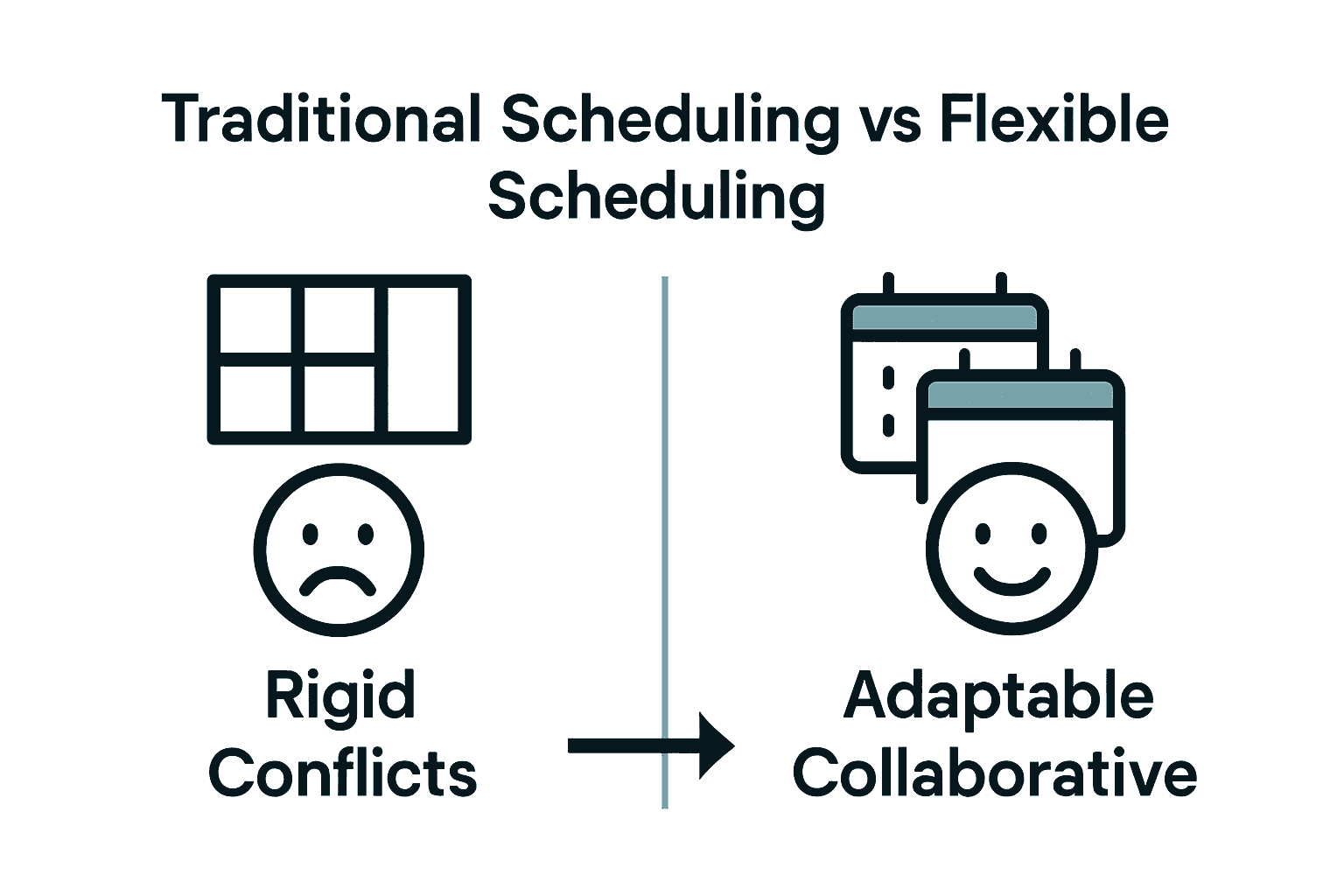
Scheduling methodologies represent fundamentally different approaches to time management, with traditional and flexible models offering distinct strategies for coordinating group activities. While traditional scheduling relies on rigid, predetermined time slots, flexible scheduling introduces a more dynamic, participant-centered framework.
According to amle, traditional schedules feature fixed-time periods characterized by standardized, uniform structures. In contrast, flexible scheduling shifts towards longer, more adaptable time segments that accommodate diverse activities and individual preferences.
Key differences between traditional and flexible scheduling include:
- Time Allocation: Traditional scheduling uses rigid, uniform time blocks
- Participant Control: Flexible scheduling prioritizes individual availability
- Adaptation Potential: Flexible models allow real-time schedule modifications
- Communication Approach: Traditional methods require extensive prior coordination
- Complexity Management: Flexible scheduling simplifies multi-participant planning
As en highlights, traditional timetables coordinate participants within fixed periods, whereas flexible scheduling enables variations that better meet dynamic needs. This approach transforms scheduling from a constraint-driven process to a collaborative, adaptive experience.
The evolution from traditional to flexible scheduling reflects broader changes in how we conceptualize time, collaboration, and individual productivity. By prioritizing human needs over rigid structures, flexible scheduling represents a more responsive, intelligent approach to coordinating group activities.
To explore more nuanced scheduling strategies, check out our guide on understanding efficient scheduling methods.
Simplify Your Flexible Group Scheduling Challenges Today
Planning group events with flexible dates can often feel overwhelming and frustrating. The article highlights key pain points like complicated coordination, communication delays, and the difficulty of managing participants' varying unavailability. By focusing on concepts such as inverse availability marking and collaborative input, it becomes clear that what you need is a scheduling solution that respects individual constraints without overcomplicating the process.
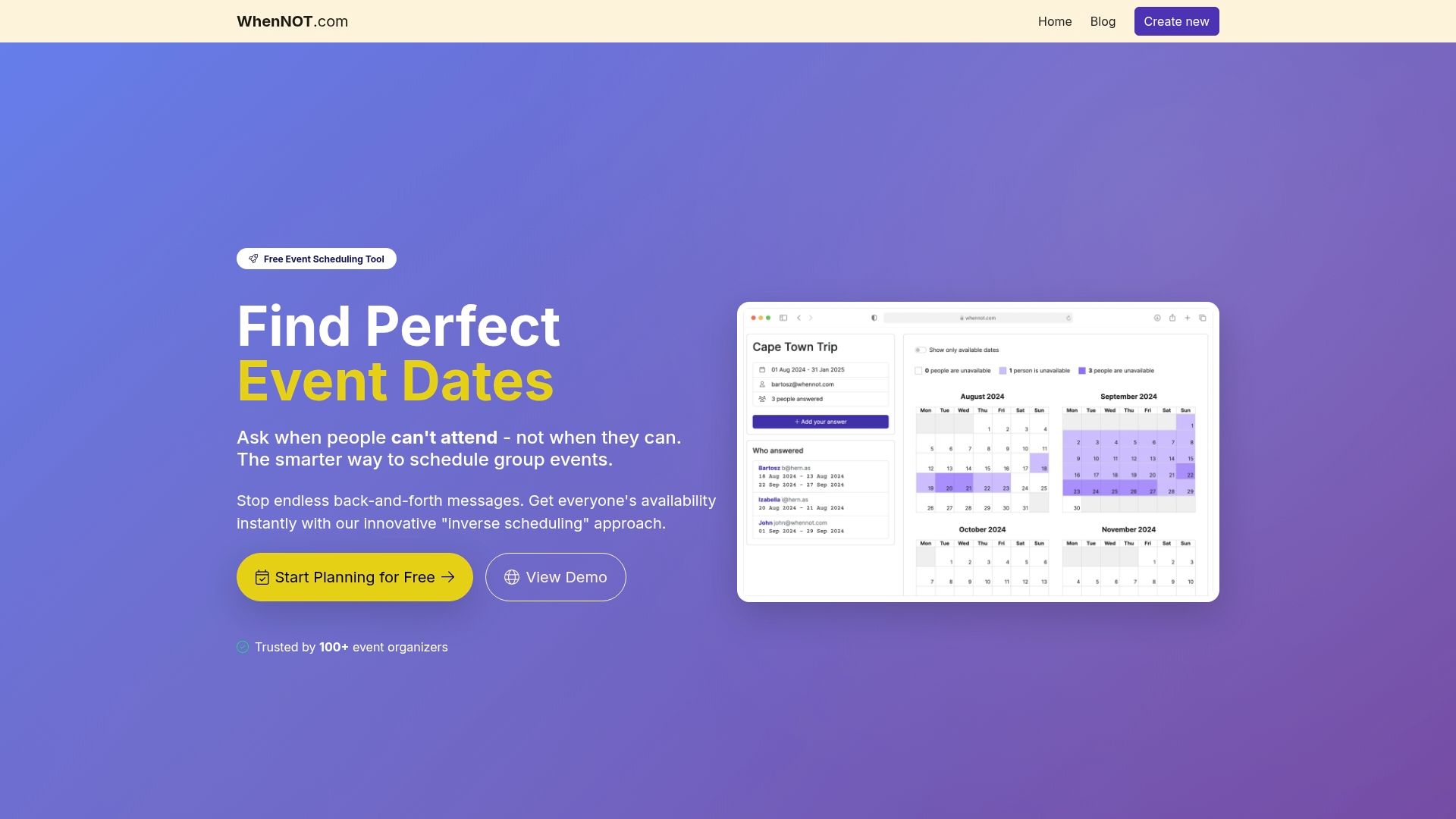
Experience the ease of scheduling with WhenNOT, an innovative tool designed exactly for these challenges. WhenNOT invites participants to share when they are not available instead of forcing them to pick exact times, making it ideal for multi-day or flexible events. This unique approach eliminates confusion and streamlines identifying perfect dates by visually mapping everyone's busy days at once. Discover how you can save time and reduce stress by trying WhenNOT now. Want to understand how this aligns with best scheduling practices? Read our guide on understanding group scheduling and explore effective group scheduling examples to see flexible scheduling in action.
Take control of your group events today with a free, privacy-focused platform that turns complicated schedules into simple solutions. Visit WhenNOT and start planning smarter now.
Frequently Asked Questions
What is flexible group scheduling?
Flexible group scheduling is a dynamic approach to coordinating events that prioritizes adaptability by allowing participants to indicate their unavailable times, creating a more collaborative planning process.
How do flexible group scheduling methods work?
Flexible group scheduling methods typically involve participants marking unavailable times, using range-based scheduling, and collaborative preference mapping to identify overlapping free periods for meetings or activities.
What are the benefits of using flexible group scheduling?
Using flexible group scheduling can enhance staff morale, reduce tardiness, and increase productivity by accommodating individual schedules and preferences, making coordination simpler and more efficient.
How is flexible scheduling different from traditional scheduling?
Flexible scheduling allows for real-time modifications and prioritizes individual availability, whereas traditional scheduling relies on fixed, predetermined time blocks without accommodating participant preferences.