
Coordinating multi-day events often feels overwhelming when participants juggle different schedules. Inverse scheduling flips the traditional approach by asking when people are unavailable rather than available, cutting planning time by nearly 30%. This guide reveals how event organizers can simplify complex coordination, boost response rates, and identify optimal dates faster using smarter scheduling techniques.
Table of Contents
- Understanding The Challenge Of Coordinating Busy Multi-Day Schedules
- The Inverse Scheduling Approach: A Game-Changer For Event Organizers
- Common Misconceptions And Pitfalls In Busy Schedule Coordination
- Comparing Scheduling Tools And Methods For Multi-Day Events
- Practical Steps And Best Practices To Simplify Schedule Coordination
- Bridging Understanding To Application: Framework And Trade-Offs In Scheduling Optimization
- How WhenNOT Simplifies Your Multi-Day Scheduling Challenges
- FAQ
Key takeaways
| Point | Details |
|---|---|
| Inverse scheduling simplifies coordination | Asking for unavailable times reduces participant burden and speeds consensus by about 30%. |
| Limit date options strategically | Offering 3-5 date choices avoids decision paralysis and accelerates participant responses. |
| Clear communication drives results | Structured deadlines and expectations boost response rates by up to 50%. |
| Visual aggregation identifies optimal dates | Displaying busy schedules concurrently helps organizers spot free windows 35% faster. |
| No-sign-up tools increase engagement | Removing account requirements raises completion rates by 25%. |
Understanding the challenge of coordinating busy multi-day schedules
Multi-day events present unique scheduling complexities that single-day gatherings never face. Participants have varied availability patterns spread across multiple days, creating exponential coordination difficulty. Traditional availability polling overwhelms attendees with too many date combinations, leading to slow responses and confusion.
Phased approaches to complex schedule coordination show that multi-day events involve intricate availability patterns that multiply coordination challenges. When organizers attempt uncoordinated scheduling methods, they trigger delays, communication overload, and frustration among participants.
Several factors compound the coordination challenge:
- Participants manage different work schedules, travel commitments, and personal obligations across date ranges
- Traditional polling forces attendees to check availability for every proposed date combination
- Back-and-forth communication creates confusion as responses arrive asynchronously
- Organizers struggle to visualize overlapping availability windows manually
Understanding why schedule multi-day events requires efficient coordination becomes crucial when complexity threatens event success. The cognitive load of tracking multiple participants across multiple days often derails planning before it begins. Recognizing these challenges sets the stage for adopting more effective scheduling approaches.
The inverse scheduling approach: a game-changer for event organizers
Inverse scheduling revolutionizes event coordination by asking one simple question: when are you unavailable? This approach reduces participant burden by focusing on unavailable times rather than availability, leading to faster consensus. Instead of mentally calculating free days across complex date ranges, participants quickly mark their busy periods.

The cognitive shift makes responding significantly easier. People naturally know when they have conflicts scheduled, such as work meetings, family commitments, or travel plans. Asking them to identify availability across multiple days requires mental gymnastics that inverse scheduling eliminates entirely.
This method delivers measurable efficiency gains:
- Planning time drops by approximately 30% compared to traditional availability polling
- Response completion happens faster when participants face simpler questions
- Visual busy-day displays let organizers spot optimal windows immediately
- Asynchronous data collection respects different time zones and schedules
Pro Tip: Choose inverse scheduling tools that display aggregated busy days visually, enabling you to identify conflict-free windows at a glance rather than manually comparing individual responses.
Research confirms that tools without mandatory sign-ups see 25% higher completion rates due to reduced participant burden. When attendees can mark unavailable dates without creating accounts or remembering passwords, friction disappears. This accessibility advantage becomes critical for modern event scheduling explained in today's fast-paced environment.
The privacy benefits matter too. Participants share only their unavailable periods, not their entire calendar details. This selective disclosure respects boundaries while providing organizers with exactly the information needed for coordination. Understanding how to optimize event scheduling means recognizing that less invasive approaches drive better participation.
Inverse scheduling transforms coordination from a frustrating puzzle into a streamlined process. By flipping the question and removing barriers, organizers accelerate planning while improving participant scheduling simplified planning outcomes.
Common misconceptions and pitfalls in busy schedule coordination
Several persistent myths sabotage efficient event scheduling. Understanding these misconceptions helps organizers avoid wasting time on ineffective approaches.
Myth: More date options improve scheduling outcomes. Reality tells a different story. Research shows more date options cause analysis paralysis, slowing decisions rather than accelerating them. When participants face 10+ date choices, they procrastinate or abandon the survey entirely.
Myth: Scheduling chaos is unavoidable for complex events. Actually, structured frameworks reduce scheduling complexity by nearly 50%. Organizers who implement phased coordination processes, clear communication protocols, and visual aggregation tools cut errors and delays dramatically.
Myth: Sign-up requirements protect privacy and security. The opposite often proves true. Mandatory account creation decreases participation rates without meaningfully enhancing security for basic scheduling data. Participants avoid tools requiring registration, leading to incomplete responses and coordination gaps.
Common pitfalls compound these misconceptions:
- Failing to set clear response deadlines allows scheduling to drag indefinitely
- Offering too many date options triggers decision fatigue and reduces completion
- Using synchronous methods creates bottlenecks when participants span time zones
- Neglecting visual aggregation forces manual comparison of individual responses
Pro Tip: Limit your date selections to 3-5 carefully chosen options that balance attendance goals with participant decision-making ease, dramatically improving response speed and quality.
Organizers who understand inclusive event scheduling benefits recognize that accessibility drives participation. Removing barriers and simplifying choices creates better outcomes than adding complexity in the name of thoroughness. Avoiding these pitfalls transforms scheduling from a dreaded task into a manageable process.
Comparing scheduling tools and methods for multi-day events
Choosing the right scheduling approach significantly impacts coordination efficiency. Different tools and methods offer distinct advantages depending on event complexity and participant preferences.
| Method | Strengths | Weaknesses | Best For |
|---|---|---|---|
| Traditional Polling | Familiar to most users | Causes decision fatigue, lower completion | Simple events with few dates |
| Inverse Scheduling | Reduces cognitive load, faster responses | Requires explaining new concept | Multi-day events, busy participants |
| Synchronous Scheduling | Real-time collaboration | Creates bottlenecks across time zones | Small local groups |
| Visual Aggregation | Spotting conflicts 35% faster | Requires compatible tool | Any group size needing quick decisions |
Traditional polling tools require participants to indicate full availability across all proposed dates. This approach leads to decision fatigue as attendees mentally calculate open windows. Lower completion rates follow when surveys feel overwhelming.
Inverse scheduling platforms collect unavailable dates instead, focusing on minimizing participant burden. No sign-up requirements remove friction entirely. Visual aggregated calendars speed optimal date identification by 35%, allowing organizers to spot common free windows immediately.
Synchronous scheduling methods create coordination bottlenecks. When organizers attempt to gather responses in real-time meetings or group chats, participants across different time zones face barriers. Research demonstrates that asynchronous methods improve completion rates by 45% compared to synchronous approaches.
Key differentiators include:
- Response burden: Inverse scheduling requires less mental effort than availability polling
- Completion rates: No-sign-up tools significantly outperform registration-required platforms
- Speed: Visual aggregation enables faster decision-making than manual response comparison
- Accessibility: Asynchronous collection accommodates different schedules and time zones
Understanding why schedule asynchronously event coordination works better reveals that flexibility drives participation. When participants respond on their own timeline without account creation, completion rates soar.
The multi-day event schedulers comparison shows trade-offs between maximizing attendance and reducing decision fatigue. Organizers must balance comprehensive date options against participant overwhelm. Tools offering visual busy-day displays provide the sweet spot, combining simplicity with clarity.
Practical steps and best practices to simplify schedule coordination
Implementing structured coordination processes transforms chaotic scheduling into manageable workflows. Follow these actionable steps to reduce complexity and accelerate event planning.
- Define 3-5 potential date ranges before soliciting participant input to narrow scope and prevent option overload
- Select an inverse scheduling tool that collects unavailable dates asynchronously without requiring sign-ups
- Communicate clear response deadlines and set participant expectations upfront to speed responses
- Visualize aggregated busy dates using the tool's display features for quick optimal window identification
- Segment scheduling into distinct phases: data collection, analysis, and final communication to improve tracking
- Send timely reminders as deadlines approach to maintain momentum and boost completion rates
Research confirms that clear deadlines increase response rates by 50% when communicated effectively. Participants respond faster when they understand exactly when feedback is needed and why the timeline matters.
Segmenting scheduling into phases improves clarity and reduces errors by 40%. Breaking coordination into manageable stages prevents confusion and allows organizers to track progress systematically.
Best practices for communication include:
- State the event purpose and why participant input matters in initial outreach
- Specify exact deadline dates and times for marking unavailable periods
- Explain how responses will inform final date selection decisions
- Provide progress updates as responses arrive to maintain engagement
- Send polite reminders 24-48 hours before deadlines to capture stragglers
Pro Tip: Schedule your reminder messages in advance so they send automatically, ensuring consistent follow-up without requiring manual tracking or last-minute scrambling.
Utilizing no-sign-up tools eliminates a major friction point. When participants can mark busy dates by simply clicking a link without account creation, completion rates jump significantly. This accessibility advantage proves especially valuable for group planning time savers for faster event coordination.
Visual aggregation transforms raw response data into actionable insights. Instead of manually comparing individual calendars, organizers see busy periods displayed concurrently. This visual clarity enables quick identification of windows where most participants remain available.
Following these phased approaches to schedule coordination creates predictable workflows that scale across different event types and group sizes. The structured methodology prevents ad hoc chaos while maintaining flexibility for participant needs.
Bridging understanding to application: framework and trade-offs in scheduling optimization
A conceptual framework helps organizers balance competing priorities when coordinating complex schedules. Understanding key decision points and trade-offs enables confident choices that align with specific event goals.
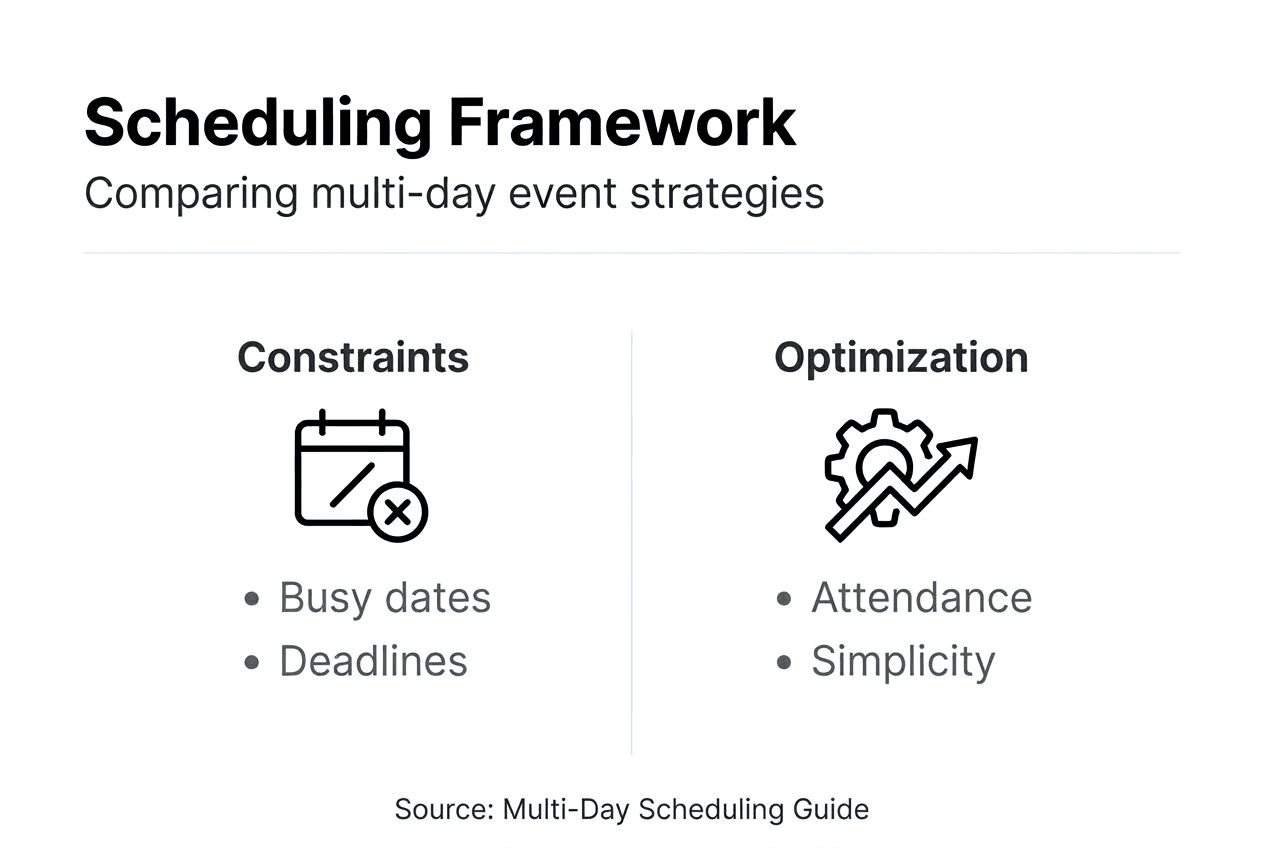
The framework treats participant unavailability as constraints preventing conflicts rather than seeking perfect open slots. Viewing availability as busy-time constraints reduces conflicts by 30% by reversing traditional scheduling logic. This shift simplifies the mental model for both organizers and participants.
| Factor | Fewer Options (3-5 dates) | More Options (6+ dates) |
|---|---|---|
| Decision Speed | Faster responses | Slower, procrastination |
| Attendance Rate | Slightly lower ceiling | Higher potential |
| Completion Rate | 15-20% higher | Lower due to overwhelm |
| Coordination Complexity | Manageable | Exponentially harder |
Offering 3-5 date options balances maximizing attendance with avoiding decision fatigue. This sweet spot gives participants meaningful choice without triggering analysis paralysis. Event organizers must weigh simpler processes against participant response rates and attendance goals.
Key trade-offs include:
- Simplicity versus inclusivity: Fewer options speed decisions but may exclude some participants
- Speed versus thoroughness: Quick coordination may sacrifice exhaustive availability checking
- Privacy versus visibility: Collecting only unavailable dates respects boundaries but provides less calendar detail
- Accessibility versus control: No-sign-up tools boost participation but limit organizer tracking features
Understanding how to optimize event scheduling requires accepting that perfect attendance and instant coordination rarely coexist. Organizers optimizing for speed prioritize streamlined processes and clear constraints. Those prioritizing maximum attendance invest more time gathering comprehensive availability data.
The inverse scheduling framework succeeds because it aligns with how people naturally think about their schedules. Participants know their conflicts immediately but struggle to calculate availability across multiple days. Reversing the question leverages this cognitive reality.
Applying this framework means consciously choosing where to optimize based on event priorities. A corporate retreat prioritizing high attendance may offer more date options despite slower coordination. A casual gathering prioritizing quick planning may limit choices for faster consensus. Neither approach is wrong; alignment with goals determines success.
How WhenNOT simplifies your multi-day scheduling challenges
Scheduling multi-day events no longer requires endless email chains or complex spreadsheets. WhenNOT applies inverse scheduling principles to streamline coordination and accelerate planning.

The WhenNOT scheduling platform asks participants when they're unavailable rather than available, dramatically simplifying responses. Create an event, set your potential date range, and share a unique link. Participants mark their busy dates in seconds without creating accounts or remembering passwords.
Visual calendar aggregation displays everyone's unavailable periods concurrently, letting you spot optimal windows immediately. Clear communication features help you set response deadlines and track completion. The platform handles the complexity while you focus on event details.
Designed specifically for multi-day event coordination, WhenNOT eliminates the friction that derails traditional scheduling. No costs, no sign-ups, just efficient planning that respects participant time and privacy.
FAQ
How does inverse scheduling speed up event planning?
By asking when participants are unavailable rather than available, inverse scheduling reduces cognitive load, leading to faster survey completion. Participants naturally know their conflicts without mental calculation. This simplification reduces back-and-forth communication and accelerates agreement on event dates.
Why should I limit my event date options to 3-5 choices?
Too many options overwhelm participants, causing delays and lower response rates. Research shows excessive date options create analysis paralysis, reducing efficiency by up to 22%. Limiting choices balances giving flexibility with encouraging quick, confident decisions.
How can I improve participant response rates when coordinating schedules?
Set and communicate clear, firm deadlines for participant feedback to create urgency. Use asynchronous, no-sign-up scheduling tools to reduce friction and boost completion. Studies confirm clear deadlines increase response rates by 50% while removing sign-up barriers raises engagement by 25%. Send timely reminders and updates to keep participants informed and engaged throughout the process.
What are the main trade-offs when optimizing multi-day event schedules?
Offering more date options can maximize attendance potential but risks decision fatigue and coordination delays. Simpler processes with fewer choices increase response rates but may slightly reduce attendance flexibility. Organizers should balance their priorities between scheduling ease and attendance inclusivity based on specific event goals and participant characteristics.