
Every event coordinator knows the headache of double-booked meeting rooms and missing key team members at corporate retreats. Scheduling conflicts are more than a minor glitch—they quickly ripple into lost engagement, session cancellations, and mounting frustration for both organizers and attendees. In the packed schedules of North American retreats, finding a way to manage competing events and overlapping commitments can make or break your event’s success. Get practical strategies to identify, prevent, and resolve conflicts before they derail your plans.
Table of Contents
- Defining Scheduling Conflicts In Event Planning
- Types Of Scheduling Conflicts For Retreats
- How Scheduling Conflicts Impact Team Collaboration
- Common Causes And Oversights By Coordinators
- Efficient Solutions: Inverse Scheduling For Groups
Key Takeaways
| Point | Details |
|---|---|
| Identify Scheduling Conflicts Early | Use tools to track participant availability and anticipate potential scheduling conflicts before finalizing plans. |
| Implement Inverse Scheduling | Collect unavailability instead of availability to reduce scheduling friction and streamline the planning process. |
| Create a Conflict Resolution System | Establish a method for team members to flag scheduling issues as they arise to mitigate problems in real-time. |
| Engage Participants Proactively | Communicate with attendees ahead of time to understand their constraints, promoting better planning and attendance. |
Defining Scheduling Conflicts in Event Planning
Scheduling conflicts happen when multiple events compete for the same time slot, forcing people or resources to be in two places simultaneously. For corporate retreat planners, this isn't just an inconvenience—it's a planning disaster that cascades through your entire event.
What exactly counts as a scheduling conflict? A scheduling conflict occurs when two or more necessary activities require attendance at the same time, creating a competition for limited resources. Think of it like overbooking a conference room for back-to-back sessions with no buffer time.
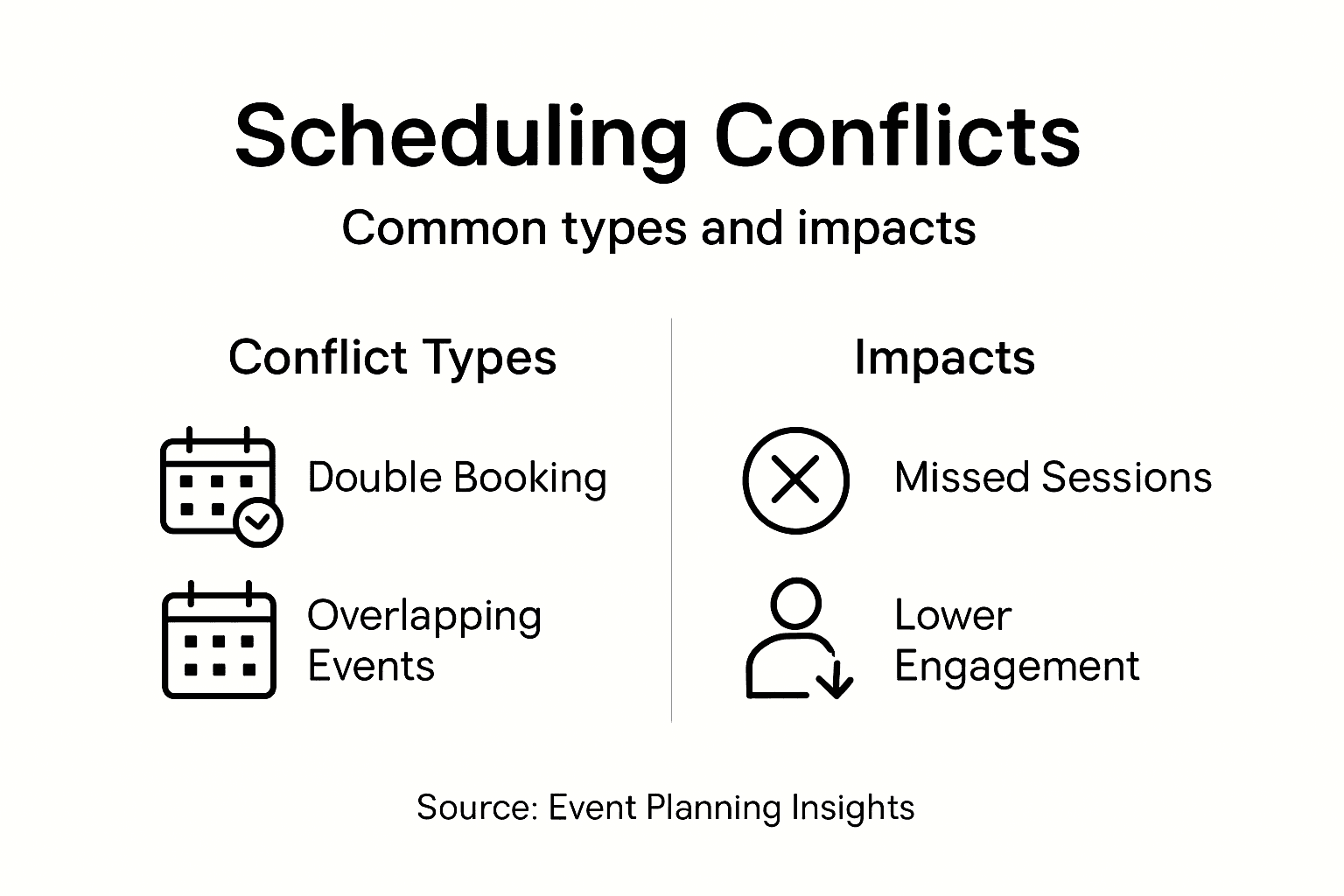
Scheduling conflicts manifest in three main ways:
- Personnel conflicts: Employees double-booked across meetings, workshops, or team-building activities
- Resource conflicts: Meeting spaces, equipment, or facilities assigned to multiple events simultaneously
- Attendance conflicts: Key participants unable to attend because of overlapping commitments elsewhere
For corporate retreats spanning multiple days, these conflicts explode in complexity. A single person might need to attend the morning leadership session, afternoon breakout workshop, evening networking dinner, and morning-after planning meeting—but their availability window gets narrower as more activities stack up.
Scheduling conflicts derail retreats because they force organizers to constantly shuffle attendees, reduce participation quality, or cancel sessions altogether.
The root cause usually traces back to poor visibility into group scheduling friction and participant availability. When you're coordinating 50+ professionals with varying calendars and constraints, traditional back-and-forth emails become a communication nightmare.
Unlike basic meeting conflicts, corporate retreat scheduling involves layered complexity:
- Multi-day duration requiring block time commitment
- Multiple concurrent sessions competing for the same attendees
- Vendor and speaker availability constraints
- Location logistics and room capacity limitations
- Time zone differences across remote or hybrid teams
Recognizing these boundaries helps you address the root issue before it tanks your retreat.
Pro tip: Ask participants to block their entire retreat dates on their calendars before sending detailed session schedules. This prevents last-minute scheduling conflicts from emerging once the agenda is locked in.
Types of Scheduling Conflicts for Retreats
Not all scheduling conflicts are created equal. Understanding the different types helps you spot problems before they tank your retreat planning.
Double booking happens when a person or resource gets assigned to multiple commitments at once. Imagine assigning your finance director to both the morning keynote and a simultaneous one-on-one coaching session.
This creates an impossible choice: which obligation do they skip? Either way, someone's disappointed.
Unavailable participant conflicts occur when you schedule people who are already committed elsewhere. A team member might be on vacation, attending a client meeting, or managing a project deadline during your retreat dates.
You don't realize the conflict until they decline or go silent.
Overlapping events happen when sessions start or end at the same time, forcing attendees to choose between them. Your afternoon networking mixer can't begin at 2 p.m. if the leadership workshop doesn't wrap until 2:15 p.m.
Attendees get stuck between loyalty to one session and missing another.
Unbalanced scheduling spreads workload unevenly across retreat dates. You might cram all critical sessions into day one while day two feels sparse, or overload one person with back-to-back facilitation duties while others coast.
This creates stress, fatigue, and resentment among both organizers and participants.
Here's a summary of common scheduling conflicts in corporate retreats, along with their potential impact:
| Conflict Type | Trigger Situation | Immediate Impact | Long-Term Consequence |
|---|---|---|---|
| Double Booking | Same person assigned to two events | Lost expertise at sessions | Reduced team engagement |
| Unavailable Participants | Schedule overlaps outside activity | Sudden cancellations | Lower overall attendance |
| Overlapping Events | Sessions run simultaneously | Attendees must choose | Decreased session effectiveness |
| Unbalanced Scheduling | Critical sessions clustered | Participant fatigue | Burnout or disengagement |
Corporate retreats amplify these conflicts because they involve overlapping events and resource constraints happening simultaneously across multiple days.
Here's what makes retreat conflicts worse:
- Multiple concurrent sessions competing for the same people
- Vendors and external speakers with rigid availability windows
- Travel and accommodation logistics that lock in specific dates
- Time zone differences across distributed teams
- Limited physical spaces that can only host one large group at a time
The difference between a single meeting conflict and a retreat conflict is scale—one conflict can cascade into dozens of ripple effects across your entire event.
When you discover conflicts during retreat week, you cannot simply reschedule. You've already blocked calendars, booked travel, arranged catering, and confirmed vendor availability.
The fix becomes expensive and stressful.
Pro tip: Create a master conflict tracking spreadsheet listing all sessions, required attendees, speaker availability, and resource needs side-by-side. Review it weekly during planning to catch overlaps before they become problems.
How Scheduling Conflicts Impact Team Collaboration
Scheduling conflicts don't just create logistical headaches. They actively damage the collaborative foundation your retreat is supposed to strengthen.
When team members miss meetings because of scheduling conflicts, engagement drops immediately. Someone stuck between two sessions attends neither fully, splitting their attention and contributing half-heartedly to both.
This scattered focus undermines the entire purpose of bringing people together.
Communication suffers first. When people skip sessions due to conflicts, critical information doesn't reach everyone. Teams end up with incomplete knowledge about decisions, initiatives, or strategic directions shared during retreat sessions.
Someone always has to catch the person up later, creating inefficiency and frustration.
Trust erodes quickly. Conflicts lead to missed meetings and split attention between tasks, which team members interpret as poor coordination from leadership. They wonder: "If they can't even schedule this retreat properly, how can I trust them with bigger strategic decisions?"
This perception damage lingers long after the retreat ends.
Scheduling conflicts create these specific collaboration breakdowns:
- Incomplete team discussions when key people are absent
- Repeated explanations of the same material to different people
- Resentment among those forced to choose between obligations
- Reduced buy-in because people feel their time wasn't respected
- Diminished psychological safety when people feel undervalued
Repeated scheduling conflicts send a clear message to your team: "Your time and priorities don't matter to us."
The damage compounds across multiple retreat days. Someone misses day-one bonding activities because of a conflict. Day two, they feel disconnected from the group.
By day three, they're mentally checked out.
Higher frequency of conflicts actually increases burnout and turnover risk. People interpret constant scheduling conflicts as a sign that the organization doesn't value their well-being or time management.
This perception directly impacts retention.
For event coordinators, this becomes your reputation problem. One poorly scheduled retreat erodes trust in your ability to coordinate events for months afterward.
Pro tip: Have a "conflict resolution buddy" system where team members can flag scheduling problems early, then immediately address them rather than ignoring them until retreat week arrives.
Common Causes and Oversights by Coordinators
Most scheduling conflicts don't emerge from bad luck. They stem from predictable coordinator mistakes that happen repeatedly across retreat planning cycles.

Poor communication between stakeholders tops the list of causes. You might ask the finance team about availability, but forget to include the IT department or external vendors in that conversation.
Everyone operates with incomplete information.
Lack of real-time visibility into participant calendars creates blind spots. You make scheduling decisions based on outdated availability data or assumptions about who's free when.
By the time you discover conflicts, sessions are already locked in.
Erroneous assumptions about schedules happen constantly. You assume a team member will be available during a retreat because they attended last year, but forget they accepted a new project deadline that week.
Or you schedule a vendor without confirming their current client commitments.
Coordinators frequently overlook critical availability changes and fail to cross-check calendars thoroughly, creating double-bookings that surface too late to fix easily.
Common oversights that derail retreats include:
- Not engaging attendees early to understand their constraints and preferences
- Skipping buffer time between consecutive sessions
- Underestimating how long transitions take between rooms or locations
- Ignoring venue capacity limits for specific sessions
- Neglecting to account for travel time between sessions
- Failing to build in contingency time for speaker delays
The biggest coordinator mistake is treating scheduling as a one-time task rather than an ongoing validation process.
You finalize the schedule three weeks before the retreat, then assume it's locked. Real life happens—people get sick, projects blow up, priorities shift.
Availability changes constantly, but you're not monitoring for updates.
Many coordinators deprioritize schedule validation against other logistical demands. You focus on catering confirmations, room setup, and name badges, then realize you never actually verified every participant's availability against the final session list.
This abdication of responsibility creates chaos.
Pro tip: Set calendar reminders to validate participant availability three weeks, two weeks, and one week before the retreat. Catch conflicts early when you still have time to reschedule sessions without incurring costs.
Efficient Solutions: Inverse Scheduling for Groups
Traditional scheduling asks people "When can you make it?" Then you manually sift through dozens of conflicting responses. Inverse scheduling flips this approach entirely.
Instead of collecting availability, you ask: "When are you NOT available?" This simple reframe eliminates the communication friction that creates conflicts in the first place.
Why inverse scheduling works for retreats. Inverse scheduling techniques maximize participant satisfaction by collecting constraints first, then generating conflict-free schedules. You get a complete picture of unavoidable constraints upfront, then build the schedule around those obstacles.
No guessing. No back-and-forth emails.
With inverse scheduling, participants simply mark their blocked dates—vacation days, existing client commitments, medical appointments, family obligations. They don't need to decode your vague availability questions or wonder if they're being helpful enough.
The system does the thinking for them.
Inverse scheduling delivers concrete benefits for retreat planning:
Below is a comparison of traditional and inverse scheduling approaches for group events:
| Approach | Scheduling Method | Key Benefit | Main Drawback |
|---|---|---|---|
| Traditional Scheduling | Collect availabilities | Flexible for small teams | Prone to conflicts and confusion |
| Inverse Scheduling | Gather unavailability | Reduces scheduling friction | Requires early advance planning |
| Automated Inverse Tools | Use conflict-detecting software | Optimal dates suggested | Tool adoption may take time |
- Participants provide unavailable dates once, then you handle the rest
- Algorithms identify optimal retreat dates with minimal conflicts
- Real-time visibility shows exactly who can and cannot attend each session
- Scheduling changes are rare because you've already accounted for constraints
- Attendees feel heard because their unavoidable commitments are respected
Inverse scheduling doesn't eliminate all conflicts—it prevents the conflicts you could have avoided through better communication.
Automated systems amplify the advantage. Conflict detection and optimization features in scheduling tools highlight unavoidable conflicts early and suggest resolutions. Instead of discovering a conflict two weeks before the retreat, you spot it during planning and adapt the schedule while you still have options.
You might learn that your keynote speaker is unavailable on your preferred retreat date, so you automatically pivot to an alternative date where attendance is higher.
For North American corporate retreat coordinators managing distributed teams, inverse scheduling eliminates the timezone nightmare. Instead of trying to find a time when everyone across Eastern, Central, Mountain, and Pacific zones is available, you simply collect their constraints and build sessions that respect those boundaries.
Some sessions might be asynchronous. Others might repeat across timezones. But conflicts disappear because you're working with reality, not against it.
Pro tip: Implement inverse scheduling at least six weeks before your retreat date. This gives you enough time to identify unavailable participants early and either adjust the retreat dates or plan workarounds like recorded sessions for those who cannot attend.
Eliminate Retreat Scheduling Conflicts with Streamlined Planning
Scheduling conflicts can deeply disrupt your corporate retreat, leading to frustration, missed sessions, and reduced team engagement. When multiple people and resources compete for overlapping times, coordinating becomes a complex challenge. If you want to stop juggling conflicting commitments and prevent last-minute chaos, adopting smarter scheduling methods is essential.
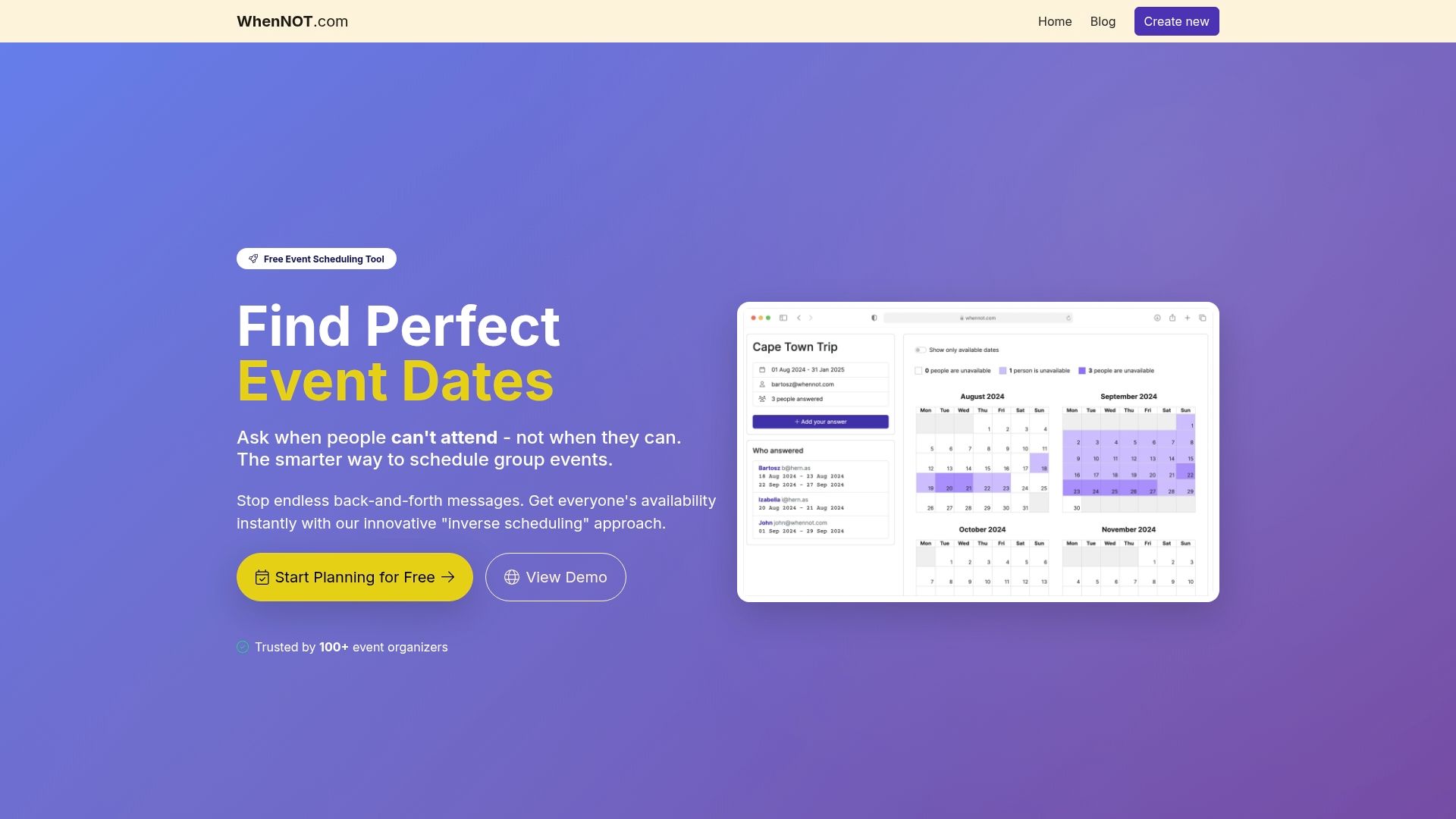
Discover how WhenNOT uses an innovative inverse scheduling approach to solve these exact challenges. Instead of asking when participants are free, it collects when they are not available, making it simple to pinpoint optimal retreat dates that respect everyone's constraints. This means fewer double bookings, minimized overlapping events, and balanced session planning for your multi-day retreat. Take control of your event planning process today by visiting WhenNOT scheduling tool and experience how easy conflict-free corporate retreat scheduling can be. Act now to save time, reduce stress, and keep your team fully engaged throughout your next event.
Frequently Asked Questions
What are the common types of scheduling conflicts that affect corporate retreats?
Scheduling conflicts can manifest as double booking, unavailable participants, overlapping events, and unbalanced scheduling. Each type can disrupt the flow of a retreat and diminish attendee engagement.
How do scheduling conflicts impact team collaboration during retreats?
When scheduling conflicts occur, key team members may miss sessions, leading to incomplete discussions, communication breakdowns, and a loss of trust in leadership. This can affect overall team dynamics and reduce buy-in from participants.
What are the main causes of scheduling conflicts in corporate retreat planning?
Common causes include poor communication among stakeholders, lack of real-time visibility into participant calendars, and erroneous assumptions about individual availability. Coordinators often overlook critical changes, resulting in double-bookings and missed opportunities for collaboration.
How can inverse scheduling help prevent conflicts during corporate retreats?
Inverse scheduling gathers unavailability information from participants upfront, allowing planners to build schedules around unavoidable constraints. This method reduces scheduling friction and ensures better attendance by respecting individual commitments.