
Coordinating a group event can feel like a puzzle, especially when every American faces the challenge of juggling busy schedules and different preferences. Studies show that over 60 percent of American professionals find group scheduling to be one of their biggest time-management headaches. Effective event coordination matters because it makes gatherings smoother and ensures nobody is left out. This guide breaks down proven strategies and fresh digital solutions that take the stress out of planning, no matter the complexity or the size of your American group.
Table of Contents
- Defining The Group Event Coordination Process
- Types Of Events And Coordination Methods
- Key Steps For Effective Event Scheduling
- Participant Roles And Responsibilities
- Addressing Common Challenges And Mistakes
- Innovative Digital Tools For Modern Scheduling
Key Takeaways
| Point | Details |
|---|---|
| Systematic Coordination Process | Group event coordination transforms individual availability into a cohesive strategy, enhancing collective participation. |
| Key Principles for Success | Effective coordination relies on clear communication, flexible scheduling, and minimizing participant burden to achieve shared goals. |
| Technological Innovations | Modern digital tools simplify scheduling by providing real-time collaboration and intelligent conflict resolution, making planning more efficient. |
| Addressing Challenges | Anticipating common challenges, like communication breakdowns and scheduling conflicts, is crucial for smooth and inclusive event planning. |
Defining the Group Event Coordination Process
Group event coordination is a systematic approach to planning complex gatherings that involves multiple participants with competing schedules and diverse requirements. At its core, this process transforms individual availability constraints into a cohesive planning strategy that maximizes collective participation. Unlike traditional scheduling methods, modern coordination recognizes the intricate network of event relationships and potential scheduling risks.
The fundamental framework of group event coordination involves several critical stages: preliminary communication, availability mapping, consensus building, and final scheduling. Each stage requires strategic information exchange and collaborative decision making. Participants must transparently share their time constraints, preferences, and potential limitations while maintaining flexibility. This approach mirrors principles from Organizational Information Theory, which emphasizes how groups make sense of complex, sometimes ambiguous scheduling information through iterative communication and mutual understanding.
Successful group event coordination hinges on several key principles:
- Clear communication channels
- Transparent availability tracking
- Flexible date range consideration
- Minimal individual scheduling burden
- Efficient consensus mechanism
While traditional methods often rely on time-consuming back-and-forth emails or lengthy group discussions, modern group scheduling processes leverage technological solutions that simplify collective planning. These innovative approaches reduce coordination complexity by allowing participants to quickly indicate their unavailable times, thereby inverting the traditional scheduling paradigm and making group event planning more intuitive and efficient.
Types of Events and Coordination Methods
Group events encompass a diverse range of gatherings, each requiring unique coordination approaches tailored to their specific dynamics and participant needs. These events span personal, professional, and community contexts, with coordination methods evolving to address increasingly complex scheduling challenges. Channel coordination strategies offer valuable insights into how multiple stakeholders can align their objectives and constraints effectively.
The primary categories of group events that demand sophisticated coordination methods include:
- Family Reunions: Multi-generational gatherings with complex availability constraints
- Corporate Retreats: Professional events requiring alignment of executive and team schedules
- Academic Conferences: Gatherings involving researchers, presenters, and administrators
- Community Workshops: Local events with diverse participant backgrounds
- Social Club Meetings: Regular gatherings with flexible participation requirements
Modern event coordination methods have dramatically transformed with technological innovations. These approaches now leverage digital platforms that enable event-driven architectures which provide high-performance, scalable solutions for complex scheduling scenarios. Efficient event coordination strategies focus on reducing communication overhead and simplifying the intricate process of finding mutually acceptable time slots.
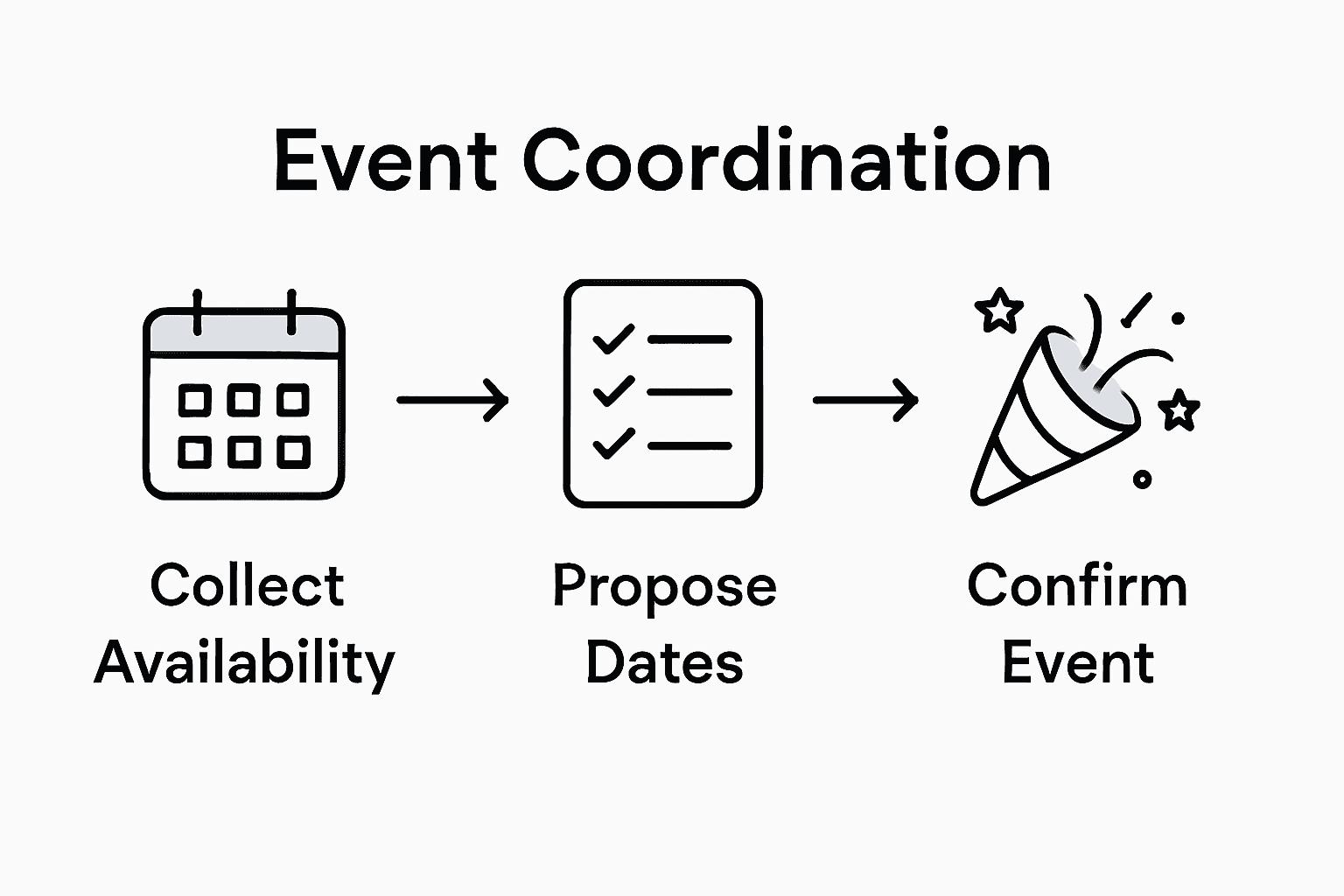
Successful coordination across different event types requires adaptive strategies that recognize the unique challenges of each gathering. Whether managing a multinational corporate meeting or organizing a local community workshop, the core principles remain consistent: transparent communication, flexible scheduling, and minimizing individual participant burden. Technology now enables event organizers to transcend traditional scheduling limitations, creating more inclusive and accessible planning processes that accommodate diverse schedules and preferences.
Key Steps for Effective Event Scheduling
Effective event scheduling requires a strategic, systematic approach that transforms complex planning challenges into manageable processes. Network analysis techniques provide critical insights into mapping task relationships and identifying potential scheduling bottlenecks, allowing event coordinators to develop more precise and reliable timelines.
The key steps for successful event scheduling encompass a comprehensive framework:
- Initial Planning Stage
- Define clear event objectives
- Identify core participant requirements
- Establish preliminary date ranges
- Availability Mapping
- Collect individual participant constraints
- Visualize collective scheduling challenges
- Identify potential time overlap windows
- Consensus Building
- Communicate potential scheduling options
- Negotiate flexible alternatives
- Confirm mutually acceptable dates
Technological innovations have dramatically transformed scheduling methodologies, enabling more sophisticated event synchronization approaches that reduce communication complexity. Modern tools allow event coordinators to move beyond traditional linear scheduling methods, incorporating advanced algorithms that can simultaneously analyze multiple participant schedules and identify optimal meeting windows with unprecedented precision.

Successful event scheduling is not merely about selecting a date, but creating a collaborative process that respects individual constraints while achieving collective goals. By implementing systematic approaches, leveraging technology, and maintaining transparent communication, event organizers can transform potentially chaotic scheduling challenges into streamlined, efficient planning experiences that satisfy all participants.
Participant Roles and Responsibilities
Group event coordination demands a nuanced understanding of individual responsibilities and collaborative dynamics. Group Communication Analysis reveals that successful events emerge from well-defined participant roles and strategic interaction patterns, transforming individual contributions into collective achievements.
Typical participant roles in event coordination include:
- Event Organizer: Primary coordinator responsible for overall planning
- Decision Maker: Key stakeholder who approves final event details
- Availability Coordinator: Manages schedule synchronization
- Logistics Support: Handles practical implementation details
- Communication Facilitator: Ensures smooth information exchange
Team effectiveness principles emphasize that successful group events depend on shared responsibility and interdependent tasks. Each participant must understand their specific contribution to the overall objective, maintaining clear communication channels and demonstrating flexibility. 7 Successful Event Organizer Habits highlight the importance of proactive communication and collaborative problem solving.
Ultimately, effective participant engagement transforms group events from potential logistical challenges into seamless, collaborative experiences. By establishing clear expectations, maintaining transparent communication, and recognizing each individual's unique value, event coordinators can create an environment where collective goals are achieved efficiently and harmoniously.
Addressing Common Challenges and Mistakes
Event coordination inevitably presents complex challenges that can derail even the most meticulously planned gatherings. Organizational Information Theory reveals that successful event management hinges on effectively processing and interpreting potentially ambiguous communication signals and participant constraints.
Common challenges in group event scheduling include:
- Communication Breakdowns: Misaligned expectations and unclear communication
- Scheduling Conflicts: Competing individual availability constraints
- Decision-Making Bottlenecks: Slow or ineffective consensus building
- Over-Complexity: Introducing unnecessary planning steps
- Inflexibility: Rigid scheduling approaches that limit participation
Student event organization research highlights the critical importance of balancing individual freedoms with collective responsibilities. Scheduling Error Examples demonstrate that most coordination challenges stem from poor communication, lack of transparent processes, and failure to accommodate diverse participant needs.
Navigating these challenges requires a proactive, adaptable approach. Successful event coordinators must develop robust communication strategies, embrace technological solutions that simplify scheduling, and maintain flexibility throughout the planning process. By anticipating potential obstacles and creating collaborative frameworks that prioritize participant needs, organizers can transform scheduling complexity into a smooth, inclusive planning experience.
Innovative Digital Tools for Modern Scheduling
Digital scheduling tools have revolutionized group event coordination, transforming complex planning challenges into streamlined, intuitive processes. Group event recommendation systems now leverage advanced algorithms that integrate individual preferences, contextual information, and sophisticated decision-making models to simplify collective planning.
Key features of modern scheduling technologies include:
- Automated Availability Mapping
- Real-Time Collaboration Interfaces
- Intelligent Conflict Resolution
- Cross-Platform Synchronization
- Privacy-Preserving Communication Channels
Online coordination research demonstrates the evolving complexity of group scheduling technologies, which now analyze synchronized actions and optimize communication windows. Why Adopt New Scheduling Tools reveals that successful digital scheduling platforms prioritize user experience, minimizing administrative overhead and reducing communication friction.
The future of event coordination lies in intelligent, user-centric technologies that understand individual constraints while facilitating collective decision making. By embracing innovative digital tools, event organizers can transform scheduling from a potential source of stress into a seamless, collaborative experience that respects participants' time and preferences.
Simplify Your Group Event Coordination with WhenNOT
Planning group events often involves navigating complex schedules and overcoming communication bottlenecks as highlighted in the article. The challenge of collecting transparent availability and building consensus while minimizing individual scheduling burdens can lead to frustration and delays. WhenNOT provides a fresh, intuitive solution by using an inverse scheduling method that focuses on when participants are not busy instead of their available times. This unique approach aligns perfectly with the article’s emphasis on reducing complexity and enhancing flexible scheduling.
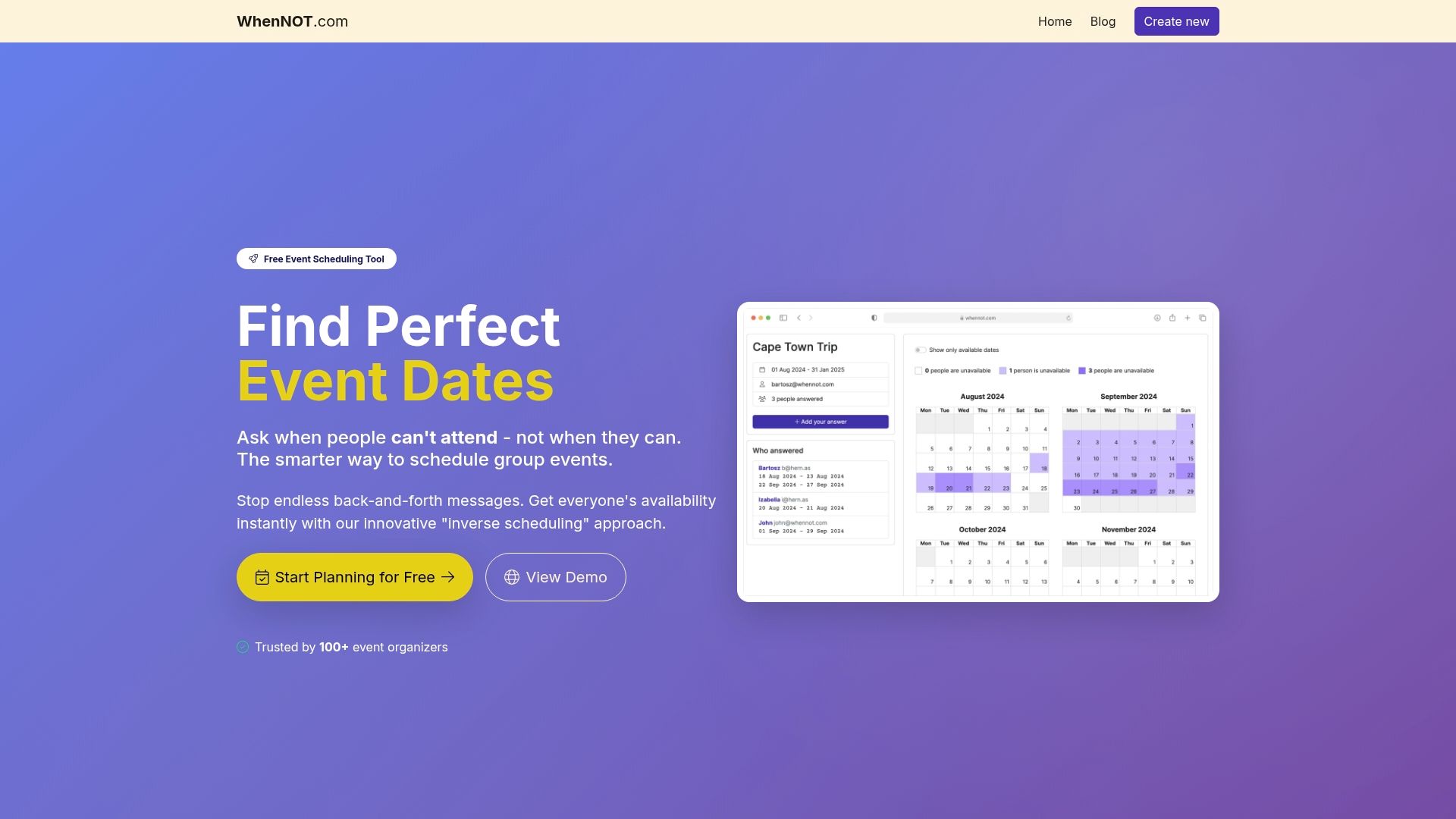
Take control of your group event planning today with WhenNOT. Experience how automated availability mapping and efficient consensus building help you avoid common scheduling pitfalls and communication breakdowns. Whether organizing family reunions, corporate retreats, or social gatherings, our free, privacy-focused platform makes finding optimal dates faster and more effective. Visit WhenNOT now to transform your scheduling workflow into a seamless, stress-free process and give your events the streamlined coordination they deserve.
Frequently Asked Questions
What is group event coordination?
Group event coordination is a systematic approach to planning complex gatherings that involve multiple participants, balancing their competing schedules and various requirements to maximize participation.
What are the key stages in the group event coordination process?
The key stages in the group event coordination process include preliminary communication, availability mapping, consensus building, and final scheduling, each requiring effective collaboration among participants.
How do digital tools improve group event scheduling?
Digital tools improve group event scheduling by automating availability mapping, facilitating real-time collaboration, and utilizing intelligent conflict resolution, which simplifies the planning process and enhances participant engagement.
What common challenges arise in group event scheduling?
Common challenges in group event scheduling include communication breakdowns, scheduling conflicts, decision-making bottlenecks, over-complexity in planning, and inflexible scheduling approaches that can hinder participant involvement.