
Many organizers assume attendee-driven scheduling is complicated, but research shows participant error rates decrease by 35% with inverse scheduling interfaces compared to traditional methods. This approach simplifies multi-day group event planning by focusing on when participants are unavailable rather than available. You'll learn what attendee-driven scheduling is, how it works, the benefits for organizers, and practical steps to implement it efficiently for your next event.
Table of Contents
- Understanding Attendee-Driven Scheduling
- How Inverse Scheduling Works
- Benefits of Attendee-Driven Scheduling for Organizers
- User Experience and Privacy Considerations
- Common Misconceptions About Attendee-Driven Scheduling
- Comparing Attendee-Driven and Traditional Scheduling
- Applying Attendee-Driven Scheduling in Practice
- Streamline Your Multi-Day Event Scheduling with WhenNOT
- Frequently Asked Questions About Attendee-Driven Scheduling
Key Takeaways
| Point | Details |
|---|---|
| Focus on unavailability | Attendee-driven scheduling asks participants to mark busy dates, not available ones, simplifying input. |
| Faster decisions | Inverse scheduling reduces coordination time and communication overhead by up to 50%. |
| No sign-up required | Tools like WhenNOT allow participation without accounts, increasing response rates. |
| Scalable solution | This method handles large multi-day events with flexible dates effectively. |
| Evidence-based benefits | Research dispels myths about complexity and confirms reduced error rates. |
Understanding Attendee-Driven Scheduling
Attendee-driven scheduling centers on participants marking when they are unavailable instead of when they are free. This inverse scheduling concept simplifies data collection by focusing on busy times, which naturally highlights conflicts and makes finding open dates easier.
Traditional methods require marking all available times, which becomes cumbersome and error-prone for scheduling multi-day events effectively. Multi-day and flexible scheduling demands a method that minimizes participant effort and accelerates decision-making.
Challenges with traditional availability polls include:
- Longer decision cycles due to multiple communication rounds
- Lower response rates from complicated input requirements
- Increased complexity for participants juggling multiple date options
- Higher chance of scheduling conflicts from misunderstood availability windows
Inverse scheduling solves these problems by asking one simple question: when can't you make it? This shift reduces cognitive load and makes participation feel effortless.
How Inverse Scheduling Works
Participants only mark the dates or times they cannot attend, reducing input complexity dramatically. Organizers receive a visual map of collective busy dates, quickly identifying optimal dates where fewer conflicts exist.
Here's the typical workflow:
- Create an event with a flexible date range
- Share a link requiring no sign-up or account creation
- Participants mark their unavailable dates in seconds
- System visualizes all busy dates simultaneously
- Organizer identifies and finalizes the best available date
Data visualization adoption increases organizer decision speed by 25%, making this approach significantly faster than traditional polls. The visual representation lets you spot patterns instantly rather than manually comparing individual responses.
Pro Tip: Emphasize the minimal effort and privacy protection when inviting participants. This transparency maximizes response rates and builds trust.
Modern multi-day event scheduling tips recommend inverse scheduling because it transforms what used to take weeks into a process that completes in days.
Benefits of Attendee-Driven Scheduling for Organizers
Attendee-driven scheduling delivers concrete advantages that make your job easier. You'll reduce communication overhead by minimizing back-and-forth availability requests that drain time and energy.
Key benefits include:
- Achieving consensus on event dates faster, often within half the time of traditional methods
- Improving organizer satisfaction by lowering administrative burden and confusion
- Increasing participant response rates due to simplified input and no sign-up barriers
- Supporting better scalability for multi-day and large group events
- Reducing decision fatigue from managing complex availability matrices
The streamlined process means fewer emails, messages, and follow-ups. You spend less time chasing responses and more time on actual event planning. For organizers managing multiple events, this efficiency compounds into significant time savings.

Boost scheduling efficiency by adopting efficient scheduling methods that prioritize participant experience. When participants find the process easy, they respond faster and more accurately.
Event planners who boost efficiency with attendee-driven scheduling report higher satisfaction scores from both organizers and attendees.
User Experience and Privacy Considerations
Participants usually do not need to create an account, reducing friction and increasing response rates significantly. Marking only unavailable dates simplifies the input process and lowers cognitive load compared to complex availability grids.
Enhanced privacy features prevent exposing participant availability unnecessarily. Traditional scheduling tools often reveal when people are free, which some find intrusive. Inverse scheduling only shows when people are busy, protecting personal schedule details.
Accessibility improvements include:
- Mobile-friendly interfaces that work on any device
- Simple, intuitive date selection requiring no training
- Clear instructions that reduce confusion and errors
- No password requirements or account management
- Instant participation without registration delays
Pro Tip: Communicate privacy policies clearly when sharing your scheduling link. Reassure participants that their data remains secure and won't be shared, encouraging prompt replies.
The privacy benefits of inverse scheduling extend beyond basic data protection. By limiting what information participants must share, you create a more comfortable experience that respects boundaries.
Common Misconceptions About Attendee-Driven Scheduling
Many organizers hesitate because of myths that don't match reality. Let's clear up the most common misunderstandings.
Myth: Attendee-driven scheduling is complicated. Truth: It simplifies input by cutting participant errors by 35% compared to traditional availability polls.
Myth: Inverse scheduling only works for small groups. Truth: It scales effectively to groups of 200+ participants without losing efficiency.
Myth: Participants must create accounts to respond. Truth: Modern tools allow no sign-up participation, dramatically increasing engagement rates.
Key clarifications:
- The method becomes more valuable as group size increases, not less
- Visual data aggregation handles complexity better than manual coordination
- Implementation requires minimal technical knowledge or setup time
- Response rates often exceed traditional methods due to reduced friction
Real-world adoption evidence from attendee-driven scheduling myths debunked shows consistent success across diverse event types and sizes. Organizations report smoother coordination and happier participants after switching from traditional methods.
Comparing Attendee-Driven and Traditional Scheduling
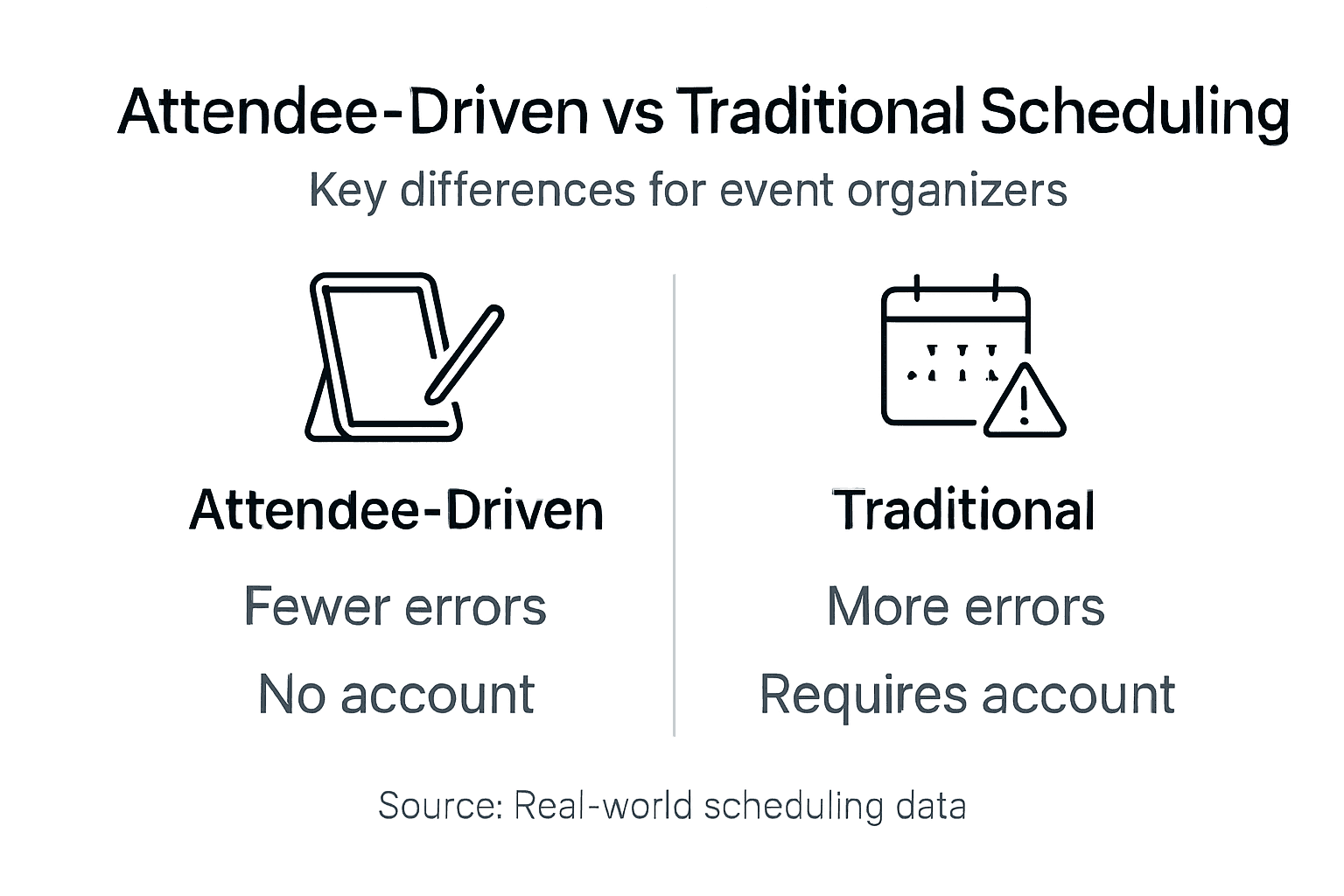
Understanding the differences helps you choose the right approach for your specific needs. Here's how the methods stack up:
| Factor | Attendee-Driven (Inverse) | Traditional (Availability) |
|---|---|---|
| Time to consensus | 2-4 days typical | 5-10 days typical |
| Participant error rate | 35% lower | Baseline |
| Communication rounds | 1-2 rounds | 3-5 rounds |
| Scalability | Excellent for 10-200+ people | Struggles beyond 20 people |
| User effort required | Mark only busy dates | Mark all available times |
| Account creation | Not required | Often required |
| Privacy protection | Shows only unavailability | Exposes full availability |
| Best use cases | Multi-day, flexible dates | Fixed dates, small groups |
Attendee-driven scheduling achieves faster decisions, fewer errors, and better scalability without requiring accounts. Traditional methods can work for very small groups with fixed dates, but struggle as group size and event duration increase.
The comparison makes clear why efficient scheduling comparisons consistently favor inverse approaches for modern event planning. Expert scheduling method comparisons reinforce these findings across different industries.
Applying Attendee-Driven Scheduling in Practice
Implementing this approach requires just a few strategic steps. Follow this workflow to maximize success:
- Define a flexible date range for your event that allows for maximized availability while meeting your constraints
- Create and share a no sign-up scheduling link to gather participant unavailability quickly
- Collect and visualize unavailability data to identify optimal dates with minimal conflicts
- Send timely reminders to encourage completion and prevent scheduling delays
- Finalize the date that works for the most participants and communicate the decision clearly
Choose tools that support inverse scheduling and prioritize user privacy. Look for features like visual conflict mapping, mobile compatibility, and no-registration participation.
Pro Tip: Clearly communicate the simple input process when you share your link. Explain that participants only need to mark dates they can't attend, which takes under a minute. This reduces hesitation and improves engagement.
Successful organizers streamline group availability by setting expectations upfront and making participation effortless. Simple instructions and a user-friendly interface make all the difference.
For more strategies, explore ways to simplify event scheduling that complement the attendee-driven approach.
Streamline Your Multi-Day Event Scheduling with WhenNOT
WhenNOT offers an intuitive attendee-driven scheduling platform requiring no participant sign-up, making coordination effortless. The tool features visualizations that help you quickly spot optimal dates and reduce endless back-and-forth communications that waste time.
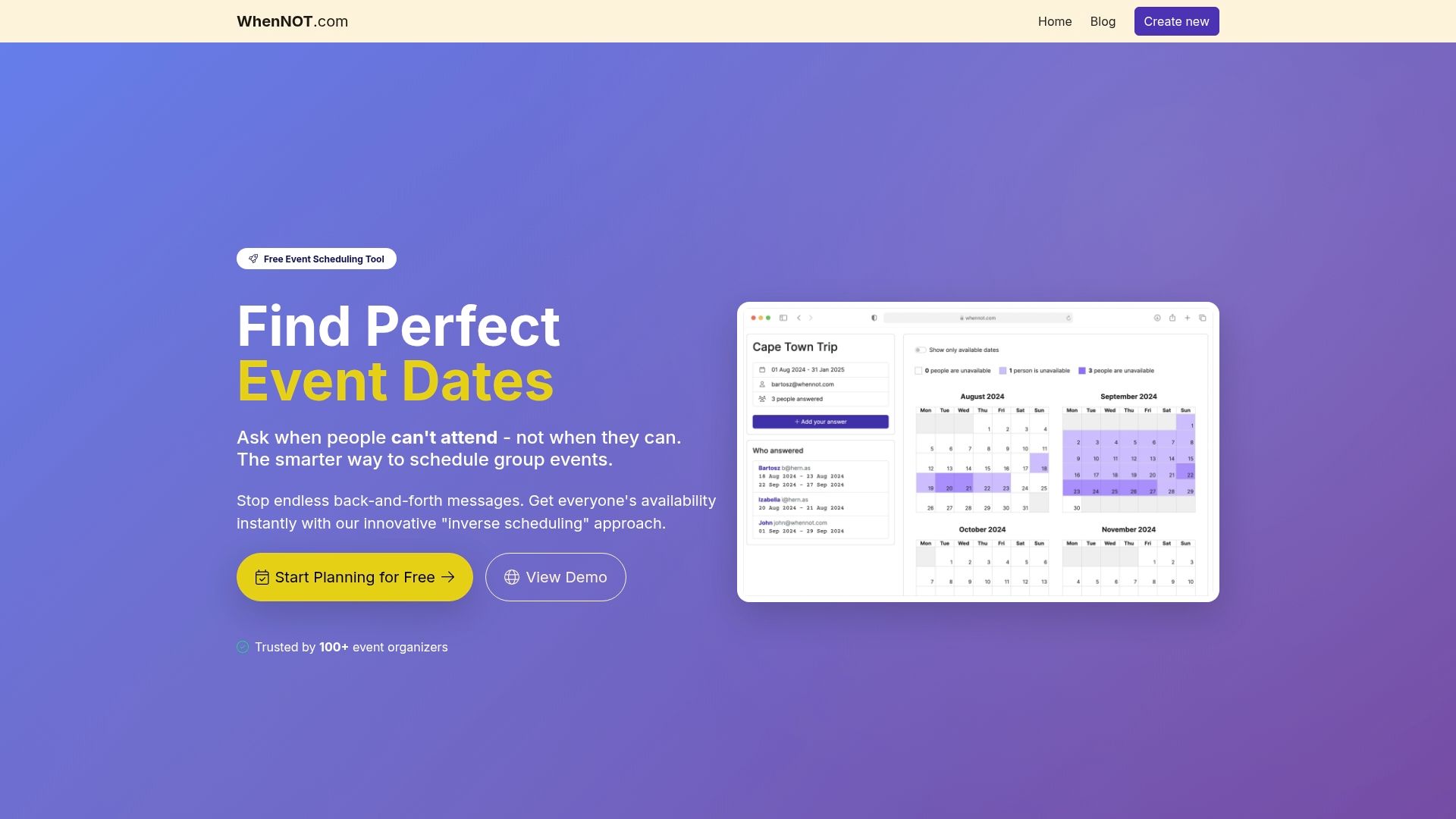
Using WhenNOT can cut your scheduling time significantly while improving overall event planning efficiency. The platform embodies inverse scheduling principles with a clean interface that participants love and organizers trust.
Explore comprehensive online scheduling tools guide resources and multi-day event planning tips to enhance your coordination skills. Visit the WhenNOT scheduling platform today to start simplifying your multi-day group event coordination and experience the difference attendee-driven scheduling makes.
Frequently Asked Questions About Attendee-Driven Scheduling
What is attendee-driven scheduling and how does it differ from traditional methods?
Attendee-driven scheduling asks participants to mark when they're unavailable rather than when they're free. This inverse approach simplifies input and reduces errors by 35% compared to traditional availability-based methods that require marking all possible available times.
Can attendee-driven scheduling be used for very large groups?
Yes, inverse scheduling scales excellently for groups of 200+ participants. The visual aggregation of unavailable dates actually handles complexity better than traditional methods, which become unwieldy as group size increases beyond 20 people.
Do participants need to create accounts to respond?
No, modern attendee-driven scheduling tools allow participation without sign-up or account creation. This no-registration approach dramatically increases response rates by removing friction and privacy concerns that discourage participation.
How do I handle participants who don't mark their unavailability promptly?
Send friendly reminders emphasizing the quick, one-minute process and highlighting that you need their input to finalize dates. Most delays stem from perceived complexity, so reassure participants about how simple marking unavailable dates really is.
What types of events benefit the most from inverse scheduling?
Multi-day events with flexible dates benefit most, including family reunions, corporate retreats, group travel, and social gatherings. Any event where you need to coordinate multiple participants across several potential dates sees significant efficiency gains. Check out group event scheduling tips for specific strategies.