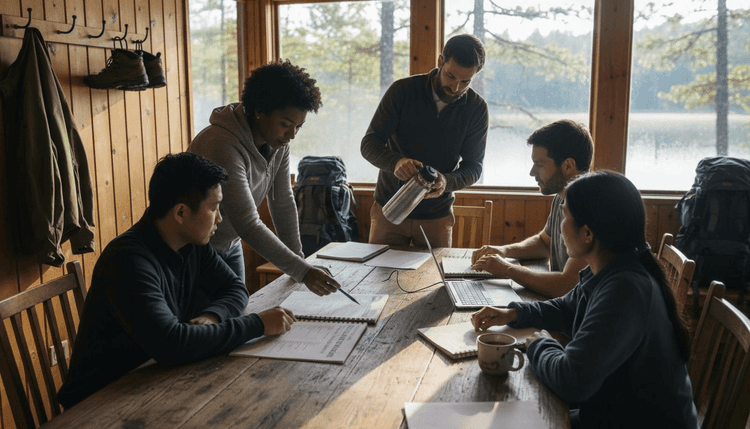
Gathering your team for meaningful strategy and growth can feel impossible when daily work gets in the way. Meetings in the office rarely spark new ideas or genuine connection—the constant distractions make it hard to focus on what matters most. Finding the right environment and structure for team retreats is a challenge every leader faces.
The good news is, there are proven retreat formats that help you break out of old routines and create space for real progress. You will find practical retreats that offer more than just a change of scenery. Each one delivers concrete benefits, from stronger team spirit to clear strategic plans, boosted skills, and lasting wellness.
Get ready to discover specific retreat approaches that will help your team return refreshed, aligned, and ready to tackle your toughest goals together.
Table of Contents
- Offsite Corporate Retreats for Strategic Planning
- Adventure Retreats to Build Team Spirit
- Wellness Retreats for Reducing Stress
- Creative Retreats for Innovation and Brainstorming
- Volunteer Retreats for Social Impact
- Skill Development Retreats for Team Growth
- Virtual Team Retreats for Remote Participation
Quick Summary
| Takeaway | Explanation |
|---|---|
| 1. Prioritize Offsite Retreats for Strategy | Offsite retreats facilitate focused discussions on strategic goals and team cohesion, leading to improved organizational alignment. |
| 2. Leverage Adventure for Team Building | Adventure retreats foster trust and communication through shared challenges, enhancing collaboration back in the workplace. |
| 3. Implement Wellness Retreats for Employee Health | Wellness retreats prioritize mental and physical well-being, significantly reducing stress and promoting a culture of care within your organization. |
| 4. Foster Creativity through Constraints | Creative retreats encourage innovative thinking by using constraints, prompting teams to explore unconventional solutions without fear of judgment. |
| 5. Engage in Volunteer Projects for Meaning | Volunteer retreats strengthen team bonds while providing meaningful contributions to the community, shifting perspectives on work and purpose. |
1. Offsite Corporate Retreats for Strategic Planning
Offsite corporate retreats represent one of the most powerful investments a company can make for strategic alignment and team development. Unlike regular office meetings where distractions abound, these dedicated retreats create a distraction-free environment where teams can step back from daily operations and focus on big-picture goals. According to the 2023 State of the Company Offsite & Retreat Report, most companies conduct offsites one to three times annually, with remote and hybrid companies increasingly adopting these events to strengthen team bonds and drive strategic initiatives forward.
The real power of an offsite lies in its structured approach to goal setting and team cohesion. When you gather your team away from the office, you create space for the conversations that rarely happen during regular workdays. Strategic planning retreats work best when you establish clear objectives before the event, foster genuine team engagement through interactive activities, and bring in an external facilitator who can help manage group dynamics and keep discussions on track. The typical corporate retreat spans about three days, providing enough time for teams to dive deep into strategic discussions, build trust among participants, and develop actionable plans they can execute when they return to the office. Documentation becomes critical here, so assign someone to capture key decisions and accountability measures throughout the retreat.
What makes these retreats effective for your planning process is how they combine relationship building with concrete strategy development. Your team members return to work not just with a new strategic plan, but with renewed connections to colleagues and a shared understanding of organizational direction. When you choose your venue thoughtfully, select activities that genuinely matter to your team, and ensure everyone has a voice in strategic discussions, you create the conditions for both personal growth and business results. This blend of human connection and strategic clarity is why companies continue to prioritize offsite retreats despite budget constraints and scheduling complexities.
Pro tip: Set your retreat dates and book your venue at least three to four months in advance, and use an inverse scheduling tool to identify when your entire team is available, cutting coordination time in half compared to traditional back-and-forth emails.
2. Adventure Retreats to Build Team Spirit
Adventure retreats take team building beyond the typical conference room activities and into environments where real challenges demand genuine collaboration. When your team faces physical and mental obstacles together, something shifts in how they work with one another. Whether it's hiking a challenging trail, rock climbing, or navigating an obstacle course, these outdoor challenges intensify trust and communication among team members in ways that traditional exercises simply cannot replicate. The shared experience of pushing through difficulty creates shared memories and authentic camaraderie that extends far beyond the retreat itself.
What makes adventure retreats so effective is that they remove the performance pressure of artificial team-building games. When someone is spotting a colleague on a climbing wall or working together to navigate a wilderness navigation challenge, they are not thinking about workplace hierarchies or playing it safe. They are thinking about trust, communication, and mutual support. Your team members discover capabilities in themselves and in each other that office environments never reveal. These moments of vulnerability and mutual reliance create bonds that translate into better collaboration back at work. Research shows that participants in interactive off-site retreats benefit significantly from informal interactions that foster a genuine sense of team identity, and adventure activities amplify this effect by creating conditions where people must truly depend on one another.
Implementing an adventure retreat requires thoughtful planning around your team's physical abilities and comfort levels. Not everyone needs to be an experienced climber or athlete to benefit. The key is selecting activities that feel challenging but achievable for your group, with proper safety equipment and trained instructors guiding the experience. Consider your team's demographics, any physical limitations, and whether they have prior experience with outdoor activities. Starting with moderately challenging activities and building from there allows team members to gradually build confidence while experiencing the benefits of working together toward meaningful goals. When your team emerges from these shared challenges, they carry forward the understanding that they can rely on one another when things get difficult.
Pro tip: Schedule your adventure retreat for the beginning of a major project cycle so your team can channel their renewed trust and camaraderie directly into collaborative work, maximizing the return on your investment.
3. Wellness Retreats for Reducing Stress
Wellness retreats offer your team a deliberate pause from the constant pressure of work, creating space for genuine recovery and reconnection with health and balance. Unlike typical corporate events focused on productivity metrics, wellness retreats prioritize mental restoration, physical rejuvenation, and emotional well-being. These retreats combine activities like yoga, meditation, nature walks, and workshops focused on stress management and healthy lifestyle choices. The beauty of a wellness retreat is that it sends a clear message to your team that their well-being matters, which itself reduces stress by demonstrating organizational commitment to employee health.
The science backing wellness retreats is compelling. Research shows that nature-based wellness retreats significantly reduce depression, anxiety, and stress symptoms among participants. Beyond the immediate relief, a well-designed wellness retreat can create lasting behavioral shifts. A two-day well-being retreat for healthcare professionals that included workshops, peer connection opportunities, and self-care education produced measurable results, with participants reporting significantly reduced perceived stress and improved professional fulfillment. The peer connection component proved particularly valuable, as team members found motivation and support through shared experiences with colleagues facing similar pressures. When your team members engage in wellness activities together, they break down isolation and discover that stress is a shared human experience, not an individual failure.
Implementing a wellness retreat requires thoughtful curation of activities and environments. You don't need a luxury spa or exotic location to create meaningful wellness experiences. Consider venues near natural settings where your team can unplug from digital distractions. Include a mix of structured activities like guided meditation or wellness workshops alongside unstructured time for rest and reflection. Incorporate peer connection opportunities where team members can share their wellness journeys and support one another. The combination of environmental change, guided wellness practices, and authentic human connection creates the conditions for genuine stress reduction. Your team will return to work physically refreshed, mentally clearer, and emotionally stronger.
Pro tip: Schedule your wellness retreat during a naturally slower business period and send participants self-care resources in advance so they arrive mentally prepared to disconnect and fully engage in stress-reducing activities.
4. Creative Retreats for Innovation and Brainstorming
Creative retreats deliberately break your team out of habitual thinking patterns and create space for genuine innovation to emerge. When your team works in the same office, following the same processes, thinking the same way, breakthrough ideas become rare. A creative retreat changes the environment, changes the pace, and most importantly, changes the permission structure around what ideas are acceptable. These retreats combine structured brainstorming sessions with activities designed to unlock creative potential and challenge conventional wisdom. The goal is not just to generate ideas, but to generate the kind of diverse, bold ideas that can transform how your organization solves problems.
The most effective creative retreats use constraint-based brainstorming techniques that rapidly induce creativity by giving your team intentional limitations to work within. Rather than vague open-ended brainstorming, constraints force your team to think differently and avoid recycling tired solutions. For example, you might ask your team to solve a problem using only three resources, or to generate ideas in exactly five minutes, or to solve the problem from the perspective of a completely different industry. These constraints might sound limiting, but they actually liberate creativity by breaking normative thinking patterns and encouraging calculated risk-taking. When people know they are operating under intentional constraints, they feel permission to suggest unconventional ideas because the constraints reframe what is possible and acceptable.
Implementing a creative retreat requires thoughtful design of both the physical environment and the activities themselves. Choose a venue that feels different from your typical workspace, somewhere that naturally sparks curiosity and conversation. Mix structured brainstorming sessions with unstructured exploration time where ideas can percolate. Bring in diverse perspectives from different departments or even outside your organization to challenge your team's assumptions. Document everything, but defer judgment during the ideation phase so people focus on quantity and boldness rather than immediate feasibility. The retreat should feel less like a meeting and more like intellectual play where your team remembers what it feels like to be genuinely creative.
Pro tip: Select a facilitator trained in creative thinking methodologies to lead your brainstorming sessions, and ensure you have a clear process for evaluating and prioritizing ideas post-retreat so your team sees their creative work translates into action.
5. Volunteer Retreats for Social Impact
Volunteer retreats combine the team-building benefits of a retreat with the meaningful purpose of giving back to your community. Rather than gathering your team for activities focused solely on internal engagement, a volunteer retreat channels that collective energy toward solving real problems in the world. Your team works together on projects that matter, whether that involves building infrastructure, supporting education, providing healthcare services, or protecting environmental resources. This type of retreat creates a powerful sense of shared purpose that strengthens team bonds while generating measurable social impact.
What makes volunteer retreats uniquely powerful is the combination of personal transformation and collective accomplishment. When your team works side by side on meaningful projects, they experience each other in a different light. You see how colleagues problem solve under real constraints, how they handle unexpected challenges, and how they support one another when the work gets difficult. These experiences build authentic trust and camaraderie that translates back to the office. Top volunteer programs emphasize sustainable impact and cultural immersion by connecting volunteers with community-led initiatives rather than parachute projects that create dependency. This approach ensures your team's work actually helps and that team members gain genuine understanding of the communities they serve.
Implementing a volunteer retreat requires partnership with legitimate organizations that have deep roots in the communities they serve. Research programs carefully to ensure they prioritize community needs over volunteer convenience, and that they provide proper training and support for volunteers. Consider the skills your team brings and match them with projects where those skills create meaningful value. A team of software engineers might help a nonprofit build digital infrastructure. A group of project managers might help streamline operations at an education nonprofit. The key is creating alignment between your team's capabilities and community needs. When your retreat ends, your team departs having made genuine contributions while having experienced what it means to work toward something larger than quarterly targets. That shift in perspective often changes how people approach their regular work.
Pro tip: Book your volunteer retreat with organizations at least four months in advance to ensure proper project planning and team preparation, and use this planning window to clearly communicate the retreat's purpose so team members arrive mentally ready to contribute meaningfully.
6. Skill Development Retreats for Team Growth
Skill development retreats invest directly in your team's professional capabilities while simultaneously building stronger working relationships. Unlike retreats focused primarily on team bonding or strategy, these events prioritize learning and growth through structured training, workshops, and interactive sessions. Your team members leave with tangible new competencies alongside strengthened connections to colleagues. In today's rapidly evolving workplace, skill development retreats address a critical organizational need. Companies increasingly recognize that investments in upskilling directly improve organizational performance and create better career prospects for employees, making these retreats a strategic investment rather than a nice to have.
The most effective skill development retreats combine formal learning with collaborative practice. You might structure a retreat around core competencies your team needs, such as advanced communication, project management, data analysis, or technical skills specific to your industry. Interactive sessions like presentations, webinars, and group exercises allow team members to learn new concepts and immediately practice them with colleagues in low-stakes environments. This combination of content delivery and hands-on application creates deeper learning than traditional training sessions. When your team learns together, something powerful happens. Team members discover expertise within the group, see how colleagues think through problems, and build shared language around new concepts. This collaborative learning strengthens both individual capabilities and team cohesion simultaneously.
Designing a skill development retreat requires clarity about what capabilities your team actually needs. Assess skill gaps through conversations with team members and managers, and align the retreat content directly to those gaps. Hire experienced facilitators or subject matter experts who can make complex topics accessible and engaging. Build in time for reflection and discussion so people can connect new learning to their actual work. Most importantly, create accountability for applying these skills after the retreat. The real value emerges when skill development investments translate into changed behaviors and improved performance back at work. Schedule follow-up sessions or coaching in the weeks after your retreat to reinforce learning and help team members overcome obstacles as they apply new skills to real projects.
Pro tip: Survey your team before the retreat to identify the specific skills they most want to develop, then use those insights to customize the agenda so attendees feel the retreat addresses their actual career development needs.
7. Virtual Team Retreats for Remote Participation
Virtual team retreats solve a critical challenge for distributed organizations where team members work across multiple time zones and locations. When your team is scattered geographically, the isolation of remote work can erode connection and shared purpose. Virtual retreats bring everyone together online for dedicated time focused on alignment, connection, and collaboration. Unlike regular video meetings that often feel transactional, a well-designed virtual retreat creates space for meaningful interaction and collective focus. Remote team retreats enable geographically dispersed teams to connect and collaborate while allowing people to participate from wherever they work, making them an accessible option for organizations with fully distributed workforces.
The key to successful virtual retreats lies in deliberate design that overcomes the limitations of video meetings. Your retreat must include diverse interactive activities that actively engage participants rather than subjecting them to passive presentations. Breakout room discussions, collaborative online whiteboards, live polls, interactive games, and small group conversations create the conditions for genuine connection. Balance structured sessions with social activities so people experience both purpose driven work and informal human connection. Regular virtual off-sites improve retention, innovation, and communication by intentionally building cohesion despite physical distances. The challenge is that video fatigue is real, so structure your retreat with shorter focused sessions, frequent breaks, and varied activity types. A four-hour virtual retreat with thoughtful design often generates better engagement than an eight-hour marathon of presentations.
When planning your virtual retreat, consider how time zones affect participation and whether you need to offer asynchronous components for people who cannot attend live sessions. Use technology strategically to enhance participation rather than complicate it. Ensure everyone has the tools and technical support needed to participate fully. Create opportunities for both large group conversations and smaller intimate discussions where real connection happens. The most effective virtual retreats balance structure with flexibility, allowing for spontaneous conversation and community building within a clear framework. Your team will appreciate that you invested in bringing them together despite the logistical challenges of distance, and the genuine connections formed during the retreat will strengthen collaboration long after it ends.
Pro tip: Use a scheduling tool to identify optimal times that work across your team's time zones, and record all sessions so team members in disadvantageous time zones can review content asynchronously without feeling excluded from the retreat experience.
Below is a comprehensive summary table outlining the different types of retreats discussed in the article, emphasizing their purpose, implementation, and benefits.
| Retreat Type | Description | Key Benefits |
|---|---|---|
| Offsite Corporate Retreats | Focused events away from the office dedicated to strategic planning and team cohesion. | Enhances goal setting, boosts team alignment, and develops actionable plans through structured interactions. |
| Adventure Retreats | Activities involving physical challenges promoting collaboration and trust. | Builds deep team connections, improves communication, and enhances problem-solving under challenging circumstances. |
| Wellness Retreats | Events designed to prioritize mental, physical, and emotional well-being. | Reduces stress, promotes healthier habits, and fosters genuine recovery and team solidarity. |
| Creative Retreats | Sessions focused on brainstorming and breaking habitual thinking to enable innovation. | Encourages out-of-the-box ideas, improves collaborative creativity, and generates transformative solutions. |
| Volunteer Retreats | Team participation in community-based projects of social impact. | Strengthens team bonds, provides meaningful work experience, and creates positive social contributions. |
| Skill Development Retreats | Retreats emphasizing professional growth through learning sessions. | Develops critical competencies, strengthens team capability, and improves organizational performance. |
| Virtual Team Retreats | Online retreats enabling connection among remote and geographically dispersed teams. | Enhances communication, drives collaboration, and builds team cohesion in remote environments. |
Simplify Your Team Retreat Planning with WhenNOT
Planning any of the 7 types of team retreats for efficient group planning—from offsite corporate retreats to virtual team gatherings—comes with the tough challenge of coordinating busy schedules across multiple participants. The article highlights how retreats require careful timing to ensure maximum attendance and meaningful engagement. If you have experienced the frustration of endless back-and-forth emails trying to find the right date or struggled to identify overlapping availability, you are not alone. These pain points can delay important events that foster strategic clarity, team trust, or innovation.
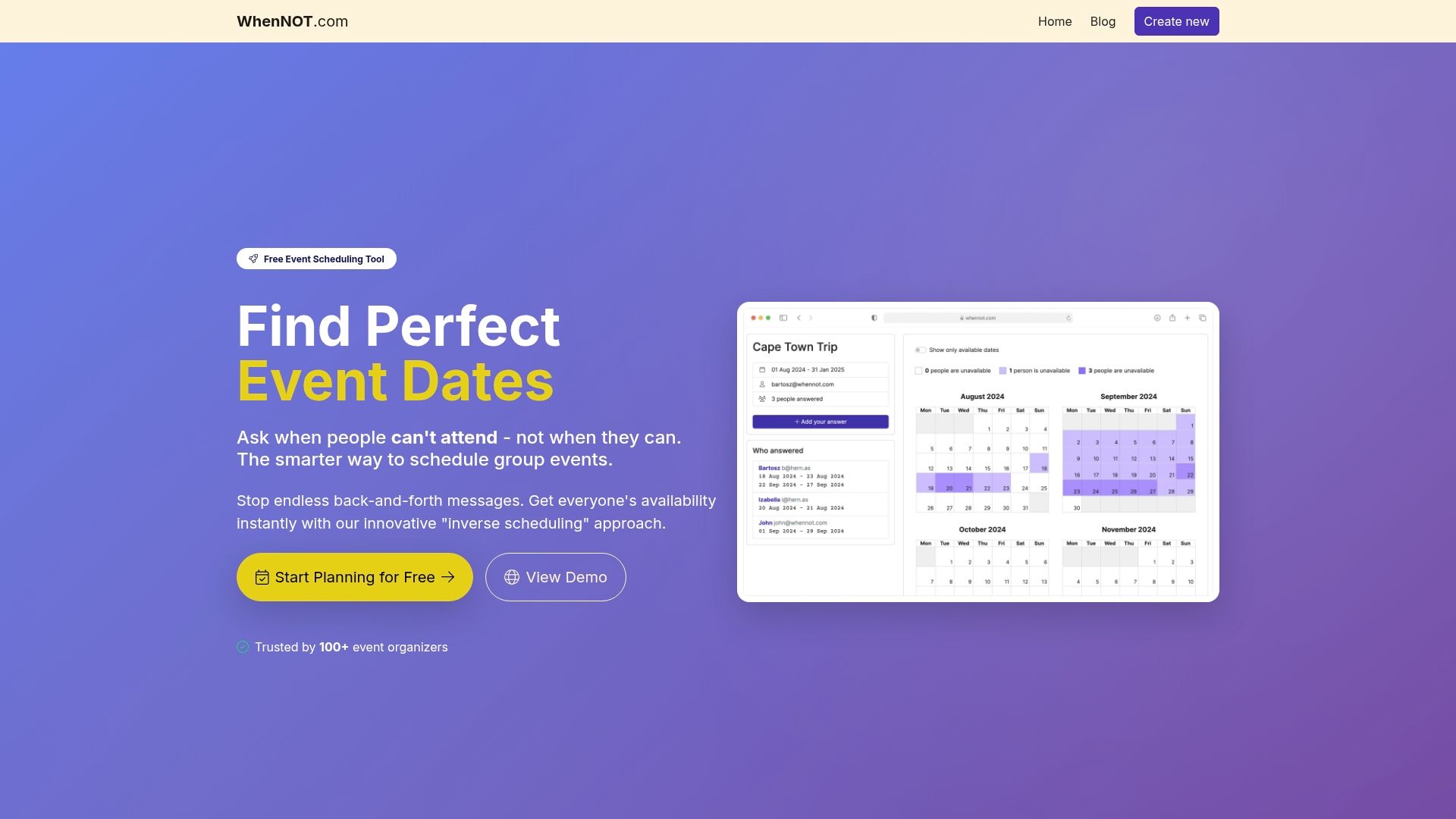
WhenNOT solves this by using an inverse scheduling approach that asks participants to mark only their busy times rather than when they are free. This method dramatically reduces complexity and saves precious time, especially for multi-day or flexible-date retreats where traditional tools fall short. By visualizing everyone's unavailable days side-by-side, you can quickly pinpoint optimal retreat dates that work for your entire team. Whether you are organizing a wellness retreat or a creative brainstorming session, WhenNOT helps you avoid coordination headaches and focus on what really matters—building stronger teams and driving results.
Discover how effortless scheduling transforms your retreat planning at WhenNOT. Experience the free, user-friendly alternative designed for busy organizers who want fast, private, and efficient coordination. Need to streamline your next team retreat? Start your scheduling journey today at WhenNOT Scheduling Tool and see how simple it can be to align your team without the hassle.
Frequently Asked Questions
What are the main types of team retreats for efficient group planning?
Offsite corporate retreats, adventure retreats, wellness retreats, creative retreats, volunteer retreats, skill development retreats, and virtual team retreats are the primary types. Each type focuses on different goals, such as improving team dynamics, fostering creativity, or enhancing skills. Evaluate your team's needs to determine which retreat type aligns best with your objectives.
How do I choose the right retreat type for my team?
Begin by identifying your team's current challenges, whether they involve stress, lack of collaboration, or stagnant innovation. Then, align these needs with the specific benefits offered by each retreat type, such as team bonding or skill enhancement. Make a decision based on your team's priorities for the upcoming planning period.
What is the typical duration of a corporate retreat?
Most corporate retreats last around three days, allowing sufficient time for in-depth discussions and team bond-building activities. Plan your agenda with ample time for both structured and informal interactions to maximize the retreat's effectiveness. This duration ensures that all participants can engage deeply with the process and each other.
How can I effectively plan a virtual team retreat?
To plan a successful virtual team retreat, design diverse interactive activities that encourage participation and engagement. Incorporate breakout sessions, collaborative tools, and balanced social activities to enhance connection among team members. Schedule your retreat at optimal times to accommodate multiple time zones, ensuring everyone can participate actively.
What should I do to prepare my team for a wellness retreat?
Prepare your team by communicating the retreat's focus on stress reduction and well-being ahead of time. Share self-care resources and set expectations for participation in activities like yoga or workshops. This preparation allows team members to arrive mentally ready to engage fully and benefit from the retreat.
How can team members ensure they get the most out of a skill development retreat?
Encourage team members to actively participate in all sessions and leverage group discussions to deepen their understanding of new skills. After the retreat, set concrete personal goals for applying what they've learned, and establish accountability mechanisms. Following up within 30 days can reinforce newly acquired skills and ensure practical application in real work scenarios.