
Over seventy percent of american event planners report that rigid schedules lead to missed opportunities and decreased participant engagement. Planning multi-day family gatherings or corporate retreats across North America means juggling countless calendars, time zones, and individual needs. Embracing inclusive scheduling concepts gives organizers tools to empower every participant, reduce conflicts, and create events where everyone feels considered from start to finish.
Table of Contents
- Inclusive Scheduling Core Concepts And Definition
- Types Of Inclusive Scheduling Approaches
- How Inverse Scheduling Streamlines Events
- Key Features: Simplicity, Privacy, Accessibility
- Risks, Pitfalls, And Common Mistakes
Key Takeaways
| Point | Details |
|---|---|
| Inclusive Scheduling Principles | Focus on flexibility, transparency, and participant empowerment to meet diverse needs. |
| Types of Approaches | Utilize methods like Inverse Availability and Consensus-Based Scheduling to enhance participant engagement. |
| Core Features | Prioritize simplicity, privacy, and accessibility in scheduling tools to increase user trust and participation. |
| Risks and Solutions | Address risks like insufficient engagement and privacy violations through proactive feedback and adaptable design. |
Inclusive scheduling core concepts and definition
Inclusive scheduling represents a comprehensive approach to event planning that prioritizes accessibility, individual preferences, and diverse participant needs. Unlike traditional scheduling methods that impose rigid timeframes, this strategy recognizes the unique constraints and availability patterns of different group members. Emerging research in social justice methodologies emphasizes the importance of creating planning processes that accommodate individual variations.
At its core, inclusive scheduling focuses on three fundamental principles: flexibility, transparency, and participant empowerment. This means designing event coordination mechanisms that allow participants to communicate their constraints without feeling marginalized or pressured. The approach acknowledges that standard scheduling tools often disadvantage individuals with complex personal schedules, caregiving responsibilities, or varying work commitments.
Effective inclusive scheduling requires tools and strategies that shift from a one-size-fits-all model to a more nuanced, collaborative framework. Key components include:
- Allowing participants to indicate unavailable times rather than forcing them to declare availability
- Providing multiple communication channels for schedule preferences
- Ensuring privacy and low-friction participation
- Minimizing administrative overhead for event organizers
Pro Tip: When planning group events, always provide multiple ways for participants to share their scheduling constraints to ensure maximum inclusivity and participation.
Types of inclusive scheduling approaches
Collaborative scheduling emerges as a primary approach in inclusive event planning, focusing on creating flexible frameworks that prioritize participant needs. Research on equitable engagement strategies highlights the importance of multi-level approaches that accommodate diverse individual constraints and preferences.
The main types of inclusive scheduling approaches include:
- Inverse Availability Scheduling: Participants indicate times they are unavailable, allowing for more natural and less restrictive planning
- Multi-Channel Preference Gathering: Offering various methods for participants to communicate scheduling constraints
- Consensus-Based Scheduling: Utilizing group voting or consensus mechanisms to determine optimal meeting times
- Adaptive Scheduling: Dynamically adjusting event timing based on collective participant feedback
These approaches differ significantly from traditional scheduling methods by centering individual needs and recognizing the complex personal constraints faced by modern participants. Efficient scheduling methods demonstrate how technology can support more inclusive planning processes by reducing administrative burden and increasing participant engagement.
Advanced inclusive scheduling techniques also incorporate principles of flexibility and transparency. This means creating systems that allow participants to update their availability, provide context for their constraints, and feel empowered in the scheduling process without feeling marginalized or pressured.
Here is a comparison of inclusive scheduling approaches and their core advantages:
| Approach Type | Core Strength | Best Use Case |
|---|---|---|
| Collaborative | Maximizes engagement | Multi-stakeholder planning |
| Inverse Availability | Reduces conflicts | Groups with busy participants |
| Consensus-Based | Increases fairness | Democratic decision making |
| Adaptive | Improves flexibility | Dynamic, changing situations |
Pro Tip: When implementing inclusive scheduling, always provide multiple communication channels and allow participants to share constraints in ways that feel most comfortable to them.
How inverse scheduling streamlines events
Inverse scheduling transforms traditional event planning by fundamentally reimagining how groups coordinate their time. Optimization techniques in scheduling demonstrate how working backwards from a fixed end date can dramatically improve coordination efficiency, reducing wasted time and minimizing scheduling conflicts.
The core mechanism of inverse scheduling revolves around a simple yet powerful concept: instead of asking participants when they are available, the approach focuses on identifying when they are unavailable. This subtle shift creates several critical advantages:
- Reduces participant decision fatigue
- Provides a more holistic view of group constraints
- Minimizes the psychological pressure of traditional scheduling
- Allows for more nuanced communication of personal limitations
Scheduling efficiency for group events highlights how this approach can transform complex coordination challenges. By allowing participants to mark their unavailable times, the system automatically reveals optimal meeting windows without requiring extensive back-and-forth communication.
Advanced inverse scheduling techniques also incorporate intelligent filtering mechanisms that can automatically suggest the most viable time slots based on collective unavailability. This approach respects individual scheduling complexities while providing a streamlined path to successful event coordination, making it particularly effective for groups with diverse schedules and competing priorities.

Pro Tip: When implementing inverse scheduling, encourage participants to be comprehensive in marking their unavailable times to maximize the accuracy of your final scheduling outcome.
Key features: simplicity, privacy, accessibility
Inclusive scheduling demands a thoughtful approach that prioritizes user experience through three fundamental principles. Accessibility in information systems underscores the critical importance of designing platforms that accommodate diverse user needs while maintaining robust privacy protections.
The three core features of effective inclusive scheduling include:
- Simplicity: Creating intuitive interfaces that minimize cognitive load
- Privacy: Implementing strong data protection mechanisms
- Accessibility: Ensuring usability across different user abilities and technological contexts
Universal design principles for scheduling emphasize removing barriers that might prevent full participation. This means developing systems that are inherently flexible, allowing users to interact with scheduling tools in ways most comfortable and natural to them.
Privacy considerations are particularly crucial in modern scheduling platforms. By protecting participant data, limiting unnecessary information sharing, and providing transparent consent mechanisms, inclusive scheduling tools can build trust and encourage broader engagement. The goal is to create a system where individuals feel secure, respected, and empowered to communicate their scheduling constraints without fear of unnecessary data exposure.
This table summarizes the essential elements that make inclusive scheduling effective:
| Feature | Impact on Users | Implementation Tip |
|---|---|---|
| Simplicity | Lowers participation barriers | Use straightforward interfaces |
| Privacy | Builds user trust | Protect all personal schedule data |
| Accessibility | Enables broader inclusion | Design for various abilities |
Pro Tip: When designing scheduling interfaces, always prioritize user control and minimize the amount of personal information required to participate.
Risks, pitfalls, and common mistakes
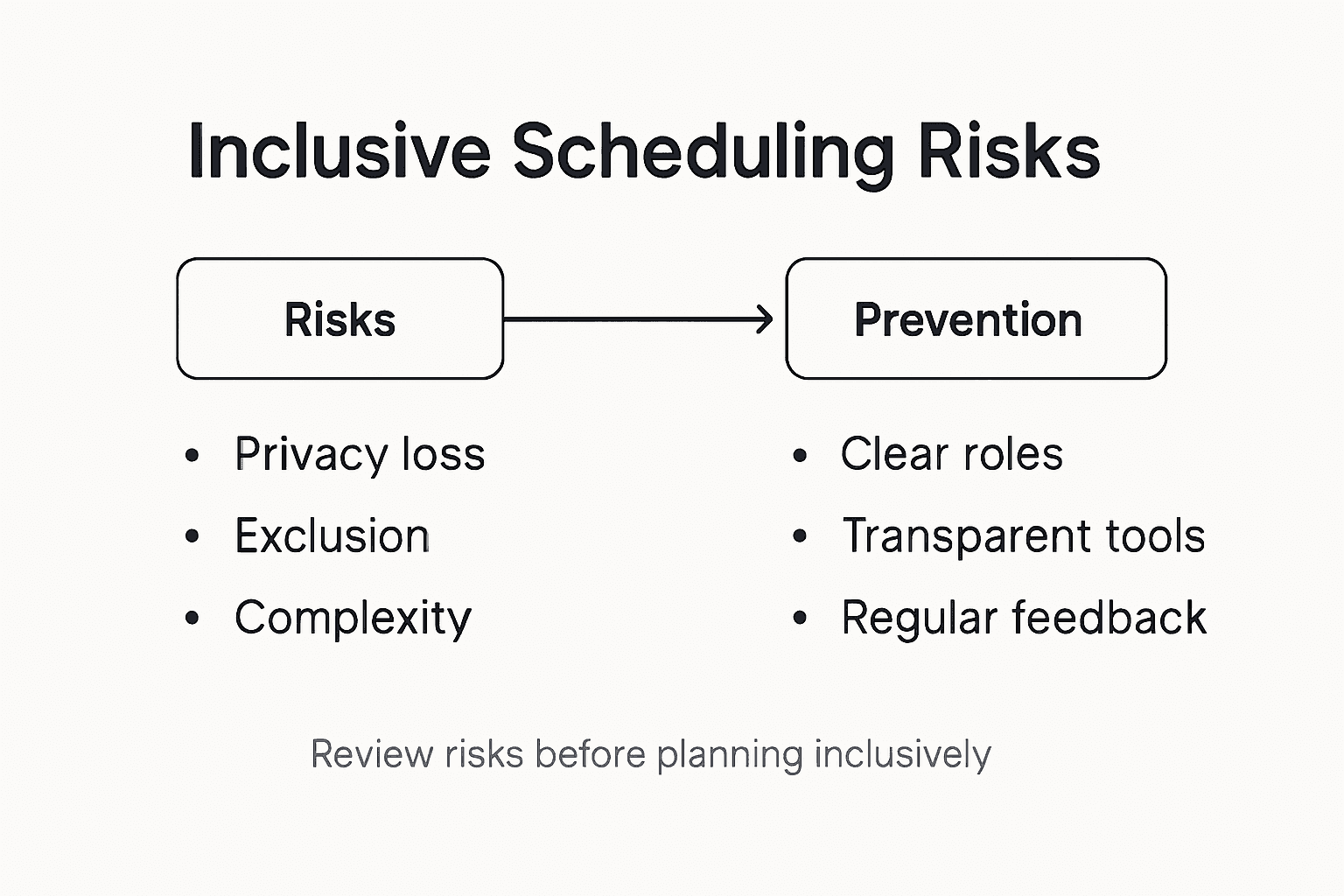
Event scheduling complexity introduces numerous potential challenges that can derail even the most well-intentioned planning efforts. Common research methodology pitfalls reveal critical mistakes that can significantly undermine the effectiveness of inclusive scheduling approaches.
The most prevalent risks in inclusive scheduling include:
- Insufficient Stakeholder Engagement: Failing to collect comprehensive input from all participants
- Inflexible Framework Design: Creating rigid scheduling systems that do not adapt to diverse needs
- Privacy Violations: Inadequate data protection and consent mechanisms
- Communication Breakdowns: Unclear communication about scheduling processes and changes
Inclusive research methodology considerations emphasize the importance of transparent, ethical approaches that prioritize participant experience. These risks can transform from potential obstacles into opportunities for creating more responsive and user-centered scheduling systems when addressed proactively.
Mitigating these risks requires a multifaceted approach that combines technological solutions with human-centered design principles. This means developing scheduling tools that are not just technically sound, but also empathetic to the diverse constraints and preferences of participants. Organizations must continually reassess their scheduling strategies, remaining open to feedback and willing to adapt their approaches to ensure maximum inclusivity and effectiveness.
Pro Tip: Regularly conduct participant surveys to identify and address potential scheduling barriers before they become significant problems.
Simplify Your Group Event Planning with Inclusive Scheduling
Inclusive scheduling challenges often revolve around balancing diverse availability while respecting privacy and minimizing communication overload. If you struggle with collecting scattered availability or feel drained by endless back-and-forth messages, you are not alone. Concepts like inverse availability scheduling highlight the need to focus on when participants are unavailable rather than available to reduce conflicts and participant fatigue.
WhenNOT is designed precisely to meet these challenges with its innovative inverse scheduling approach. By letting your group easily mark their busy times without creating accounts, WhenNOT ensures simplicity, privacy, and accessibility for every participant. This means faster, fairer scheduling for your family gatherings, corporate events, or group travel with no complicated sign-ups or confusing surveys.
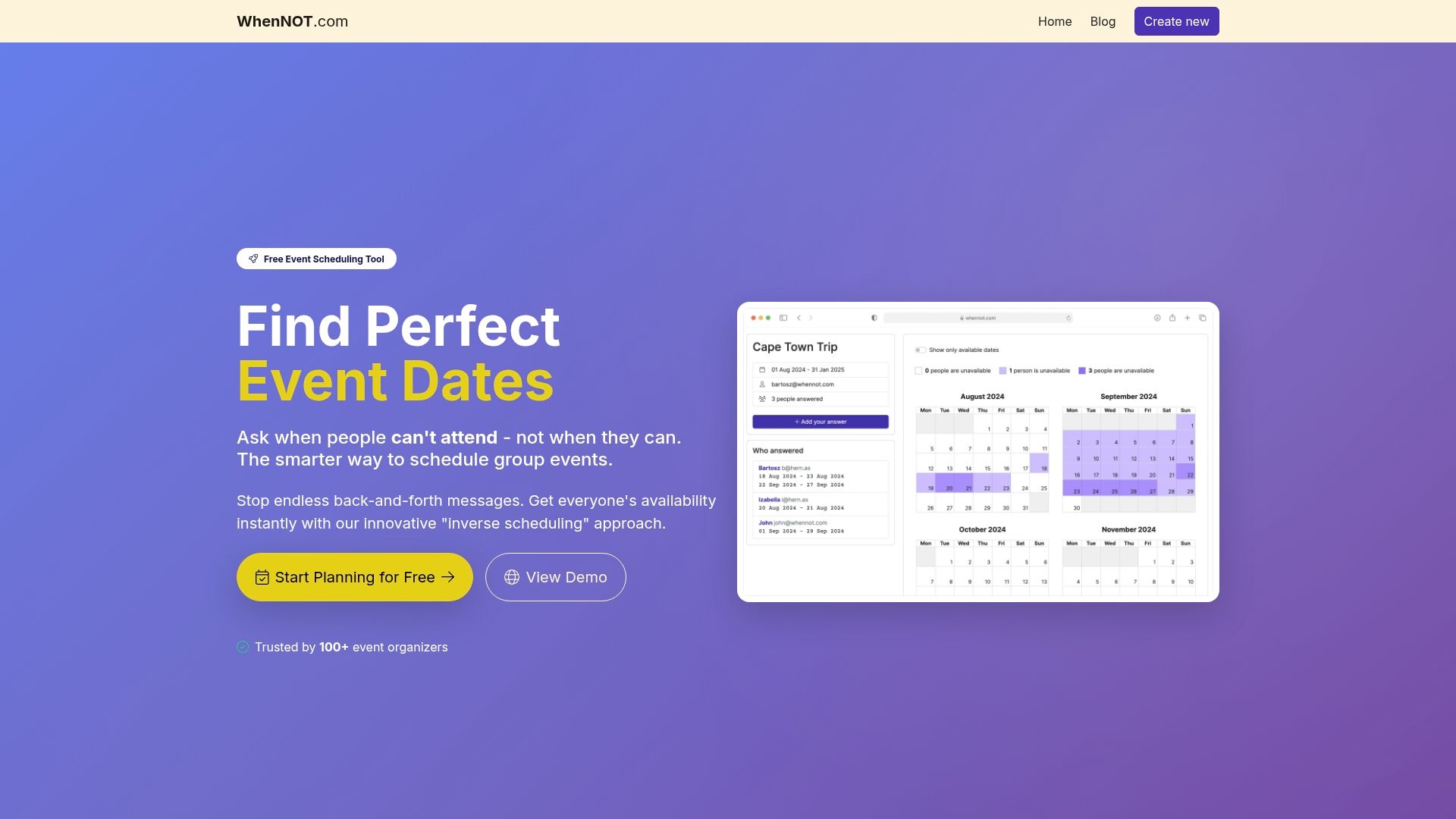
Ready to experience streamlined, inclusive scheduling? Visit WhenNOT now to create your event and empower your participants to share their constraints effortlessly. Don’t let scheduling headaches slow you down—start simplifying your group event planning today with an approach that truly works for everyone.
Frequently Asked Questions
What is inclusive scheduling?
Inclusive scheduling is an approach to event planning that prioritizes accessibility, individual preferences, and diverse participant needs, moving away from rigid timeframes to accommodate the unique constraints of group members.
How does inverse scheduling work?
Inverse scheduling focuses on identifying when participants are unavailable instead of asking for their availability, which reduces decision fatigue and provides a clearer view of group constraints for better event coordination.
What are the key features of effective inclusive scheduling?
The key features include simplicity, ensuring user-friendly interfaces; privacy, protecting participant data; and accessibility, providing usability across varying technological contexts and user abilities.
How can organizations mitigate risks in inclusive scheduling?
Organizations can mitigate risks by engaging all stakeholders, designing flexible frameworks, ensuring strong data privacy protections, and maintaining clear communication throughout the scheduling process.