
Did you know that automated scheduling tools can reduce no-shows by up to 30 percent? With more people facing packed calendars and scattered commitments, finding time that works for everyone can quickly become stressful. New hassle-free scheduling platforms are changing the game by using intelligent technology to simplify planning, cut manual effort, and keep everyone in sync, making group coordination smoother and less frustrating.
Table of Contents
- Defining Hassle-Free Scheduling And Its Core Concepts
- How Inverse Scheduling Differs From Traditional Tools
- Key Features Of Hassle-Free Scheduling Platforms
- Use Cases: Group Events, Work, And Travel
- Benefits, Limitations, And Common Pitfalls
Key Takeaways
| Point | Details |
|---|---|
| Hassle-free Scheduling | Leverages AI and automation to streamline the scheduling process, significantly reducing manual effort and increasing efficiency. |
| Inverse Scheduling | Innovatively focuses on participants' unavailability, automating preference analysis to expedite coordination and decision-making. |
| Key Features | Includes real-time conflict detection, smart integration, and customizable rules to enhance coordination and communication. |
| Considerations | While beneficial, users must be aware of potential drawbacks such as privacy concerns and reliance on technology for personal interactions. |
Defining Hassle-Free Scheduling and Its Core Concepts
Hassle-free scheduling represents a modern approach to organizing tasks and events with minimal manual effort and maximum efficiency. According to myshyft, this method leverages advanced technologies like artificial intelligence to automate and optimize scheduling processes, dramatically reducing the complexity traditionally associated with coordinating multiple people and activities.
At its core, hassle-free scheduling transforms how we plan and allocate time by eliminating common pain points. As unisco explains, dynamic scheduling techniques adjust resource allocation in real-time, ensuring that plans remain flexible and responsive to changing conditions. This approach stands in stark contrast to traditional static scheduling methods that often become obsolete as soon as unexpected changes occur.
Key characteristics of hassle-free scheduling include:
- Automated coordination
- Real-time adaptability
- Minimal manual input
- Error reduction
- Instant updates for all participants
The ultimate goal of hassle-free scheduling is to streamline planning processes, saving time and reducing the cognitive load associated with traditional scheduling methods. By leveraging intelligent technologies and user-friendly interfaces, these systems enable individuals and groups to coordinate more efficiently, whether planning family gatherings, professional meetings, or complex multi-day events. For those seeking to understand more about efficient scheduling approaches, our understanding efficient scheduling methods guide offers additional insights into this transformative approach.
How Inverse Scheduling Differs From Traditional Tools
Inverse scheduling represents a revolutionary approach to coordinating events, fundamentally transforming how groups plan and allocate time. According to lockedinai, this method utilizes AI-powered meeting assistants that automate scheduling by analyzing participants' availability and preferences, a stark departure from traditional tools that rely on manual input and extensive back-and-forth communication.
Inverse scheduling flips the conventional scheduling paradigm on its head by focusing on participants' unavailable times instead of asking everyone to identify when they are free. While traditional scheduling tools require each person to manually suggest potential meeting times, inverse scheduling algorithms intelligently detect common open windows by first identifying when individuals cannot meet. This approach significantly reduces coordination complexity and eliminates the endless email chains and message threads typically associated with group scheduling.
Key differences between inverse and traditional scheduling include:
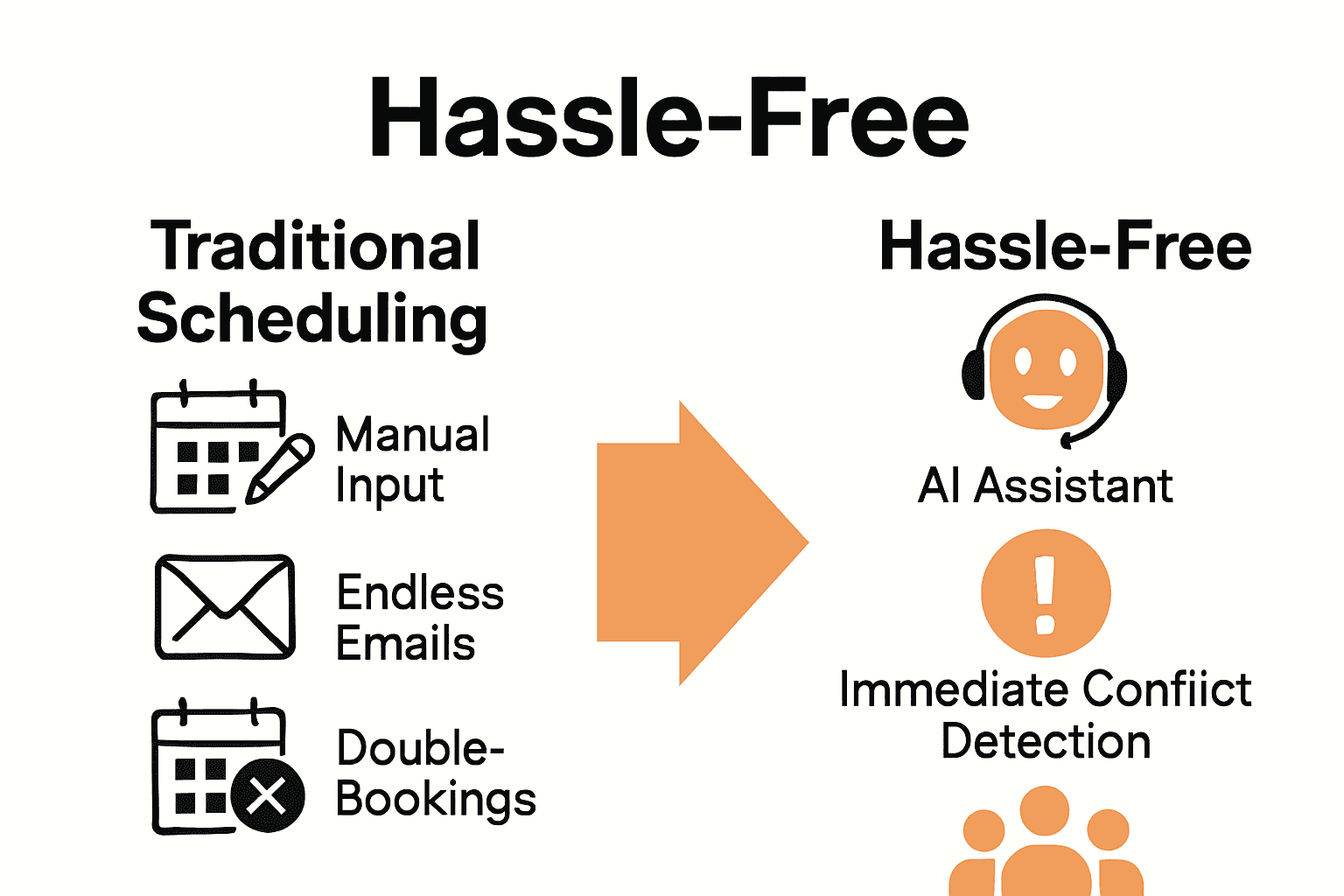
- Automated preference analysis
- Reduced communication overhead
- Faster decision-making
- Minimal manual coordination required
- Enhanced accuracy in finding mutual availability
Research from dailymoss highlights the tangible benefits, noting that AI-powered scheduling tools can reduce no-shows by up to 30% and dramatically streamline administrative tasks. These innovations represent more than just technological improvements—they fundamentally reimagine how groups coordinate, making the process more intuitive and efficient.
For those interested in exploring user-friendly scheduling solutions, our guide to understanding simple scheduling tools provides additional insights into this transformative approach.
Key Features of Hassle-Free Scheduling Platforms
Hassle-free scheduling platforms represent a technological leap in coordinating complex group events and professional activities. According to ai-calendar, these advanced systems offer comprehensive automation of event scheduling, featuring real-time conflict resolution and seamless integration with existing business tools, which dramatically enhances overall productivity and reduces manual administrative effort.
The core functionality of these platforms goes beyond simple calendar management. Unlike traditional scheduling methods, these intelligent systems leverage sophisticated algorithms to streamline coordination processes. Workever demonstrates this evolution with features like drag-and-drop scheduling, GPS tracking for field agents, and real-time job updates that transform how teams communicate and manage their time.
Key features of hassle-free scheduling platforms include:
Here's a summary of key features found in hassle-free scheduling platforms:
| Feature | Description | Benefit |
|---|---|---|
| Automated conflict detection | System identifies schedule overlaps | Fewer double-bookings |
| Real-time availability tracking | Monitors participant schedules instantly | Up-to-date coordination |
| Smart tool integration | Links with calendars, messaging, CRMs | Streamlined workflows |
| Customizable scheduling rules | Users set preferences and limitations | More accurate planning |
| Instant notifications | Sends immediate updates and reminders | Speedier communication |
| Cross-platform accessibility | Works on mobile, desktop, web | Flexible access |
| Privacy management | Protects participant data | Enhanced confidentiality |
- Automated conflict detection
- Real-time availability tracking
- Smart integration with existing tools
- Customizable scheduling rules
- Instant notifications and updates
- Cross-platform accessibility
- Privacy-focused participant management
The ultimate goal of these platforms is to eliminate the traditional pain points of scheduling—endless email threads, manual coordination, and communication gaps. By providing intuitive, intelligent solutions, hassle-free scheduling tools empower teams and individuals to focus on what truly matters. Those interested in diving deeper into scheduling optimization can explore our guide on automated scheduling for additional insights into this transformative technology.
Use Cases: Group Events, Work, and Travel
Hassle-free scheduling platforms have revolutionized coordination across multiple domains, transforming how people plan and manage complex group interactions. In educational settings, ncsa demonstrates how alternative scheduling models can dramatically improve resource utilization and performance, highlighting the broader potential of intelligent scheduling approaches beyond traditional planning methods.
Group events represent a critical use case where hassle-free scheduling truly shines. Whether organizing family reunions, community gatherings, or professional conferences, these platforms eliminate the traditional communication challenges that often derail event planning. Teams and organizers can now seamlessly coordinate multiple participants' availability, track responses, and finalize arrangements with unprecedented efficiency.
Key use cases for hassle-free scheduling include:
- Family and social gatherings
- Corporate team meetings and retreats
- Academic and educational program coordination
- Medical and healthcare appointment scheduling
- Group travel and vacation planning
- Professional conferences and workshops
- Community and volunteer event organization
In professional healthcare contexts, pmc research illustrates the transformative potential of web-based scheduling systems, showing how these tools can reduce no-show rates and improve patient progression.
 For those seeking to dive deeper into group event planning strategies, our guide to group event scheduling tips offers additional insights into making your next event a seamless success.
Benefits, Limitations, and Common Pitfalls
Hassle-free scheduling platforms offer remarkable advantages while simultaneously presenting nuanced challenges that users must understand. According to researchgate, innovative scheduling approaches, particularly AI-based methods, have demonstrated significant improvements in project completion rates and budget management compared to traditional scheduling techniques, though their effectiveness remains context-dependent.
The benefits of these platforms are substantial, but they are not without potential limitations. Mansfield ISD highlights how different scheduling models can provide distinct advantages while simultaneously introducing unique constraints—a principle that extends beyond educational contexts into broader organizational planning.
Key considerations for hassle-free scheduling platforms include:
- Potential over-reliance on technological solutions
- Initial learning curve for users
- Privacy and data security concerns
- Varying compatibility with different organizational structures
- Potential limitations in handling extremely complex scheduling scenarios
- Risk of reduced personal communication
While these platforms dramatically streamline coordination, successful implementation requires a balanced approach that combines technological efficiency with human insight. Understanding both the strengths and potential pitfalls ensures more effective utilization of these innovative scheduling tools. Those interested in exploring more nuanced scheduling strategies can refer to our guide on essential group event scheduling tips for additional perspectives on maximizing scheduling effectiveness.
Simplify Your Group Scheduling Today with WhenNOT
The article highlights how hassle-free scheduling and the innovative inverse scheduling method eliminate the endless back-and-forth communication and reduce coordination stress when planning group events. If you want to overcome these exact challenges by knowing when participants are busy instead of when they are free, you will appreciate how this approach saves time and minimizes confusion. No more guessing or double-booking and no complicated sign-ups for your guests.
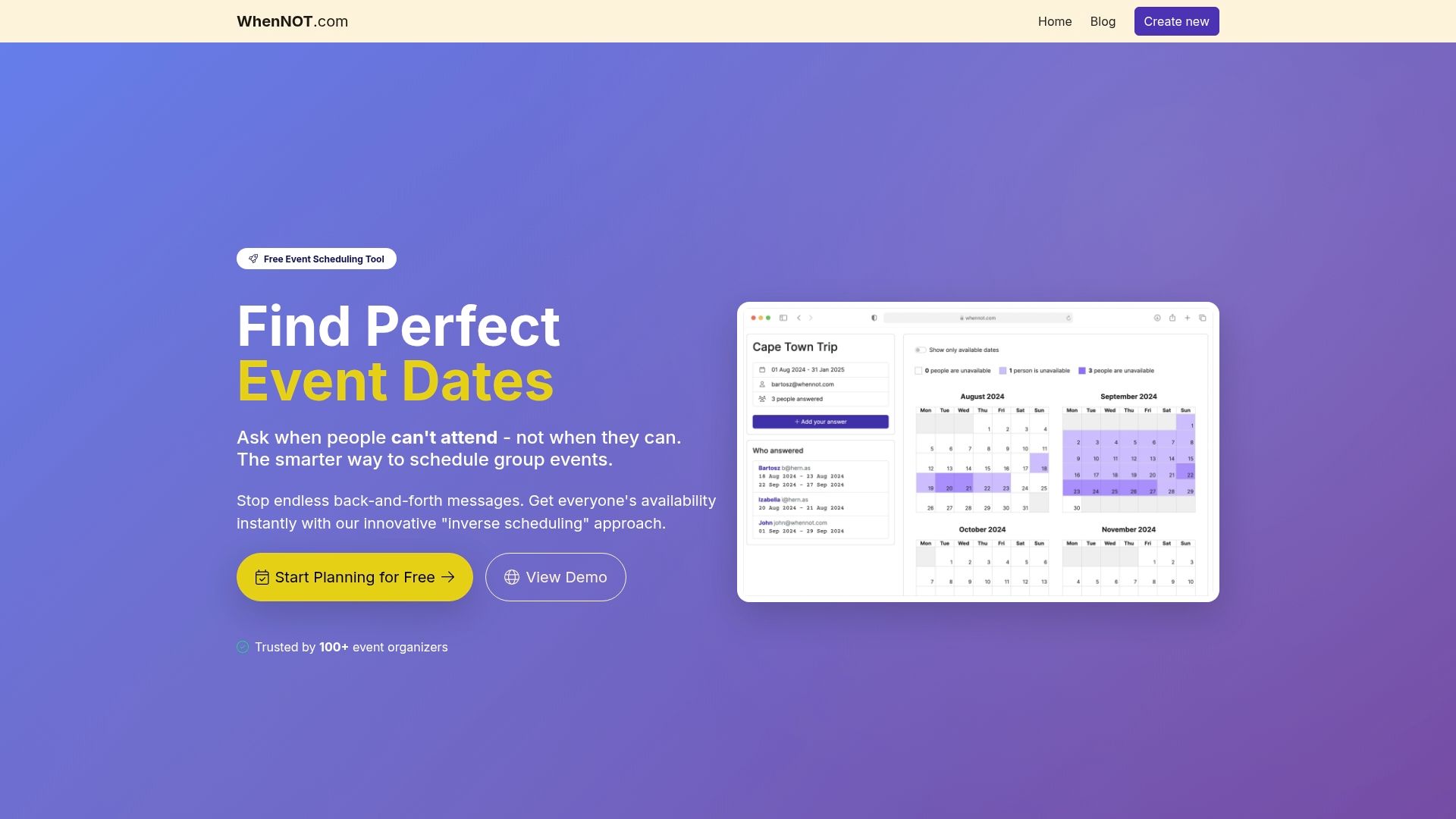
Discover how WhenNOT makes scheduling lightning fast and intuitive for *family gatherings, corporate retreats, and group travel plans. By simply sharing a unique event link, you and your participants instantly see everyone’s unavailable dates, so finding the best fit becomes effortless. Ready to experience hassle-free scheduling yourself? Visit WhenNOT’s homepage and start planning your next event the smart way with our free, secure, and user-friendly platform. For more tips on group event planning, check out our essential group event scheduling tips to make your coordination even smoother.
Frequently Asked Questions
What is hassle-free scheduling?
Hassle-free scheduling is a modern approach to organizing tasks and events using advanced technologies, primarily artificial intelligence, to automate and optimize the scheduling process, reducing manual effort and increasing efficiency.
How does inverse scheduling differ from traditional scheduling methods?
Inverse scheduling focuses on identifying participants' unavailable times instead of asking for their available times, which significantly reduces communication overhead and streamlines the process of finding mutual availability.
What are the key features of hassle-free scheduling platforms?
Key features include automated conflict detection, real-time availability tracking, smart tool integration, customizable scheduling rules, instant notifications, cross-platform accessibility, and privacy management for participants' data.
What are some use cases for hassle-free scheduling?
Hassle-free scheduling can be used for various purposes, including family gatherings, corporate meetings, educational program coordination, healthcare appointments, group travel planning, professional conferences, and community event organization.