
Coordinating a multi-day retreat or meeting can push even seasoned planners to juggle shifting priorities and unexpected changes. For American corporate event organizers, finding cost-efficient scheduling tools is more than just penny pinching—it means balancing resources, avoiding costly delays, and achieving maximum impact with minimal stress. Discover how effective cost management within scheduling tools can turn complex event logistics into a smoother, more time-saving process—highlighting the features that matter most when every minute and dollar counts.
Table of Contents
- Defining Cost In Scheduling Tools
- Common Pricing Models And Structures
- Key Features Versus Pricing Tiers
- Cost Savings Through Free Solutions
- Choosing Between Paid And Free Tools
- Real-World Scenarios In Event Planning
Key Takeaways
| Point | Details |
|---|---|
| Comprehensive Cost Analysis | Scheduling tools should incorporate various cost dimensions like resource allocation and delay expenses for optimized event planning. |
| Flexible Pricing Models | Understanding different pricing structures, including free and paid options, is crucial for selecting the right scheduling tool based on organizational needs. |
| Feature Evaluation Across Tiers | Compare features across pricing tiers to align capabilities with specific requirements, ensuring you choose the most effective tool for your event planning. |
| Leveraging Technology for Efficiency | Invest in scheduling solutions that offer advanced capabilities, enhancing logistical management and participant engagement for modern events. |
Defining Cost in Scheduling Tools
Cost in scheduling tools represents more than just a monetary value - it's a comprehensive assessment of resources, time investments, and potential financial implications across event planning and management. Comprehensive scheduling strategies fundamentally tie cost considerations to project performance, timeline accuracy, and resource allocation.
Understanding cost within scheduling tools involves analyzing several key dimensions:
- Resource Allocation: Quantifying personnel, equipment, and material expenses
- Time Investment: Calculating potential productivity losses and opportunity costs
- Delay Expenses: Measuring financial impacts of scheduling disruptions
- Performance Metrics: Tracking actual versus projected expenditure
Scheduling tools enable corporate event planners to transform abstract cost considerations into actionable insights. Financial forecasting becomes more precise when managers can visualize resource requirements and potential bottlenecks before they emerge. Project budgeting techniques allow for granular cost tracking that goes beyond simple expense tracking.
Here’s a summary of how cost dimensions influence real-world scheduling tool decisions:
| Cost Dimension | Typical Business Impact | Example Use Case |
|---|---|---|
| Resource Allocation | Helps prevent resource shortages | Assigning staff for multi-day events |
| Time Investment | Improves deadline prediction | Planning conference sessions |
| Delay Expenses | Minimizes unexpected penalties | Adjusting timelines for disruptions |
| Performance Metrics | Enhances budgeting accuracy | Monitoring project spending |
By integrating cost analysis directly into scheduling platforms, organizations can make data-driven decisions that minimize financial risks and optimize resource utilization. These tools provide real-time visibility into potential budget overruns, enabling proactive management strategies that protect both project timelines and financial health.
Pro tip: Regularly compare projected versus actual costs in your scheduling tool to identify potential inefficiencies and optimize future event planning strategies.
Common Pricing Models and Structures
Scheduling tools employ diverse pricing strategies that reflect the complexity and value of their services. Strategic pricing models play a critical role in determining how organizations approach cost management and tool selection for event planning.
The primary pricing models for scheduling tools typically include:
- Cost-Based Pricing: Calculating prices based on direct development and maintenance expenses
- Value-Based Pricing: Determining cost according to perceived tool value and potential time savings
- Competitive Pricing: Aligning prices with market alternatives
- Usage-Based Pricing: Charging according to specific feature utilization or event scale
Competition-oriented pricing approaches reveal how scheduling tool providers strategically position their offerings. Some companies adopt a tiered structure where basic features are free, and advanced capabilities require paid subscriptions. This model allows users to experience core functionality before committing to a full-featured solution.
Enterprise-level scheduling tools often implement more complex pricing structures that accommodate varying organizational needs. These might include per-user licensing, annual contracts with volume discounts, or customized packages that align with specific industry requirements. The goal is to provide flexibility while ensuring the tool delivers measurable value for corporate event planners.

Pro tip: Always compare the total cost of ownership, including potential time savings and productivity gains, not just the upfront pricing of scheduling tools.
Key Features Versus Pricing Tiers
Navigating the complex landscape of scheduling tool features requires a strategic understanding of how different pricing tiers impact organizational capabilities. Project scheduling tools typically segment their offerings into distinct levels that balance functionality with cost considerations.
The typical feature progression across pricing tiers includes:
- Basic Tier: Core scheduling functionality
- Simple task tracking
- Basic team collaboration
- Limited user accounts
- Professional Tier: Enhanced collaborative features
- Advanced reporting
- Multiple project management
- Increased user permissions
- Enterprise Tier: Comprehensive organizational solutions
- Custom integrations
- Advanced security protocols
- Unlimited project scalability
Collaborative scheduling capabilities demonstrate how pricing tiers strategically unlock additional functionalities. While basic plans provide fundamental scheduling tools, higher-tier options introduce sophisticated features like resource management, custom work week definitions, and complex timeline tracking. Corporate event planners must carefully evaluate these feature progressions to determine the most cost-effective solution for their specific organizational needs.
This comparison table highlights how feature sets differ across scheduling tool pricing tiers:
| Tier | Core Capabilities | Advanced Options | Scalability Level |
|---|---|---|---|
| Basic | Task assignment, calendar | Minimal reporting | Suitable for small teams |
| Professional | Resource management | Custom permissions, analytics | Supports larger projects |
| Enterprise | Full integration, security | Unlimited users, API access | Handles complex, multi-event planning |
The relationship between features and pricing is not linear. Some tools offer surprisingly robust capabilities in lower-cost tiers, while others reserve critical functionalities for premium packages. Successful selection requires a comprehensive analysis of organizational requirements, budget constraints, and potential return on investment.
Pro tip: Always request a detailed feature comparison and free trial before committing to a scheduling tool's pricing tier to ensure alignment with your specific event planning requirements.
Cost Savings Through Free Solutions
Free scheduling tools represent a strategic opportunity for organizations to minimize event planning expenses without compromising functionality. Open-source scheduling solutions demonstrate that cost-effective alternatives can provide robust capabilities for complex event management needs.
Key advantages of free scheduling solutions include:
- Zero Licensing Costs: Eliminating software purchase expenses
- Minimal Implementation Barriers: No upfront financial investment
- Scalable Functionality: Core features available without additional charges
- Collaborative Capabilities: Shared access without per-user fees
- Rapid Deployment: Quick implementation without procurement delays
Government cost-saving strategies highlight the potential for organizations to reduce technological expenditures by leveraging free scheduling platforms. These solutions often provide comparable functionality to paid alternatives, enabling corporate event planners to allocate budget resources more strategically. The key is identifying tools that balance feature requirements with zero or minimal financial commitment.
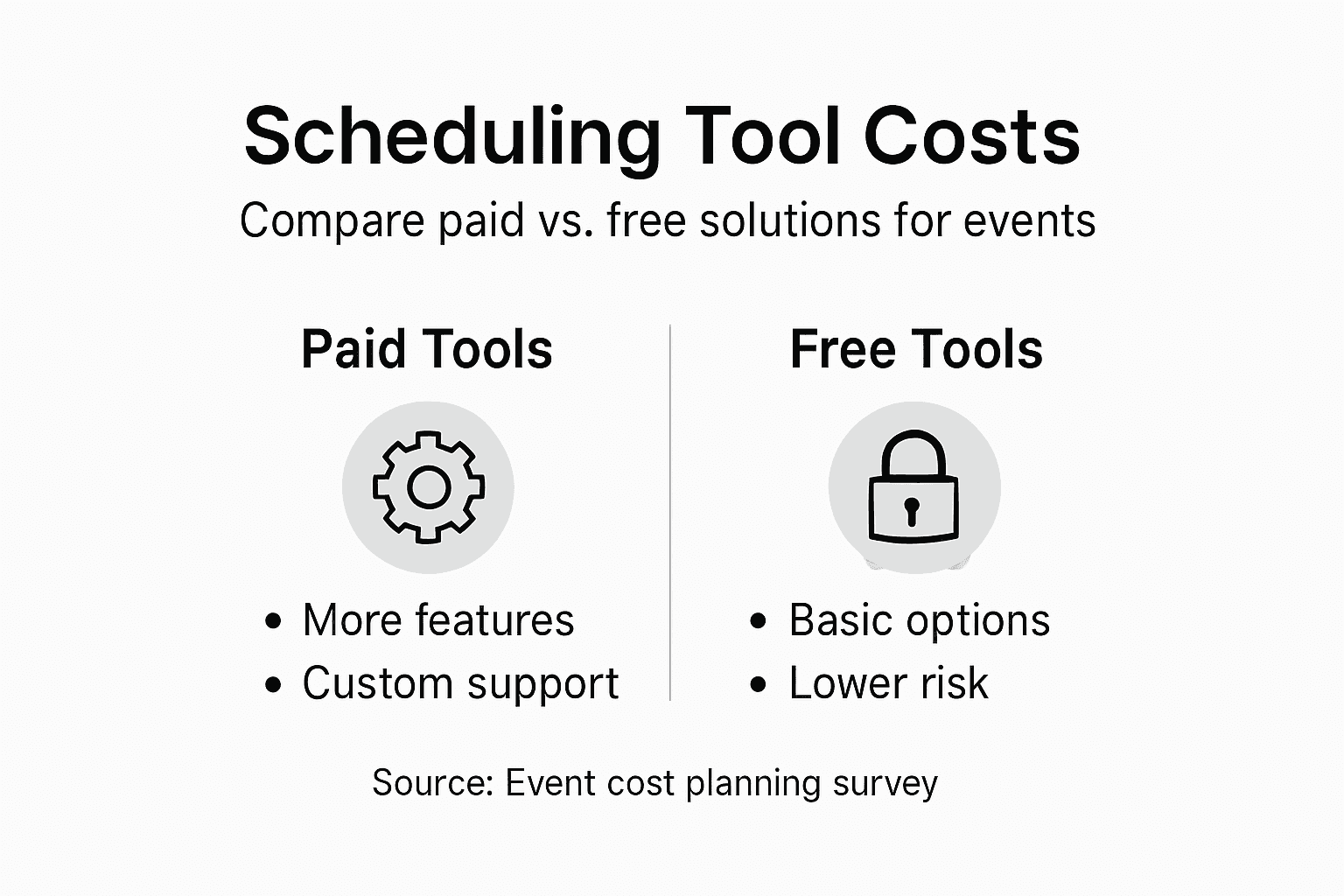
While free solutions offer significant advantages, corporate event planners must carefully evaluate their specific organizational needs. Some free tools may have limitations in advanced reporting, integration capabilities, or user management that could impact large-scale event planning. Conducting thorough feature assessments and pilot testing becomes crucial in determining the most appropriate cost-effective scheduling approach.
Pro tip: Conduct a comprehensive feature comparison between free and paid scheduling tools, focusing on your specific event planning requirements to maximize cost efficiency.
Choosing Between Paid and Free Tools
Selecting the right scheduling tool requires a nuanced understanding of organizational needs and financial constraints. Business scheduling software strategies reveal critical considerations for making informed decisions about tool selection.
Key comparative factors between paid and free tools include:
- Free Tools Advantages:
- Zero upfront costs
- Basic scheduling functionalities
- Suitable for small teams
- Minimal financial risk
- Paid Tools Advantages:
- Advanced feature sets
- Dedicated customer support
- Enhanced security protocols
- Scalable infrastructure
Scheduling app considerations highlight the importance of matching tool capabilities with specific organizational requirements. While free solutions provide fundamental scheduling features, paid platforms offer comprehensive integration capabilities that can significantly streamline complex event management processes. Corporate event planners must carefully evaluate their specific needs against the available functionality.
The decision between paid and free tools is not simply about cost, but about strategic value. Enterprise-level organizations often require robust features like advanced reporting, multiple user management, and seamless third-party integrations that typically necessitate investment in paid solutions. Smaller teams or those with straightforward scheduling needs might find free tools sufficiently powerful and cost-effective.
Pro tip: Create a detailed feature checklist comparing your specific event planning requirements against both free and paid scheduling tool capabilities before making a final selection.
Real-World Scenarios in Event Planning
Modern event planning requires sophisticated tools that can adapt to complex and dynamic scheduling challenges. Event management software strategies demonstrate how technology transforms traditional approaches to coordinating multi-dimensional events across various formats and requirements.
Typical real-world scheduling scenarios include:
- Hybrid Conference Management:
- Simultaneous in-person and virtual attendance tracking
- Dynamic session scheduling
- Seamless participant engagement across platforms
- Corporate Retreat Coordination:
- Multi-day activity synchronization
- Resource allocation tracking
- Personalized participant scheduling
- Educational Institution Events:
- Large-scale event logistics
- Complex participant registration
- Real-time attendance monitoring
Advanced scheduling system deployment reveals how cutting-edge technologies like QR code tracking and dynamic algorithms can dramatically improve event management efficiency. These tools enable planners to automate complex administrative tasks, reduce manual intervention, and provide real-time insights into participant engagement and event performance.
Successful event planning now requires more than traditional scheduling - it demands intelligent, adaptive systems that can handle intricate logistical challenges while providing comprehensive visibility into event dynamics. Corporate event planners must leverage technology that offers flexibility, comprehensive tracking, and seamless communication across multiple platforms and participant groups.
Pro tip: Select scheduling tools that offer robust integration capabilities and comprehensive analytics to transform event planning from a logistical challenge into a strategic advantage.
Optimize Your Event Costs with Smarter Scheduling Solutions
The article highlights how understanding and managing cost in scheduling tools is key to event success. Many event planners face challenges like inefficient resource allocation, unpredictable delays, and difficulties aligning team availability over multi-day schedules. These pain points can lead to overspending and last-minute adjustments that strain budgets and timelines. WhenNOT addresses these specific challenges by simplifying the scheduling process through an inverse approach that directly visualizes participants' unavailable dates. This method reduces communication delays and helps identify optimal dates quickly, ensuring better cost control and preventing the financial risks linked to scheduling disruptions.
Discover a solution designed for efficiency and affordability: WhenNOT offers a free, user-friendly platform that eliminates licensing costs while providing robust privacy and accessibility for group events of any size. Whether coordinating a corporate retreat or a family gathering, its innovative approach transforms complex scheduling into a streamlined, stress-free experience.
Ready to reduce your scheduling overhead and gain real-time clarity on event costs? Explore how WhenNOT can empower your planning process today.
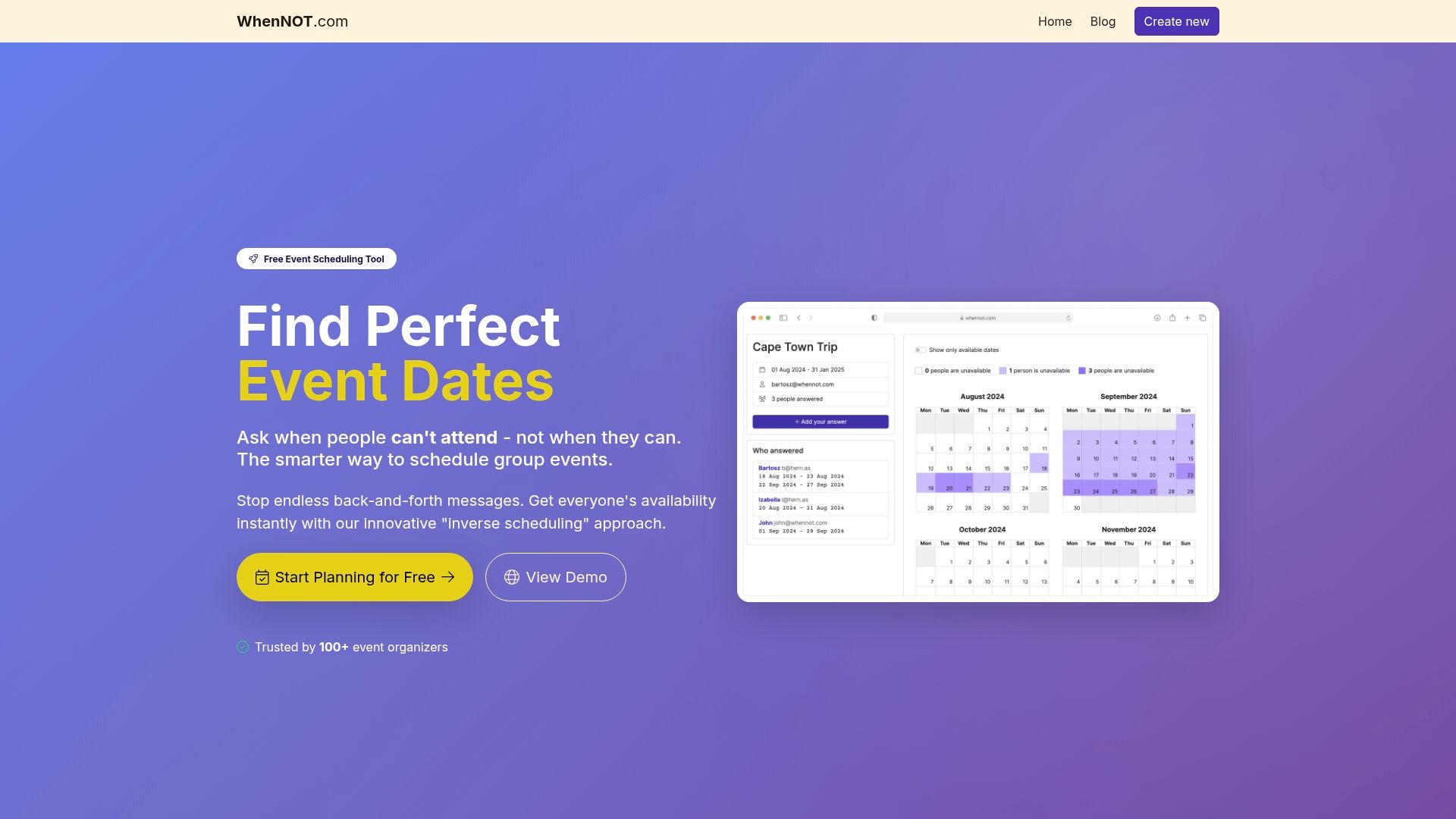
Act Now to Save Time and Minimize Event Costs with WhenNOT's Scheduling Tool. Learn more about its unique features and start simplifying your group event planning instantly at WhenNOT. Experience scheduling without complicated signup requirements for you or your participants at WhenNOT's Official Site.
Frequently Asked Questions
What is the significance of cost analysis in scheduling tools?
Cost analysis in scheduling tools is crucial as it encompasses resource allocation, time investment, delay expenses, and performance metrics, helping event planners make informed, data-driven decisions.
How can scheduling tools help in minimizing unexpected costs during an event?
Scheduling tools provide real-time visibility into potential budget overruns and resource requirements, enabling proactive management strategies that minimize financial risks associated with scheduling disruptions.
What are the common pricing models for scheduling tools?
Common pricing models include cost-based pricing, value-based pricing, competitive pricing, and usage-based pricing, each reflecting the complexity of services and organizational needs in event planning.
How can free scheduling tools be effective for corporate event planners?
Free scheduling tools can be effective as they eliminate licensing costs, offer core functionalities, and allow collaboration without financial commitment, making them suitable for smaller teams or straightforward planning needs.