
Coordinating meetings and events should be simple, but anyone who has juggled a group calendar knows it quickly gets messy. Imagine a tool that can slash the time spent on scheduling by up to 60 percent, according to Gartner Research. The catch is that the real magic of these free scheduling tools is not just saving hours. They quietly eliminate the biggest scheduling headaches before you even notice them.
Table of Contents
- What Are Free Scheduling Tools And Their Features?
- Why Free Scheduling Tools Matter For Event Planning
- How Free Scheduling Tools Facilitate Group Coordination
- Key Concepts Behind Efficient Scheduling Practices
Quick Summary
| Takeaway | Explanation |
|---|---|
| Free scheduling tools streamline event planning | These tools reduce time spent coordinating meetings by automating availability matching for participants. |
| Advanced features improve group coordination | Key features include time zone alignment and integration with calendar platforms, enhancing overall scheduling efficiency. |
| Reduced communication friction enhances collaboration | Tools eliminate excessive email exchanges, providing clear visibility of schedules and allowing for asynchronous participation. |
| Systematic scheduling reduces cognitive load | Effective time optimization strategies lower mental strain by helping individuals focus on important tasks without conflict. |
| Psychological factors impact successful scheduling | Understanding interpersonal dynamics and respecting individual preferences are essential for effective group coordination. |
What are Free Scheduling Tools and Their Features?
Free scheduling tools are digital platforms designed to simplify the complex process of coordinating events, meetings, and group activities by providing intuitive interfaces that enable seamless time management. These digital solutions eliminate the traditional back-and-forth communication challenges associated with finding mutually convenient time slots.
Understanding the Core Functionality
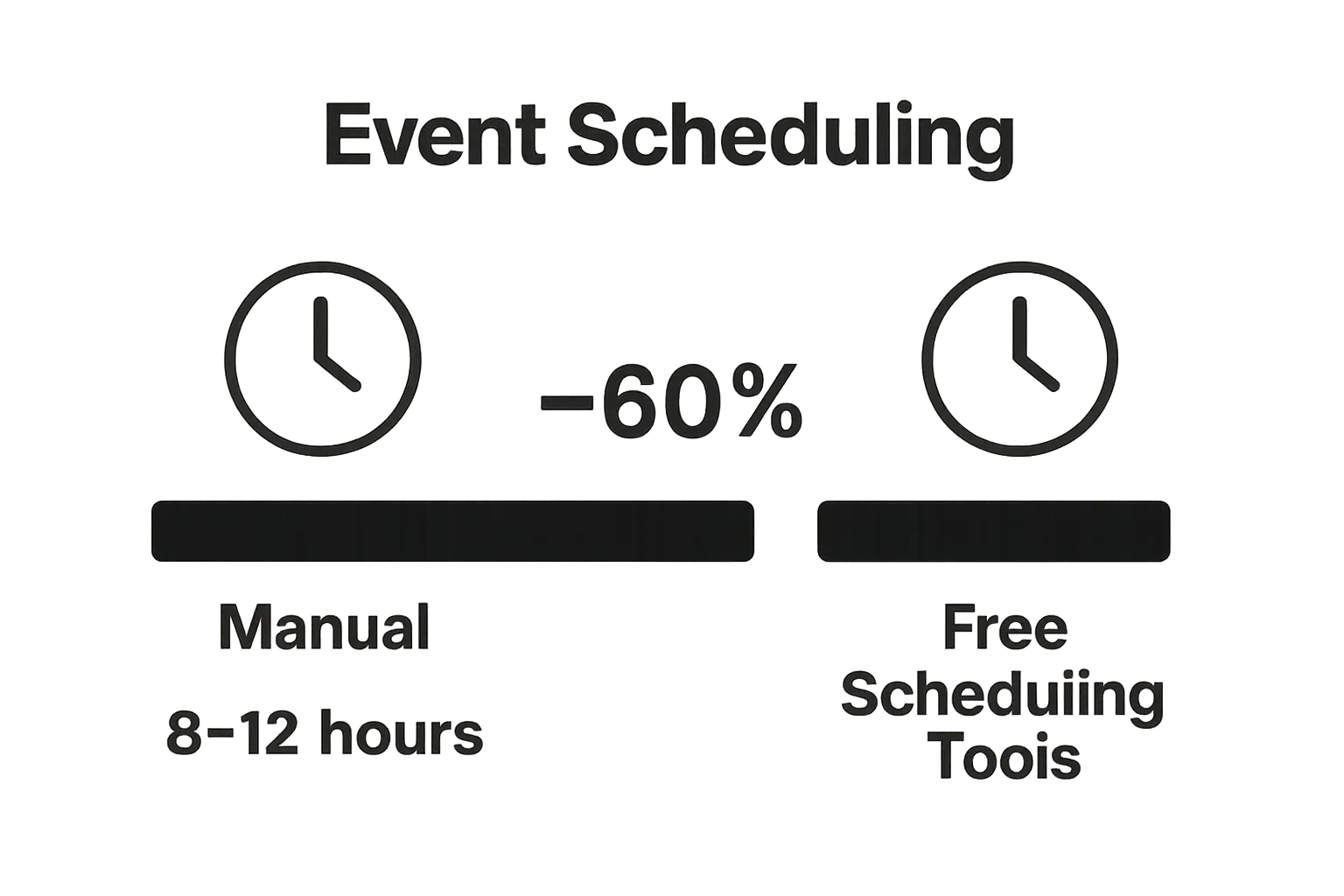
At their fundamental level, free scheduling tools serve as digital coordinators that streamline the process of finding optimal meeting times. Gartner Research indicates that these tools leverage advanced algorithms to match participants' availability, reducing the time spent on manual coordination by up to 60%. The role of free scheduling tools extends beyond simple calendar synchronization, offering features that transform how groups plan and organize their time.
The primary mechanisms of these tools typically involve:
- Allowing participants to input their availability
- Generating time slot recommendations
- Providing visual representations of shared free periods
- Sending automated invitations and reminders
Key Features That Define Modern Scheduling Solutions
Modern free scheduling tools go far beyond basic time matching. Harvard Business Review highlights that effective scheduling platforms now integrate multiple advanced capabilities that cater to diverse organizational and personal needs.
These comprehensive features often include:
- Time zone alignment for global teams
- Integration with popular calendar platforms
- Customizable event type settings
- Privacy controls and secure sharing mechanisms
By offering flexible, user-friendly interfaces, free scheduling tools democratize time management, making complex coordination tasks accessible to individuals and teams across various contexts. Whether planning a family reunion, organizing a corporate meeting, or coordinating a community event, these digital solutions provide a streamlined approach to finding the perfect time for everyone involved.
To help clarify the main features of modern free scheduling tools and what sets them apart, the following table summarizes their core components and functions in one place.
| Feature | Description |
|---|---|
| Time zone alignment | Automatically adjusts for participants in different time zones |
| Calendar integration | Syncs with popular calendar platforms for seamless updates |
| Customizable event type settings | Allows tailoring of meetings and events to fit specific needs |
| Privacy controls | Provides secure sharing and participant privacy options |
| Automated invites & reminders | Sends notifications and reminders to reduce manual follow-up |
| Visual schedule representation | Displays shared free/busy periods with easy-to-read visuals |
| Availability input & sharing | Lets users submit and share their available times digitally |
Why Free Scheduling Tools Matter for Event Planning
Event planning requires precision, coordination, and effective communication. Free scheduling tools have emerged as critical solutions that transform how groups organize complex gatherings, reducing administrative overhead and minimizing potential scheduling conflicts.
The Complexity of Group Event Coordination
Coordinating events involves managing multiple moving parts and participant schedules. Stanford University Research reveals that traditional scheduling methods consume approximately 8-12 hours of administrative time for medium-sized group events. Free scheduling tools dramatically reduce this time investment by automating availability matching and communication processes.
Key challenges in event planning that these tools address include:
- Synchronizing calendars across different time zones
- Managing diverse participant availability
- Reducing email communication cycles
- Tracking participant responses efficiently
Strategic Benefits for Event Organizers
Free scheduling tools provide strategic advantages that extend beyond simple time coordination. Project Management Institute suggests these platforms enhance overall event planning efficiency by creating transparent, accessible communication channels that enable real-time collaboration.
Significant strategic benefits include:
- Reducing scheduling-related miscommunication
- Creating centralized information repositories
- Enabling flexible planning approaches
- Supporting remote and distributed team coordination
By leveraging free scheduling tools, event organizers can transform complex planning processes into streamlined, user-friendly experiences. These digital solutions democratize event coordination, making sophisticated scheduling accessible to individuals and teams across various contexts, from professional conferences to family reunions.
How Free Scheduling Tools Facilitate Group Coordination
Group coordination represents one of the most challenging aspects of modern collaborative work and event planning. Free scheduling tools have emerged as sophisticated platforms that transform complex coordination processes into seamless, intuitive experiences that bridge communication gaps and simplify collective decision making.
Mechanisms of Collaborative Scheduling
The underlying mechanics of group scheduling tools prioritize participant flexibility and transparent communication. MIT Sloan Management Review demonstrates that digital scheduling platforms can reduce coordination time by up to 70% compared to traditional communication methods. These tools operate through intelligent algorithms that analyze multiple individual schedules simultaneously, identifying optimal meeting windows without extensive manual negotiation.
Key collaborative mechanisms include:
- Automatic availability detection
- Real-time schedule comparison
- Conflict resolution suggestions
- Dynamic time slot recommendations
Overcoming Communication Barriers
Free scheduling tools serve as critical communication bridges that transcend traditional scheduling limitations. Gartner Research highlights that these platforms enable participants to share availability without constant direct interaction, significantly reducing communication friction and potential scheduling conflicts.
Significant communication advantages encompass:
- Eliminating repetitive email exchanges
- Providing transparent scheduling visibility
- Supporting asynchronous participation
- Maintaining participant privacy preferences
By leveraging advanced technological capabilities, free scheduling tools fundamentally reimagine group coordination. They transform what was once a complex, time-consuming process into an efficient, user-friendly experience that empowers teams, organizations, and individuals to collaborate more effectively across diverse geographical and temporal boundaries.

Key Concepts Behind Efficient Scheduling Practices
Efficient scheduling transcends mere time management, representing a sophisticated approach to organizing complex activities with precision, clarity, and strategic intent. Modern scheduling practices integrate technological solutions with nuanced understanding of human coordination dynamics.
The Science of Time Optimization
National Institutes of Health Research reveals that systematic scheduling approaches can reduce cognitive load by up to 45%, enabling individuals and teams to allocate mental resources more effectively. The fundamental science behind efficient scheduling involves understanding how time can be strategically mapped to maximize productivity and minimize potential conflicts.
Core principles of time optimization include:
- Recognizing individual energy patterns
- Prioritizing task complexity
- Creating flexible time buffers
- Understanding personal and collective performance rhythms
Psychological Foundations of Scheduling
Scheduling is not merely a logistical exercise but a complex psychological process involving interpersonal dynamics, communication strategies, and individual preferences. Effective scheduling practices acknowledge the human elements that influence time management and group coordination.
Psychological considerations in scheduling encompass:
- Respecting individual autonomy
- Minimizing scheduling stress
- Creating transparent decision making processes
- Supporting diverse working styles
By integrating technological capabilities with a deep understanding of human behavior, efficient scheduling practices transform time management from a mechanical task into a strategic, collaborative endeavor.
The following table organizes key research-based statistics related to scheduling efficiency and cognitive load, illustrating the impact of digital scheduling tools on time savings and mental workload.
| Research Source | Metric/Statistic | Context |
|---|---|---|
| Gartner Research | 60% reduction in scheduling time | Free scheduling tools vs. manual coordination |
| Stanford University Research | 8-12 hours spent coordinating medium-size events | Traditional scheduling methods |
| MIT Sloan Management Review | Up to 70% reduction in coordination time | Digital scheduling platforms vs. traditional methods |
| National Institutes of Health Research | 45% reduction in cognitive load | Systematic scheduling approaches vs. non-systematic |
Effortless Group Scheduling Starts Here: Discover the Power of Inverse Coordination
Have you ever felt overwhelmed by endless back-and-forth emails and the hassle of matching everyone’s availability when planning an event? This article highlighted common frustrations with traditional scheduling tools, such as time-consuming manual coordination, communication gaps, and the struggle to align busy calendars. When planning for multi-day or flexible date events, these pain points become even more challenging. WhenNOT transforms the way you organize group events by flipping the old approach on its head. Instead of asking when everyone is free, WhenNOT simply asks when participants are busy, instantly revealing the best possible dates for your gathering.
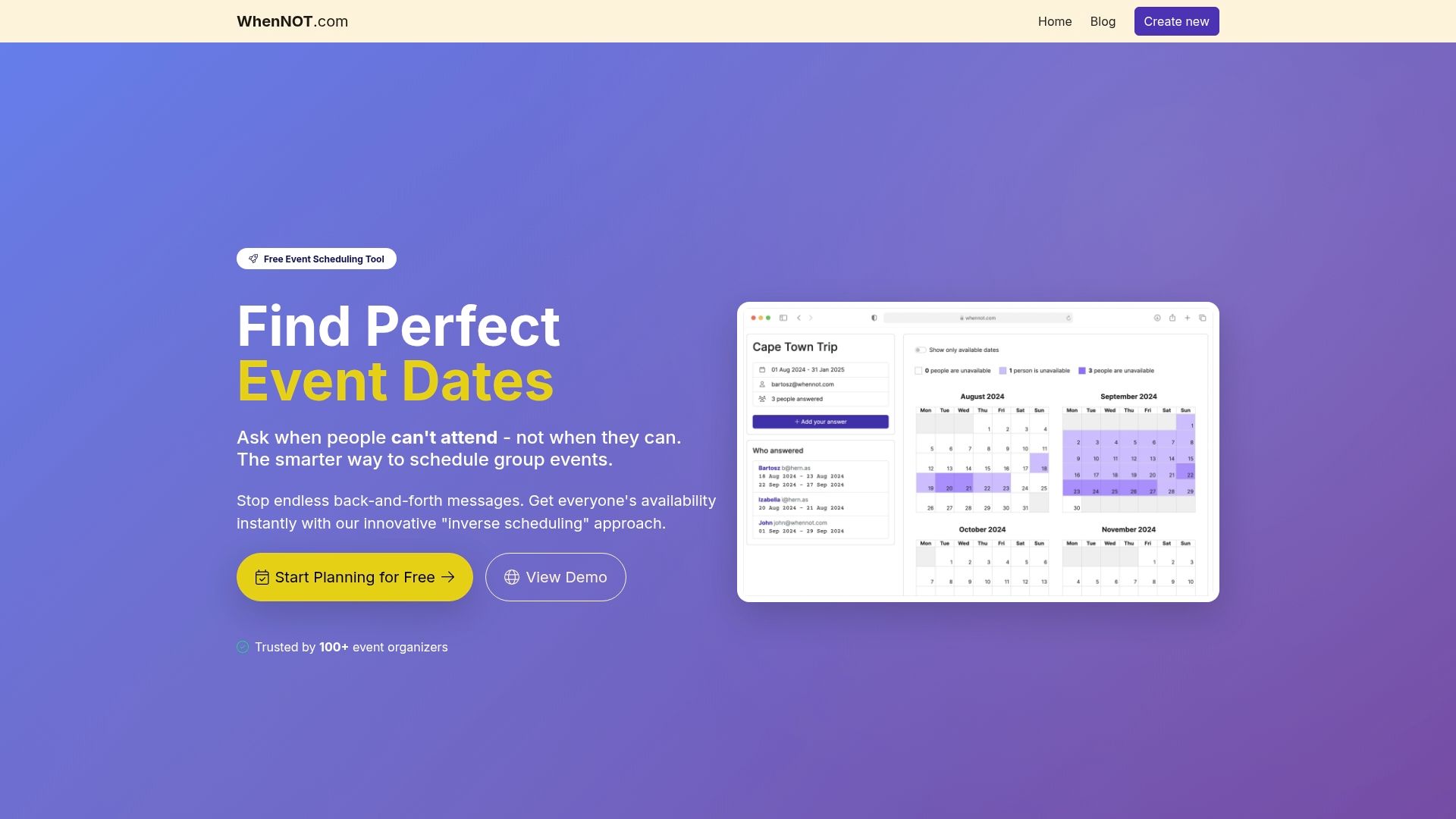
Take control of your time and eliminate the headaches of group coordination. Experience how WhenNOT’s free event scheduling tool empowers you to visualize everyone’s unavailable days at a glance, removing the guesswork and cutting down delays. Plan family gatherings, company retreats, social parties, or group travel today with no signups or costs. Visit WhenNOT now to effortlessly organize your next event and enjoy simple, stress-free scheduling.
Frequently Asked Questions
What are free scheduling tools?
Free scheduling tools are digital platforms designed to simplify the process of coordinating events, meetings, and group activities by providing intuitive interfaces that help manage time effectively.
How do free scheduling tools work?
Free scheduling tools allow participants to input their availability, generate time slot recommendations, and automatically send invitations and reminders, streamlining the coordination process.
What are the main features of modern scheduling solutions?
Modern free scheduling tools include features like time zone alignment, integration with popular calendar platforms, customizable event settings, and privacy controls, enhancing their usability across various contexts.
Why are free scheduling tools important for event planning?
Free scheduling tools reduce administrative overhead in event planning, help synchronize schedules, minimize scheduling conflicts, and create transparency, leading to more efficient event organization.