
Scheduling a simple group event used to mean a flood of emails and endless calendar checks. Now imagine this. Research shows that advanced free scheduling tools can cut administrative time by up to 40 percent. That sounds like the main draw, right? Actually, the biggest shift comes from tools that flip the script entirely by letting you just say when you cannot meet. The result is event planning that feels almost effortless.
Table of Contents
- Understanding Free Scheduling Tools And Their Purpose
- Benefits Of Using Free Scheduling Tools
- Key Features To Look For In Free Scheduling Tools
- Real-World Applications Of Free Scheduling Tools
- The Future Of Event Planning With Free Scheduling Tools
Quick Summary
| Takeaway | Explanation |
|---|---|
| Free scheduling tools enhance collaboration | These tools simplify event coordination for both personal and professional contexts, making scheduling easier for everyone involved. |
| Automated features save time | With automated availability matching and real-time synchronization, users spend less time coordinating and more time participating. |
| User-friendly design is crucial | A clean interface allows users of any technical skill to navigate the platform, facilitating easier event planning. |
| Cost-effective solutions exist | Free scheduling tools reduce administrative costs and minimize communication expenses, yielding significant savings for organizations. |
| Privacy protection is essential | The best platforms prioritize user privacy by limiting shared information, ensuring safe and secure scheduling. |
Understanding Free Scheduling Tools and Their Purpose
Free scheduling tools have transformed how individuals and organizations coordinate events, meetings, and group activities. These digital platforms provide a streamlined solution for managing complex calendar logistics without requiring extensive manual coordination. Research on digital collaboration tools highlights the growing importance of efficient scheduling technologies in modern professional and personal environments.
The Core Purpose of Scheduling Tools
At their fundamental level, free scheduling tools solve a universal challenge: finding mutually convenient times for multiple participants. These platforms eliminate the traditional back-and-forth communication typically required when trying to align different schedules. Whether you are planning a family reunion, coordinating a work meeting, or organizing a community event, these tools simplify the process by presenting a clear, visual representation of everyone's availability.
Key Features and Functionality
Modern scheduling tools offer several critical features that make event planning more efficient:
- Automated Availability Matching: Quickly identify overlapping free time slots
- Real-Time Synchronization: Integrate with personal and professional calendars
- Privacy Protection: Share only necessary scheduling information
Unique platforms like WhenNOT take this concept further by inverting traditional scheduling approaches. Instead of asking participants when they are available, these innovative tools allow users to mark when they are not available, dramatically simplifying multi-participant event planning.
The primary goal of free scheduling tools is to reduce complexity, save time, and minimize communication friction.
Below is a comparison table highlighting how traditional scheduling methods differ from modern free scheduling tools, emphasizing improvements discussed in the article.
| Aspect | Traditional Scheduling Methods | Free Scheduling Tools |
|---|---|---|
| Communication Overhead | High (many emails/messages) | Low (centralized platform) |
| Time Spent Coordinating | Significant | Reduced (up to 40% less) |
| User Experience | Manual, scattered | Intuitive, user-friendly |
| Privacy Protection | Limited (often oversharing) | Enhanced (controlled sharing) |
| Cost | Potentially high (admin time) | Free or low-cost |
| Availability Tracking | Manual, error-prone | Automated, synchronized |
| Multi-Time Zone Support | Difficult, often confusing | Automatic conversion (in many) |
![5 Free Apps to Help You Organise Your Business [Free Scheduling & Planning Apps for Creators]](https://i.ytimg.com/vi/w4lKEnzj4Go/hqdefault.jpg)
Benefits of Using Free Scheduling Tools
Free scheduling tools offer substantial advantages for individuals and groups seeking efficient event coordination.
INFOGRAPHIC:infographic_content] [Research from productivity experts demonstrates that these digital platforms can significantly reduce time spent on administrative scheduling tasks and improve overall group communication.
Time and Communication Efficiency
One of the most compelling benefits of free scheduling tools is their ability to dramatically reduce communication overhead. Traditional scheduling methods involve endless email threads, text messages, and phone calls to find mutually convenient times. Free scheduling tools eliminate this complexity by providing a centralized platform where participants can quickly share their availability without repetitive back-and-forth interactions.
Cost-Effective Collaboration Solutions
The economic benefits of free scheduling tools are particularly noteworthy. Organizations and individuals can save substantial resources by using platforms that:
- Eliminate Manual Coordination Costs: Reduce administrative labor hours
- Minimize Communication Expenses: Decrease time spent on scheduling-related communications
- Provide Accessible Technology: Enable scheduling without purchasing expensive software
Moreover, understanding why choose simple scheduling tools reveals that these platforms are designed with user experience in mind, making them accessible to people with varying technical skills.
Enhanced Productivity and Flexibility
Beyond basic scheduling, these tools offer strategic advantages. They provide real-time updates, synchronize across multiple devices, and often integrate with existing calendar systems. This seamless connectivity allows users to manage complex scheduling scenarios with unprecedented ease, whether coordinating international business meetings or planning family gatherings across different time zones.
Ultimately, free scheduling tools represent more than just a technological convenience. They are powerful instruments that transform how people collaborate, communicate, and optimize their collective time management.

Key Features to Look For in Free Scheduling Tools
Selecting the right free scheduling tool requires understanding the critical features that transform a basic platform into an exceptional scheduling solution. Research on digital collaboration technologies emphasizes the importance of choosing tools that align with specific group coordination needs.
Intuitive User Experience
The most effective scheduling tools prioritize user-friendly design. A clean, straightforward interface allows participants of all technical skill levels to navigate and use the platform without extensive training. This means minimal clicks, clear visual representations of schedules, and an intuitive process for marking availability or unavailability.
Advanced Scheduling Capabilities
Beyond basic functionality, top-tier free scheduling tools offer sophisticated features that streamline complex event planning:
- Multi-Platform Compatibility: Seamless integration with various calendar systems
- Timezone Automatic Conversion: Simplify scheduling across global locations
- Customizable Availability Ranges: Flexible time slot selections
Innovative platforms like understanding why choose simple scheduling tools demonstrate how advanced features can radically simplify group coordination.
Privacy and Security Considerations
Protecting participant information is paramount in scheduling tools. The best platforms offer robust privacy controls that allow users to share only necessary scheduling details. This includes features like:
- Anonymized Participant Tracking: Prevent unnecessary personal information exposure
- Secure Link Sharing: Generate unique, time-limited event links
- Data Encryption: Protect scheduling information from unauthorized access
By prioritizing these key features, users can select free scheduling tools that not only simplify event planning but also provide a secure, efficient, and user-friendly experience.
This table summarizes key features and functionalities to consider when selecting a free scheduling tool, as described in the article.
| Feature/Functionality | Description |
|---|---|
| Automated Availability Matching | Instantly matches overlapping free/busy times |
| Real-Time Synchronization | Integrates with calendars for up-to-date information |
| Multi-Platform Compatibility | Works across devices and calendar systems |
| Timezone Automatic Conversion | Adjusts meeting times for global participants |
| Customizable Availability Ranges | Allows flexible time slot selection |
| Privacy Controls | Limits what information is shared |
| Secure Link Sharing | Generates unique, time-limited event links |
| Data Encryption | Protects scheduling data from unauthorized access |
Real-World Applications of Free Scheduling Tools
Free scheduling tools have evolved from simple calendar applications to sophisticated platforms solving complex coordination challenges across multiple domains. Research from workplace collaboration studies indicates these tools are transforming how groups interact and plan events.
Professional and Business Environments
In corporate settings, scheduling tools become critical infrastructure for managing team interactions. Sales teams use these platforms to coordinate client meetings across different time zones, while remote work teams leverage them to synchronize global collaboration. Project managers can quickly identify overlapping availability, reducing the time spent on administrative coordination and increasing overall team productivity.
Personal and Social Event Planning
Beyond professional contexts, free scheduling tools have revolutionized personal event coordination. Family reunions, friend group vacations, and community events become significantly easier to plan. These tools allow participants to:
- Share Availability Transparently: Eliminate guessing about participant schedules
- Reduce Communication Complexity: Minimize back-and-forth messaging
- Create Inclusive Planning Environments: Ensure everyone's input is considered
Understanding the role of free scheduling tools reveals how these platforms democratize event planning across various social contexts.
Specialized Coordination Scenarios
Unique scheduling challenges emerge in specific domains like academic research collaborations, volunteer organizations, and multi-stakeholder projects. Free scheduling tools provide flexible solutions that adapt to complex group dynamics. Healthcare professionals use these platforms for interdepartmental consultations, while educational institutions employ them for managing cross-campus research initiatives.
The versatility of free scheduling tools demonstrates their potential to streamline communication and reduce administrative friction across diverse human interaction scenarios.
The Future of Event Planning with Free Scheduling Tools
Research on technological collaboration trends indicates that free scheduling tools are poised to revolutionize how groups coordinate and plan events. The landscape of event planning is rapidly evolving, driven by technological innovations that prioritize efficiency, accessibility, and user experience.
Artificial Intelligence and Predictive Scheduling
The next generation of scheduling tools will leverage advanced artificial intelligence to transform event coordination. Machine learning algorithms will analyze historical scheduling patterns, predict optimal meeting times, and automatically suggest the most convenient slots for multiple participants. This technology will go beyond simple calendar matching, offering intelligent recommendations that consider individual preferences, work patterns, and contextual availability.
Enhanced Personalization and Integration
Future scheduling platforms will offer unprecedented levels of customization and cross-platform functionality. Users can expect features that:
- Adapt to Individual Scheduling Preferences: Learn and anticipate user behaviors
- Seamlessly Connect Multiple Digital Ecosystems: Integrate with work, personal, and social platforms
- Provide Intelligent Conflict Resolution: Automatically suggest alternative time slots
8 Essential Event Planning Tools for Every Organizer highlights the growing complexity and sophistication of digital scheduling solutions.
Privacy-Focused and Decentralized Coordination
Emerging scheduling technologies will prioritize user privacy and data protection. Decentralized platforms will allow participants to share minimal necessary information, maintaining personal boundaries while facilitating efficient group coordination. The future of event planning tools will balance technological convenience with robust privacy controls, ensuring users maintain complete control over their scheduling data and personal information.
As digital collaboration continues to evolve, free scheduling tools will become increasingly intelligent, intuitive, and integral to how people and organizations coordinate their time and activities.
Tired of Scheduling Headaches? Try the Simpler Way to Get Everyone Together
If endless back-and-forth messages and missed connections have made group event planning stressful, you are not alone. The article shows how traditional scheduling tools often make things complicated by asking everyone when they are free. This leads to confusion, delays, and wasted time. You deserve an easier way that saves your energy and helps your group quickly pick dates that work for all.
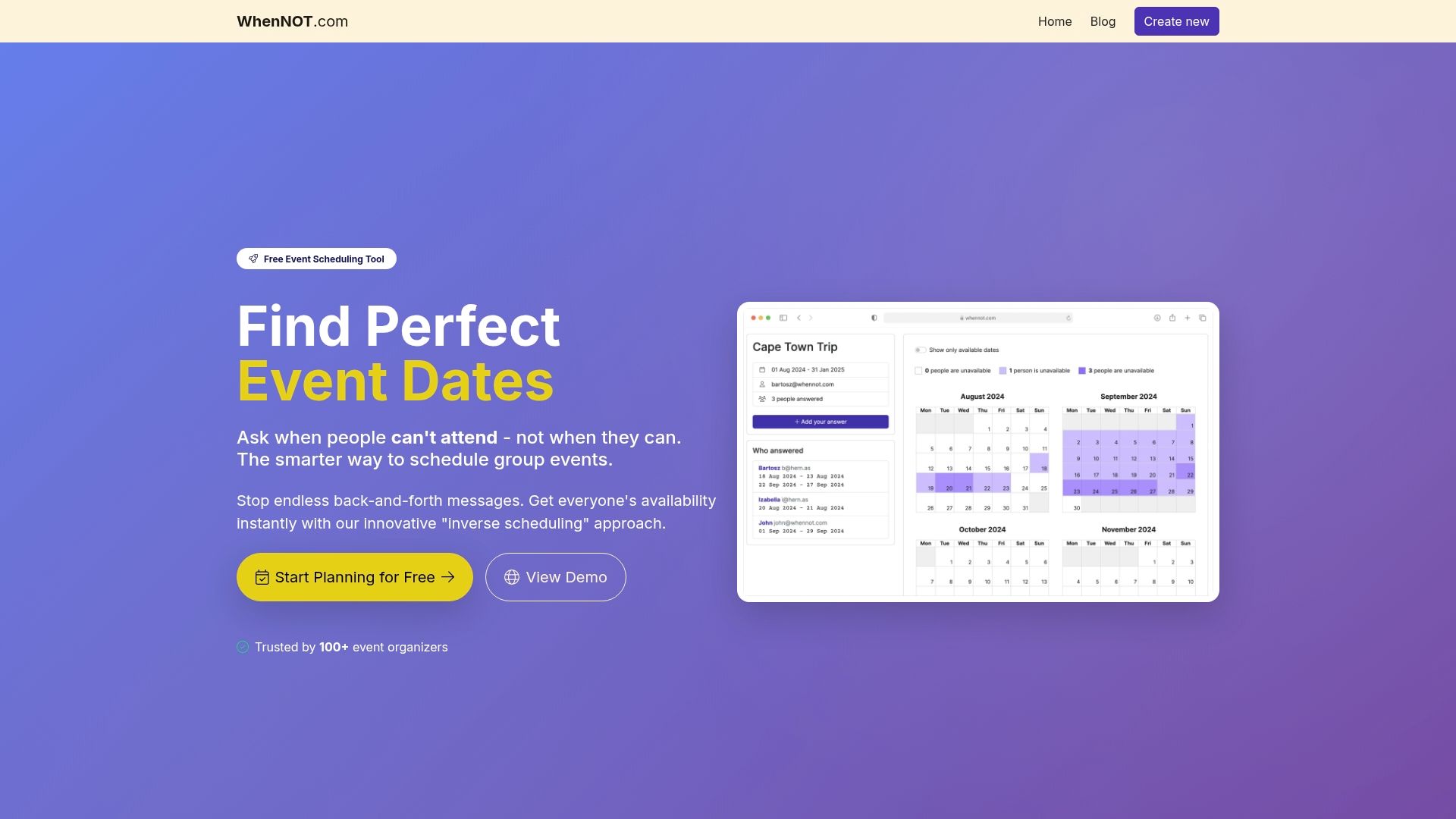
Discover WhenNOT, a free solution that puts an end to scheduling frustration. Rather than chasing after when people are available, invite your group to simply mark when they are busy. WhenNOT's unique approach instantly visualizes overlapping busy days, so you can see the best dates for your event at a glance. Enjoy effortless coordination, stronger privacy, and absolutely no cost or sign-ups. Take control and make your next event stress-free by starting today at WhenNOT's homepage and learn more about why simple scheduling is better in our quick guide.
Frequently Asked Questions
What are the benefits of using free scheduling tools for my events?
Using free scheduling tools can significantly reduce the time spent on organizing and coordinating event logistics. They streamline communication, allow participants to share their availability transparently, and can help eliminate unnecessary back-and-forth emails. Start by exploring available options to find one that fits your needs and simplifies your event planning process.
How do free scheduling tools improve communication among participants?
Free scheduling tools centralize the process of sharing availability, reducing the need for endless messaging about schedules. By using these platforms, everyone can see available time slots at a glance, making it easier to agree on a meeting time. Try implementing a scheduling tool to combine everyone's input quickly, reducing communication complexity by up to 50%.
Can free scheduling tools help with coordinating events across different time zones?
Yes, many free scheduling tools automatically convert time zones, making it easier to organize meetings or events with participants from various locations. This feature ensures everyone sees the correct time for their region, preventing confusion. Check the tools you consider to ensure they offer automatic time zone conversions as part of their features.
What features should I look for in free scheduling tools?
When choosing a free scheduling tool, prioritize features like intuitive user interfaces, automated availability matching, and customizable time settings. These capabilities will enhance the ease of organizing events and make the process efficient for all attendees. Evaluate the options based on these features to find a tool that meets your specific event coordination needs.
How do I ensure the privacy of participants when using scheduling tools?
To maintain participant privacy, select free scheduling tools that provide robust privacy controls, such as anonymized tracking and secure link sharing. These features help ensure that only necessary information is shared among participants. Review the privacy settings of the tools you consider to make sure they offer adequate protection for everyone involved in your events.
How can I maximize the efficiency of scheduling tools for my events?
To maximize efficiency, familiarize yourself and other users with the tool’s available features and how to use them effectively. Encourage participants to mark their availability promptly and utilize features like real-time synchronization to keep everyone updated. Implement these practices to streamline coordination time by roughly 30-40%.