
Managing multi-day corporate events often means juggling shifting agendas, overlapping tasks, and mounting logistical headaches. For American and Canadian event coordinators aiming to deliver seamless retreats, finding a smarter method to organize team schedules matters more than ever. By embracing the structured strategy of group time blocking, professionals can reduce interruptions and sharpen focus, creating clear work segments that prevent cognitive overload and ensure every detail stays on track.
Table of Contents
- Time-Blocking For Groups Explained
- Major Types And Strategies For Teams
- How Group Time-Blocking Operates
- Real-World Applications For Event Coordinators
- Benefits And Common Challenges For Groups
- Comparing Group Time-Blocking To Other Methods
Key Takeaways
| Point | Details |
|---|---|
| Effective Group Coordination | Time blocking enables teams to structure their work periods strategically, minimizing distractions and enhancing collective productivity. |
| Reduced Context Switching | By implementing time blocking, groups can limit the frequency of task-switching, allowing for deeper focus on specific tasks. |
| Clear Communication Protocols | Successful time blocking requires teams to establish visible schedules and agreed-upon boundaries to ensure mutual respect for deep work periods. |
| Iterative Improvement Strategy | It is beneficial to pilot time blocking with a small team, gathering feedback to refine the approach before broader implementation across the organization. |
Time-Blocking for Groups Explained
Time blocking transforms how teams manage collective productivity by strategically allocating focused work periods. Unlike traditional scheduling methods, this approach helps groups protect deep work time and minimize unnecessary interruptions. By creating structured time segments dedicated to specific tasks, organizations can dramatically improve collaboration and individual performance.
At its core, time blocking involves systematically scheduling concentrated work periods that align team members' energy and focus. The technique goes beyond simple calendar management - it's a deliberate strategy to combat cognitive fragmentation caused by constant task-switching and back-to-back meetings.
Key benefits of group time blocking include:
- Reduced context switching between different work modes
- Clear expectations about individual and collective work periods
- Enhanced team coordination and predictable workflow
- Improved individual concentration and productivity
- Minimized unnecessary meeting interruptions
When implementing time blocking for groups, consider establishing clear boundaries and communication protocols. Team members should understand shared time block expectations, respecting designated deep work periods while maintaining flexibility for collaborative needs.
Pro tip: Start by introducing time blocking with a pilot group and gradually expand the approach across your organization, allowing teams to adapt and refine the technique collaboratively.
Major Types and Strategies for Teams
Time blocking offers multiple strategic approaches for teams seeking to optimize their collective workflow. Three primary methods emerge as particularly effective for group productivity: task batching, time boxing, and day theming. Each technique provides unique advantages for managing team schedules and reducing cognitive load.
Task batching consolidates similar activities into concentrated work periods, minimizing context switching and allowing team members to maintain focused momentum. Time boxing establishes strict time limits for specific tasks, creating accountability and preventing work from expanding indefinitely. Day theming takes a broader approach by assigning entire days to particular types of work or project categories, enabling deeper strategic planning and reducing mental overhead.
Key strategies for successful team time blocking include:
- Establishing clear communication protocols about individual time blocks
- Creating shared visibility into team members' focused work periods
- Developing flexible boundaries that respect personal productivity rhythms
- Implementing collaborative tools that track and support time blocking efforts
- Regularly reviewing and adjusting time blocking approaches
Pro tip: Start by piloting time blocking with a small team, documenting challenges and successes, then gradually expand the approach across your organization.
Here's a comparison of the three major group time-blocking methods:
| Method | Key Focus Area | Best Use Case | Typical Outcome |
|---|---|---|---|
| Task Batching | Grouping similar tasks | Handling repetitive processes | Reduced context switching |
| Time Boxing | Fixed time for each activity | High accountability, deadline-driven work | Prevents task overrun |
| Day Theming | Assigning themes to days | Strategic planning, project management | Lower mental fatigue |
How Group Time-Blocking Operates
Systematic time allocation techniques enable teams to transform their collective productivity by creating structured, intentional work periods. Group time-blocking operates as a collaborative scheduling approach that segments the workday into dedicated, purposeful blocks, allowing teams to minimize distractions and maximize focused effort.

The fundamental mechanism involves creating collective schedules where each segment is assigned a specific type of work or collaborative activity. Team members synchronize their individual time blocks, establishing clear expectations about when deep work, meetings, collaborative sessions, and individual tasks will occur. This approach creates a predictable rhythm that reduces cognitive load and helps teams maintain consistent momentum.
Key operational components of group time-blocking include:
- Establishing shared visibility into team members' schedules
- Creating mutually agreed-upon block boundaries
- Defining clear purposes for each time segment
- Implementing communication protocols during blocked periods
- Developing flexibility within structured time frames
Effective group time-blocking transforms reactive work patterns into proactive, intentional collaboration.
Successful implementation requires ongoing communication and periodic review of the time-blocking strategy. Teams must remain adaptable, recognizing that individual and collective productivity needs can shift over time.
Pro tip: Conduct monthly retrospectives to assess the effectiveness of your group time-blocking approach, making incremental adjustments to optimize team performance.
Real-World Applications for Event Coordinators
Event management professionals use time blocking to transform chaotic planning processes into streamlined, strategic workflows. By segmenting their day into purposeful blocks, coordinators can effectively manage complex multi-stage event preparations, reducing stress and improving overall project execution.
Typical time-blocking applications for event coordinators include dedicated periods for critical activities such as vendor negotiations, client communications, venue site inspections, and logistical planning. This approach allows professionals to create intentional spaces for deep strategic thinking, preventing reactive work patterns and enabling more proactive event design.
Key real-world time-blocking strategies for event coordination include:
- Allocating specific morning hours for vendor communication and contract negotiations
- Blocking afternoon periods for site visits and venue assessments
- Reserving dedicated time for detailed budget reconciliation
- Creating uninterrupted segments for creative event design and conceptualization
- Establishing buffer zones for unexpected challenges and last-minute adjustments
Strategic time blocking transforms event coordination from a reactive to a proactive management approach.
Successful implementation requires continuous refinement and flexibility. Event coordinators must remain adaptable, recognizing that each event presents unique scheduling demands and potential disruptions.
Pro tip: Create a flexible template for your time blocks that allows 20% buffer time, enabling you to manage unexpected challenges without derailing your entire event planning schedule.
Benefits and Common Challenges for Groups
Time blocking offers significant advantages for collaborative teams by creating structured approaches to managing collective workloads. This technique transforms group productivity by establishing clear boundaries and intentional work periods, enabling teams to focus more effectively and reduce overall organizational stress.
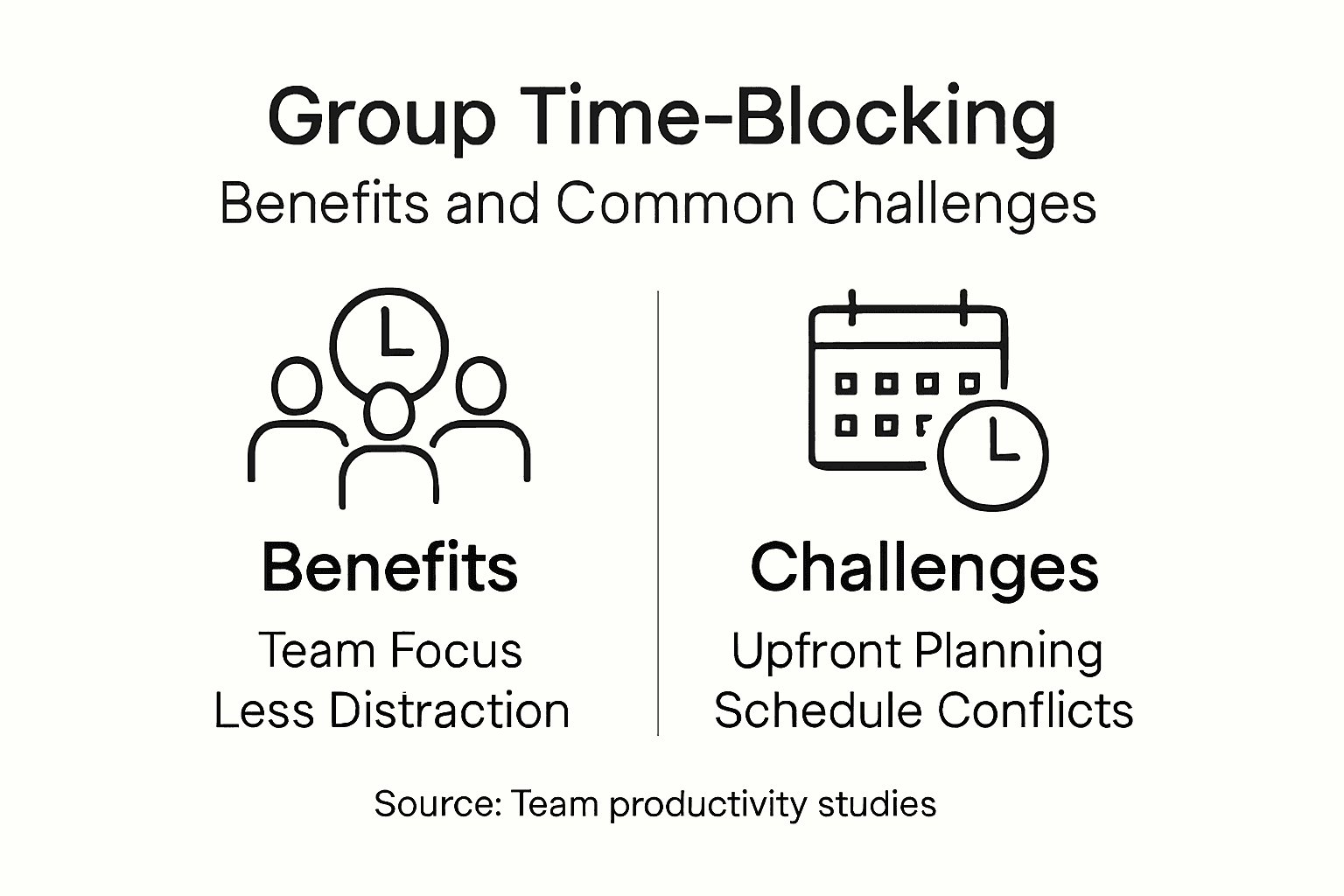
The primary benefits of group time blocking include enhanced team coordination, minimized interruptions, and improved individual and collective performance. By dedicating specific time segments to particular tasks, groups can create predictable workflows that align individual contributions with broader team objectives, ultimately reducing cognitive fragmentation and increasing overall efficiency.
Key benefits and challenges of group time blocking include:
- Improved focus and task concentration
- Reduced context switching between different work modes
- Enhanced team communication and expectations management
- Potential resistance to changing established scheduling patterns
- Need for flexible implementation strategies
Successful time blocking requires consistent discipline and a willingness to adapt collective work rhythms.
Implementing time blocking is not without challenges. Teams must invest significant initial effort in designing effective block structures, negotiating individual preferences, and creating mechanisms for flexibility that accommodate unexpected work demands.
Pro tip: Start with a pilot group and iteratively refine your time blocking approach, collecting feedback and making incremental adjustments to improve team adoption and effectiveness.
Comparing Group Time-Blocking to Other Methods
Time blocking distinguishes itself from traditional scheduling approaches through its precise, intentional allocation of time segments. Unlike generic to-do lists or multitasking strategies, this method offers groups a structured framework for managing collective productivity with unprecedented granularity and focus.
Whereas task batching groups similar activities and day theming assigns entire days to specific categories, time blocking provides a more dynamic and granular approach. This method allows teams to create highly specific time windows for individual and collaborative tasks, enabling more nuanced control over workflow and reducing the cognitive overhead associated with constant task switching.
Key comparative advantages of group time blocking include:
- More precise time allocation compared to traditional scheduling
- Enhanced ability to minimize context switching
- Greater accountability through defined start and end times
- Improved team coordination and predictability
- Reduced mental fatigue from constant task negotiation
Traditional scheduling fragments time; time blocking transforms it into a strategic resource.
Although time blocking requires more upfront planning than conventional methods, it offers superior long-term efficiency by creating a deliberate, structured approach to team productivity that adapts to complex work environments.
The following table highlights business impacts of group time-blocking versus traditional scheduling:
| Approach | Impact on Team Productivity | Workflow Predictability | Adaptability to Change |
|---|---|---|---|
| Time-Blocking | Enables deep work, minimizes distractions | High due to structured blocks | Moderate, requires planning |
| Traditional Scheduling | Frequent task switching, more interruptions | Lower, often reactive management | High, easier last-minute adjustments |
Pro tip: Experiment with hybrid time blocking approaches that combine elements of task batching and traditional scheduling to find the most effective method for your specific team dynamics.
Streamline Your Group Time-Blocking with WhenNOT
Managing group schedules and protecting focused work periods can feel overwhelming when dealing with constant interruptions and conflicting calendars. The article highlights key challenges like coordinating collective time blocks, minimizing context switching, and aligning team availability for deep work and collaboration. WhenNOT offers a revolutionary solution by simplifying group scheduling through its inverse availability system that asks participants only when they are not available. This approach directly addresses common pain points such as lengthy back-and-forth communications and unclear shared availability.
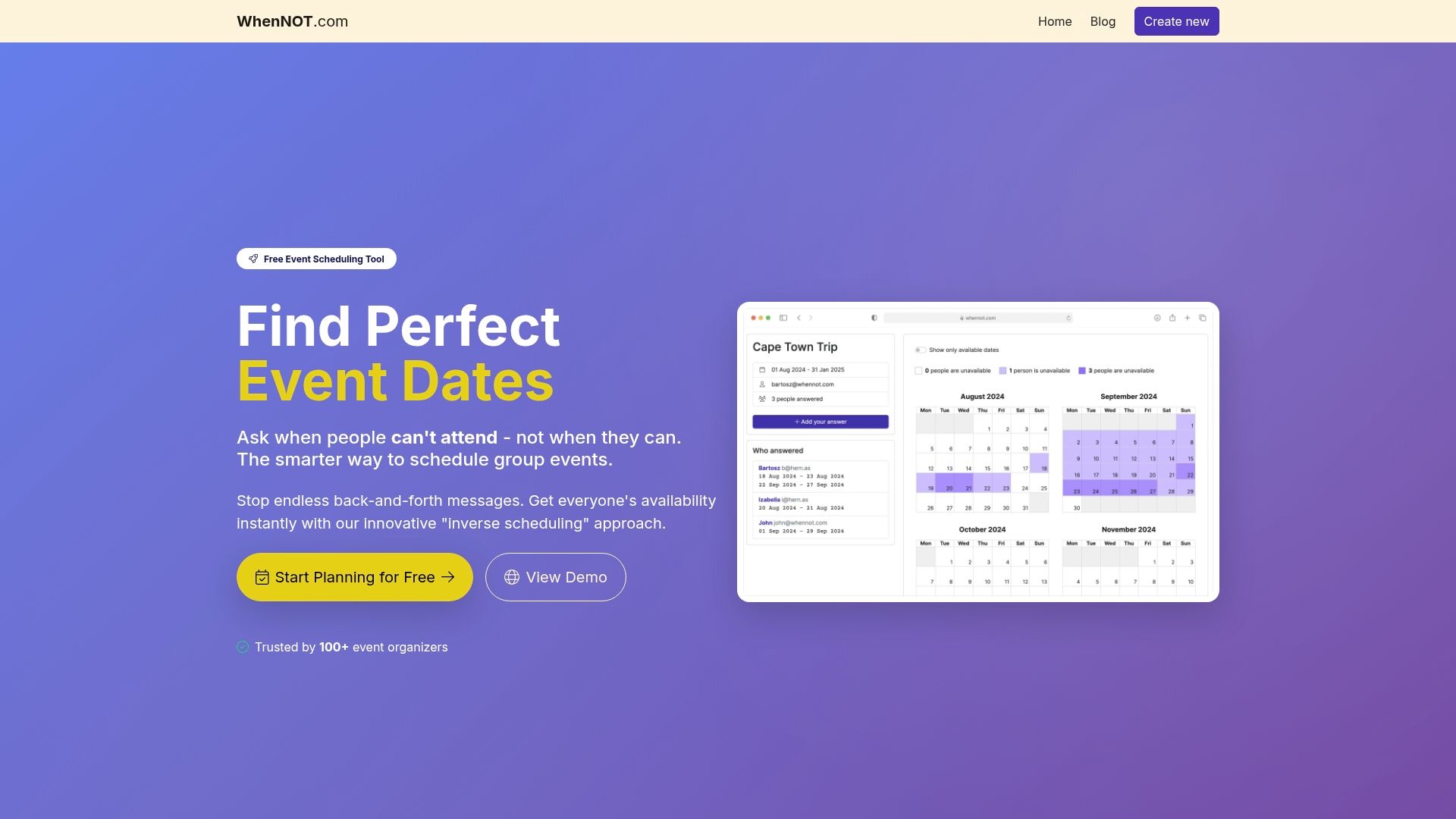
Discover how you can enhance your group productivity by easily identifying optimal meeting or work session times that fit everyone’s schedule. With WhenNOT’s intuitive platform, you create an event, set flexible date ranges, and invite participants to mark their unavailable days without any signup hassle. This effortless process empowers your team to implement effective time-blocking strategies like task batching or day theming with confidence and less stress. Visit WhenNOT today to experience a free, user-friendly online scheduling tool designed to keep your group focused and coordinated. Start transforming your group’s time management now at WhenNOT.
Frequently Asked Questions
What is time-blocking for groups?
Time-blocking for groups is a collaborative scheduling technique that segments the workday into dedicated periods for specific tasks, allowing teams to enhance productivity by minimizing distractions and focusing on deep work.
How does time-blocking improve team productivity?
Time-blocking improves team productivity by reducing context switching, establishing clear expectations about work periods, and creating predictability in workflows, which ultimately allows for better concentration and performance.
What are the main methods of time-blocking for teams?
The three main methods of time-blocking for teams are task batching, time boxing, and day theming, each providing unique advantages for managing schedules and optimizing group productivity.
What are some common challenges when implementing time-blocking in a team?
Common challenges include resistance to changing established scheduling habits, the need for flexible strategies to accommodate unexpected work demands, and the initial effort required to design effective block structures.