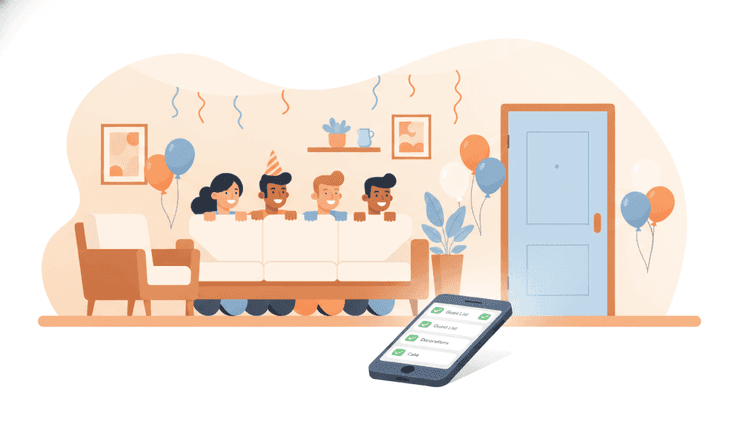
Planning a surprise party sounds thrilling until you realize you need to coordinate dozens of people, pick a date the guest of honor is free, and keep everything under wraps. One wrong text message or a slip in conversation can ruin weeks of planning.
This guide walks you through every step of planning a surprise party, from setting the date secretly to pulling off the big reveal. You will learn how to coordinate guests, manage RSVPs without raising suspicion, and avoid the most common mistakes that give the surprise away.
Why Surprise Parties Are Harder to Plan Than Regular Events
Quick answer: You have to do everything a regular party requires, but without the one person who matters most knowing about it.
With a regular event, you simply ask the guest of honor when they are available and build plans around their schedule. A surprise party flips that process upside down. You need to figure out their availability without asking, coordinate with guests behind the scenes, and create a convincing cover story.
The biggest challenges include:
- Scheduling blind. You cannot ask the guest of honor what dates work for them.
- Communication silos. Every conversation about the party must exclude the guest of honor entirely.
- Secrecy fatigue. The longer the planning takes, the more likely someone slips up.
- Coordination complexity. You are managing food, venue, decorations, and guest logistics while keeping everything hidden.
The good news? With the right tools and a clear plan, you can pull it off without the stress spiral. Let's walk through it step by step.
Step 1: Set a Date Without Tipping Off the Guest of Honor
Quick answer: Use inverse-availability scheduling to find a date when the guest of honor is free, without ever asking them directly.
This is the trickiest part of surprise party planning. You need a date when the guest of honor has no conflicts, but you cannot exactly send them a scheduling poll titled "Your Surprise Birthday Bash."
Here are a few ways to figure out their availability:
- Check shared calendars. If you share a Google or Apple calendar with them, look for open weekends or evenings.
- Ask a close friend or partner. Someone in their inner circle likely knows their schedule well enough to confirm a few dates.
- Use a casual excuse. Suggest a low-key hangout ("Want to grab dinner sometime next month?") to feel out which dates they are free.
Using Inverse-Availability Scheduling
A smarter approach is to poll everyone except the guest of honor for their availability. Tools like WhenNOT let you create a scheduling poll and share it only with the people who need to attend. You find the date that works for the most guests, then cross-reference it with the guest of honor's known schedule.
This way, you lock in a date that works for the majority of your crew without sending a single suspicious message to the person you are surprising.
Step 2: Build Your Secret Planning Committee
Quick answer: Pick 2 to 4 trusted people to help coordinate, and keep the wider guest list out of detailed planning conversations.
You cannot plan a surprise party alone, but you also cannot loop in 30 people and expect the secret to hold. The solution is a small planning committee.
Choose people who:
- Can keep a secret (this is non-negotiable)
- Have a good relationship with the guest of honor so they can help with the cover story
- Are willing to take on specific responsibilities like food, decorations, or guest coordination
Set up a private communication channel. Create a group chat or email thread that includes only your planning committee. Label it clearly so nobody accidentally sends a message to the wrong thread. A name like "Committee" works better than "SURPRISE PARTY FOR ALEX" if someone glances at a notification on your phone.
Pro tip: Assign each committee member a clear role early on. One person handles the venue, another manages the guest list, and another coordinates food. Clear ownership prevents the "I thought you were doing that" problem.
Step 3: Choose a Venue and Create a Cover Story
Quick answer: Pick a venue the guest of honor would visit naturally, and build a believable reason for them to show up at the right time.
The venue and cover story work together. The best surprise party locations are places the guest of honor would go without suspicion.
Venue options to consider:
| Venue Type | Best For | Cover Story Ideas |
|---|---|---|
| Your home | Budget-friendly, easy setup | "Come over for a casual dinner" |
| A friend's house | Spreads hosting duties | "We are helping them with something" |
| Restaurant private room | Larger groups, no cleanup | "Double date" or "team dinner" |
| Park or outdoor space | Summer parties, big guest lists | "Let's go for a walk / picnic" |
| Activity venue (bowling, escape room) | Active groups | "Trying out this new place" |
Cover story tips:
- Keep it simple. The more elaborate the lie, the easier it is to trip over details.
- Match the dress code. If the party has a theme, make sure the cover story explains why they should dress a certain way.
- Involve a co-conspirator. Have someone the guest of honor trusts be responsible for getting them to the venue on time.
Step 4: Coordinate Food, Decorations, and Activities
Quick answer: Assign each category to a specific person and set clear deadlines so nothing falls through the cracks.
Once you have a date and venue locked in, break the remaining tasks into three buckets:
Food and drinks:
- Decide between catering, potluck, or cooking yourself
- Account for dietary restrictions (ask guests when they RSVP)
- Order a cake at least one week in advance
- Plan for beverages, ice, and serving supplies
Decorations:
- Choose a theme or color scheme that fits the guest of honor's personality
- Order supplies at least two weeks early to avoid rush shipping costs
- Assign someone to set up while another person keeps the guest of honor busy
Activities and entertainment:
- Plan a playlist the guest of honor would love
- Consider a slideshow or photo display with memories from their life
- Have a backup plan if weather or logistics change last minute
If you are coordinating a group event with multiple moving parts, keeping a shared checklist with your planning committee saves time and prevents duplicate work.
Step 5: Manage RSVPs Discreetly
Quick answer: Use a private RSVP method that does not show up on social media or public event pages.
Sending a Facebook event invite titled "Surprise Party for Jordan" is a guaranteed way to ruin the surprise. You need an RSVP method that is private, easy to track, and does not require guests to do anything publicly.
Comparison Table: RSVP Methods for Secret Events
| Method | Privacy Level | Ease of Tracking | Best For |
|---|---|---|---|
| Direct text/DM | High | Low (manual tracking) | Small parties (under 10 guests) |
| Private email thread | High | Medium | Medium groups |
| Scheduling poll (WhenNOT) | High | High (automatic) | Any size, also helps find the best date |
| Shared spreadsheet | Medium | High | Organized planning committees |
| Social media event (private) | Low | Medium | Not recommended for surprises |
For the smoothest experience, use a private scheduling and RSVP tool that lets guests confirm attendance and indicate availability without any public trace. This also helps you track headcount for food and seating.
Need help managing your guest responses? Check out our guide on event RSVP management for more tips on keeping your guest list organized.
Step 6: Plan the Big Reveal
Quick answer: Choreograph the arrival so guests are hidden and ready at least 20 minutes before the guest of honor shows up.
The reveal is the moment everything comes together, so you want it to go smoothly. Here is how to set it up:
Timing the arrival:
- Tell guests to arrive 30 minutes before the guest of honor
- Send a reminder text the morning of with the exact arrival time and parking instructions
- Have one person stationed at the door or window to signal when the guest of honor is approaching
The reveal itself:
- Decide on a signal. "Lights off, everyone yell surprise" is classic, but it works.
- Keep the surprise short. A 3-second reaction is all you need. After that, transition into the party naturally.
- Have someone ready to capture the moment on camera or video
After the reveal:
- Give the guest of honor a few minutes to process. Some people get emotional, and that is totally okay.
- Transition into activities or food quickly so the energy stays high
- Thank the people who helped make it happen
Ready to schedule your next group event without the headache? Find the perfect dates in minutes with WhenNOT.
Common Surprise Party Mistakes and How to Avoid Them
Quick answer: Most surprise parties fail because of communication leaks, bad timing, or forgetting key logistics.
Here are the top mistakes and how to dodge them:
-
Too many people know too early. Only tell your planning committee first. Send invitations to the wider guest list no more than 3 weeks before the event.
-
No backup plan for the cover story. What if the guest of honor cancels the fake plan? Always have a Plan B reason to get them to the venue.
-
Ignoring time zones. If you have guests joining remotely or traveling from different areas, make sure your invitation clearly states the time zone. A good event planning workflow accounts for this automatically.
-
Forgetting dietary needs. Asking about food preferences in the RSVP prevents awkward moments at the party.
-
Arriving late as a guest. Stress to every guest that arriving after the guest of honor ruins the surprise. Bold the arrival time in your invitation. Underline it. Say it twice.
-
Over-planning the reveal. Keep it simple. Complicated reveal sequences with pyrotechnics and choreographed dances sound fun in theory but fall apart in practice.
-
Not assigning a "guest of honor wrangler." One person should be solely responsible for getting the guest of honor to the right place at the right time. No committee decisions here. One person, one job.
FAQ
How far in advance should I start planning a surprise party?
Start planning at least 4 to 6 weeks before the event. This gives you enough time to find a date that works for most guests, book a venue, and handle food and decorations without rushing.
What is the best way to keep a surprise party secret?
Limit the number of people involved in detailed planning to 2 to 4 trusted friends. Use private communication channels, avoid social media event pages, and keep the guest list invitation window short (2 to 3 weeks before the event).
How do I find a date when everyone is available for a surprise party?
Use a private scheduling poll to collect availability from guests without involving the guest of honor. WhenNOT lets you poll your group and find the best overlapping dates in minutes.
What should I do if the guest of honor finds out about the surprise?
Pivot gracefully. Turn it into a "you knew but you did not know the details" situation. Focus on making the event itself memorable rather than the surprise element. Most people are thrilled that friends went through the effort regardless.
How many guests should I invite to a surprise party?
It depends on the venue and the guest of honor's personality. Intimate surprise parties work well with 10 to 20 people. Larger celebrations can include 30 or more, but the more people involved, the harder it is to keep the secret. Adjust your RSVP method accordingly.
Can I plan a surprise party on a budget?
Absolutely. Host at home, ask guests to bring a dish (potluck style), use free scheduling tools like WhenNOT to coordinate, and focus on personal touches like handwritten cards or a photo slideshow instead of expensive decorations.
Ready to schedule your next group event without the headache? Find the perfect dates in minutes with WhenNOT.