
Studies show that more than 60 percent of events struggle with attendee engagement and logistical hiccups. Every planner, from seasoned professionals to first-timers, faces a maze of decisions that can make or break the experience. Understanding event organization strategies means building a plan that tackles common obstacles and unlocks smooth coordination. You will discover what separates an average gathering from a truly unforgettable event, and how to put proven methods into practice for any type of occasion.
Table of Contents
- Defining Event Organization Strategies
- Types of Events and Scheduling Approaches
- Step-By-Step Event Planning Process
- Effective Group Scheduling Using WhenNOT
- Common Pitfalls and How to Avoid Them
Key Takeaways
| Point | Details |
|---|---|
| Core Principles | Successful event organization strategies focus on accessibility, inclusivity, and attendee engagement to create memorable experiences. |
| Critical Elements | Effective event planning requires clear goal definition, resource allocation, stakeholder communication, contingency planning, and post-event evaluation. |
| Scheduling Approaches | Utilize predictive or reactive scheduling methods based on the unique needs of the event type and its participants. |
| Common Pitfalls | Anticipate and address issues related to communication, logistics, and engagement to ensure a successful event execution. |
Defining Event Organization Strategies
Event organization strategies are systematic approaches designed to plan, coordinate, and execute successful gatherings across various contexts. According to Enrollify, effective strategies fundamentally revolve around three core principles: accessibility, inclusivity, and attendee engagement. These principles serve as the foundation for creating memorable and impactful events, whether you're planning a small family reunion or a large corporate conference.
At its core, an event organization strategy is a comprehensive blueprint that guides every aspect of event planning. According to research from Academic OUP, successful strategies should incorporate five critical elements:
- Clear goal definition
- Comprehensive resource allocation
- Stakeholder communication
- Contingency planning
- Post-event evaluation
These strategies are not one-size-fits-all but require customization based on the specific event type, audience, and objectives. For instance, a scientific conference will have dramatically different organizational needs compared to a community social gathering. What remains consistent is the underlying approach of thoughtful, methodical planning that anticipates potential challenges and creates frameworks for smooth execution.
The most successful event organization strategies recognize that planning is an iterative process. This means continuously refining your approach, learning from previous experiences, and staying adaptable. By developing a flexible yet structured strategy, you can transform complex event coordination from a potential source of stress into an exciting and rewarding experience.
 And yes, I've learned this lesson through more than a few event planning adventures that didn't go quite as smoothly as anticipated.
For a deeper exploration of event scheduling workflows, check out our scheduling workflow for events guide.
Types of Events and Scheduling Approaches
Event scheduling is a complex process that varies dramatically depending on the type and scale of the gathering. According to IMeetify, there are several primary scheduling methods that event organizers can leverage, each with unique characteristics and applications.
Research from Research Paper highlights two fundamental scheduling approaches that can help planners navigate complexity:
- Predictive Scheduling: Planning events with predetermined timelines and structured frameworks
- Reactive Scheduling: Adapting schedules dynamically in response to unexpected changes or disruptions
These approaches can be applied across various event types, including:
Here's a comparison of predictive and reactive scheduling approaches for different event types:
| Event Type | Predictive Scheduling | Reactive Scheduling |
|---|---|---|
| Corporate Conference | Fixed agenda Set speakers | Live session adjustments |
| Academic Symposium | Published program Paper slots | Session reordering Late changes |
| Social Gathering | Planned timeline Booked activities | Flexible timeline Spontaneous activities |
| Community Workshop | Pre-set sessions Assigned facilitators | On-the-fly group forming Responsive activities |
| Multi-day Retreat | Detailed daily schedule Structured breaks | Adapted pace Open sessions |
- Corporate Conferences
- Academic Symposiums
- Social Gatherings
- Community Workshops
- Multi-day Retreats
The key is understanding that no single scheduling method works universally.
Professional event organizers must assess their specific context, participant needs, and logistical constraints to select the most appropriate approach.
For additional insights into navigating complex scheduling challenges, explore our guide to understanding efficient scheduling methods.
Step-By-Step Event Planning Process
Planning an event requires a strategic and systematic approach that transforms complex logistics into a seamless experience. According to Purplepass, successful event planning involves careful consideration of multiple interconnected elements that go far beyond simple scheduling.
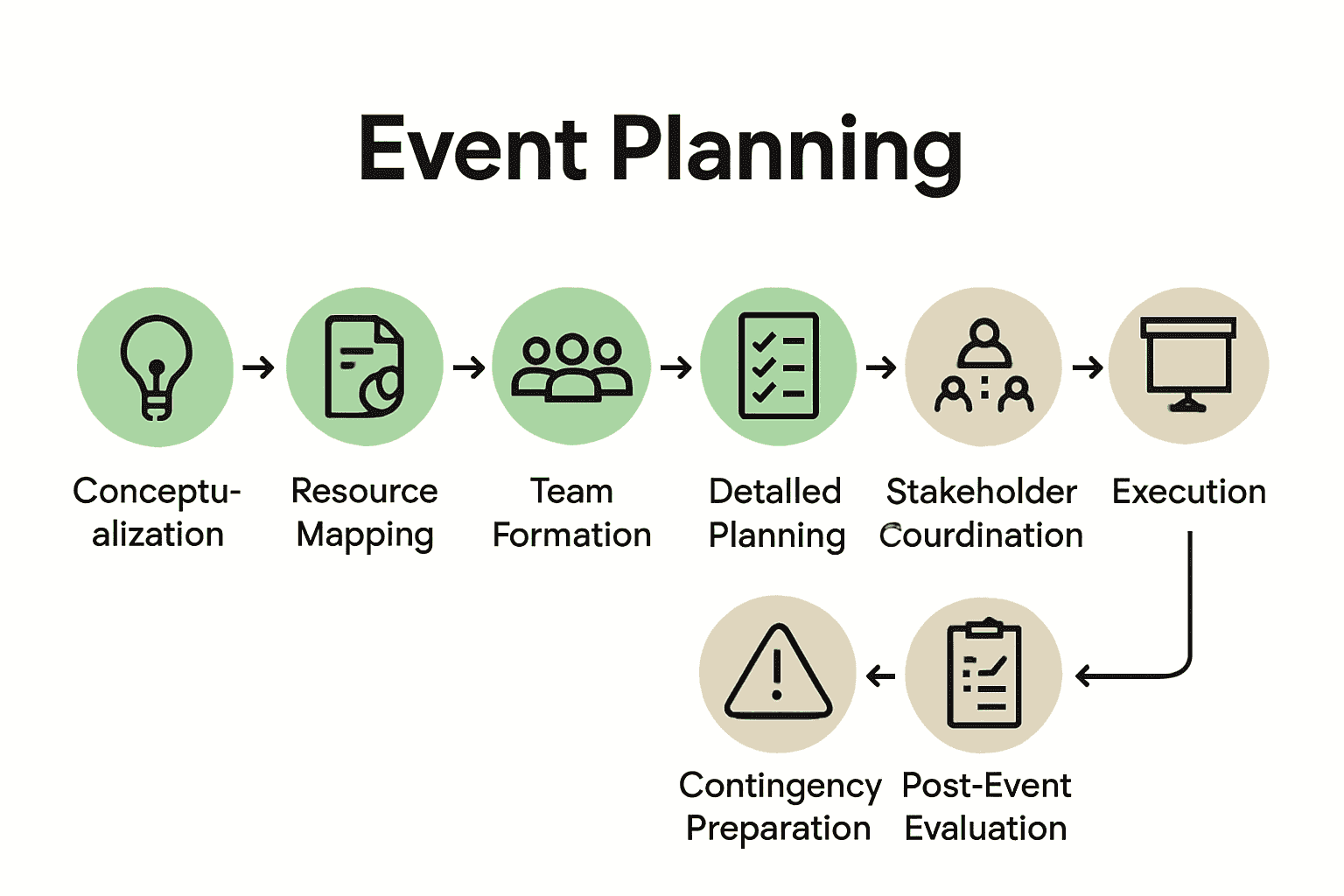
Research from IR UiTM suggests a comprehensive event planning process that can be broken down into essential stages:
- Conceptualization: Define event goals and vision
- Resource Mapping: Identify available resources and potential constraints
- Team Formation: Assemble and assign roles to key committee members
- Detailed Planning: Create comprehensive timelines and action plans
- Stakeholder Coordination: Establish communication channels with all involved parties
- Contingency Preparation: Develop backup plans for potential disruptions
- Execution: Implement the planned strategy
- Post-Event Evaluation: Analyze outcomes and gather feedback
Successful event planning is not about perfection, but about creating flexible frameworks that can adapt to unexpected challenges. Each stage requires meticulous attention and proactive problem-solving.
 Professional event organizers understand that the most memorable events often emerge from careful planning combined with the ability to pivot when necessary.
For more comprehensive insights into streamlining your event organization approach, check out our ultimate event planning checklist for successful gatherings.
Effective Group Scheduling Using WhenNOT
Group scheduling can be a complex puzzle, often involving multiple participants and competing availability constraints. Research from ArXiv highlights the critical importance of understanding contextual and social influences when coordinating events, which is precisely where WhenNOT's innovative approach shines.
The platform introduces a revolutionary inverse scheduling method that fundamentally transforms how groups coordinate their time. Instead of traditional methods that ask participants when they are available, WhenNOT flips the script by asking participants to mark when they are not available. This approach offers several key advantages:
- Reduces coordination time
- Minimizes back-and-forth communication
- Provides instant visual clarity of group availability
- Eliminates the need for individual account creation
- Works seamlessly for multi-day events
Further insights from ArXiv Research underscore the significance of intelligent resource grouping and scheduling, which WhenNOT accomplishes through its intuitive interface. By allowing participants to quickly mark unavailable dates and generating a comprehensive availability overview, the platform streamlines what was once a time-consuming process.
For those looking to dive deeper into streamlining their group scheduling workflow, our guide to understanding the group scheduling process offers additional strategies and insights.
Common Pitfalls and How to Avoid Them
Event planning is a minefield of potential mistakes that can derail even the most carefully crafted gatherings. According to Enrollify, two fundamental areas consistently trip up event organizers: accessibility and inclusivity.
Research from Purplepass reveals several critical pitfalls that can sabotage event success:
- Poor Communication
- Unclear event objectives
- Inadequate participant information
- Lack of timely updates
- Logistical Oversights
- Insufficient venue planning
- Overlooking technical requirements
- Ineffective time management
- Engagement Failures
- Neglecting participant interaction
- Failing to create meaningful experiences
- Ignoring post-event follow-up
Mitigation strategies require proactive planning and a holistic approach. Successful event organizers understand that preventing problems is far more effective than attempting to resolve them mid-event. This means anticipating potential challenges, creating flexible backup plans, and maintaining open lines of communication with all stakeholders.
For those seeking to refine their event planning skills and sidestep common traps, our group event organization process guide offers comprehensive insights into creating seamless, memorable gatherings.
Simplify Your Event Organization with Smarter Scheduling
Every event planner knows the challenge of balancing complex logistics and multiple participant schedules. This article highlights common hurdles like poor communication, unpredictable changes, and time-consuming coordination that can turn even the best event strategies into stressful experiences. If you want to avoid these pitfalls and embrace a planning approach that values flexibility and clarity, it is time to rethink how you gather availability from your attendees.
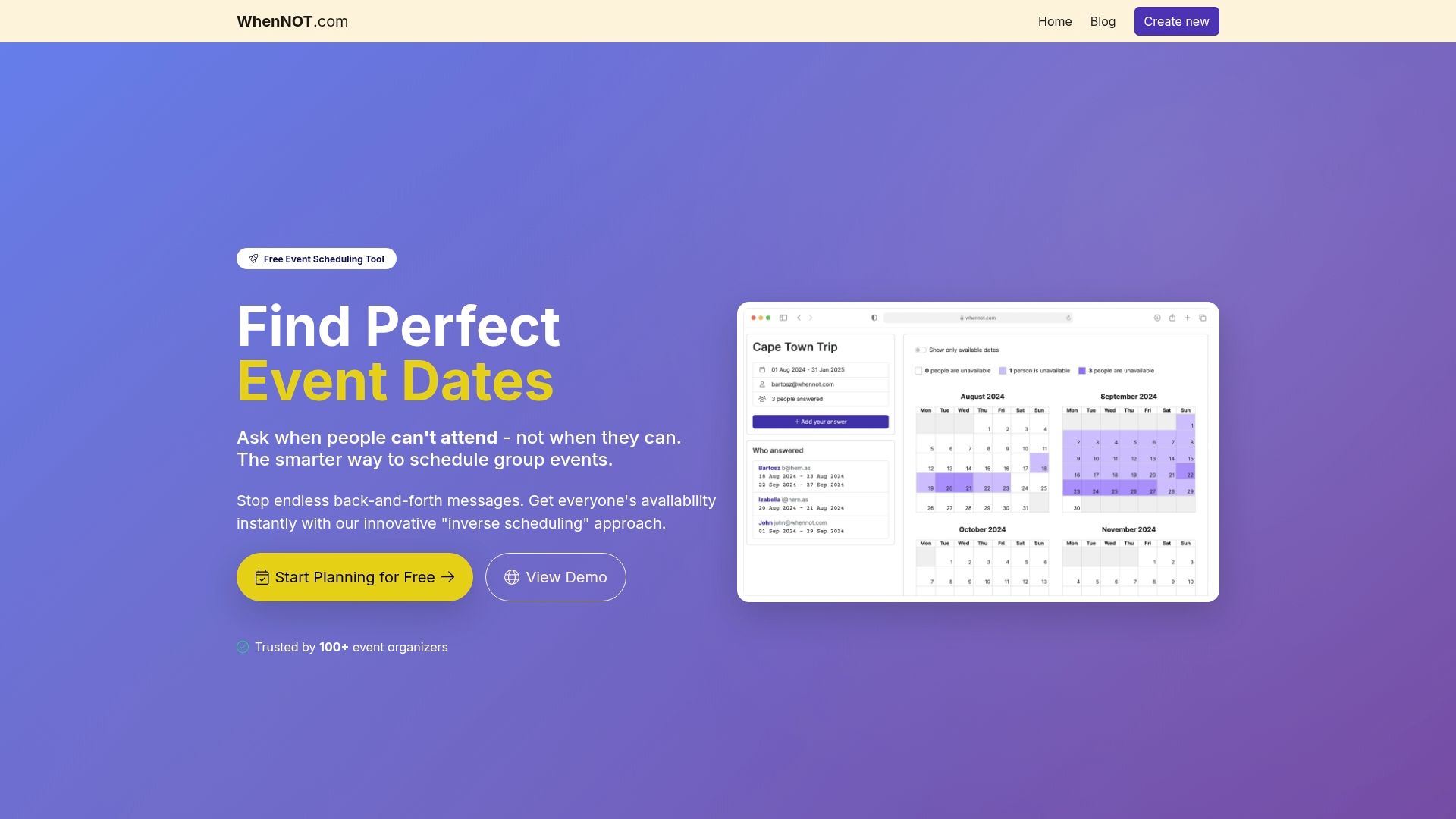
Experience the power of WhenNOT's innovative inverse scheduling approach that dramatically reduces coordination hassle and speeds up decision-making. Whether organizing a corporate conference, community workshop, or a multi-day retreat, you can effortlessly create an event and let participants mark only when they are unavailable. This method reveals the best dates visually and instantly, providing the clarity and control every organizer needs. Join others who have transformed their event planning by exploring our ultimate event planning checklist for successful gatherings and learning more about understanding efficient scheduling methods.
Don’t let scheduling conflicts hold back your next event. Visit WhenNOT now to start planning with confidence and ease.
Frequently Asked Questions
What are the core principles of effective event organization strategies?
Effective event organization strategies revolve around three core principles: accessibility, inclusivity, and attendee engagement. These principles are fundamental to creating memorable and impactful events.
What are the critical elements of a successful event organization strategy?
A successful event organization strategy should incorporate five critical elements: clear goal definition, comprehensive resource allocation, stakeholder communication, contingency planning, and post-event evaluation.
How do predictive and reactive scheduling methods differ in event planning?
Predictive scheduling involves planning events with predetermined timelines and structured frameworks, while reactive scheduling adapts schedules dynamically in response to unexpected changes or disruptions.
What are common pitfalls in event planning and how can they be avoided?
Common pitfalls in event planning include poor communication, logistical oversights, and engagement failures. To avoid these, proactive planning, creating flexible backup plans, and maintaining open lines of communication with all stakeholders are essential.