
Managing multi-day corporate retreats for diverse teams often means juggling countless schedules and preferences, all while aiming for seamless coordination. Traditional centralized planning can feel restrictive, especially when rapid changes and group input are crucial. Adopting decentralized scheduling offers a flexible, participant-driven approach that empowers every member while reducing bottlenecks. This article breaks down decentralized scheduling, dispels myths about chaos and inefficiency, and spotlights practical advantages for event planners seeking smarter ways to coordinate group events.
Table of Contents
- Defining Decentralized Scheduling And Misconceptions
- Variations In Decentralized Scheduling Systems
- How Decentralized Scheduling Platforms Operate
- Real-World Benefits For Multi-Day Events
- Privacy, Security, And Potential Pitfalls
Key Takeaways
| Point | Details |
|---|---|
| Decentralized Scheduling Offers Flexibility | This approach allows multiple participants to make independent scheduling decisions, enhancing collaboration and responsiveness to changes. |
| Variety of Scheduling Systems Exists | Different decentralized scheduling systems cater to various coordination needs, including autonomous and distributed models. |
| Security Measures Are Essential | Privacy risks are heightened in decentralized scheduling, necessitating robust authentication and encryption strategies to protect user data. |
| Dynamic Adaptation for Events | Decentralized scheduling proves beneficial for multi-day events by allowing real-time adjustments and minimizing scheduling conflicts. |
Defining decentralized scheduling and misconceptions
Decentralized scheduling represents a transformative approach to coordinating group events that challenges traditional centralized planning models. Unlike conventional methods where a single coordinator manages all scheduling details, decentralized scheduling distributes decision-making across multiple participants, creating a more flexible and collaborative process.
At its core, decentralized scheduling involves distributing task allocation independently without relying on a single central authority. This approach fundamentally differs from traditional scheduling by enabling multiple agents to make independent yet coordinated choices about availability and event participation.
Key characteristics of decentralized scheduling include:
- Participant-driven availability mapping
- Reduced dependency on single coordinators
- Enhanced flexibility for complex group events
- Improved resource allocation efficiency
- Faster consensus building
Many misconceptions surround decentralized scheduling, with critics often assuming it implies chaos or inefficiency. However, game-theoretic research demonstrates that these systems can actually perform optimally under specific interaction constraints. The key is establishing clear communication protocols and shared objectives among participants.
Pro tip: When implementing decentralized scheduling, establish clear guidelines and expectations upfront to ensure smooth coordination and participant engagement.
Variations in decentralized scheduling systems
Decentralized scheduling is not a monolithic approach but a diverse ecosystem with multiple system architectures designed to address complex coordination challenges. Decentralized scheduling protocols can be broadly categorized into three primary variations, each with unique characteristics and operational mechanisms.
The first variation encompasses autonomous schedulers, which operate independently with minimal external intervention. These systems empower individual agents to make scheduling decisions based on local information and predefined rules. In contrast, distributed schedulers facilitate more collaborative interactions, enabling participants to share and negotiate availability through interconnected communication channels.
Key variations in decentralized scheduling systems include:
- Autonomous scheduling
- Distributed scheduling
- Reinforcement learning-based scheduling
- Grid-based scheduling approaches
- Adaptive event coordination models
Grid scheduling algorithms represent another sophisticated variation, particularly valuable in large-scale computing environments. These systems prioritize scalability and minimizing job start times by distributing computational tasks across multiple nodes without centralized control.
Reinforcement learning-based schedulers represent the most advanced iteration, utilizing machine learning techniques to dynamically optimize scheduling processes. These systems continuously adapt and improve scheduling strategies by learning from previous interactions and outcomes.
Pro tip: Select a decentralized scheduling approach that aligns with your specific coordination complexity and organizational communication dynamics.
Here is a comparison of decentralized scheduling system variations and their ideal use cases:
| System Variation | Best For | Key Advantage |
|---|---|---|
| Autonomous Scheduling | Small, independent teams | Minimal coordination required |
| Distributed Scheduling | Cross-department groups | Facilitates negotiation and sharing |
| Grid-Based Scheduling | Large-scale computing networks | High scalability and load balance |
| Reinforcement Learning Scheduling | Dynamic, complex environments | Continuous self-optimization |
| Adaptive Event Coordination | Fast-changing participant pools | Rapid adjustment to new constraints |
How decentralized scheduling platforms operate
Decentralized scheduling platforms fundamentally transform traditional event coordination by distributing decision-making processes across multiple participants. Randomized scheduling techniques enable these platforms to efficiently manage complex coordination challenges by leveraging cached server load information and independent agent interactions.
The operational framework of decentralized scheduling platforms typically involves multiple interconnected mechanisms. Core operational strategies include distributed task allocation, where individual participants can independently propose and modify scheduling options without relying on a central authority. This approach empowers users to make real-time adjustments and negotiate availability more dynamically.
Key operational characteristics of decentralized scheduling platforms include:
- Independent agent decision-making
- Peer-to-peer communication protocols
- Adaptive scheduling mechanisms
- Minimal communication overhead
- Dynamic load balancing
- Fault-tolerant design
Federated learning scheduling models represent an advanced iteration of these platforms, utilizing sophisticated communication policies that enable distributed nodes to coordinate without centralized server intervention. These systems excel at managing complex scheduling scenarios by allowing local model training and peer-to-peer synchronization.
The technical architecture typically involves sophisticated algorithms that process participant inputs, identify potential scheduling windows, and generate optimal coordination strategies. By distributing computational load and decision-making, these platforms significantly reduce communication bottlenecks and enhance overall scheduling efficiency.
Pro tip: Choose a decentralized scheduling platform with robust communication protocols and transparent decision-making mechanisms to ensure smooth group coordination.
Real-world benefits for multi-day events
Decentralized scheduling transforms multi-day event planning by introducing unprecedented flexibility and efficiency across complex coordination scenarios. Decentralized scheduling algorithms enable organizations to dynamically balance workloads and respond to rapidly changing participant availability with remarkable precision.

The strategic advantages of decentralized scheduling for multi-day events extend far beyond traditional coordination methods. Operational flexibility becomes a key differentiator, allowing event planners to create more adaptive and responsive scheduling frameworks that accommodate diverse participant needs and unexpected changes.
Key real-world benefits include:
- Reduced scheduling conflicts
- Enhanced participant engagement
- Improved time management
- Faster decision-making processes
- Greater scheduling transparency
- Minimized administrative overhead
Community-aware scheduling approaches demonstrate remarkable scalability in managing complex multi-day events across distributed participant groups. These systems excel at resource optimization, ensuring that event timelines remain robust and adaptable even when confronting multiple scheduling challenges.
By distributing decision-making capabilities, decentralized scheduling platforms empower participants to actively contribute to event planning, creating a more collaborative and inclusive approach to multi-day event coordination. This model significantly reduces communication bottlenecks and enables real-time adjustments that traditional centralized systems cannot match.
Pro tip: Implement decentralized scheduling tools that provide clear visibility and individual agency to maximize participant engagement and event planning efficiency.
Privacy, security, and potential pitfalls
Decentralized scheduling introduces complex privacy and security considerations that demand careful navigation. Federated learning scheduling highlights the nuanced challenges of maintaining data confidentiality while enabling collaborative scheduling across distributed networks.
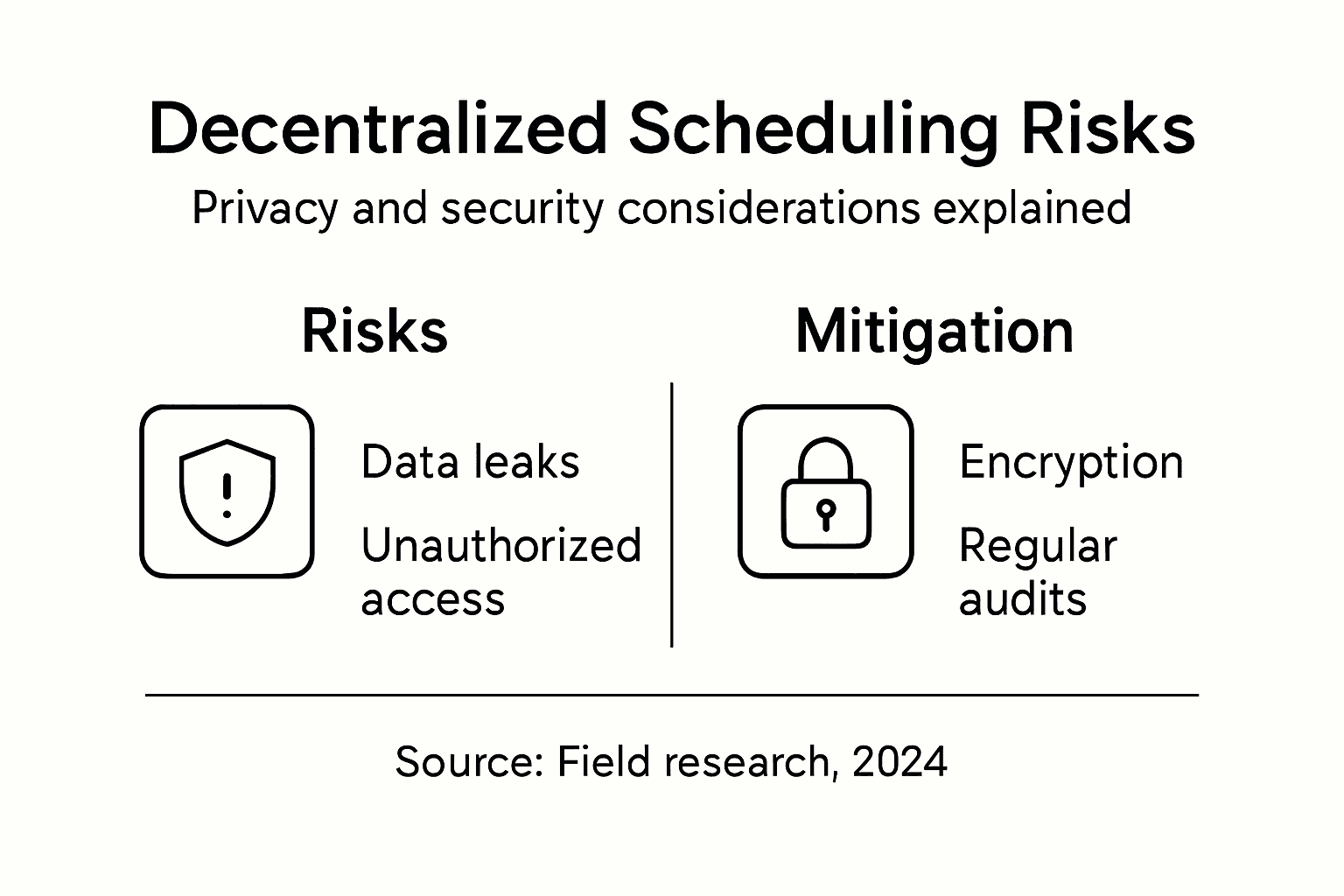
Security vulnerabilities emerge from the inherent distributed nature of these systems, creating unique challenges that traditional centralized approaches do not encounter. The absence of a single controlling entity means that each participant becomes both a potential point of strength and potential weakness in the overall scheduling ecosystem.
Key privacy and security concerns include:
- Potential information leakage
- Risk of adversarial attacks
- Challenges in data anonymization
- Inconsistent scheduling decisions
- Complex authentication requirements
- Synchronization vulnerabilities
Decentralized scheduling research reveals that mitigating these risks requires advanced cryptographic protocols and robust consensus algorithms. Organizations must implement sophisticated security measures that go beyond traditional data protection strategies, focusing on creating secure, transparent communication channels between participants.
While decentralized systems offer remarkable flexibility, they also demand heightened vigilance. Event planners and coordinators must carefully assess the security implications, implement multi-layered authentication processes, and develop clear guidelines for information sharing and participant interactions.
Pro tip: Conduct comprehensive security audits and implement end-to-end encryption when adopting decentralized scheduling platforms to protect participant information and maintain system integrity.
The following table summarizes main privacy and security pitfalls in decentralized scheduling and possible solutions:
| Challenge | Risk Example | Mitigation Approach |
|---|---|---|
| Information Leakage | Data visible to all agents | End-to-end encryption |
| Adversarial Attacks | Malicious participant input | Participant authentication |
| Synchronization Vulnerability | Delays from missed updates | Robust consensus algorithms |
| Data Anonymization Issues | Personal info exposure | Data minimization protocols |
Simplify Your Group Event Planning with Decentralized Scheduling Principles
The article highlights the challenges of coordinating multi-day group events with traditional centralized methods that often cause scheduling conflicts and slow decision-making. If you struggle with inefficient communication and participant overload when finding optimal dates, adopting a decentralized approach can bring flexibility and faster consensus to your planning process. Key issues like participant-driven availability mapping and reduced dependency on a single coordinator are exactly what WhenNOT addresses through its innovative inverse scheduling model.
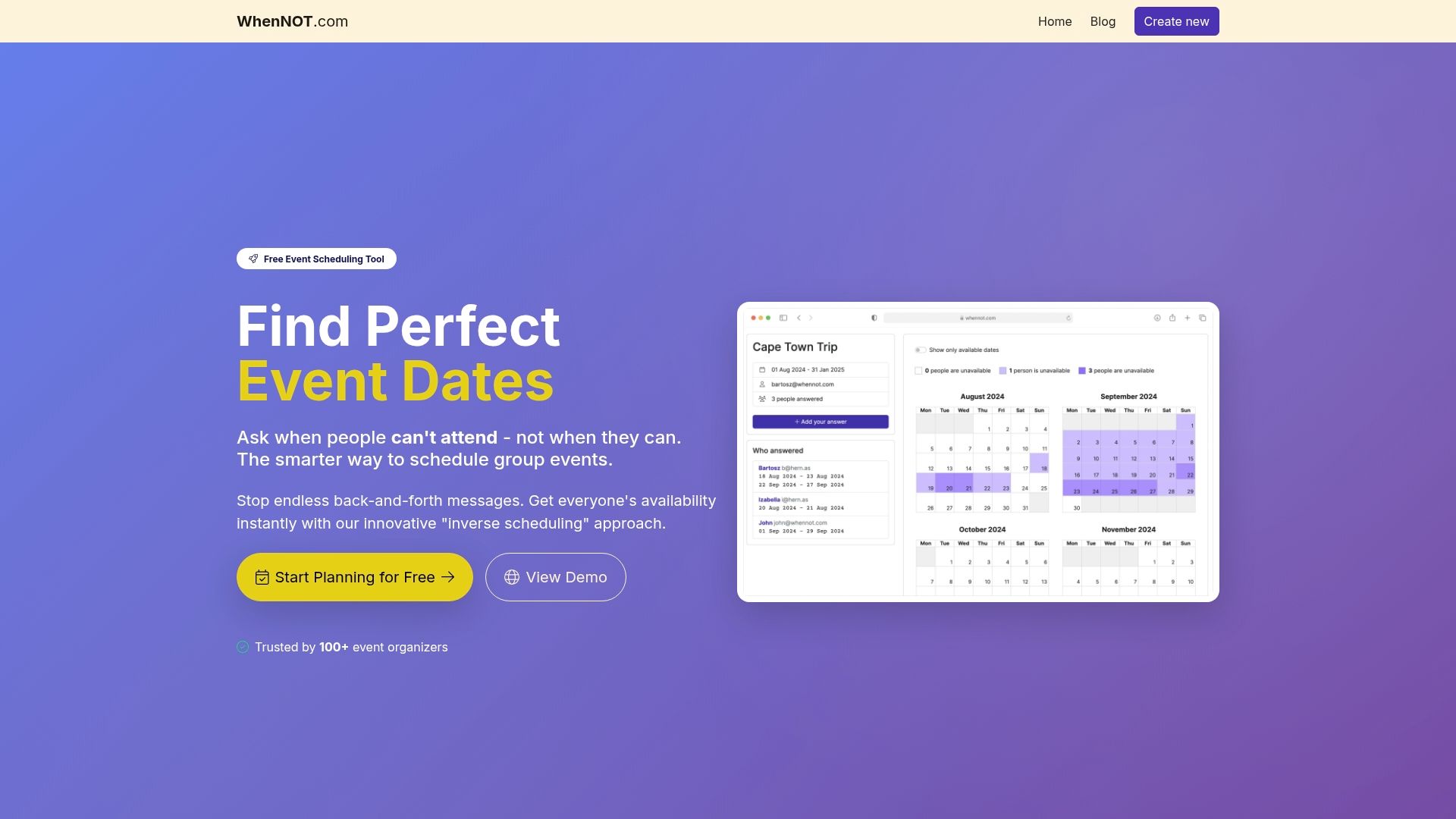
Experience the benefits of decentralized scheduling firsthand by trying WhenNOT. This free, user-friendly tool allows you to create events where participants only mark when they are busy rather than available. That means less confusion and a clearer overview of everyone’s schedules at once. There is no need for participants to sign up or share sensitive details, enhancing privacy and reducing administrative tasks. Ready to streamline your next group event with flexible, transparent, and efficient coordination Visit WhenNOT now and start scheduling smarter today.
Frequently Asked Questions
What is decentralized scheduling?
Decentralized scheduling is an approach to organizing group events that distributes decision-making across multiple participants, allowing for more flexible and collaborative planning compared to traditional centralized methods.
What are the benefits of decentralized scheduling for multi-day events?
Decentralized scheduling offers several advantages for multi-day events, including reduced scheduling conflicts, enhanced participant engagement, improved time management, and greater scheduling transparency.
How do decentralized scheduling platforms operate?
Decentralized scheduling platforms utilize independent agent decision-making, peer-to-peer communication protocols, and adaptive scheduling mechanisms to manage complex coordination challenges without relying on a central authority.
What are the privacy and security considerations in decentralized scheduling?
Decentralized scheduling raises unique privacy and security concerns, such as potential information leakage and synchronization vulnerabilities. Mitigation strategies include implementing end-to-end encryption and robust authentication processes.
Recommended
- Group Event Coordination Process: Streamlining Planning for Busy Schedules - WhenNOT Blog
- Group Event Coordination Explained: Faster Solutions - WhenNOT Blog
- Understanding the Group Scheduling Process for Events - WhenNOT Blog
- Understanding Group Scheduling Explained for Easy Coordination - WhenNOT Blog